Seasonal Care
Mesh or solid: one keeps the water out, the other lets it through
The choice is not really about debris. It is about whether you want to pump standing water off a cover all winter, and whether the cover needs to hold a child's weight.

Heads up: we earn a commission if you buy through the links on this page, at no extra cost to you. It never decides the ranking — here is how we pick and here is the full disclosure. Prices are checked automatically; last verified October 8, 2026.
Quick picks
Segmented before it is ranked — the right answer depends on which of these you actually are. Tap any row for the full write-up.
The standard above-ground answer
Woven polyethylene, cable and winch, and genuine overlap past the wall. Cheap, effective, and it will collect water on top.
| # | Product | Best for | Score | Price |
|---|---|---|---|---|
| 1 | No image Winter Cover for Above-Ground Pools A structural product, not a summer one. Its job is carrying snow and blocking light for a whole winter, and a solar cover pressed into that role will be in shreds by February. | Five months of weather, not one nightSeveral seasons | 8.3out of 10 |
If the cover has to be a barrier
A mesh safety cover drains instead of pooling and is tested to a published load standard. It needs anchor points, which is the catch.
| # | Product | Best for | Score | Price |
|---|---|---|---|---|
| 1 | 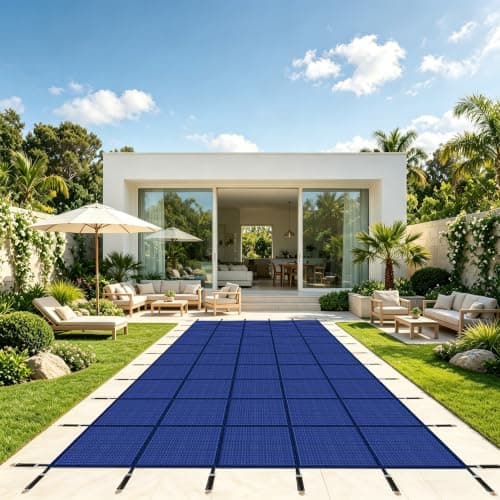 Mesh Safety Cover (ASTM F1346) A tensioned mesh cover built and tested to hold weight, which is the one thing a winter tarp cannot do. If a cover is doing safety work on your pool, this is the only category that qualifies. | A cover that is actually a barrierSeveral seasons | 7.8out of 10 |
If the pool sits under trees
A leaf net goes over the winter cover and is lifted off with the leaves on it. It is an addition, not an alternative.
| # | Product | Best for | Score | Price |
|---|---|---|---|---|
| 1 | 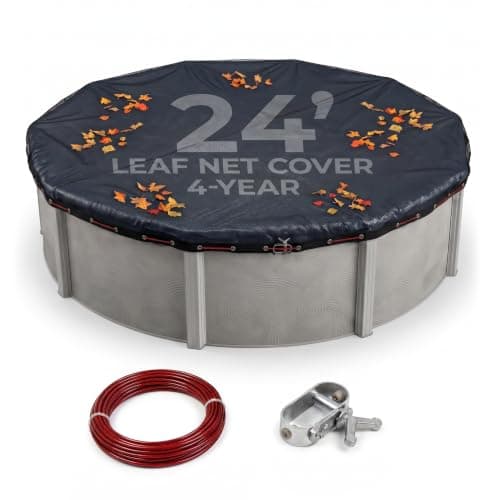 Leaf Net Cover A fine mesh net that sits over the winter cover and lifts off with the leaves on it. On a treed yard it is the difference between dragging a loaded cover and rolling one. | A pool under trees in OctoberSeveral seasons | 8.0out of 10 |
The short version
- Solid covers collect water. That is not a fault, it is physics — and it is why a cover pump belongs on the closing list.
- Mesh drains and is load rated. The safety standard publishes a minimum 485 lb load test.
- Mesh needs anchors. It is tensioned to fixed points rather than laid over the water, which most above-ground pools do not have.
- A leaf net is neither. It goes over the winter cover and comes off with the leaves in it.
What each one is
A solid winter cover is woven polyethylene laid over the pool and held with a cable and winch or wraparound straps. It blocks sunlight and keeps debris out of the water entirely. It also blocks water, which means rain and snowmelt sit on top of it.
A mesh safety cover is a tensioned fabric tested against the ASTM F1346 safety-cover standard: a published minimum 485 lb load test, taken as two adults and a child, with gaps tested so a child cannot pass through. Water drains straight through the mesh, so nothing pools on top.
A leaf net is a fine mesh sized by pool diameter, typically with about three feet of overlap, that sits over the winter cover and is lifted off in late autumn with the leaves on it.
| Solid winter cover | Mesh safety cover | Leaf net | |
|---|---|---|---|
| Water on top | Yes - needs a cover pump | Drains through | Drains through |
| Debris in the water | None | Fine debris passes | Catches leaves |
| Load rated | No | ASTM F1346, min 485 lb | No |
| How it fixes | Cable and winch, or straps | Tensioned to anchors | Grommets, sometimes cable |
| Light blocked | Yes - helps stop algae | Partly | No |
| Role | The cover | The cover, and a barrier | An addition to the cover |
The catch with mesh on an above-ground pool
A safety cover is tensioned to anchor points. On an inground pool those go into the surrounding deck. An above-ground pool usually has nothing to anchor to — which is why the standard answer for this site’s readers is a solid cover with a cable and winch, and why our winter cover roundup is built around that format.
Where a mesh safety cover genuinely fits above-ground is a pool with a surrounding deck to anchor into — the case our decks guide covers. If you have that, the safety rating is a real gain, because a winter cover floating on the water is not a barrier at all and should never be treated as one.
The standing water problem
This is the practical difference you will live with. A solid cover holds every inch of rain and every thaw, and a few hundred pounds of water in the middle of a cover pulls on grommets, stretches seams and can drag the cover into the pool.
The answer is a cover pump, not a bigger cover — our cover pump roundup covers the tool, and our cover care guide makes the case that covers fail from water on top rather than from cold.
An air pillow helps here too, by raising the center so water runs to the edges instead of collecting in the middle. That is its second job after absorbing ice expansion, as our air pillow roundup explains.
Debris, algae and what you find in April
A solid cover blocks light, and light is what algae needs. A pool closed clean under a solid cover usually opens clear. Mesh lets some light and fine debris through, so a mesh-covered pool typically opens dirtier and may need more work in spring — the scenario our green opening guide deals with.
That trade is worth stating plainly: mesh buys you a winter with no pumping and a dirtier spring; solid buys you a clean spring and a winter of watching the cover.
Who should buy which
Solid for almost every above-ground pool without a deck. Size it with real overlap — our cover sizing guide covers the three to four feet manufacturers build in — and buy a cover pump with it.
Mesh if the pool is decked so you have something to anchor to, and if the load rating matters to you. Expect a dirtier opening.
Add a leaf net if the pool is under trees, whichever cover you choose. It is the cheapest way to make the autumn job a lift rather than a dredge.
Securing either one against wind
Wind destroys winter covers, not cold. A solid cover that lifts at one edge becomes a sail, and the grommets go before the fabric does.
The cable and winch that comes with most above-ground covers is the primary fixing, and it is usually enough on a sheltered site. On an exposed one, add cover clips that clamp the cover to the top rail, or a winter cover seal that wraps the ledge so wind cannot get underneath. Our cover clip roundup covers the hardware, and our cover care guide covers the failure it prevents.
A mesh cover is tensioned rather than laid on, so wind is less of a problem — but the anchors have to be into something solid, which is the constraint that rules it out on most above-ground pools.
Sizing, whichever you choose
Covers are ordered by pool size, not by fabric size: manufacturers build in three to four feet of overlap so the cover still reaches after the winter water drop. Our cover sizing guide works through it, including what happens if you lower the water further than the overlap allows.
Get this wrong in the direction of too small and the cover cannot be secured at all. Too large is workable, if untidy.
Taking it off in spring
This is where a solid cover charges you for the winter. Pump the standing water off first — our cover pump roundup covers the tool — then loosen the cable and draw the cover off in one direction so debris travels with it rather than into the pool.
A mesh cover comes off cleaner but has let fine debris and light through all winter, so the water underneath usually needs more work. Either way, our spring opening guide sequences the rest, and our green opening guide covers the morning when it has not gone to plan.
Five winters, and what each one costs
A solid above-ground winter cover is the cheaper purchase and the shorter-lived one. It takes UV, ice and standing water, and most owners replace one every few seasons — sooner if it has spent a winter holding water because the cover pump failed.
A mesh safety cover costs several times as much and is built to a load standard, so it lasts longer where it can be properly anchored. The catch remains the same: on a pool without a deck there is nothing to anchor to, so the comparison is theoretical for most above-ground owners.
The honest budgeting advice is therefore to buy the solid cover and spend the difference on the things that make it last: a cover pump so water never sits on it, clips or a sealer so wind cannot lift it, and an air pillow so ice pushes inward rather than against the wall. Those three cost a fraction of a safety cover and address the actual failure modes, which our cover care guide sets out.
Then replace the cover when it fails rather than nursing it. A cover that splits in January is a pool full of leaf mulch by April, and our bad-close guide prices that outcome.
What to buy
Scores are our own reading of published specifications. They are not test results — we have not tested these products and we do not claim to.
Five months of weather, not one night
Winter Cover for Above-Ground Pools
Various
A structural product, not a summer one. Its job is carrying snow and blocking light for a whole winter, and a solar cover pressed into that role will be in shreds by February.
Key specs
- Construction
- Woven polyethylene, weight published in mil or scrim count
- Securing
- Cable and winch, or wraparound straps
- Overlap
- Needs genuine overlap past the wall — check the stated size against your pool
- Not the same as
- A solar cover or a safety cover
How it scoresour reading of published specs, not a test result
- Retention
- 8.5
- Durability
- 8.0
- Handling
- 6.5
- Running cost
- 9.0
- Value
- 8.5
Overall 8.3 / 10
What works
- Blocks light for the whole winter, which is what stops algae in a closed pool
- Cable-and-winch securing survives wind that lifts a strapped cover
- Buying the heavier scrim genuinely doubles the number of winters you get
What doesn't
- Needs a way to shed or pump off standing water, or the weight tears it
- Bulky to store in summer
- Not a safety cover — it will not support a person and must not be treated as if it will
Skip it if: A pool you take down each autumn. If the pool comes apart, the cover is money spent on nothing.
What it costs to run: This is insurance rather than a saving. A torn cover in January means an opening in April that costs a full shock treatment and a week of filtration to fix, which is more than the better cover cost.
Several seasons: Buy-once. Built and warranted to come back out of the box for a few years, if you store it properly.
A cover that is actually a barrier
Mesh Safety Cover (ASTM F1346)
Various
A tensioned mesh cover built and tested to hold weight, which is the one thing a winter tarp cannot do. If a cover is doing safety work on your pool, this is the only category that qualifies.
#ad how this is funded · price as of October 8, 2026
Key specs
- Standard
- ASTM F1346 — the safety cover specification
- Load test
- Minimum 485 lb, taken as two adults and a child
- Drainage
- Mesh passes water through; no standing puddle
- Gaps
- Tested so a child cannot pass through an opening
- Fixing
- Tensioned to anchors, not floated on the water
- Material
- Triple-stitched heavy mesh polypropylene on most
How it scoresour reading of published specs, not a test result
- Retention
- 6.5
- Durability
- 9.0
- Handling
- 6.0
- Running cost
- 9.0
- Value
- 7.0
Overall 7.8 / 10
What works
- The only cover type with a published load figure behind it
- Mesh drains, so there is no standing water to pump and no weight to build up
- Tensioned fixing means it does not lift in wind the way a tarp does
- Removes the cover pump from the winter routine entirely
What doesn't
- Far more expensive than a standard winter cover, and the price gap is large
- Needs proper anchor points, which a free-standing above-ground pool may not have
- Mesh lets light and fine dust through, so spring water is dirtier than under a solid cover
- Most listings are cut for inground pools — above-ground fitment needs checking carefully
Skip it if: Keeping the water clean. It is a barrier that happens to be a cover, not a cover that happens to be safe.
What it costs to run: The saving is not in the season, it is in what it replaces: a winter cover, a cover pump and the annual cover-tear risk. Whether that closes the price gap depends entirely on whether you needed a barrier anyway.
Several seasons: Buy-once. Built and warranted to come back out of the box for a few years, if you store it properly.
Specs from: ASTM F1346 safety covers — current Amazon category listing
A pool under trees in October
Leaf Net Cover
Various
A fine mesh net that sits over the winter cover and lifts off with the leaves on it. On a treed yard it is the difference between dragging a loaded cover and rolling one.
#ad how this is funded · price as of October 8, 2026
Key specs
- Sizing
- Sold by pool diameter, typically with 3 ft overlap
- Material
- Polyethylene or nylon fine mesh
- Binding
- Around 1.75 in nylon binding with sewn loops
- Fixing
- Grommets, and cable and winch on some
- Position
- Over the winter cover, not instead of it
- Weight
- Light — one person can lift it loaded
How it scoresour reading of published specs, not a test result
- Retention
- 5.0
- Durability
- 8.0
- Handling
- 9.0
- Running cost
- 10.0
- Value
- 8.5
Overall 8.0 / 10
What works
- Lifts off with the whole leaf fall on it, so the winter cover underneath stays clean
- Removes the single largest source of standing water weight on a cover
- Cheap, and it lasts several seasons because nothing stresses it
- Works over a solar cover in autumn too, before the pool is closed
What doesn't
- Useless on a yard with no trees, which is most of the argument against it
- Has to come off before the leaves are wet and heavy, so timing matters
- Fine mesh still passes needles and small debris
- Another large item to dry and store
Skip it if: Being a cover. It stops debris, it does not block light, hold heat, or keep anything out of the water on its own.
What it costs to run: Set against a torn winter cover and a spring opening full of leaf tannin. On a treed yard the payback is one autumn; on a clear yard there is none.
Several seasons: Buy-once. Built and warranted to come back out of the box for a few years, if you store it properly.
Specs from: Above-ground pool leaf nets — current Amazon category listing
Questions people actually ask
Can you use a mesh safety cover on an above-ground pool?
Is a winter cover a safety barrier?
How do I stop water collecting on the cover?
Do I still need a leaf net if I have a winter cover?
Read next
- Closing, covering and opening againWinterizing, covers and spring opening - the four weeks of the year that decide whether you own a pool next summer.
- The best winter covers for an above-ground poolScrim weight, cable-and-winch versus straps, and the overlap you need - the three specs that decide whether a cover survives a winter.
- A tarp that keeps leaves out is not a barrierASTM F1346 safety covers explained — the 485 lb load test, the drainage and gap requirements, and the above-ground fitting problem.
- What size cover you need, and the overlap that decides itWhy winter covers are ordered by pool size, how much overlap manufacturers build in, what the water drop is for, and how cable, clips and sealers work together.
- A winter cover fails from water on top of it, not from coldWhy standing water is what destroys winter covers, the mid-winter checks that prevent it, and how to store one so it lasts.
- The leaf net is a yard purchase, not a pool purchaseHow a leaf net sits over the winter cover, what to check on sizing and mesh, and the yard test that decides whether it is worth buying.
- The cover pump exists because water is heavier than people thinkWhy standing water on a winter cover is a structural problem, what a cover pump costs to run, and automatic versus manual.
- How to winterize an above-ground poolThe correct closing sequence, the freeze damage that ends pools, and why a cracked pump housing is entirely preventable.