Pool Care & Chemistry
Stains on the liner, and the one test that tells you which kind
Every stain on a vinyl liner is either something that grew or something dissolved in the water. The cure is completely different, and a chlorine tablet held against the mark tells you which you have.

Heads up: we earn a commission if you buy through the links on this page, at no extra cost to you. It never decides the ranking — here is how we pick and here is the full disclosure. Prices are checked automatically; last verified October 8, 2026.
The short version
- Two families of stain, one test. Hold a chlorine tablet against the mark for a few seconds. If it lightens, it is organic. If nothing happens, it is a metal or mineral stain.
- Organic stains respond to chlorine. Brush, shock, filter, and they generally go.
- Metal stains do not, and shocking makes them worse. Chlorine oxidizes dissolved metal and sets the color into the vinyl.
- Both are usually a chemistry story, not a cleaning story. Low pH pulls metal into solution; poor circulation lets organics settle.
The test, before anything else
Do this before you buy a product, because the two stain families want opposite treatments and the wrong one makes the problem permanent. Take a three-inch chlorine tablet, put on a glove, and hold it directly against the stain for five to ten seconds. Then look.
If the mark visibly lightens where the tablet touched, you have an organic stain — leaf tannin, algae residue, something that grew or decomposed. Chlorine is the answer. If nothing happens at all, you have a metal or mineral stain, and chlorine is the last thing you want to add.
| What you see | Tablet test | Most likely |
|---|---|---|
| Brown or tan patches, often under where leaves sat | Lightens | Leaf tannin — organic |
| Green or gray film that brushes but returns | Lightens | Algae residue — organic |
| Rust-orange, often at fittings or in streaks | No change | Iron — metal |
| Blue-green on a pool with a heater or salt cell | No change | Copper — metal |
| Purple or dark gray blotches | No change | Manganese — metal |
| White crusty deposit at the water line | No change | Calcium scale — mineral |
Organic stains: brush, shock, filter
These are the easy ones and the common ones on a seasonal pool. Leaves that sat on the floor for a week leave tannin behind; an algae bloom that has been killed leaves a shadow of itself. Both are on the surface of the vinyl rather than in it.
The sequence is the same as any recovery: brush the stained area first so the chlorine can reach it, then shock in the evening with the pump running, then filter continuously until the water clears and the mark fades. Doing it in the other order — shocking a stained pool without brushing — wastes most of the dose. Our shock guide covers the dosing and the algae guide covers the full bloom recovery if the stain came with green water.
Prevention is unglamorous and effective: skim daily so organic material never sinks, and keep a cover on when the pool is not in use. Everything that never reaches the floor is a stain that never happens.
Metal stains: find the source before you treat the symptom
Metal in pool water comes from somewhere, and until you know where, any treatment is temporary. There are three usual sources, and you can narrow it down without a laboratory.
The fill water. Well water in particular can carry dissolved iron and manganese, and a pool filled from it will stain regardless of how well you look after the chemistry. If the stains appeared shortly after filling or after a large top-up, this is the likely answer.
Corroding metal in the pool. Anything metal below the water line — ladder feet, fittings, a heater element, a salt cell — will give up metal if the water is aggressive to it. That normally means persistently low pH.
Something dropped in. A hairpin, a can, a toy with a metal part. It leaves a small, sharply defined stain exactly where it sat.
What actually helps a metal stain on a seasonal pool
Be honest about the ceiling here: a metal stain that has been in vinyl for a season is often permanent, and the products sold to remove them work by holding metal in solution rather than lifting what has already deposited. On an inground pool the calculation is different because draining is expensive. On a seasonal above-ground pool it is not.
The practical route is: get pH and total alkalinity back inside range so the water stops attacking metal; stop shocking while there is dissolved metal present; and, if the fill water is the source, plan a partial drain and refill from a different source rather than repeating the cycle. A third of a 3,955-gallon pool is roughly $8 of water at the national average — our cost-to-fill guide has the arithmetic for your own volume. It is one of the real advantages of owning a small pool.
Testing, so you are not guessing
A seven-way strip gives you pH, total alkalinity, free chlorine, cyanuric acid and total hardness in about fifteen seconds, which is enough to see whether your water is aggressive. When you want an actual number rather than a color band — and stain diagnosis is exactly that situation — a drop-count kit measures calcium hardness and the rest as figures you can act on. Our test kit roundup compares them, and the calcium hardness guide covers the reading behind white scale specifically.
When a stain is telling you the liner is finished
One distinction worth making. A stain sits on or in the vinyl and the vinyl underneath is still supple. Chalky, faded, stiff material at the water line is not a stain — it is ultraviolet ageing, and no chemical addresses it. If the liner crackles when you flex it, you are looking at the end of its life rather than a cleaning job. Our lifespan guide covers the difference, and the liner replacement guide covers what comes next.
Before buying anything for a stain, find out which kind it is. Our stain remover roundup starts with a free thirty-second test that separates metal staining from organic staining — they respond to opposite chemistry, and treating the wrong one wastes the product and the weekend.
On well water the better answer is upstream of all of this. Our hose pre-filter roundup covers the resin cartridge that takes iron out of the fill water before it can ever reach the liner — prevention rather than treatment.
What to buy
Scores are our own reading of published specifications. They are not test results — we have not tested these products and we do not claim to.
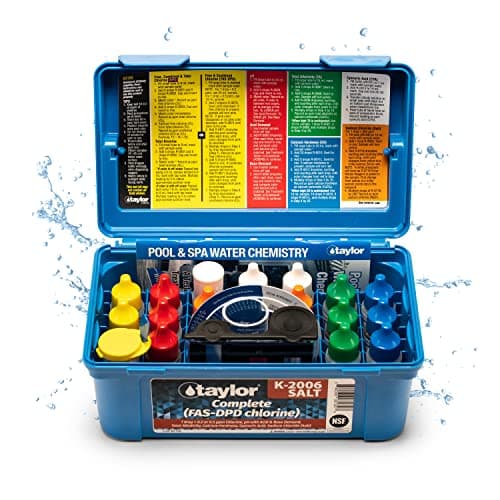
When you need a number, not a color band
Taylor K-2006 Complete Test Kit (FAS-DPD)
Taylor Technologies
The reference kit. It uses a drop-count titration for free chlorine, which gives you an actual figure rather than a shade of pink. Overkill for a 1,500-gallon pool and indispensable when something has gone properly wrong.
#ad how this is funded · price as of October 8, 2026
Key specs
- Method
- FAS-DPD drop-count titration
- Measures
- Free and combined chlorine, pH, alkalinity, calcium hardness, cyanuric acid
- Resolution
- Reads to 0.2 ppm free chlorine with the standard 10 mL sample
- Format
- Reagent bottles and graduated comparators
How it scoresour reading of published specs, not a test result
- Accuracy
- 9.8
- Ease
- 5.5
- Coverage
- 9.5
- Cost per use
- 7.0
- Value
- 8.0
Overall 8.3 / 10
What works
- Distinguishes free from combined chlorine, which is the single most useful thing a test can tell you when water smells of chlorine
- Gives a numeric result you can act on precisely rather than a color to interpret
- Reagents are individually replaceable, so the kit is a multi-season purchase
What doesn't
- Considerably more expensive than strips and more of a ritual to use
- Reagents have a shelf life and do expire
- Genuinely more kit than a small seasonal pool needs
Skip it if: Casual weekly checks. If it is a five-minute job you will skip it, and a test you skip is worse than a rough one you actually do.
What it costs to run: The reagents are the running cost, not the kit. For most seasonal above-ground owners this is a second purchase made in year two after a bad algae summer, not a first one.
Several seasons: Buy-once. Built and warranted to come back out of the box for a few years, if you store it properly.
Specs from: Taylor Technologies
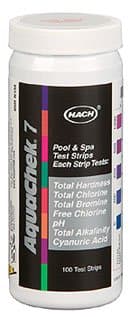
The default first test kit
AquaChek Silver 7-Way Test Strips (100 count)
AquaChek
Seven readings in fifteen seconds, including the two that beginners never measure and then fight all summer: total alkalinity and cyanuric acid.
#ad how this is funded · price as of October 8, 2026
Key specs
- Tests
- Free chlorine, total chlorine, bromine, pH, total alkalinity, total hardness, cyanuric acid
- Free chlorine range
- 0-20 ppm
- pH range
- 6.2-8.4
- Total alkalinity range
- 0-240 ppm
- Cyanuric acid range
- 0-300 ppm
- Read time
- 15 seconds
- Count
- 100 strips
How it scoresour reading of published specs, not a test result
- Accuracy
- 7.0
- Ease
- 9.5
- Coverage
- 9.5
- Cost per use
- 9.0
- Value
- 9.2
Overall 8.9 / 10
What works
- Covers cyanuric acid, which most cheap strips omit and which is the reason chlorine stops working in a stabilized pool
- pH range spans 6.2-8.4, comfortably bracketing the CDC's recommended 7.0-7.8
- 15 seconds and a color chart printed on the bottle — no separate booklet to lose
- 100 strips is a full season of twice-weekly testing with room to spare
What doesn't
- Strips are a comparison against a printed color chart, so they are directional rather than precise
- Reading them in bright sun is harder than it should be
- The bottle must be kept sealed and dry or the strips degrade quietly
Skip it if: Fine adjustment. If you are chasing a stubborn problem and need a number rather than a color band, a liquid reagent kit is the tool.
What it costs to run: 100 strips at twice-weekly testing covers roughly two seasons for one pool. The real saving is upstream: knowing your alkalinity stops you buying pH adjuster you did not need.
One honest season: The cheapest setup that genuinely works for a season of real swimming. Nothing spare, nothing missing.
Specs from: CDC — home pool and hot tub water treatment and testing
Actually clearing a green pool
Calcium Hypochlorite Pool Shock
Various (compare available chlorine %)
Unstabilized, fast-acting and strong. This is the tool for an algae bloom precisely because it does not add more cyanuric acid to a pool that probably already has too much.
Key specs
- Type
- Calcium hypochlorite, unstabilized
- Adds stabilizer
- No
- Adds
- Calcium hardness
- Dosing
- By pool volume, per the bag
How it scoresour reading of published specs, not a test result
- Effectiveness
- 9.5
- Ease
- 6.5
- Water impact
- 7.0
- Cost per season
- 9.0
- Value
- 8.8
Overall 8.6 / 10
What works
- No cyanuric acid added, so it does not worsen the problem it is usually solving
- Fast and strong enough to actually break an algae bloom in one treatment when dosed properly
- Cheap per pound of available chlorine
What doesn't
- Adds calcium hardness, which matters in hard-water areas
- Must be dissolved properly or it will bleach a vinyl liner where it settles
- Needs careful storage — it is a genuine oxidizer, not a household product
Skip it if: Routine daily chlorination. This is the emergency tool; tablets are the routine.
What it costs to run: The single most cost-effective way to fix a green pool, and the most commonly under-dosed. Half a dose twice does not equal a full dose once — it just wastes the bag.
One honest season: The cheapest setup that genuinely works for a season of real swimming. Nothing spare, nothing missing.
Bringing pH back up after a season of trichlor
pH Increaser (sodium carbonate)
Various
One of two bottles every pool owner ends up with. Trichlor tablets push pH down all season, and this is what pushes it back.
Key specs
- Active
- Sodium carbonate (soda ash)
- Raises
- pH, and total alkalinity somewhat
- CDC pH target
- 7.0-7.8
How it scoresour reading of published specs, not a test result
- Effectiveness
- 8.5
- Ease
- 8.5
- Water impact
- 8.0
- Cost per season
- 9.5
- Value
- 8.8
Overall 8.5 / 10
What works
- Cheap, stable and does exactly one thing
- Also nudges total alkalinity up, which is often what actually needed fixing
- A single container lasts most seasonal pools a full year
What doesn't
- Overdosing clouds the water for a day or two
- Raises alkalinity as well as pH, which is not always what you want
- Needs to be added with the pump running or it settles
Skip it if: Raising alkalinity on its own without moving pH. Use sodium bicarbonate for that.
What it costs to run: A few dollars a season. The expensive mistake is not this bottle, it is failing to fix alkalinity first and then using this one repeatedly all summer.
One honest season: The cheapest setup that genuinely works for a season of real swimming. Nothing spare, nothing missing.
Specs from: CDC — recommended pH range for pools
Fixing the number beginners skip
Alkalinity Increaser (sodium bicarbonate)
Various
The most under-bought chemical in the category. If your pH will not stay put, this is almost always the actual fix, and it is chemically just baking soda.
Key specs
- Active
- Sodium bicarbonate
- Raises
- Total alkalinity, with minimal pH movement
- Common target range
- 80-120 ppm (industry convention, not a CDC figure)
How it scoresour reading of published specs, not a test result
- Effectiveness
- 9.0
- Ease
- 8.0
- Water impact
- 9.0
- Cost per season
- 9.8
- Value
- 9.5
Overall 9.0 / 10
What works
- Raises alkalinity with only a small effect on pH, which is exactly what you want
- Extremely cheap — it is sodium bicarbonate
- Fixing alkalinity first stops the endless pH chase that eats a first season
What doesn't
- Works slowly and needs circulation, so it is not a same-afternoon fix
- Easy to overshoot, and bringing alkalinity back down is more work than raising it
- The 80-120 ppm target is an industry convention rather than a published federal standard, so treat it as guidance
Skip it if: Emergencies. Nothing about alkalinity is urgent; it is the thing you fix first and then stop thinking about.
What it costs to run: Pennies per dose, and it is the cheapest lever on your whole chemical bill: stable alkalinity means stable pH, and stable pH means the chlorine you already bought actually works.
One honest season: The cheapest setup that genuinely works for a season of real swimming. Nothing spare, nothing missing.
Questions people actually ask
How do I know if a pool stain is organic or metal?
What causes rust-colored stains in a pool?
Will shocking the pool remove stains?
Can you get old stains out of a vinyl pool liner?
Sources
Read next
- Pool care, from someone who assumes you have never done thisThe weekly routine, the four numbers that matter, and the fix for the week the water turns.
- Pool algae: brush, shock, filter, then rebalanceThe correct order for clearing green water, how to tell algae from pollen, and why algaecide prevents rather than cures.
- pH and alkalinity, and why yours will not stay putWhy pH drifts, what total alkalinity actually does, and the order of operations that turns a season of chasing into one adjustment.
- Calcium hardness: the reading a vinyl pool can mostly ignoreWhy the fourth reading matters less on a vinyl above-ground pool, the two cases where it genuinely does, and how to test it.
- The best pool test stripsTest strips compared on parameter coverage - specifically whether they read cyanuric acid, which most cheap strips omit.
- Liner replacement: the big occasional cost, and how to avoid itOverlap, beaded and unibead are not interchangeable - plus the three habits that decide whether you ever need a replacement.
- How long an above-ground pool actually lastsRealistic lifespans by pool type, the four failure modes that account for nearly all of them, and the cheap items that add seasons.
- Filling from a well: test first, or stain the linerWhy well water stains pool liners, the iron and manganese thresholds that matter, what a fill-hose pre-filter actually removes, and the order of operations that avoids the problem.