Pool Costs
Liner replacement: the big occasional cost, and how to avoid it
The largest unplanned expense in above-ground pool ownership is also the most preventable. Here is what decides whether you ever pay it.
Heads up: we earn a commission if you buy through the links on this page, at no extra cost to you. It never decides the ranking — here is how we pick and here is the full disclosure. Prices are checked automatically; last verified October 19, 2026.
The short version
- Three fitting types — overlap, beaded, unibead — are not interchangeable. Buying the wrong one is a total loss.
- Most liner failures start underneath, from a stone or root. A ground cloth is the cheapest prevention there is.
- A liner failure often reveals a base or frame problem that caused it. Replacing the vinyl without fixing that just delays the next one.
- Fitting is a warm-day job. Cold vinyl will not stretch into place, and forcing it is how a new liner tears on installation day.
The three types, and why it matters so much
Above-ground liners come in three fitting systems, and they are genuinely not compatible with one another. Getting this wrong is the most expensive mistake in this page.
Overlap liners drape over the top of the pool wall and are held by coping strips and the top rail. They are the cheapest and the most forgiving of small measurement errors, at the cost of looking less tidy.
Beaded liners have a molded bead at the top edge that snaps into a track fitted to the wall. They are the easiest to replace later — you can change a beaded liner without dismantling the top rail — but only if your pool has the track.
Unibead liners can be used either way: hung from a J-hook over the wall, or with the hook trimmed off and the bead snapped into a track. The flexibility is genuinely useful when you are not certain what your pool has.
What it costs
We do not print prices in body copy on this site — they go stale and become false claims. The cost hub explains why, and the product cards below carry live prices instead. What is worth knowing about the shape of the cost:
- Gauge drives price. Liners are sold by thickness in mil, and a heavier gauge costs more and lasts longer. On a budget kit, a thicker replacement often outlasts the original by a wide margin.
- Beaded is usually cheaper to fit, because you are not taking the top rail apart.
- Labor, if you pay for it, can rival the liner. This is a two-person job but it is genuinely doable at home on a warm day.
The comparison that matters: against a whole new pool. If the frame and wall are sound, replacing the liner is clearly the better purchase. If the wall is corroded or the base has shifted, you are putting new vinyl into a failing structure and the money is better spent on a replacement pool.
How to never need this page again
Three habits account for nearly all preventable liner failures.
Put something under it. Most punctures come from below — a stone, a root, a piece of gravel you did not see. A ground cloth costs a tiny fraction of a liner and prevents the failure you cannot reach to patch.
Get the base right once. An unlevel pool puts sustained uneven stress on the liner seam all season. That stress is what turns a small manufacturing weakness into a split. Our setup guide covers leveling properly.
Close it properly. Ice expanding against a wall, or a liner left to freeze folded and dry, is the single most common winter loss. The winterizing guide is an afternoon of work that protects the most expensive component you own.
Before you price a replacement, check whether you need one. Our pool liner guide covers the three attachment types, what gauge in mil actually buys, and the underwater patch kit that turns a pinhole into a fifteen-minute job rather than this bill.
What to buy
Scores are our own reading of published specifications. They are not test results — we have not tested these products and we do not claim to.
When the liner has failed, not before
Replacement Above-Ground Pool Liner
Various
The one repair that is genuinely worth doing rather than replacing the whole pool, provided the frame is sound. Measure twice: liner fit is unforgiving.
Key specs
- Types
- Overlap, beaded and unibead — they are not interchangeable
- Measure
- Diameter and wall height, exactly
- Gauge
- Published in mil — thicker lasts longer and is harder to fit
How it scoresour reading of published specs, not a test result
- Retention
- 8.0
- Durability
- 8.0
- Handling
- 5.5
- Running cost
- 9.0
- Value
- 8.0
Overall 7.9 / 10
What works
- Far cheaper than replacing a pool whose frame is still good
- A thicker gauge liner outlasts the original on most budget kits
- Beaded liners can be replaced without dismantling the top rail
What doesn't
- Overlap, beaded and unibead are different fitting systems and buying the wrong one is a total loss
- Fitting is a warm-day job — cold vinyl will not stretch into place
- A liner failure often reveals a frame or base problem that caused it
Skip it if: A pool whose frame is corroded. Replacing the liner in a failing frame just moves the failure a few months out.
What it costs to run: The largest single unplanned expense of above-ground pool ownership, and it is mostly preventable: a ground cloth, a level base and a winter close done properly are what decide whether you ever buy one.
Several seasons: Buy-once. Built and warranted to come back out of the box for a few years, if you store it properly.
Protecting the liner from below
Pool Ground Cloth / Under-Pool Pad
Various
Most liner punctures come from underneath, from a stone or a root you did not see. A ground cloth is the cheapest way to avoid the most expensive repair in above-ground pool ownership.
Key specs
- Function
- Barrier between ground and liner
- Sizing
- Should extend past the pool footprint
- Included with
- Some kits — check before buying separately
How it scoresour reading of published specs, not a test result
- Retention
- 8.0
- Durability
- 7.5
- Handling
- 8.5
- Running cost
- 10.0
- Value
- 9.0
Overall 8.5 / 10
What works
- Prevents the failure mode that ends pools: a puncture in the floor you cannot reach to patch
- Also slows grass and weeds growing up under the pool
- Included free in better kits, so check before you buy one
What doesn't
- Not a substitute for actually clearing stones and roots first
- Thin ones tear during installation before the pool is even up
- Traps moisture, which kills the grass underneath regardless
Skip it if: Fixing uneven ground. It protects against punctures; it does nothing about level, and level is the bigger problem.
What it costs to run: Compare its cost to a liner replacement, which is the single largest unplanned expense in above-ground pool ownership. It is not a close call.
Several seasons: Buy-once. Built and warranted to come back out of the box for a few years, if you store it properly.
Not throwing away a float over one hole
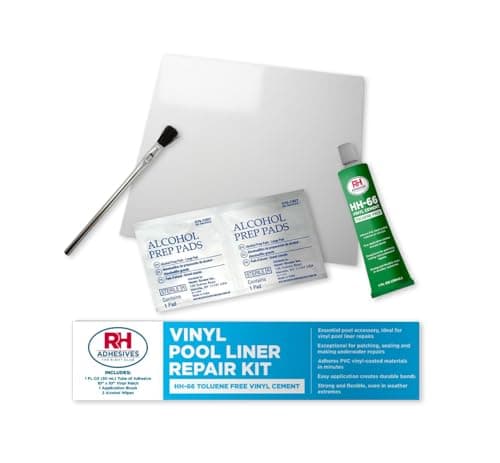
Vinyl Repair Patch Kit
Various
A few dollars of adhesive patches that turn most float failures into a ten-minute fix. The reason people replace floats annually is usually that they did not own one of these.
#ad how this is funded · price as of October 19, 2026
Key specs
- Use
- Vinyl floats, liners, air beds
- Requirement
- Surface must be clean and fully dry
- Cure
- Follow the kit — most need hours before re-inflating
How it scoresour reading of published specs, not a test result
- Material
- 8.0
- Valve
- 8.0
- Capacity
- 7.0
- Storage
- 9.5
- Value
- 9.5
Overall 8.5 / 10
What works
- Fixes the dominant failure mode of the entire floats category
- Also patches a pinhole in a pool liner, which is a far more expensive save
- Lasts indefinitely in the shed
What doesn't
- Will not fix a split seam, only a puncture
- Needs a genuinely dry surface, which is inconvenient poolside
- Cheap kits use adhesive that fails after a season in the water
Skip it if: Seam failures and valve leaks. Those are the end of the float and no patch changes that.
What it costs to run: The highest-leverage few dollars in this hub: one saved float pays for it several times over, and one saved liner pays for it a hundred times over.
Several seasons: Buy-once. Built and warranted to come back out of the box for a few years, if you store it properly.
Five months of weather, not one night
Winter Cover for Above-Ground Pools
Various
A structural product, not a summer one. Its job is carrying snow and blocking light for a whole winter, and a solar cover pressed into that role will be in shreds by February.
Key specs
- Construction
- Woven polyethylene, weight published in mil or scrim count
- Securing
- Cable and winch, or wraparound straps
- Overlap
- Needs genuine overlap past the wall — check the stated size against your pool
- Not the same as
- A solar cover or a safety cover
How it scoresour reading of published specs, not a test result
- Retention
- 8.5
- Durability
- 8.0
- Handling
- 6.5
- Running cost
- 9.0
- Value
- 8.5
Overall 8.3 / 10
What works
- Blocks light for the whole winter, which is what stops algae in a closed pool
- Cable-and-winch securing survives wind that lifts a strapped cover
- Buying the heavier scrim genuinely doubles the number of winters you get
What doesn't
- Needs a way to shed or pump off standing water, or the weight tears it
- Bulky to store in summer
- Not a safety cover — it will not support a person and must not be treated as if it will
Skip it if: A pool you take down each autumn. If the pool comes apart, the cover is money spent on nothing.
What it costs to run: This is insurance rather than a saving. A torn cover in January means an opening in April that costs a full shock treatment and a week of filtration to fix, which is more than the better cover cost.
Several seasons: Buy-once. Built and warranted to come back out of the box for a few years, if you store it properly.
Questions people actually ask
How long does an above-ground pool liner last?
Can I replace an above-ground pool liner myself?
Are above-ground pool liners interchangeable?
Read next
- What a pool actually costs, with the arithmetic shownPurchase, electricity, chemicals, water and replacement parts - added up, sourced, and shown as arithmetic you can redo.
- What an above-ground pool actually costs to run for a yearElectricity, chemicals, water and consumables for a full season - every input sourced, every calculation shown, and every assumption named.
- How to set up an above-ground pool properlyLeveling, ground protection, filling and priming - the afternoon that decides how the rest of the season goes.
- How to winterize an above-ground poolThe correct closing sequence, the freeze damage that ends pools, and why a cracked pump housing is entirely preventable.
- Above-ground pool ladders, and the spec everyone skipsWeight capacity, height matching, and removable outer steps - the three things that decide whether a ladder is right.
- The patch kit is the difference between a hole and a new linerUnderwater vinyl repair kits compared on cure time, patch material supplied and what each maker actually publishes — plus the one that sets in thirty minutes.