Above-Ground Pools
How long an above-ground pool actually lasts
Almost nothing in this category fails from being used. They fail from UV, from grit underneath, from being packed away wet - and from one bad winter.
Heads up: we earn a commission if you buy through the links on this page, at no extra cost to you. It never decides the ranking — here is how we pick and here is the full disclosure. Prices are checked automatically; last verified October 8, 2026.
The short version
- No manufacturer publishes a lifespan, and we are not going to invent one. What we can do is name the four things that end these pools, and how much of each is within your control.
- Construction sets the ceiling. A soft-side pool is closer to a consumable; a bolted frame with a three-ply liner is built to come back out of the box for several seasons.
- Storage decides more than use does. Pools packed away damp, folded on a cold day, or stored where rodents live rarely see a third season.
- A ground cloth and a proper winter cover are the cheapest years you can buy, and both are frequently left out of kits.
Why nobody publishes a number
Search this question and you will find confident ranges attributed to nobody. We checked the manufacturer specification pages for the pools we cover, and none of them publishes an expected service life. That is unsurprising: lifespan in this category depends far more on the owner than on the product. The same 12-foot frame pool can be firewood after one season or still going in year four, and the difference is almost entirely ground preparation, water chemistry and winter storage.
So instead of a fabricated figure, here is what actually decides it. Manufacturers do publish the things that matter: liner construction, frame material and coating, and whether a pool is designed to be taken down each year.
What construction tells you
Soft-side and inflatable pools. An inflated top ring and a three-ply wall. Intex publishes a ten-minute setup claim for the Easy Set, and that convenience is the whole product. There is no frame to corrode, but there is also nothing holding the wall up except water pressure, so the material takes the entire load and the sun works on it all summer. Treat these as seasonal and be pleasantly surprised.
Metal-frame pools. A liner hung inside a bolted, powder-coated steel frame. Intex publishes a powder-coated metal frame with a tool-free locking system on the Prism, and Bestway publishes a three-layer Tritech liner on the Steel Pro MAX. This class is designed to be dismantled and re-erected, which is exactly why storage practice decides its life.
Heavier steel-wall pools. The Intex Ultra XTR publishes a galvanized steel frame powder-coated inside and out, which is the most corrosion-resistant construction in the price class. It is also nearly 7,000 gallons and not something you take down casually, so it lives outside all winter and its fate is decided by how it is closed rather than how it is stored.
| Type | Main failure mode | Biggest lever you control |
|---|---|---|
| Inflatable / soft-side | UV degradation and seam or ring failure | Shade, and dry indoor storage |
| Metal frame | Liner punctures and frame corrosion at joints | Ground cloth, and drying fully before storage |
| Steel wall, left up | Ice damage and wall corrosion | A correct winter close, every year |
| Any type | Punctures from underneath | A ground cloth, which costs very little |
The four things that actually end pools
1. Grit under the liner. This is the big one and it is invisible. A stone, a root or a patch of gravel under the liner is loaded with the full weight of the water and works through the material over weeks. It is also the most preventable failure in the category: an under-pool pad costs very little and goes down before the pool does. Our setup guide covers preparing the ground properly.
2. Ultraviolet light. Vinyl gets brittle in sun, and a pool sits in it for the whole season by definition. You cannot stop this, but a cover reduces the hours of direct exposure at the water line, which is where liners usually fail first.
3. Water chemistry. Persistently low pH is aggressive to liners and to metal fittings, and persistently high chlorine with no stabilizer bleaches vinyl. The CDC publishes a pH range of 7.2 to 7.8 for pools, and staying inside it is a liner-preservation measure as much as a comfort one. Our pH and alkalinity guide is the practical version, and cyanuric acid explains why unstabilized chlorine in full sun burns off so fast.
4. One bad winter. More seasonal pools die between October and April than in July. A pool packed away damp grows mildew you will not remove; a liner folded in freezing weather cracks along the folds; a pool left up without an air pillow lets ice push directly against the wall. Our winterizing guide covers pools that stay up, and storing a pool covers the ones that come down.
When to repair and when to replace
A puncture in a liner or a float is a patch job, not a replacement, and a vinyl repair kit handles both. The requirement everyone ignores is that the surface must be genuinely clean and dry, and most kits need hours of cure before the pool goes back under pressure. Doing it properly on a Saturday beats doing it twice.
A liner that has gone brittle at the water line, or that has multiple failures in the same season, is telling you something different. At that point the arithmetic gets interesting: a replacement liner on a cheap pool can approach the price of the whole pool, and the liner types are not interchangeable. Our liner replacement guide does that comparison, including how to measure so you order the right one.
What a longer-lasting pool is worth
Spread across seasons, the durability difference between classes is often smaller than it looks, because the recurring costs dominate. A larger, sturdier pool that lasts twice as long also consumes roughly proportionally more chemicals and water every season it is up. If you are weighing a cheap pool you replace against an expensive one you keep, run both through our annual cost-to-run guide before deciding — the answer is less obvious than the marketing suggests, and it is the same reasoning behind our are they worth it page.
The longest-lived category is the one where the wall and the liner are separate parts. Our permanent pool roundup covers steel-wall pools built to stay up year-round, where a worn liner is a replacement rather than the end of the pool.
What to buy
Scores are our own reading of published specifications. They are not test results — we have not tested these products and we do not claim to.
Water in the yard this weekend
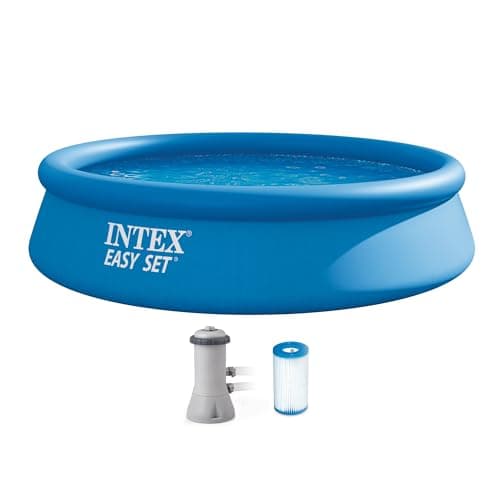
Intex Easy Set Pool Set, 12ft x 30in
Intex
Inflate the ring, add water, done. It is the fastest route from box to swimming that exists, and it is honest about being a seasonal item rather than a fixture.
#ad how this is funded · price as of October 8, 2026
Key specs
- Water capacity
- 1,485 gallons (80% full)
- Water depth
- 23 inches
- Pump supplied
- 530 GPH Krystal Clear cartridge pump
- Material
- 3-ply, puncture resistant
- Manufacturer setup claim
- Ready for water in about 10 minutes
- Pump wattage
- Not published by Intex
How it scoresour reading of published specs, not a test result
- Build
- 5.5
- Setup
- 9.8
- Upkeep
- 8.5
- Running cost
- 9.2
- Value
- 8.8
Overall 8.3 / 10
What works
- Genuinely 10 minutes to set up — the top ring rises with the water and there is no frame to assemble
- 1,485 gallons at 80% is a real, filterable pool rather than a paddling pool
- Comes down as fast as it goes up, which makes mid-season relocation possible
- Cheapest way to find out whether your family actually wants a pool before committing to a frame one
What doesn't
- The inflated ring is the single point of failure and it is exposed to sun all season
- 23 inches of water is shallow — this is for cooling off, not swimming
- Soft walls flex, so it needs level ground as much as a frame pool does
Skip it if: Lasting. Treat this as a two-or-three-season item at best and you will not be disappointed; expect five years and you will be.
What it costs to run: A fill at the EPA WaterSense average of $6.06 per 1,000 gallons is about $9. The 530 GPH pump moves 1,485 gallons in under three hours, so this is a pool where a genuinely short daily run does the job — which is where the running-cost saving actually comes from.
One honest season: The cheapest setup that genuinely works for a season of real swimming. Nothing spare, nothing missing.
Specs from: Intex — Easy Set 12' x 30' pool set, EPA WaterSense — cost per 1,000 gallons
Small yards and first-time owners
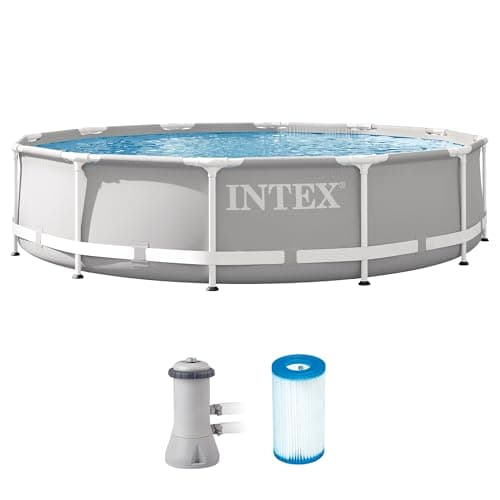
Intex Prism Frame Pool Set, 12ft x 30in
Intex
The size most people should buy first and the one most people talk themselves out of. 1,718 gallons is cheap to fill, cheap to treat, and forgiving of every mistake you are about to make.
Key specs
- Water capacity
- 1,718 gallons
- Pump supplied
- Krystal Clear C530 — 530 GPH pump / 475 GPH system
- Frame
- Powder-coated metal, tool-free Easy Lock
- Liner
- 3-ply, puncture resistant
- Manufacturer setup claim
- Ready in 30 minutes
- Pump wattage
- Not published by Intex
How it scoresour reading of published specs, not a test result
- Build
- 7.0
- Setup
- 9.0
- Upkeep
- 9.0
- Running cost
- 9.0
- Value
- 9.0
Overall 8.6 / 10
What works
- A 12-foot circle fits in a yard where a 15 or 18 will not, once you allow three feet of walking space
- 1,718 gallons turns over in about 3.6 hours on the supplied 475 GPH system flow — so a short daily run genuinely filters it
- Cheapest of the frame pools to make a mistake in: a bad chemical week costs a few dollars, not a few tens
- Tool-free assembly is real, not marketing — this is a genuinely one-afternoon job
What doesn't
- 30-inch wall means shallow water and it warms and cools fast
- Small enough that three adults fill it
- The C530 is sized for exactly this pool and nothing bigger, so it does not carry over if you upgrade
Skip it if: Anyone planning to swim rather than sit. This is a cooling-off and playing pool and it is very good at that.
What it costs to run: The cheapest frame pool here to run, and the gap is not small. At the EPA WaterSense average of $6.06 per 1,000 gallons a fill is about $10. Its turnover math — 1,718 gallons at 475 GPH system flow — means roughly 3.6 hours per full turnover, so a 7-8 hour daily run is two full turnovers rather than a partial one.
One honest season: The cheapest setup that genuinely works for a season of real swimming. Nothing spare, nothing missing.
Specs from: Intex — Prism Frame 12' x 30' pool set, Intex — Krystal Clear cartridge filter pumps
The honest middle of the market
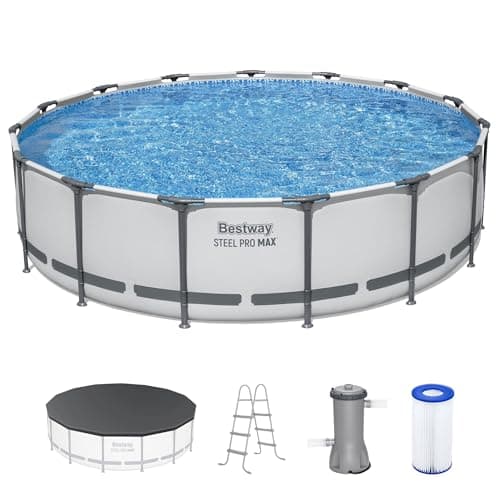
Bestway Steel Pro MAX Pool Set, 15ft x 42in
Bestway
Fewer gallons and a shallower wall than the Intex flagship, which makes it easier to level, cheaper to fill and cheaper to keep clean. For most first-pool families this is the right size, not the compromise size.
#ad how this is funded · price as of October 8, 2026
Key specs
- Water capacity
- 3,955 gallons (90% full)
- Pump supplied
- 1,000 gal filter pump, Type III cartridge
- Liner
- Tritech 3-layer
- Included
- Ladder and cover
- Wall height
- 42 inches
- Pump wattage
- Not published by Bestway (US listing)
How it scoresour reading of published specs, not a test result
- Build
- 7.5
- Setup
- 8.0
- Upkeep
- 8.0
- Running cost
- 7.5
- Value
- 8.8
Overall 8.2 / 10
What works
- 3,955 gallons is roughly 43% less water than the 18ft Intex — that is 43% less chemical spend, every season, forever
- 42-inch wall is far more forgiving of a yard that is nearly-but-not-quite level
- Ladder and cover included
- Cartridge filtration means no sand to buy or change
What doesn't
- Cartridges are a recurring consumable, and in a busy pool you will rinse one weekly
- 42 inches is shallow for adults who want to actually swim rather than sit
- Wattage is not published, so the running-cost math needs the label on the box
Skip it if: Adults who want to swim lengths. At 42 inches you are sitting in it, not swimming in it.
What it costs to run: The gallons are the story. Chemical dosing scales with volume, so 3,955 gallons costs meaningfully less to sanitize all season than 6,981 does. Filling it once at the EPA WaterSense national average of $6.06 per 1,000 gallons is about $24 of water; the same fill on the 18ft Intex is about $42.
Several seasons: Buy-once. Built and warranted to come back out of the box for a few years, if you store it properly.
Specs from: Bestway USA — Steel Pro MAX 15' x 42' pool set, EPA WaterSense — how the calculator works ($6.06 per 1,000 gallons)
A family that will still be using it in year three
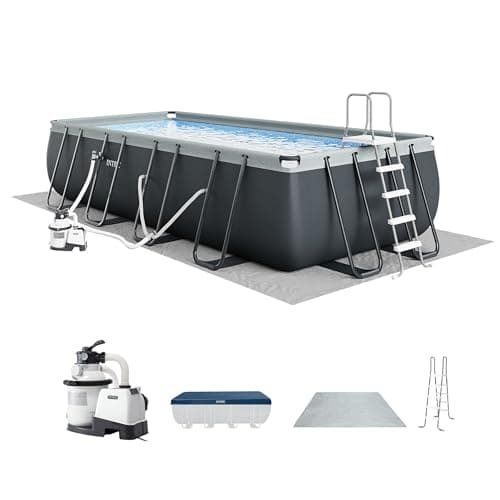
Intex Ultra XTR Frame Pool Set, 18ft x 52in
Intex
The biggest, sturdiest thing in this class that a homeowner can still put up in a weekend. It is also, by a wide margin, the most expensive one to run.
#ad how this is funded · price as of October 8, 2026
Key specs
- Water capacity
- 6,981 gallons
- Pump supplied
- 2,100 GPH sand filter
- Frame
- Galvanized steel, powder-coated inside and out
- Liner
- 3-ply, puncture and tear resistant
- Manufacturer setup claim
- Ready for water in 60 minutes
- Pump wattage
- Not published by Intex
How it scoresour reading of published specs, not a test result
- Build
- 9.0
- Setup
- 6.0
- Upkeep
- 7.5
- Running cost
- 5.0
- Value
- 8.5
Overall 8.4 / 10
What works
- 6,981 gallons is genuinely swimmable for adults, not just a cooling-off pool
- Sand filter rather than a cartridge, so there is no cartridge to buy every few weeks
- Galvanized frame with inner and outer powder coating is the most corrosion-resistant construction in this price class
- Ships with the ladder, cover and ground cloth that cheaper kits make you buy separately
What doesn't
- 52 inches of wall on an 18-foot circle is a lot of water pressure — the ground under it has to be genuinely level
- Intex publishes flow rate but not wattage, so you cannot compute your running cost until the pump is in your hands
- Too heavy and too large to take down and put up casually
Skip it if: Your yard is not close to level, or you want a pool you can pack away mid-season. Nearly 7,000 gallons is not a thing you move.
What it costs to run: It is the most water in this roundup, so it is the most chemicals, the most evaporation and the largest pump. Using ENERGY STAR's own published figures for above-ground pool pumps (an ENERGY STAR model saves about $20 a year, being 11% more efficient), a standard above-ground pump implies roughly $182 a year in electricity — and that is before you scale for a 2,100 GPH sand filter running on a pool this size. Price the season before you price the pool.
Several seasons: Buy-once. Built and warranted to come back out of the box for a few years, if you store it properly.
Specs from: Intex — Ultra XTR Frame 18' x 52' specifications, ENERGY STAR — Pool Pumps
Protecting the liner from below
Pool Ground Cloth / Under-Pool Pad
Various
Most liner punctures come from underneath, from a stone or a root you did not see. A ground cloth is the cheapest way to avoid the most expensive repair in above-ground pool ownership.
Key specs
- Function
- Barrier between ground and liner
- Sizing
- Should extend past the pool footprint
- Included with
- Some kits — check before buying separately
How it scoresour reading of published specs, not a test result
- Retention
- 8.0
- Durability
- 7.5
- Handling
- 8.5
- Running cost
- 10.0
- Value
- 9.0
Overall 8.5 / 10
What works
- Prevents the failure mode that ends pools: a puncture in the floor you cannot reach to patch
- Also slows grass and weeds growing up under the pool
- Included free in better kits, so check before you buy one
What doesn't
- Not a substitute for actually clearing stones and roots first
- Thin ones tear during installation before the pool is even up
- Traps moisture, which kills the grass underneath regardless
Skip it if: Fixing uneven ground. It protects against punctures; it does nothing about level, and level is the bigger problem.
What it costs to run: Compare its cost to a liner replacement, which is the single largest unplanned expense in above-ground pool ownership. It is not a close call.
Several seasons: Buy-once. Built and warranted to come back out of the box for a few years, if you store it properly.
Five months of weather, not one night
Winter Cover for Above-Ground Pools
Various
A structural product, not a summer one. Its job is carrying snow and blocking light for a whole winter, and a solar cover pressed into that role will be in shreds by February.
Key specs
- Construction
- Woven polyethylene, weight published in mil or scrim count
- Securing
- Cable and winch, or wraparound straps
- Overlap
- Needs genuine overlap past the wall — check the stated size against your pool
- Not the same as
- A solar cover or a safety cover
How it scoresour reading of published specs, not a test result
- Retention
- 8.5
- Durability
- 8.0
- Handling
- 6.5
- Running cost
- 9.0
- Value
- 8.5
Overall 8.3 / 10
What works
- Blocks light for the whole winter, which is what stops algae in a closed pool
- Cable-and-winch securing survives wind that lifts a strapped cover
- Buying the heavier scrim genuinely doubles the number of winters you get
What doesn't
- Needs a way to shed or pump off standing water, or the weight tears it
- Bulky to store in summer
- Not a safety cover — it will not support a person and must not be treated as if it will
Skip it if: A pool you take down each autumn. If the pool comes apart, the cover is money spent on nothing.
What it costs to run: This is insurance rather than a saving. A torn cover in January means an opening in April that costs a full shock treatment and a week of filtration to fix, which is more than the better cover cost.
Several seasons: Buy-once. Built and warranted to come back out of the box for a few years, if you store it properly.
When the liner has failed, not before
Replacement Above-Ground Pool Liner
Various
The one repair that is genuinely worth doing rather than replacing the whole pool, provided the frame is sound. Measure twice: liner fit is unforgiving.
Key specs
- Types
- Overlap, beaded and unibead — they are not interchangeable
- Measure
- Diameter and wall height, exactly
- Gauge
- Published in mil — thicker lasts longer and is harder to fit
How it scoresour reading of published specs, not a test result
- Retention
- 8.0
- Durability
- 8.0
- Handling
- 5.5
- Running cost
- 9.0
- Value
- 8.0
Overall 7.9 / 10
What works
- Far cheaper than replacing a pool whose frame is still good
- A thicker gauge liner outlasts the original on most budget kits
- Beaded liners can be replaced without dismantling the top rail
What doesn't
- Overlap, beaded and unibead are different fitting systems and buying the wrong one is a total loss
- Fitting is a warm-day job — cold vinyl will not stretch into place
- A liner failure often reveals a frame or base problem that caused it
Skip it if: A pool whose frame is corroded. Replacing the liner in a failing frame just moves the failure a few months out.
What it costs to run: The largest single unplanned expense of above-ground pool ownership, and it is mostly preventable: a ground cloth, a level base and a winter close done properly are what decide whether you ever buy one.
Several seasons: Buy-once. Built and warranted to come back out of the box for a few years, if you store it properly.
Not throwing away a float over one hole
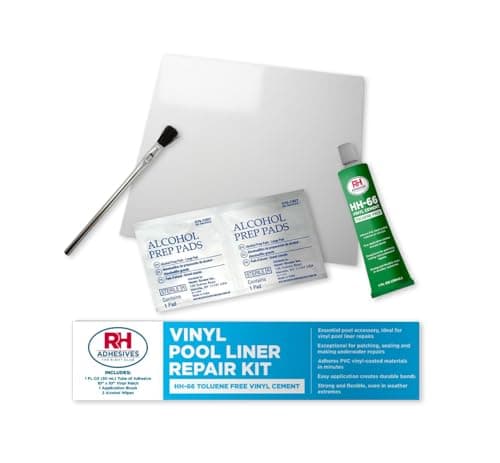
Vinyl Repair Patch Kit
Various
A few dollars of adhesive patches that turn most float failures into a ten-minute fix. The reason people replace floats annually is usually that they did not own one of these.
#ad how this is funded · price as of October 8, 2026
Key specs
- Use
- Vinyl floats, liners, air beds
- Requirement
- Surface must be clean and fully dry
- Cure
- Follow the kit — most need hours before re-inflating
How it scoresour reading of published specs, not a test result
- Material
- 8.0
- Valve
- 8.0
- Capacity
- 7.0
- Storage
- 9.5
- Value
- 9.5
Overall 8.5 / 10
What works
- Fixes the dominant failure mode of the entire floats category
- Also patches a pinhole in a pool liner, which is a far more expensive save
- Lasts indefinitely in the shed
What doesn't
- Will not fix a split seam, only a puncture
- Needs a genuinely dry surface, which is inconvenient poolside
- Cheap kits use adhesive that fails after a season in the water
Skip it if: Seam failures and valve leaks. Those are the end of the float and no patch changes that.
What it costs to run: The highest-leverage few dollars in this hub: one saved float pays for it several times over, and one saved liner pays for it a hundred times over.
Several seasons: Buy-once. Built and warranted to come back out of the box for a few years, if you store it properly.
Questions people actually ask
How many years does an above-ground pool last?
What is the most common way an above-ground pool fails?
Does taking the pool down each winter make it last longer?
Can you patch an above-ground pool liner?
Sources
Read next
- Above-ground pools for ordinary backyardsSoft-side, metal-frame and steel-wall pools compared by what they cost across a whole season, not at the till.
- The types of backyard pool, and who each is forInflatable, metal frame, permanent steel wall and inground - what separates them and which one you are actually shopping for.
- How to set up an above-ground pool properlyLeveling, ground protection, filling and priming - the afternoon that decides how the rest of the season goes.
- Liner replacement: the big occasional cost, and how to avoid itOverlap, beaded and unibead are not interchangeable - plus the three habits that decide whether you ever need a replacement.
- Are backyard pools worth it?The four questions that decide whether a pool is a good buy for your household - argued honestly in both directions.
- How to winterize an above-ground poolThe correct closing sequence, the freeze damage that ends pools, and why a cracked pump housing is entirely preventable.
- Taking the pool down without ruining itThe take-down sequence for a seasonal pool: draining responsibly, drying completely, folding warm, and storing where rodents are not.