Pool Care & Chemistry
Chlorine alternatives, and the ones that are chlorine wearing a hat
Two of the popular options are chlorine systems with better marketing. Two are supplements that still need a sanitizer. One genuinely replaces it, and it is the one nobody recommends here.

Heads up: we earn a commission if you buy through the links on this page, at no extra cost to you. It never decides the ranking — here is how we pick and here is the full disclosure. Prices are checked automatically; last verified October 8, 2026.
The short version
- A salt pool is a chlorine pool. The generator makes chlorine from salt; the sanitizer in the water is identical.
- Mineral systems are supplements, not replacements. They reduce how much chlorine you need, and every one of them still requires some.
- UV and ozone treat water passing through a chamber, not the water in the pool, so they leave no residual protection at all.
- Biguanide genuinely replaces chlorine and brings its own set of problems, which is why it is a niche choice.
The question behind the question
Almost nobody asking about chlorine alternatives objects to chlorine as a chemical. They object to one of three specific things: handling and storing it, the smell, or skin and eye irritation. Those have different answers, and two of them are not really about the sanitizer.
The smell is chloramines — spent chlorine — and it means the pool needs more sanitizer rather than less. Our chlorine smell guide covers it, and a properly maintained pool barely smells.
Stinging eyes are far more often pH than chlorine. The CDC publishes a range of 7.2 to 7.8, and water outside it is uncomfortable at any sanitizer level — our pH and alkalinity guide covers correcting it in the right order.
Handling is the objection with a genuine equipment answer, and that answer is usually a salt system. Which brings us to the first entry.
| Option | What it is | Still needs chlorine? |
|---|---|---|
| Salt chlorine generator | Makes chlorine from dissolved salt | It is chlorine |
| Mineral system | Silver or copper supplement | Yes, at a reduced level |
| UV system | Treats water inside a chamber | Yes, fully |
| Ozone system | Oxidiser generated inline | Yes, fully |
| Biguanide (PHMB) | A genuinely different sanitizer | No — and it is incompatible |
| Nothing but a filter | Not a sanitation strategy | Yes |
Salt: chlorine, generated instead of dosed
This is the most common answer given to “I want to avoid chlorine”, and it is worth being clear that it does not avoid chlorine. A generator electrolyses dissolved salt to produce chlorine continuously while the pump runs. The sanitizer in the water is the same molecule and all the same testing applies.
What it genuinely removes is handling — no buckets, no tablets, no measuring — and many people find the water feels softer, which is a real perception rather than a chemistry claim. Against that: the cell is a consumable with a published life in hours, it needs cleaning, and it produces at a set rate rather than on demand, so it copes poorly with a sudden spike in swimmers on a small pool.
On a seasonal above-ground pool there is a further wrinkle: the salt goes out with the water every autumn. Our salt systems guide covers the payback question and salt versus chlorine is the direct comparison.
Mineral systems: supplements with a real but partial effect
These introduce silver or copper ions into the water, usually via a cartridge in the skimmer or an inline unit. Both metals have genuine antimicrobial properties, and the effect is real enough that these systems let you run a lower chlorine residual.
Two honest caveats for a vinyl pool. First, they are supplements: every one of them still specifies a chlorine level, so the handling objection is reduced rather than removed. Second, copper in pool water is exactly what produces blue-green metal staining on a liner — the kind our liner stains guide describes as not responding to the chlorine tablet test and not being removable once it has set into the vinyl. That risk rises when pH drifts low, which on a seasonal pool it does.
UV and ozone: powerful, and in the wrong place
Both are used seriously in commercial water treatment and both work. The limitation on a backyard pool is structural rather than chemical: they treat water as it passes through a chamber in the plumbing, and they leave no residual behind.
That matters because the water in your pool is where swimmers are. Anything introduced by a swimmer at three o’clock is not addressed until it has been drawn through the skimmer, the pump and the chamber — and on a pool turning over in three to five hours, that is a long wait. A residual sanitizer, by definition, is working everywhere at once.
So both are supplementary systems that reduce chlorine demand rather than replacing chlorine, and both add equipment, cost and a lamp or cell to maintain. On a seasonal pool that is up for four months, the case is weak.
Biguanide: the one that genuinely replaces chlorine
Polyhexamethylene biguanide is a different sanitizer chemistry entirely, sold under a small number of brand names as a complete chlorine-free system with its own shock and algaecide. It works, it has no chlorine smell, and it is stable in sunlight without needing a stabilizer.
The reasons it stays niche are practical rather than theoretical. It is incompatible with chlorine, so switching is a one-way decision until the water is replaced — and adding any chlorine product by accident causes a mess. It is more expensive per season. It is known for gumming filter media, which on a cartridge system means shorter cartridge life. And you cannot use ordinary chlorine test strips, so your seven-way strips become useless.
On a seasonal above-ground pool where the water is replaced annually anyway, the one-way-door objection is smaller than it would be elsewhere. The cost and the filter issue remain.
| Option | Handling | Smell | Cost |
|---|---|---|---|
| Trichlor tablets and a dispenser | Some | Low if maintained | Lowest |
| Salt generator | Removed | Low | Higher up front |
| Mineral supplement | Reduced | Reduced | Moderate, recurring |
| UV or ozone | Reduced | Reduced | Higher, plus equipment |
| Biguanide | Different, not less | None | Highest per season |
What we would actually recommend
For nearly every seasonal above-ground pool: stabilized trichlor tablets metered through a floating dispenser, with cyanuric acid watched across the season and a partial drain when it climbs. It is the cheapest, the most available, and the best understood.
If handling chemicals is the genuine objection and the pool is at the larger end, a salt generator is a reasonable purchase — provided you understand it is still a chlorine pool and that the salt leaves with the water each autumn.
If someone in the household reacts badly to chlorinated water specifically, that is the one case where biguanide is worth the cost and the constraints, and it should be a decision made at fill time rather than mid-season. Everything else on this page is a supplement being sold as a replacement.
What to buy
Scores are our own reading of published specifications. They are not test results — we have not tested these products and we do not claim to.
Owners who dislike handling chemicals
Above-Ground Saltwater Chlorine Generator
Various
It makes chlorine from salt rather than replacing chlorine. Whether the hardware pays for itself over a seasonal pool's life is genuinely arguable, and it usually depends on how many seasons you will own it.
Key specs
- What it does
- Electrolyzes dissolved salt into chlorine
- Still a chlorine pool
- Yes — the sanitizer is identical
- Cell life
- Published in hours; the cell is a replaceable consumable
- Salt required
- Published per model, added once per season
How it scoresour reading of published specs, not a test result
- Sizing fit
- 7.0
- Running cost
- 6.0
- Maintenance
- 8.0
- Build
- 7.0
- Value
- 6.5
Overall 6.9 / 10
What works
- No weekly handling or storage of chlorine tablets
- Water feels noticeably softer to most people, which is the real reason people like them
- Salt is added once and stays until the water is changed
What doesn't
- The cell is a consumable and replacing it is a significant cost
- Adds another powered device to a pool whose running cost is already dominated by power
- Salt is corrosive to some metal frames and fittings if not managed
Skip it if: A pool that gets drained every autumn. You lose the salt with the water each year, and the payback period never arrives.
What it costs to run: The honest comparison is cell replacement cost plus salt plus power, against a season of tablets. On a pool kept up for several years it can work out; on a pool drained every October it generally does not.
More than you need yet: Real capability a first-pool family cannot use yet. Buy cheaper and put the difference toward chemicals and a cover.
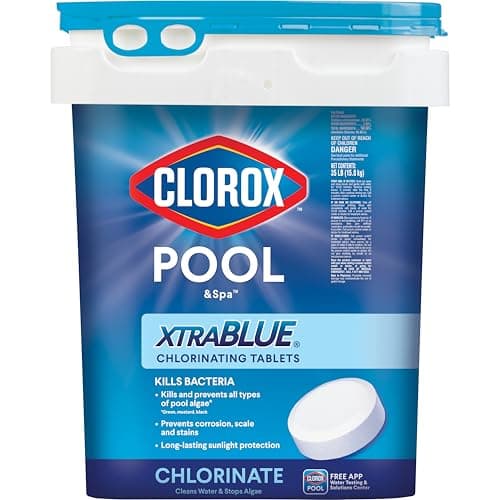
The default chlorine source
Clorox Pool&Spa 3-Inch Chlorinating Tablets
Clorox Pool&Spa
Stabilized trichlor tablets in a floating dispenser is the standard answer for a seasonal above-ground pool, and this is the standard version of it.
#ad how this is funded · price as of October 8, 2026
Key specs
- Type
- Stabilized trichlor, 3-inch tablets
- Contains stabilizer
- Yes — cyanuric acid is part of trichlor
- Dosing
- Per manufacturer instructions, by pool volume
- CDC target
- At least 2 ppm free chlorine when using a stabilizer
How it scoresour reading of published specs, not a test result
- Effectiveness
- 9.0
- Ease
- 9.0
- Water impact
- 6.0
- Cost per season
- 8.5
- Value
- 8.5
Overall 8.5 / 10
What works
- Dissolves slowly, so a floating dispenser meters chlorine out over days rather than hours
- Stabilized, so sunlight does not destroy your chlorine within an afternoon
- Widely stocked, so you are never hunting for it in July
What doesn't
- Every tablet adds cyanuric acid, and in a pool you never fully drain that accumulates until chlorine stops responding
- Trichlor is acidic and will pull your pH down over a season
- Tablets must be kept dry and sealed or they degrade and gas off
Skip it if: A small pool that is topped up rather than drained. Cyanuric acid only leaves with the water, so in a 1,500-gallon pool it climbs fast.
What it costs to run: The standing chemical cost of the season, and it scales directly with gallons. Watch the cyanuric acid reading on your test strip: once it is high, you are buying chlorine that cannot work, which is the most common invisible waste in a first pool year.
One honest season: The cheapest setup that genuinely works for a season of real swimming. Nothing spare, nothing missing.
Specs from: CDC — free chlorine target with cyanuric acid
Actually clearing a green pool
Calcium Hypochlorite Pool Shock
Various (compare available chlorine %)
Unstabilized, fast-acting and strong. This is the tool for an algae bloom precisely because it does not add more cyanuric acid to a pool that probably already has too much.
Key specs
- Type
- Calcium hypochlorite, unstabilized
- Adds stabilizer
- No
- Adds
- Calcium hardness
- Dosing
- By pool volume, per the bag
How it scoresour reading of published specs, not a test result
- Effectiveness
- 9.5
- Ease
- 6.5
- Water impact
- 7.0
- Cost per season
- 9.0
- Value
- 8.8
Overall 8.6 / 10
What works
- No cyanuric acid added, so it does not worsen the problem it is usually solving
- Fast and strong enough to actually break an algae bloom in one treatment when dosed properly
- Cheap per pound of available chlorine
What doesn't
- Adds calcium hardness, which matters in hard-water areas
- Must be dissolved properly or it will bleach a vinyl liner where it settles
- Needs careful storage — it is a genuine oxidizer, not a household product
Skip it if: Routine daily chlorination. This is the emergency tool; tablets are the routine.
What it costs to run: The single most cost-effective way to fix a green pool, and the most commonly under-dosed. Half a dose twice does not equal a full dose once — it just wastes the bag.
One honest season: The cheapest setup that genuinely works for a season of real swimming. Nothing spare, nothing missing.
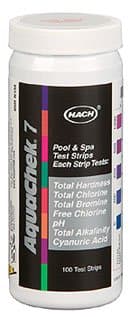
The default first test kit
AquaChek Silver 7-Way Test Strips (100 count)
AquaChek
Seven readings in fifteen seconds, including the two that beginners never measure and then fight all summer: total alkalinity and cyanuric acid.
#ad how this is funded · price as of October 8, 2026
Key specs
- Tests
- Free chlorine, total chlorine, bromine, pH, total alkalinity, total hardness, cyanuric acid
- Free chlorine range
- 0-20 ppm
- pH range
- 6.2-8.4
- Total alkalinity range
- 0-240 ppm
- Cyanuric acid range
- 0-300 ppm
- Read time
- 15 seconds
- Count
- 100 strips
How it scoresour reading of published specs, not a test result
- Accuracy
- 7.0
- Ease
- 9.5
- Coverage
- 9.5
- Cost per use
- 9.0
- Value
- 9.2
Overall 8.9 / 10
What works
- Covers cyanuric acid, which most cheap strips omit and which is the reason chlorine stops working in a stabilized pool
- pH range spans 6.2-8.4, comfortably bracketing the CDC's recommended 7.0-7.8
- 15 seconds and a color chart printed on the bottle — no separate booklet to lose
- 100 strips is a full season of twice-weekly testing with room to spare
What doesn't
- Strips are a comparison against a printed color chart, so they are directional rather than precise
- Reading them in bright sun is harder than it should be
- The bottle must be kept sealed and dry or the strips degrade quietly
Skip it if: Fine adjustment. If you are chasing a stubborn problem and need a number rather than a color band, a liquid reagent kit is the tool.
What it costs to run: 100 strips at twice-weekly testing covers roughly two seasons for one pool. The real saving is upstream: knowing your alkalinity stops you buying pH adjuster you did not need.
One honest season: The cheapest setup that genuinely works for a season of real swimming. Nothing spare, nothing missing.
Specs from: CDC — home pool and hot tub water treatment and testing
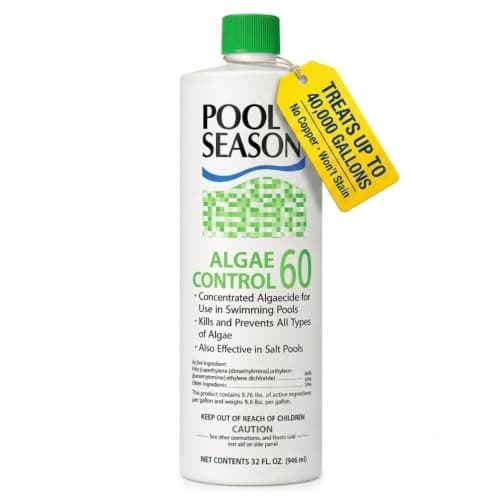
Preventing algae, not curing it
Pool Algaecide (polyquat 60)
Various
Polyquat is the non-foaming, non-staining choice and it is far better at stopping algae than at killing an established bloom. Use it as insurance and as part of closing.
Key specs
- Type
- Polyquaternium (polyquat 60)
- Foaming
- Non-foaming, unlike quat algaecides
- Metal content
- None, unlike copper-based algaecides
How it scoresour reading of published specs, not a test result
- Effectiveness
- 7.5
- Ease
- 9.0
- Water impact
- 9.0
- Cost per season
- 7.5
- Value
- 8.0
Overall 8.0 / 10
What works
- Does not foam, which the cheaper quat products do
- No copper, so no risk of the metal staining a vinyl liner
- The standard product in a winterizing routine, for good reason
What doesn't
- Poor at killing an established bloom — shock does that job
- More expensive than copper-based alternatives
- Easy to over-rely on instead of maintaining chlorine
Skip it if: Rescuing a green pool. Brush and shock first; algaecide is what stops it coming back.
What it costs to run: One of the few chemicals where buying the better version is clearly right — a copper algaecide that stains a liner costs vastly more than the few dollars it saved.
One honest season: The cheapest setup that genuinely works for a season of real swimming. Nothing spare, nothing missing.
Questions people actually ask
Is a saltwater pool chlorine-free?
Do mineral pool systems replace chlorine?
Do UV or ozone systems work on an above-ground pool?
What is a genuinely chlorine-free pool sanitizer?
Sources
Read next
- Pool care, from someone who assumes you have never done thisThe weekly routine, the four numbers that matter, and the fix for the week the water turns.
- Salt vs chlorine: a saltwater pool is a chlorine poolWhat a salt chlorine generator actually does, the honest cost comparison over several seasons, and when it does not make sense.
- Bromine or chlorine: sunlight settles itWhy bromine works in a covered hot tub and struggles in an open pool, what it costs, and when it is still the right answer.
- Tablets or liquid: the difference is what else goes inTrichlor tablets against liquid chlorine on stabilizer, convenience, storage and cost, for a seasonal above-ground pool.
- Salt systems for an above-ground poolHow a chlorine generator works, what the cell costs over time, and why draining the pool each autumn changes the answer entirely.
- Clear water and safe water are two different thingsWhy a pool can look perfect and be unsanitized, why haze is often harmless, and the four readings that answer the question clarity cannot.
- What a season of pool chemicals actually adds up toSeason chemical quantities computed from published dosing for four pool volumes, plus the shopping list that is genuinely necessary.
- Borates: the buffer most pools never addWhat borates do to pH and algae, the 30 to 50 ppm range published by industry chemists, how to test, and the safety and labeling caveats nobody mentions.