Pool Care & Chemistry
The chlorine smell means you need more chlorine, not less
This is the single most useful counter-intuitive fact in pool care, and almost nobody is told it before their first season.

Heads up: we earn a commission if you buy through the links on this page, at no extra cost to you. It never decides the ranking — here is how we pick and here is the full disclosure. Prices are checked automatically; last verified October 8, 2026.
The short version
- Clean chlorinated water barely smells. The strong swimming-pool smell is chloramines — chlorine that has already reacted and is no longer sanitizing.
- The smell therefore usually means too little effective chlorine, not too much. The instinct to add less is exactly backwards.
- Free chlorine is what works; total chlorine includes the spent kind. The gap between the two readings is your answer.
- The fix is shock, not dilution — a dose large enough to break the chloramines apart rather than a small top-up that adds to them.
What you are actually smelling
Chlorine does its job by reacting with things: sweat, sunscreen, leaves, whatever a hot afternoon and four children introduce. When chlorine reacts with nitrogen compounds it forms chloramines, and chloramines are what produce the sharp, unmistakable smell people associate with swimming pools. They are also, from a sanitizing point of view, spent. They are not killing anything.
So the smell is a report on chlorine that has already been used up, not on chlorine that is available. A well-maintained pool with adequate free chlorine has very little odor at all. The public-pool smell that everyone recognizes is the smell of a pool that has been working hard and needs help, which is why the CDC frames a strong chemical odor as a sign to check the water rather than a sign of a heavily chlorinated one.
Free chlorine, total chlorine, and the gap between them
Two numbers explain the whole thing. Free chlorine is the sanitizer still available to do work — the CDC publishes a minimum of 1 ppm for pools, and at least 2 ppm where a stabilizer is in use, which is the case for anyone dosing with trichlor tablets. Total chlorine is free chlorine plus the combined, spent chlorine. Subtract one from the other and you have your combined chlorine, which is the smell.
A seven-way test strip reports free chlorine and total chlorine side by side, which is enough to see the gap. If you want an actual number rather than a color band, the Taylor K-2006 uses a drop-count titration that reads free and combined chlorine separately and resolves to about 0.2 ppm free chlorine on the standard sample. That resolution is the reason people who take this seriously own one.
| What you see | What it means | What to do |
|---|---|---|
| Free chlorine adequate, no smell | The pool is working normally | Nothing — carry on with the weekly routine |
| Strong smell, total well above free | Chloramines have built up | Shock the pool to break them apart |
| Free chlorine at or near zero | The pool is not sanitizing at all | Shock, then re-establish the routine |
| Smell after heavy use or a hot week | Normal demand outran the tablets | Shock, then test more often that week |
The fix is a real shock, not a top-up
Chloramines are broken apart by a large enough dose of chlorine, not by a small one. This is why the weekly tablet is the wrong tool here: it maintains a level, it does not reset one. Shock is a deliberately heavy dose, and half a dose achieves close to nothing while consuming the same afternoon.
Which shock depends on your stabilizer. Calcium hypochlorite is unstabilized, hits hard, and is the right choice when cyanuric acid is already high — it adds calcium hardness instead, which matters far less on a seasonal pool you drain each autumn. Dichlor is stabilized and gentler on a vinyl liner, dissolving fast and generally without pre-dissolving, but it adds more cyanuric acid to a pool that may already have plenty. Our shock guide covers the dosing and the procedure; our cyanuric acid guide covers which of the two you should be reaching for.
Other reasons a pool smells
If the smell is musty rather than sharp, that is usually organic — leaves in the skimmer basket, debris under the liner folds, or a filter cartridge that needed replacing a fortnight ago. Rinse or swap the cartridge and clear the baskets before reaching for chemicals.
If the water also stings eyes, check pH before assuming chlorine is the culprit. Eye irritation is far more often a pH problem than a chlorine problem, and pH outside the CDC’s published 7.2 to 7.8 range is uncomfortable regardless of how much chlorine is in the water. Our pH guide covers correcting it in the right order.
Preventing it rather than fixing it
Chloramines are produced by what swimmers bring into the water, so the preventive measures are unglamorous and effective: rinse off before getting in, keep the routine steady rather than heroic, and increase testing frequency during heatwaves and busy weeks rather than after them. A pool that is tested twice a week rarely gets far enough out of balance to smell — our weekly schedule is the version you can pin to the shed door.
What to buy
Scores are our own reading of published specifications. They are not test results — we have not tested these products and we do not claim to.
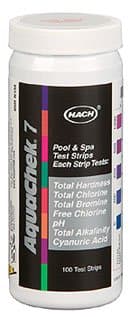
The default first test kit
AquaChek Silver 7-Way Test Strips (100 count)
AquaChek
Seven readings in fifteen seconds, including the two that beginners never measure and then fight all summer: total alkalinity and cyanuric acid.
#ad how this is funded · price as of October 8, 2026
Key specs
- Tests
- Free chlorine, total chlorine, bromine, pH, total alkalinity, total hardness, cyanuric acid
- Free chlorine range
- 0-20 ppm
- pH range
- 6.2-8.4
- Total alkalinity range
- 0-240 ppm
- Cyanuric acid range
- 0-300 ppm
- Read time
- 15 seconds
- Count
- 100 strips
How it scoresour reading of published specs, not a test result
- Accuracy
- 7.0
- Ease
- 9.5
- Coverage
- 9.5
- Cost per use
- 9.0
- Value
- 9.2
Overall 8.9 / 10
What works
- Covers cyanuric acid, which most cheap strips omit and which is the reason chlorine stops working in a stabilized pool
- pH range spans 6.2-8.4, comfortably bracketing the CDC's recommended 7.0-7.8
- 15 seconds and a color chart printed on the bottle — no separate booklet to lose
- 100 strips is a full season of twice-weekly testing with room to spare
What doesn't
- Strips are a comparison against a printed color chart, so they are directional rather than precise
- Reading them in bright sun is harder than it should be
- The bottle must be kept sealed and dry or the strips degrade quietly
Skip it if: Fine adjustment. If you are chasing a stubborn problem and need a number rather than a color band, a liquid reagent kit is the tool.
What it costs to run: 100 strips at twice-weekly testing covers roughly two seasons for one pool. The real saving is upstream: knowing your alkalinity stops you buying pH adjuster you did not need.
One honest season: The cheapest setup that genuinely works for a season of real swimming. Nothing spare, nothing missing.
Specs from: CDC — home pool and hot tub water treatment and testing
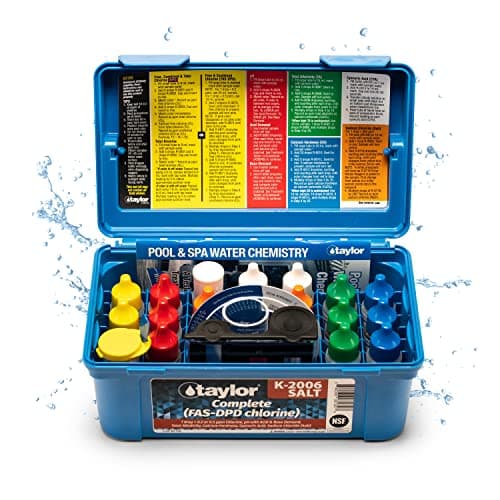
When you need a number, not a color band
Taylor K-2006 Complete Test Kit (FAS-DPD)
Taylor Technologies
The reference kit. It uses a drop-count titration for free chlorine, which gives you an actual figure rather than a shade of pink. Overkill for a 1,500-gallon pool and indispensable when something has gone properly wrong.
#ad how this is funded · price as of October 8, 2026
Key specs
- Method
- FAS-DPD drop-count titration
- Measures
- Free and combined chlorine, pH, alkalinity, calcium hardness, cyanuric acid
- Resolution
- Reads to 0.2 ppm free chlorine with the standard 10 mL sample
- Format
- Reagent bottles and graduated comparators
How it scoresour reading of published specs, not a test result
- Accuracy
- 9.8
- Ease
- 5.5
- Coverage
- 9.5
- Cost per use
- 7.0
- Value
- 8.0
Overall 8.3 / 10
What works
- Distinguishes free from combined chlorine, which is the single most useful thing a test can tell you when water smells of chlorine
- Gives a numeric result you can act on precisely rather than a color to interpret
- Reagents are individually replaceable, so the kit is a multi-season purchase
What doesn't
- Considerably more expensive than strips and more of a ritual to use
- Reagents have a shelf life and do expire
- Genuinely more kit than a small seasonal pool needs
Skip it if: Casual weekly checks. If it is a five-minute job you will skip it, and a test you skip is worse than a rough one you actually do.
What it costs to run: The reagents are the running cost, not the kit. For most seasonal above-ground owners this is a second purchase made in year two after a bad algae summer, not a first one.
Several seasons: Buy-once. Built and warranted to come back out of the box for a few years, if you store it properly.
Specs from: Taylor Technologies
Actually clearing a green pool
Calcium Hypochlorite Pool Shock
Various (compare available chlorine %)
Unstabilized, fast-acting and strong. This is the tool for an algae bloom precisely because it does not add more cyanuric acid to a pool that probably already has too much.
Key specs
- Type
- Calcium hypochlorite, unstabilized
- Adds stabilizer
- No
- Adds
- Calcium hardness
- Dosing
- By pool volume, per the bag
How it scoresour reading of published specs, not a test result
- Effectiveness
- 9.5
- Ease
- 6.5
- Water impact
- 7.0
- Cost per season
- 9.0
- Value
- 8.8
Overall 8.6 / 10
What works
- No cyanuric acid added, so it does not worsen the problem it is usually solving
- Fast and strong enough to actually break an algae bloom in one treatment when dosed properly
- Cheap per pound of available chlorine
What doesn't
- Adds calcium hardness, which matters in hard-water areas
- Must be dissolved properly or it will bleach a vinyl liner where it settles
- Needs careful storage — it is a genuine oxidizer, not a household product
Skip it if: Routine daily chlorination. This is the emergency tool; tablets are the routine.
What it costs to run: The single most cost-effective way to fix a green pool, and the most commonly under-dosed. Half a dose twice does not equal a full dose once — it just wastes the bag.
One honest season: The cheapest setup that genuinely works for a season of real swimming. Nothing spare, nothing missing.
A gentler shock on a vinyl liner
Dichlor Granular Shock (stabilized)
Various (compare available chlorine %)
Dissolves fast and completely, which makes it kinder to a vinyl liner than cal-hypo. The catch is that it is stabilized, so every shock treatment also adds cyanuric acid.
Key specs
- Type
- Sodium dichlor, stabilized
- Adds stabilizer
- Yes
- Dissolving
- Fast, generally without pre-dissolving
How it scoresour reading of published specs, not a test result
- Effectiveness
- 8.5
- Ease
- 9.0
- Water impact
- 5.5
- Cost per season
- 7.0
- Value
- 7.5
Overall 7.8 / 10
What works
- Dissolves quickly and evenly, so there is much less liner-bleaching risk
- Close to pH neutral, so it does not swing your water while you are fixing it
- Convenient for routine oxidation rather than emergencies
What doesn't
- Adds cyanuric acid every single time, which is a problem in a pool that is never drained
- Generally more expensive per pound of available chlorine than cal-hypo
- Wrong tool for a heavy algae bloom in an already over-stabilized pool
Skip it if: A pool whose cyanuric acid is already high. Check the strip before you reach for this one.
What it costs to run: Costs more per treatment than cal-hypo and carries a hidden cost: the stabilizer it adds eventually forces a partial drain and refill, which is water you pay for.
One honest season: The cheapest setup that genuinely works for a season of real swimming. Nothing spare, nothing missing.
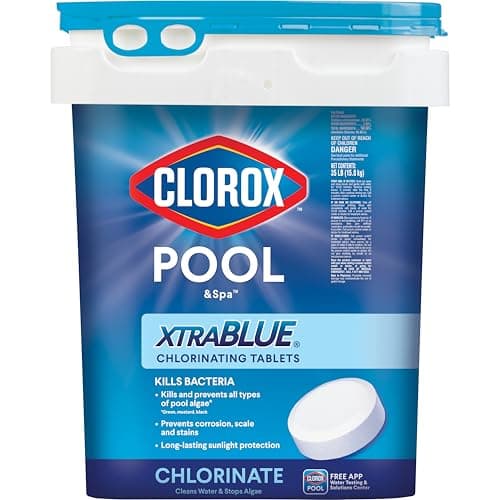
The default chlorine source
Clorox Pool&Spa 3-Inch Chlorinating Tablets
Clorox Pool&Spa
Stabilized trichlor tablets in a floating dispenser is the standard answer for a seasonal above-ground pool, and this is the standard version of it.
#ad how this is funded · price as of October 8, 2026
Key specs
- Type
- Stabilized trichlor, 3-inch tablets
- Contains stabilizer
- Yes — cyanuric acid is part of trichlor
- Dosing
- Per manufacturer instructions, by pool volume
- CDC target
- At least 2 ppm free chlorine when using a stabilizer
How it scoresour reading of published specs, not a test result
- Effectiveness
- 9.0
- Ease
- 9.0
- Water impact
- 6.0
- Cost per season
- 8.5
- Value
- 8.5
Overall 8.5 / 10
What works
- Dissolves slowly, so a floating dispenser meters chlorine out over days rather than hours
- Stabilized, so sunlight does not destroy your chlorine within an afternoon
- Widely stocked, so you are never hunting for it in July
What doesn't
- Every tablet adds cyanuric acid, and in a pool you never fully drain that accumulates until chlorine stops responding
- Trichlor is acidic and will pull your pH down over a season
- Tablets must be kept dry and sealed or they degrade and gas off
Skip it if: A small pool that is topped up rather than drained. Cyanuric acid only leaves with the water, so in a 1,500-gallon pool it climbs fast.
What it costs to run: The standing chemical cost of the season, and it scales directly with gallons. Watch the cyanuric acid reading on your test strip: once it is high, you are buying chlorine that cannot work, which is the most common invisible waste in a first pool year.
One honest season: The cheapest setup that genuinely works for a season of real swimming. Nothing spare, nothing missing.
Specs from: CDC — free chlorine target with cyanuric acid
Questions people actually ask
Does a strong chlorine smell mean too much chlorine?
What is the difference between free and total chlorine?
Will shocking the pool get rid of the chlorine smell?
Why does my pool sting my eyes?
Sources
Read next
- Pool care, from someone who assumes you have never done thisThe weekly routine, the four numbers that matter, and the fix for the week the water turns.
- Pool shock: use enough, once, and use the right kindCal-hypo versus dichlor, correct dosing, and the counter-intuitive reason a chlorine smell means you need more chlorine.
- The best pool test stripsTest strips compared on parameter coverage - specifically whether they read cyanuric acid, which most cheap strips omit.
- Cyanuric acid: the reading that explains your chlorineWhy an outdoor pool needs stabilizer, why tablets add it whether you want them to or not, and the only way to bring it back down.
- Pool maintenance for beginners, in twenty minutes a weekThe complete weekly routine in order, what each step is actually for, and the things you can safely ignore.
- Cloudy pool water: work out which of four problems you haveA diagnostic decision tree for cloudy water - four causes, how to tell them apart, and the correct fix for each.