Pool Care & Chemistry
Bromine or chlorine: sunlight settles it
Bromine is genuinely better in several ways, and one of the ways it is worse - it has no sunscreen - is the one that matters in an open backyard pool.
Heads up: we earn a commission if you buy through the links on this page, at no extra cost to you. It never decides the ranking — here is how we pick and here is the full disclosure. Prices are checked automatically; last verified October 8, 2026.
The short version
- Bromine has no equivalent of cyanuric acid. There is no practical stabilizer for it, so ultraviolet light strips it from an open pool quickly.
- That single fact decides the comparison outdoors. Everything bromine does better is real, and none of it survives a sunny afternoon.
- It is the standard for hot tubs, which are covered, hot, and where its tolerance of heat and higher pH is genuinely useful.
- Seven-way strips read bromine, so testing is not the obstacle — five-way strips generally read it too.
What bromine is actually good at
It is worth being fair to it, because the advantages are real and they are why bromine dominates a neighboring category.
It tolerates a wider pH range. Chlorine loses effectiveness noticeably as pH rises through the CDC’s published 7.2 to 7.8 window and above it. Bromine holds up better, which matters in water that drifts.
It handles heat better. Hot water accelerates the loss of chlorine. Bromine copes, which is the main reason hot tubs use it.
Its combined form still sanitizes. When chlorine reacts with nitrogen compounds it forms chloramines, which smell and do not sanitize — the mechanism our chlorine smell guide explains. Bromamines remain active, which means less of the sharp smell and less need to shock purely to break combined sanitizer apart.
It is gentler on the nose. Related to the point above, and the reason people who dislike the smell of public pools ask about it.
| Chlorine (trichlor tablets) | Bromine | |
|---|---|---|
| Cost per season | Lower | Higher |
| Availability | Every shop that sells pool goods | Narrower, often spa aisle |
| Tolerance of high pH | Falls off | Better |
| Tolerance of heat | Poorer | Better |
| Smell when spent | Chloramines — sharp | Bromamines — milder |
| Spent form still sanitizes | No | Largely yes |
| Shocking to reset | Needed regularly | Reactivates bromide, so less often |
| UV protection available | Yes — cyanuric acid | No practical stabilizer |
Why the last row wins outdoors
An above-ground pool is a shallow, open body of water sitting in direct sun for the whole season, by definition. That is the worst possible environment for an unstabilized sanitizer, and it is the environment every pool in this hub lives in.
The practical consequence is that a bromine pool outdoors needs dosing far more often and more heavily to hold a level, which erases the cost gap in the wrong direction — bromine already costs more per unit than trichlor tablets. You end up paying more, more often, for a sanitizer that is being destroyed faster.
None of that applies to a hot tub, which is covered when not in use, has a fraction of the surface area, and is hot. That is the environment bromine was made for, and it is why the advice differs so completely between the two products.
Testing is not the obstacle
A common assumption is that switching sanitizer means new test equipment. It does not. Seven-way strips read free chlorine, total chlorine and bromine, and even the cheaper five-way strips typically include bromine on the panel. What five-way strips omit is cyanuric acid, which matters for chlorine and is irrelevant for bromine — one of the few situations where the cheaper strip loses you nothing.
Our test kit roundup covers what each format reports, and testing mistakes covers reading them properly.
Switching, and why it is a one-way door mid-season
You cannot simply alternate. Once a pool has been run on bromine there is bromide in the water, and adding chlorine to it regenerates bromine rather than acting as chlorine. In practice that means a pool that has been on bromine stays on bromine until the water is replaced.
On a seasonal above-ground pool that is a much smaller problem than it sounds, because the water gets replaced anyway — either at a partial drain, or at the start of the next season. It does mean the decision should be made deliberately at fill time rather than drifted into halfway through July.
The honest recommendation
For an outdoor above-ground pool: chlorine, in three-inch stabilized tablets, metered through a floating dispenser, with an eye on cyanuric acid across the season. Our chlorine tablet roundup covers the options and liquid versus tablets covers the form factor question.
Consider bromine if the pool is genuinely shaded for most of the day, if it is covered whenever it is not in use, if someone in the household reacts badly to chlorinated water, or if you are treating a hot tub rather than a pool. Those are real cases; they are just not the common one. If your interest is really about handling fewer chemicals, our salt versus chlorine comparison is the more relevant page — a salt system is still a chlorine pool, generated rather than dosed.
What to buy
Scores are our own reading of published specifications. They are not test results — we have not tested these products and we do not claim to.
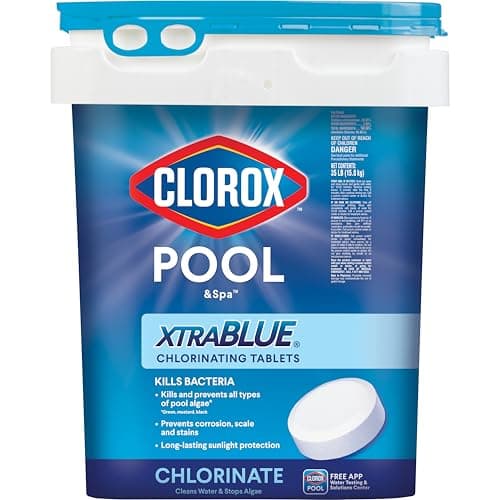
The default chlorine source
Clorox Pool&Spa 3-Inch Chlorinating Tablets
Clorox Pool&Spa
Stabilized trichlor tablets in a floating dispenser is the standard answer for a seasonal above-ground pool, and this is the standard version of it.
#ad how this is funded · price as of October 8, 2026
Key specs
- Type
- Stabilized trichlor, 3-inch tablets
- Contains stabilizer
- Yes — cyanuric acid is part of trichlor
- Dosing
- Per manufacturer instructions, by pool volume
- CDC target
- At least 2 ppm free chlorine when using a stabilizer
How it scoresour reading of published specs, not a test result
- Effectiveness
- 9.0
- Ease
- 9.0
- Water impact
- 6.0
- Cost per season
- 8.5
- Value
- 8.5
Overall 8.5 / 10
What works
- Dissolves slowly, so a floating dispenser meters chlorine out over days rather than hours
- Stabilized, so sunlight does not destroy your chlorine within an afternoon
- Widely stocked, so you are never hunting for it in July
What doesn't
- Every tablet adds cyanuric acid, and in a pool you never fully drain that accumulates until chlorine stops responding
- Trichlor is acidic and will pull your pH down over a season
- Tablets must be kept dry and sealed or they degrade and gas off
Skip it if: A small pool that is topped up rather than drained. Cyanuric acid only leaves with the water, so in a 1,500-gallon pool it climbs fast.
What it costs to run: The standing chemical cost of the season, and it scales directly with gallons. Watch the cyanuric acid reading on your test strip: once it is high, you are buying chlorine that cannot work, which is the most common invisible waste in a first pool year.
One honest season: The cheapest setup that genuinely works for a season of real swimming. Nothing spare, nothing missing.
Specs from: CDC — free chlorine target with cyanuric acid
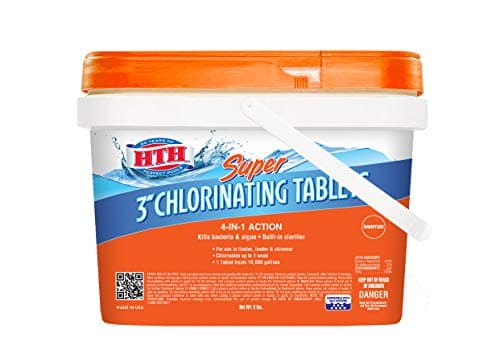
The direct alternative
HTH 3-Inch Chlorinating Tablets
HTH
Functionally the same product as any other stabilized trichlor tablet. Buy on price per pound of available chlorine, not on the label.
#ad how this is funded · price as of October 8, 2026
Key specs
- Type
- Stabilized trichlor, 3-inch tablets
- Contains stabilizer
- Yes
- Compare on
- Available chlorine percentage stated on the label
How it scoresour reading of published specs, not a test result
- Effectiveness
- 9.0
- Ease
- 9.0
- Water impact
- 6.0
- Cost per season
- 8.8
- Value
- 8.5
Overall 8.4 / 10
What works
- Chemically equivalent to competing trichlor tablets — this is a commodity
- Widely available in large buckets, which is the cheaper format
- Long shelf life if the bucket stays sealed and dry
What doesn't
- Same cyanuric acid accumulation as every other trichlor product
- Same downward pH pressure over a season
- Bucket sizes are often larger than a small seasonal pool will use in a year
Skip it if: Being different. If you are comparing trichlor brands you are comparing price, and you should be.
What it costs to run: Cost per season is decided by the available-chlorine percentage on the label and the bucket size, not the brand. Compare those two numbers and buy the cheaper one.
One honest season: The cheapest setup that genuinely works for a season of real swimming. Nothing spare, nothing missing.
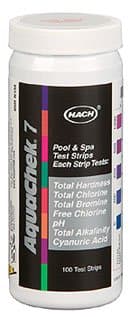
The default first test kit
AquaChek Silver 7-Way Test Strips (100 count)
AquaChek
Seven readings in fifteen seconds, including the two that beginners never measure and then fight all summer: total alkalinity and cyanuric acid.
#ad how this is funded · price as of October 8, 2026
Key specs
- Tests
- Free chlorine, total chlorine, bromine, pH, total alkalinity, total hardness, cyanuric acid
- Free chlorine range
- 0-20 ppm
- pH range
- 6.2-8.4
- Total alkalinity range
- 0-240 ppm
- Cyanuric acid range
- 0-300 ppm
- Read time
- 15 seconds
- Count
- 100 strips
How it scoresour reading of published specs, not a test result
- Accuracy
- 7.0
- Ease
- 9.5
- Coverage
- 9.5
- Cost per use
- 9.0
- Value
- 9.2
Overall 8.9 / 10
What works
- Covers cyanuric acid, which most cheap strips omit and which is the reason chlorine stops working in a stabilized pool
- pH range spans 6.2-8.4, comfortably bracketing the CDC's recommended 7.0-7.8
- 15 seconds and a color chart printed on the bottle — no separate booklet to lose
- 100 strips is a full season of twice-weekly testing with room to spare
What doesn't
- Strips are a comparison against a printed color chart, so they are directional rather than precise
- Reading them in bright sun is harder than it should be
- The bottle must be kept sealed and dry or the strips degrade quietly
Skip it if: Fine adjustment. If you are chasing a stubborn problem and need a number rather than a color band, a liquid reagent kit is the tool.
What it costs to run: 100 strips at twice-weekly testing covers roughly two seasons for one pool. The real saving is upstream: knowing your alkalinity stops you buying pH adjuster you did not need.
One honest season: The cheapest setup that genuinely works for a season of real swimming. Nothing spare, nothing missing.
Specs from: CDC — home pool and hot tub water treatment and testing
A cheap backup bottle
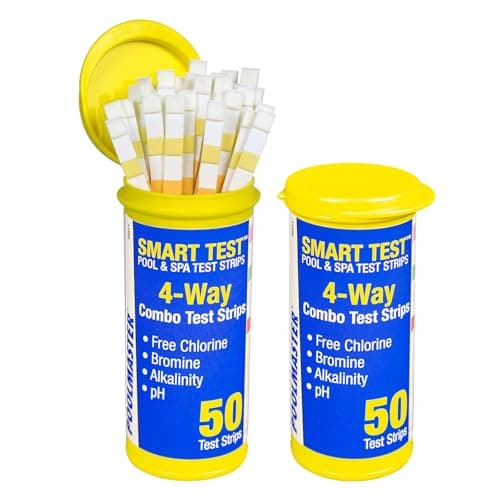
Poolmaster 5-Way Test Strips
Poolmaster
Five readings instead of seven, and the two it drops are the ones that matter most. Fine as a spare in the shed, wrong as your only kit.
#ad how this is funded · price as of October 8, 2026
Key specs
- Tests
- Typically free chlorine, bromine, pH, total alkalinity, total hardness
- Omits
- Cyanuric acid on most 5-way formats
- Read time
- About 15 seconds
How it scoresour reading of published specs, not a test result
- Accuracy
- 6.0
- Ease
- 9.0
- Coverage
- 5.0
- Cost per use
- 9.0
- Value
- 6.0
Overall 6.4 / 10
What works
- Cheap enough to keep a second bottle where you actually test
- Covers the three daily readings — chlorine, pH, alkalinity
- Same 15-second workflow as any strip
What doesn't
- No cyanuric acid reading, which is the number that explains why your chlorine stopped working
- Color bands are coarser than the AquaChek equivalent
- Format varies between production runs, so check what the bottle actually tests
Skip it if: Diagnosing a stabilized pool. Without a cyanuric acid reading you are guessing at exactly the point where guessing is expensive.
What it costs to run: Saves a couple of dollars against a 7-way and can cost you a season of unnecessary chlorine. This is the wrong place to economize.
A few weekends: Fine for a heatwave and a toddler. Treat it as consumable, not as a pool — it will not survive a winter in the yard.
Making tablets work properly
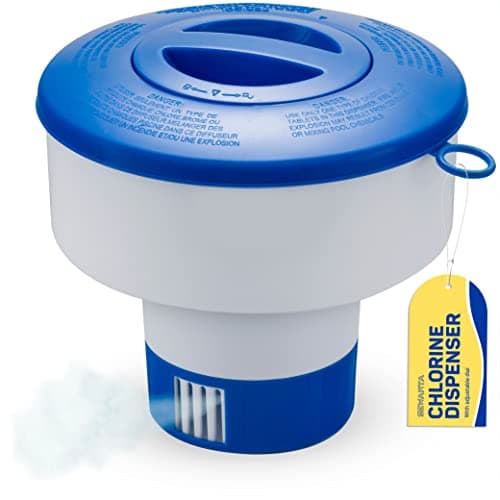
Floating Chlorine Tablet Dispenser
Various
Two dollars of plastic that decides whether your chlorine dissolves evenly over days or sits in a corner bleaching your liner. Buy it with the tablets, not after.
#ad how this is funded · price as of October 8, 2026
Key specs
- Function
- Holds 3-inch tablets, meters dissolution rate
- Adjustment
- Vented base, adjustable on most models
- Compatibility
- Standard 3-inch tablets
How it scoresour reading of published specs, not a test result
- Effectiveness
- 8.0
- Ease
- 9.5
- Water impact
- 9.0
- Cost per season
- 9.8
- Value
- 9.5
Overall 9.0 / 10
What works
- Adjustable venting lets you slow or speed dissolution to match the weather
- Keeps tablets off the liner, which is what causes bleach spots
- Trivially cheap and lasts years
What doesn't
- Drifts to one end of the pool in wind, so distribution is uneven without circulation
- Must be removed before swimming with small children
- Cheap ones crack after a season in UV
Skip it if: Being left in an empty or unfiltered pool. Without circulation it creates a concentrated pocket rather than an even dose.
What it costs to run: The cheapest item on this site and one of the highest-return: even dissolution means you use fewer tablets to hold the same free chlorine level.
One honest season: The cheapest setup that genuinely works for a season of real swimming. Nothing spare, nothing missing.
Questions people actually ask
Is bromine better than chlorine for an above-ground pool?
Can you use bromine and chlorine in the same pool?
Do pool test strips measure bromine?
Why does bromine smell less than chlorine?
Sources
Read next
- Pool care, from someone who assumes you have never done thisThe weekly routine, the four numbers that matter, and the fix for the week the water turns.
- The best chlorine tablets for an above-ground poolTrichlor tablets compared on available chlorine and stabilizer load, with the season-quantity arithmetic for your pool size.
- Cyanuric acid: the reading that explains your chlorineWhy an outdoor pool needs stabilizer, why tablets add it whether you want them to or not, and the only way to bring it back down.
- Salt vs chlorine: a saltwater pool is a chlorine poolWhat a salt chlorine generator actually does, the honest cost comparison over several seasons, and when it does not make sense.
- Tablets or liquid: the difference is what else goes inTrichlor tablets against liquid chlorine on stabilizer, convenience, storage and cost, for a seasonal above-ground pool.
- The best pool test stripsTest strips compared on parameter coverage - specifically whether they read cyanuric acid, which most cheap strips omit.
- The chlorine smell means you need more chlorine, not lessWhat the chlorine smell actually is, why it means the opposite of what people assume, and the test that distinguishes free from combined chlorine.