Pool Care & Chemistry
Draining an above-ground pool, and the two ways it goes wrong
The water is what holds a vinyl liner in shape. Take it away and you are not emptying a pool, you are unloading a structure that was designed to be full.
Heads up: we earn a commission if you buy through the links on this page, at no extra cost to you. It never decides the ranking — here is how we pick and here is the full disclosure. Prices are checked automatically; last verified October 8, 2026.
The short version
- A vinyl liner pool should not be fully drained. Latham, which makes liners, says never to remove more than half the volume.
- Frame pools are the exception. Intex requires draining and dismantling below 41°F; permanent pools must stay part-full all winter.
- Dilution is the only practical fix for high cyanuric acid and the usual one for high calcium hardness.
- Where the water goes is regulated. One watershed district requires under 0.1 mg/L chlorine and pH 7 to 8 before discharge to a yard or floor drain.
What the water is actually doing
In a vinyl pool the liner is not a lining, it is the vessel. Water pressure is what holds it flat against the wall and floor. Latham, a liner manufacturer, is unambiguous: a vinyl liner pool “should never be completely drained, as its water volume helps keep your liner properly in place and wrinkle-free”, and if you must drain, “never remove more than half your pool’s total water volume”.
The failure modes are well documented by the trade. An older liner that has shrunk slightly pulls away from the wall once unloaded, then wrinkles or tears when refilled. A brittle liner can split outright. On older pools the wall itself, designed to be braced by water pressure from inside, can tilt or collapse. And in wet ground, a high water table can push under an empty liner and float it.
None of that is a reason to never drain. It is a reason to treat draining as a deliberate operation with a specific purpose, rather than as routine maintenance.
The one case where the manufacturer says drain it
Seasonal frame pools are the exception, and their makers are explicit. Intex’s metal frame manual instructs owners to drain, disassemble and properly store the pool when the temperature drops below 41°F, because ice damage “can result in sudden liner failure or pool collapse”.
Pools designed to stay up say the opposite. Bestway’s guidance for its year-round pools is to lower the water to a stated distance below the inlet and outlet valves — four inches on the Hydrium, two on the TANX — and warns that water left in those valves can freeze, damage the liner and void the warranty. Leslie’s industry guidance for freezing climates is to lower the level four to six inches below the skimmer and no further.
So “do I drain for winter” has two correct answers depending on which pool you own, and our winterizing guide and take-down guide cover the two paths separately. What is never correct is draining a permanent pool completely and leaving it empty over winter.
When a partial drain is the only fix
Two chemistry problems have no other practical answer, because the substance involved does not break down or evaporate.
Cyanuric acid. Orenda, a pool chemistry company, states that the most effective CYA removal methods are draining and diluting water, and reverse osmosis filtration. For a backyard above-ground pool, reverse osmosis is not a realistic service call, which leaves dilution. Our cyanuric acid guide explains how pools get there in the first place: stabilized tablets and dichlor shock, used all season.
Calcium hardness. Taylor Technologies, which makes test kits, gives the ideal range as 200 to 400 ppm in pools and notes you can partially drain and refill with lower-hardness water — while also documenting an alternative where refilling is not feasible: managing the saturation index by lowering pH and alkalinity with acid instead. Our calcium guide covers why a vinyl pool tolerates this better than a plaster one.
The arithmetic of dilution is simple and worth doing before you start: replacing a third of the water removes roughly a third of whatever is dissolved in it. If your CYA is triple where you want it, one partial drain will not finish the job.
Where the water is allowed to go
This is the part most guides skip, and it is the part with legal consequences. Chlorinated water is toxic to fish and aquatic life, so discharge rules exist almost everywhere.
The South Washington Watershed District in Minnesota states plainly that it is illegal to discharge chlorinated pool water to city drains or storm sewers, and permits discharge to a yard or floor drain only once the water is below 0.1 mg/L chlorine and within a pH range of 7 to 8, after stopping chemical additions and leaving the water exposed to air for three to five days.
Ohio EPA takes a similar line for storm sewers, recommending that pool water be dechlorinated by resting for typically 48 hours or more before discharge, and notes that local communities may impose stricter rules. Intex’s own manual simply says to check local regulations for disposal of pool water.
Doing it without damaging anything
Decide how much, in gallons, before you start
Work out your volume, then the fraction you need to replace. Half the volume is the manufacturer ceiling for a vinyl pool; a third is usually enough for a dilution.Stop chlorinating several days ahead
Chlorine has to fall before the water can be discharged. Published guidance runs from 48 hours to five days of resting with no chemical additions.Pump from the surface, not the floor
A submersible cover pump set on the top step lowers the level steadily and stops where you place it, rather than emptying the pool if you get distracted.Send it somewhere it can soak away
Spread the discharge over lawn or planting away from watercourses and storm drains. Move the hose periodically rather than flooding one spot.Refill promptly and rebalance
Do not leave the liner part-empty overnight in hot sun or a storm forecast. Refill, then retest everything - fresh water changes hardness and alkalinity as well as the thing you were diluting.
A submersible pump does this job far better than a siphon, and most owners already have one for the winter cover. It is also the tool that empties a cover in spring, which is why it earns its place in the shed twice a year.
What it costs, and why that matters
Dilution is not free. You are paying for the water twice: once to buy it, and again to rebalance it. Our cost-to-fill guide prices the water itself from your own rate, and fresh water arrives with its own hardness, alkalinity and sometimes metals — which is why our well water guide exists for anyone not on a municipal supply.
That cost is the real argument for avoiding the situation. A pool that never lets cyanuric acid run away, because it alternates stabilized and unstabilized chlorine, never has to buy a third of its water twice. Our shock roundup covers that choice, and it is a cheaper habit than a drain.
The dilution arithmetic, before you start
Dilution is proportional, which makes the planning straightforward and occasionally discouraging. Replacing a third of the water removes roughly a third of whatever is dissolved in it. If a reading is three times where you want it, one partial drain will not get you there.
Bringing cyanuric acid down by dilution
- Pool volume
- 10,000 gal
- Current reading
- 150 ppm
- Water replaced
- 1/3 (3,333 gal)
150 ppm × (1 − 0.33) = about 100 ppm
A third of the water for a third of the reading
That is also the argument for acting early. A reading caught at one and a half times target is one modest partial drain; the same reading left to double is most of the pool. Our weekly routine is built around catching drift while it is still cheap.
What to buy
Scores are our own reading of published specifications. They are not test results — we have not tested these products and we do not claim to.
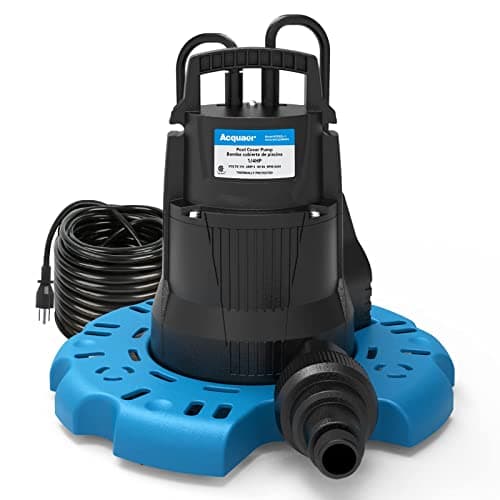
Getting standing water off a winter cover
Submersible Pool Cover Pump
Various
A small submersible pump that sits on the cover and clears the puddle. It exists because water weight is what destroys winter covers, and sweeping in January is nobody's idea of a Saturday.
#ad how this is funded · price as of October 8, 2026
Key specs
- Type
- Submersible, sits on top of the cover
- Operation
- Manual or automatic float switch, by model
- Discharge
- Garden hose thread on most models
- Requirement
- Outdoor-rated, GFCI-protected outlet
How it scoresour reading of published specs, not a test result
- Sizing fit
- 8.0
- Running cost
- 9.0
- Maintenance
- 7.0
- Build
- 7.0
- Value
- 8.5
Overall 7.9 / 10
What works
- Removes the single biggest cause of winter cover failure, which is accumulated water weight
- Automatic models handle rain you were not there for
- Cheap relative to a replacement cover
- Also useful for draining the last few inches of a pool at take-down
What doesn't
- It is an electrical appliance sitting in water outdoors, so the GFCI rules are not optional
- Automatic float switches are the part that fails, usually with debris under them
- Needs storing dry and drained or it freezes and cracks like any other pump
- Cheaper units struggle with the last half inch, which is where debris collects
Skip it if: Being left connected and forgotten all winter. It wants checking after storms, which is when you should be looking at the cover anyway.
What it costs to run: One purchase against the cost of a torn winter cover and the spring opening that follows it. On that comparison it is not a close call.
Several seasons: Buy-once. Built and warranted to come back out of the box for a few years, if you store it properly.
Specs from: Submersible pool cover pumps — current Amazon category listing
Questions people actually ask
Can I drain my above-ground pool completely?
How do I lower cyanuric acid without draining?
Where can I discharge pool water?
Should I drain the pool for winter?
How long can a vinyl pool sit empty?
Sources
- Latham Pool Products — vinyl liner pool wrinkles, on draining
- Intex — metal frame pool owner's manual (cold-weather drain and storage)
- Bestway — how to winterize a year-round above-ground pool (water level)
- Orenda Technologies — how to reduce cyanuric acid in a swimming pool
- Ohio EPA — discharging swimming pool water into storm sewers
- South Washington Watershed District — safely dispose of chlorinated water
Read next
- Pool care, from someone who assumes you have never done thisThe weekly routine, the four numbers that matter, and the fix for the week the water turns.
- Cyanuric acid: the reading that explains your chlorineWhy an outdoor pool needs stabilizer, why tablets add it whether you want them to or not, and the only way to bring it back down.
- Calcium hardness: the reading a vinyl pool can mostly ignoreWhy the fourth reading matters less on a vinyl above-ground pool, the two cases where it genuinely does, and how to test it.
- How to winterize an above-ground poolThe correct closing sequence, the freeze damage that ends pools, and why a cracked pump housing is entirely preventable.
- Taking the pool down without ruining itThe take-down sequence for a seasonal pool: draining responsibly, drying completely, folding warm, and storing where rodents are not.
- The liner is the most expensive thing you can wreck in an afternoonBeaded, overlap and unibead liners explained, what gauge in mil buys, and the patch kit that turns a leak into a fifteen-minute job.
- What it costs to fill a pool, and to keep it fullOne fill priced for four common pool volumes at the national average water rate, plus why every gallon you add has to be re-balanced.
- Moving a pool, and the two things that decide whether it survivesThe sequence for relocating an above-ground pool across the garden or to a new house, and an honest read on when it is not worth it.