Above-Ground Pools
Building around the pool, and what it changes about the pool
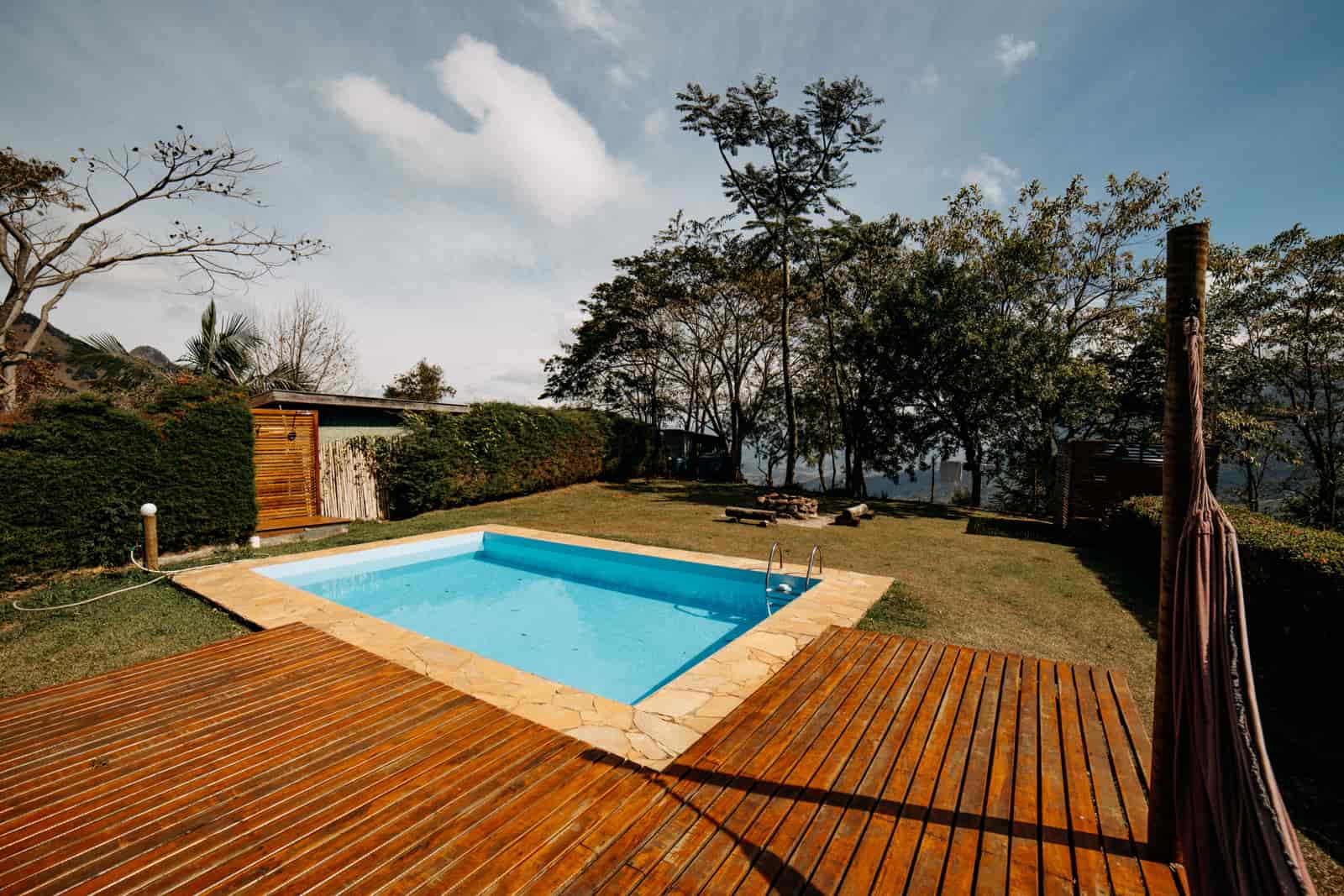
A deck turns an above-ground pool into something that looks installed. It also removes the barrier the pool wall was providing, which is the part nobody mentions.
Heads up: we earn a commission if you buy through the links on this page, at no extra cost to you. It never decides the ranking — here is how we pick and here is the full disclosure. Prices are checked automatically; last verified October 8, 2026.
The short version
- A deck removes your barrier. The pool wall keeps people out only while there is no way to climb it; a deck is a permanent, unlockable way up.
- The pool is not designed to support a deck and a deck must not support itself on the pool. They are two separate structures that meet.
- Hand a builder the load figure: these pools apply roughly 110 to 230 pounds per square foot, continuously, for months.
- Most of the benefit is available for far less. A small landing, a mat and a proper ladder solve access without a structure.
What people are actually trying to solve
Almost every deck conversation starts from one of three real problems: getting in and out feels precarious, the ground around the pool is permanently wet and muddy, or the pool looks like an appliance parked on the lawn. Those are three different problems and only one of them needs a deck.
It is worth separating them before spending anything, because a full surround is the most expensive thing in this hub by a wide margin, and it is the only one that permanently changes the safety picture.
| The problem | Cheapest real fix | When you need more |
|---|---|---|
| Getting in and out feels unsteady | A correctly matched ladder with a wide tread | If mobility is a genuine issue, a platform with a handrail |
| Mud and wet grass around the pool | Pavers or a mat on the traffic side only | If the whole perimeter is used, a partial surround |
| It looks like an appliance | Planting and a screen on the visible side | If you want it to read as installed, a full deck |
| Nowhere to put anything down | A small landing at the top of the ladder | Rarely more than this |
The safety consequence, which is the important part
On an above-ground pool the wall is doing the work of a barrier. Four feet of smooth vertical wall with a removable ladder is genuinely difficult for a small child to get over, and removing or locking the ladder is the control most owners actually have.
A deck deletes that. It provides a permanent staircase to the water that cannot be taken away at bedtime, which turns the pool into something much closer to an inground pool from a barrier point of view — and inground pools are the ones with the fencing requirements. If you build a deck, the barrier has to be rebuilt somewhere else: a gate at the bottom of the deck stairs, a lockable gate at the deck edge, or a fence around the whole thing.
That is not us being cautious — it is exactly the question your local building department will ask, and their answer governs. Our permits and rules guide lists the questions to put to them, and this is the single most important one on the list.
The number to hand a builder
If a deck is going to run alongside or partly under the pool footprint, whoever designs it needs to know what is standing there. A US gallon of water weighs 8.34 pounds, so published capacity converts directly into load.
Load applied by the pool, per square foot
- Bestway Steel Pro MAX 15ft [Bestway]
- 3,955 gallons
- Weight of one US gallon
- 8.34 lb
- Footprint
- 176.7 sq ft
3,955 × 8.34 = 32,985 lb ÷ 176.7 = 187 lb/sq ft
About 187 pounds per square foot, sustained for months
What a deck changes about maintenance
Three things, and all of them are worth planning for rather than discovering.
You lose access to the wall. Whatever the deck covers, you can no longer inspect, and the frame joints under a deck are the ones that corrode unseen. Leave a gap you can look down, or accept that you will not see a problem until it is a leak.
Debris changes. A timber deck sheds far more into a pool than grass does, particularly in autumn, and a deck under trees compounds it. Skimming goes from a two-minute daily job to a slightly bigger one — our autumn leaves guide covers the seasonal version.
Equipment access gets awkward. The pump, the hoses and the drain plug all need to be reachable, and boxing them in behind decking is a decision you regret the first time you need to prime the pump. Leave a hatch. Our pump troubleshooting guide lists what you need to be able to reach in a hurry.
The cheaper options, which are usually enough
A landing at the top of the ladder. A small platform with a handrail and somewhere to put a towel solves most of the felt problem at a fraction of the cost, and it keeps the ladder removable.
Pavers or a mat on the traffic side. Wet grass turns to mud where people walk, and that mud ends up in the pool on feet. Hard standing on the two sides that get used solves it without surrounding anything.
A reel for the cover. Unglamorous, but a great deal of the awkwardness people attribute to the pool is actually the daily fight with a wet solar cover. Our solar cover roundup covers it.
Planting and a screen. If the objection is aesthetic, this is the answer, and it does not change the barrier situation at all.
If you are building anyway
Get the electrical route planned before the timber goes down, because retro-fitting an outdoor outlet under a finished deck is miserable and running an extension cord across it is the improvisation our electrical safety guide is about. Plan drainage away from the pool footprint. And be honest about what is worth doing yourself versus paying for — our DIY versus paying someone guide is the frank version, and this job sits firmly on the paying side for most people.
What to buy
Scores are our own reading of published specifications. They are not test results — we have not tested these products and we do not claim to.
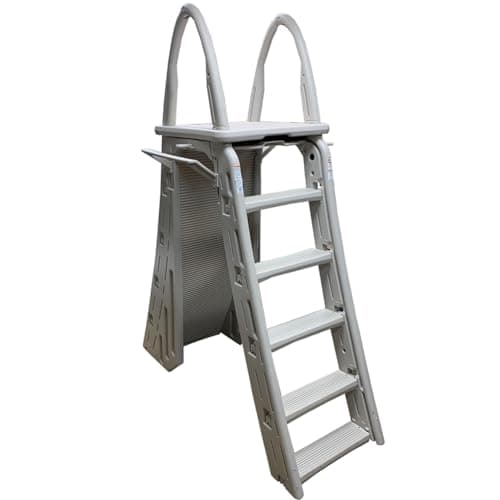
Getting in and out safely
A-Frame Above-Ground Pool Ladder
Various
Read the published weight limit before anything else. It is frequently lower than buyers assume, and it is the one spec on a ladder that genuinely matters.
#ad how this is funded · price as of October 8, 2026
Key specs
- Critical spec
- Published weight capacity — check it against every adult who will use it
- Height match
- Must match your wall height, not approximate it
- Safety feature
- Removable or lockable outer steps on better models
How it scoresour reading of published specs, not a test result
- Sizing fit
- 8.5
- Running cost
- 10.0
- Maintenance
- 8.5
- Build
- 7.5
- Value
- 8.5
Overall 8.4 / 10
What works
- Removable outer steps genuinely prevent unsupervised access, which is a real safety layer
- Resin frames do not corrode the way early steel ladders did
- Correctly matched height is far more stable than a too-tall ladder
What doesn't
- Weight limits are often lower than people expect and are easy to overlook in a listing
- A ladder sized for a 42-inch wall is wrong on a 52-inch wall and vice versa
- Cheap models flex enough to feel alarming
Skip it if: Being a barrier on its own. The CPSC's guidance treats barriers, supervision and alarms as layers; a removable step is one layer, not the answer.
What it costs to run: Buy it with the pool. Kits that include a ladder are frequently cheaper than the pool-plus-ladder bought separately, and this is one of the accessories that makes a cheap-looking kit expensive.
Several seasons: Buy-once. Built and warranted to come back out of the box for a few years, if you store it properly.
Specs from: CPSC — Pool Safely
Protecting the liner from below
Pool Ground Cloth / Under-Pool Pad
Various
Most liner punctures come from underneath, from a stone or a root you did not see. A ground cloth is the cheapest way to avoid the most expensive repair in above-ground pool ownership.
Key specs
- Function
- Barrier between ground and liner
- Sizing
- Should extend past the pool footprint
- Included with
- Some kits — check before buying separately
How it scoresour reading of published specs, not a test result
- Retention
- 8.0
- Durability
- 7.5
- Handling
- 8.5
- Running cost
- 10.0
- Value
- 9.0
Overall 8.5 / 10
What works
- Prevents the failure mode that ends pools: a puncture in the floor you cannot reach to patch
- Also slows grass and weeds growing up under the pool
- Included free in better kits, so check before you buy one
What doesn't
- Not a substitute for actually clearing stones and roots first
- Thin ones tear during installation before the pool is even up
- Traps moisture, which kills the grass underneath regardless
Skip it if: Fixing uneven ground. It protects against punctures; it does nothing about level, and level is the bigger problem.
What it costs to run: Compare its cost to a liner replacement, which is the single largest unplanned expense in above-ground pool ownership. It is not a close call.
Several seasons: Buy-once. Built and warranted to come back out of the box for a few years, if you store it properly.
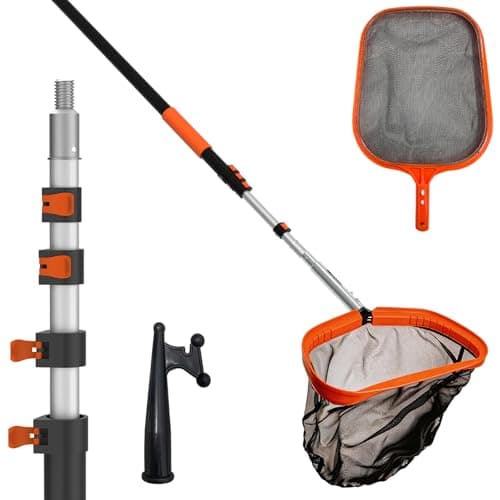
The five-dollar tool you use most
Skimmer Net with Telescopic Pole
Various
Catching leaves while they float is a two-minute job. Catching them after they sink is a vacuum session and a filter clean. Buy this first.
Key specs
- Type
- Flat skimmer or deep leaf rake
- Pole
- Telescopic, sized to reach the middle of your pool
- Frame
- Plastic or aluminum
How it scoresour reading of published specs, not a test result
- Retention
- 8.5
- Durability
- 7.0
- Handling
- 9.0
- Running cost
- 10.0
- Value
- 9.5
Overall 8.8 / 10
What works
- The single most-used tool in pool ownership and among the cheapest
- Removing debris before it sinks prevents most of the work that follows
- A deep leaf rake handles far more per pass than a flat skimmer
What doesn't
- Cheap plastic frames snap where the pole attaches, which is the standard failure
- Telescopic poles seize with hard water unless rinsed
- A too-short pole means you cannot reach the middle, which makes it useless
Skip it if: Anything on the floor. This is a surface tool and pretending otherwise is how debris ends up in the filter.
What it costs to run: Free to use and it directly reduces your chemical bill: organic debris consumes chlorine as it breaks down, so removing leaves is the cheapest sanitizer saving there is.
Several seasons: Buy-once. Built and warranted to come back out of the box for a few years, if you store it properly.
Making sure the cover actually gets used
Solar Cover Reel for Above-Ground Pools
Various
A cover that takes two people and ten minutes to move gets left off. A reel makes it a one-person, one-minute job, which is the difference between owning a cover and using one.
Key specs
- Function
- Rolls the solar cover on and off
- Fit
- Must match pool diameter and wall type
- Mounting
- Freestanding or wall-mounted depending on model
How it scoresour reading of published specs, not a test result
- Retention
- 7.0
- Durability
- 7.5
- Handling
- 9.5
- Running cost
- 8.5
- Value
- 7.0
Overall 7.7 / 10
What works
- Turns cover use from a chore into a habit, which is where all the savings actually are
- Keeps the cover off the ground, which is what shortens its life
- One-person operation
What doesn't
- Frequently costs more than the cover it handles
- Takes up permanent space beside the pool
- Sizing must match the pool exactly, and returns are awkward
Skip it if: A small pool. Under about 12 feet the cover is light enough to handle by hand and the reel is a solution to a problem you do not have.
What it costs to run: Only justified on larger pools. The value is not the reel, it is the cover getting used every night instead of most nights — quantify it by how often you would actually bother otherwise.
Several seasons: Buy-once. Built and warranted to come back out of the box for a few years, if you store it properly.
Questions people actually ask
Can you build a deck around an above-ground pool?
Does a deck around a pool need a fence?
How much weight does an above-ground pool put on a deck?
What is a cheaper alternative to decking around a pool?
Sources
Read next
- Above-ground pools for ordinary backyardsSoft-side, metal-frame and steel-wall pools compared by what they cost across a whole season, not at the till.
- What an above-ground pool can and cannot sit onEvery common surface assessed, with the load per square foot each pool size actually applies - the number that rules a deck in or out.
- Permits, fences and the calls to make before you buyThe questions that decide whether you need a permit or a barrier, who to ask, and the safety layers that apply regardless of what the rules say.
- How long an above-ground pool actually lastsRealistic lifespans by pool type, the four failure modes that account for nearly all of them, and the cheap items that add seasons.
- Above-ground pool ladders, and the spec everyone skipsWeight capacity, height matching, and removable outer steps - the three things that decide whether a ladder is right.
- The electrical side, which is the one part of a pool you should not improviseGFCI protection, extension cords, timers and heater circuits - what is a homeowner job around a pool and what is not.
- What is worth doing yourself, and the two things that are notEvery above-ground pool task sorted into do-it-yourself, worth paying for, and not a DIY decision - with the reasoning for each.
- Pool steps, and the weight rating that is not what it looks likeAbove-ground entry steps compared on weight rating conventions, wall-height range, sand or gravel ballast, deck mounting and the lock-out that CPSC guidance actually asks for.
- A pool for older swimmers starts at the steps, not the waterChoosing an above-ground pool for older swimmers: wall height, entry systems with handrails and gates, the published weight ratings, and what to fit before the pool is filled.