Pool Equipment · Best Ladder
Above-ground pool ladders, and the spec everyone skips
It is a safety item more than an accessory. Read the published weight limit before anything else - it is often lower than you would guess.
Heads up: we earn a commission if you buy through the links on this page, at no extra cost to you. It never decides the ranking — here is how we pick and here is the full disclosure. Prices are checked automatically; last verified October 19, 2026.
Quick picks
Segmented before it is ranked — the right answer depends on which of these you actually are. Tap any row for the full write-up.
The ladder is a safety layer
Removable or lockable outer steps are the only genuine barrier an above-ground pool has. That feature is worth paying for.
| # | Product | Best for | Score | Price |
|---|---|---|---|---|
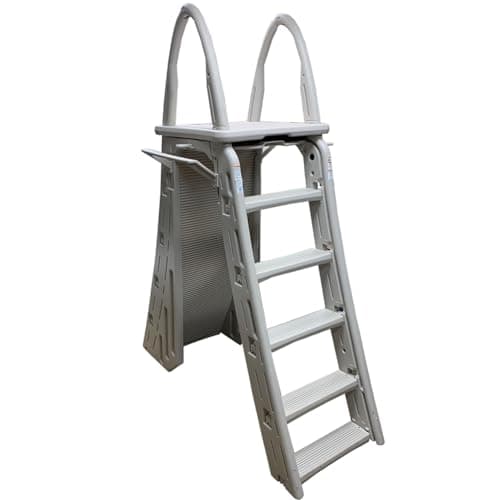
| 1 | A-Frame Above-Ground Pool Ladder Read the published weight limit before anything else. It is frequently lower than buyers assume, and it is the one spec on a ladder that genuinely matters. | Getting in and out safelySeveral seasons | 8.4out of 10 |
The short version
- Published weight capacity is the spec that matters, and it is frequently lower than buyers assume.
- Match the height to your wall exactly. A ladder for a 48-inch wall is wrong on a 52-inch pool.
- Removable or lockable outer steps are the only real barrier an above-ground pool has.
- A ladder is one layer of pool safety, not the answer to it.
Read the weight limit before anything else
This is the spec people skip and it is the one that matters. Above-ground pool ladders publish a maximum weight capacity, and on budget models it is often lower than an average adult expects. A ladder used above its rating flexes, and a flexing ladder at the top of a four-foot wall is a genuine hazard rather than an inconvenience.
Check it against every adult who will use the pool, not the average one. If a listing does not publish a capacity at all, that is a reason to look at a different product.
Height matching is not approximate
Ladders are sold for specific wall-height ranges and the fit is not flexible. A ladder sized for a 48-inch wall on a 52-inch pool leaves the top step short and the angle wrong; one sized too tall is unstable and sits proud of the rail.
| Pool wall | Example | Ladder height needed |
|---|---|---|
| 30 in | Intex Prism Frame 12ft | Short A-frame or steps |
| 42 in | Bestway Steel Pro MAX 15ft | 42in-rated A-frame |
| 52 in | Intex Ultra XTR 18ft | 52in-rated A-frame |
The safety feature worth paying for
Removable or lockable outer steps. On a frame pool, taking the outside half of the ladder away when the pool is not in use genuinely prevents access — and it is the only real barrier an above-ground pool has, since the wall itself is the rest of it.
The CPSC’s Pool Safely guidance frames pool safety as layers: a barrier preventing unsupervised access, constant supervision during use, and approved flotation where needed. A removable ladder is one of those layers, properly. It is not all of them, and it should not be treated as if it were.
Construction
Resin frames have largely replaced the early steel ladders and it is a genuine improvement — no corrosion at the waterline, which is where steel ladders always failed. Check the treads: wide, textured steps are meaningfully safer wet than narrow round rungs, and the difference is obvious the first time somebody comes down them quickly.
Also check what sits under the ladder feet inside the pool. Ladder feet concentrate weight onto a small area of liner, and a liner puncture under a ladder is a classic and expensive failure. A pad under the feet costs almost nothing.
The picks, in full
Scores are our own reading of published specifications. They are not test results — we have not tested these products and we do not claim to.
Pick #1 · Getting in and out safely
A-Frame Above-Ground Pool Ladder
Various
Read the published weight limit before anything else. It is frequently lower than buyers assume, and it is the one spec on a ladder that genuinely matters.
#ad how this is funded · price as of October 19, 2026
Key specs
- Critical spec
- Published weight capacity — check it against every adult who will use it
- Height match
- Must match your wall height, not approximate it
- Safety feature
- Removable or lockable outer steps on better models
How it scoresour reading of published specs, not a test result
- Sizing fit
- 8.5
- Running cost
- 10.0
- Maintenance
- 8.5
- Build
- 7.5
- Value
- 8.5
Overall 8.4 / 10
What works
- Removable outer steps genuinely prevent unsupervised access, which is a real safety layer
- Resin frames do not corrode the way early steel ladders did
- Correctly matched height is far more stable than a too-tall ladder
What doesn't
- Weight limits are often lower than people expect and are easy to overlook in a listing
- A ladder sized for a 42-inch wall is wrong on a 52-inch wall and vice versa
- Cheap models flex enough to feel alarming
Skip it if: Being a barrier on its own. The CPSC's guidance treats barriers, supervision and alarms as layers; a removable step is one layer, not the answer.
What it costs to run: Buy it with the pool. Kits that include a ladder are frequently cheaper than the pool-plus-ladder bought separately, and this is one of the accessories that makes a cheap-looking kit expensive.
Several seasons: Buy-once. Built and warranted to come back out of the box for a few years, if you store it properly.
Specs from: CPSC — Pool Safely
Pick #2 · Protecting the liner from below
Pool Ground Cloth / Under-Pool Pad
Various
Most liner punctures come from underneath, from a stone or a root you did not see. A ground cloth is the cheapest way to avoid the most expensive repair in above-ground pool ownership.
Key specs
- Function
- Barrier between ground and liner
- Sizing
- Should extend past the pool footprint
- Included with
- Some kits — check before buying separately
How it scoresour reading of published specs, not a test result
- Running cost
- 10.0
- Value
- 9.0
Overall 8.5 / 10
What works
- Prevents the failure mode that ends pools: a puncture in the floor you cannot reach to patch
- Also slows grass and weeds growing up under the pool
- Included free in better kits, so check before you buy one
What doesn't
- Not a substitute for actually clearing stones and roots first
- Thin ones tear during installation before the pool is even up
- Traps moisture, which kills the grass underneath regardless
Skip it if: Fixing uneven ground. It protects against punctures; it does nothing about level, and level is the bigger problem.
What it costs to run: Compare its cost to a liner replacement, which is the single largest unplanned expense in above-ground pool ownership. It is not a close call.
Several seasons: Buy-once. Built and warranted to come back out of the box for a few years, if you store it properly.
Pick #3 · The five-dollar tool you use most
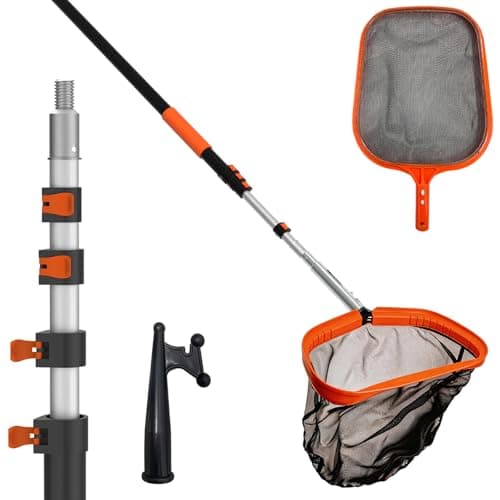
Skimmer Net with Telescopic Pole
Various
Catching leaves while they float is a two-minute job. Catching them after they sink is a vacuum session and a filter clean. Buy this first.
Key specs
- Type
- Flat skimmer or deep leaf rake
- Pole
- Telescopic, sized to reach the middle of your pool
- Frame
- Plastic or aluminum
How it scoresour reading of published specs, not a test result
- Running cost
- 10.0
- Value
- 9.5
Overall 8.8 / 10
What works
- The single most-used tool in pool ownership and among the cheapest
- Removing debris before it sinks prevents most of the work that follows
- A deep leaf rake handles far more per pass than a flat skimmer
What doesn't
- Cheap plastic frames snap where the pole attaches, which is the standard failure
- Telescopic poles seize with hard water unless rinsed
- A too-short pole means you cannot reach the middle, which makes it useless
Skip it if: Anything on the floor. This is a surface tool and pretending otherwise is how debris ends up in the filter.
What it costs to run: Free to use and it directly reduces your chemical bill: organic debris consumes chlorine as it breaks down, so removing leaves is the cheapest sanitizer saving there is.
Several seasons: Buy-once. Built and warranted to come back out of the box for a few years, if you store it properly.
Questions people actually ask
What weight can an above-ground pool ladder hold?
Do above-ground pool ladders come in different heights?
Should I remove the pool ladder when not in use?
Sources
Read next
- Equipment, sized to your pool and costed by the wattPumps, filters, vacuums, heaters and ladders - matched to your gallons and priced by what they draw.
- The best backyard pools for kidsPools chosen for young children - depth, shade and securability rank above capacity and construction here.
- How to set up an above-ground pool properlyLeveling, ground protection, filling and priming - the afternoon that decides how the rest of the season goes.
- What size pool your backyard can actually takeThe three-foot rule, the level-ground tolerance, and a table matching yard size to pool size with the running cost attached.
- What an above-ground pool costs to buyThe purchase side: what is in the kit, what is not, and the day-one spend that turns a cheap pool into a not-cheap one.
- Pool steps, and the weight rating that is not what it looks likeAbove-ground entry steps compared on weight rating conventions, wall-height range, sand or gravel ballast, deck mounting and the lock-out that CPSC guidance actually asks for.
- In-wall steps are a pool decision, not a step decisionWhat in-wall pool steps actually involve - concrete cap blocks, a poured trench, liner face plates - why retrofitting voids warranties, and the drop-in alternatives.
- Steps or a ladder: comfort against the thing you can lockDrop-in entry steps against A-frame ladders on weight rating, ballast, install requirements and the CPSC principle that pool entry should be securable.