Above-Ground Pools
Permits, fences and the calls to make before you buy
Nobody can tell you your local rules from the internet, including us. What we can do is tell you exactly which questions decide the answer, and who to ask.
Heads up: we earn a commission if you buy through the links on this page, at no extra cost to you. It never decides the ranking — here is how we pick and here is the full disclosure. Prices are checked automatically; last verified October 8, 2026.
The short version
- Rules are local and we cannot look yours up. Permit thresholds, barrier heights and setbacks vary by state, county and city, and anyone quoting you a single national rule is guessing.
- Depth and capacity are the usual triggers. Most jurisdictions key their requirements to water depth, and above-ground pools sit right around the common thresholds.
- Three calls, before you buy: the building department, the HOA if you have one, and your home insurer. All three are cheaper before delivery than after.
- Safety layers apply whatever the rules say. The CPSC frames pool safety as layers — barrier, supervision, then flotation — and none of them is contingent on a permit.
Why this page does not give you a rule
Search this question and you will find confident, specific numbers — a depth above which a permit is required, a fence height, a gate latch height. Those numbers are real somewhere. They are not necessarily real where you live, because residential pool requirements are set at state, county and often city level, and they are not consistent between neighboring towns.
So we are not going to print one. What we can give you is the set of questions that determines the answer everywhere, so that one phone call gets you a complete answer instead of three calls getting you a partial one.
The three calls, and what to ask
Your local building or planning department
Ask these, in this order: does an above-ground pool of this depth and this capacity require a permit here; what barrier is required and does the pool wall itself count toward it; what setback is required from property lines, the house and overhead power; and does the pump require a permitted electrical connection. Have your intended pool’s published gallons and wall height in front of you — those two numbers are what they will ask for.Your HOA or landlord, if you have one
Separate from and stricter than the law in many cases. Ask whether above-ground pools are permitted at all, whether there is a size or visibility limit, whether the structure must be removed seasonally, and whether approval has to be in writing before installation. An HOA can require removal of something the city was happy with.Your home insurer
Ask whether a pool changes your liability coverage, whether they require a barrier of a particular type, and whether the premium changes. This is the call people skip, and it is the one with a financial consequence attached. Get the answer in writing rather than over the phone.
The barrier question, which is the real one
The single most common requirement attached to residential pools is a barrier that prevents unsupervised access, and above-ground pools sit in an interesting position: the wall itself is already a barrier four feet high, and the ladder is the hole in it.
That is why the ladder matters more here than its price suggests. Removable or lockable outer steps turn the pool wall into a genuine barrier when nobody is using it, and it is the practical control most above-ground owners actually have. Whether your jurisdiction accepts it as the barrier or requires a fence as well is exactly what the first phone call is for. Our ladder guide leads with published weight capacity and with that removable-step feature, because both get skipped.
| Layer | On an above-ground pool | What it does not do |
|---|---|---|
| Barrier | The wall, plus a removable or lockable ladder | Nothing, if the ladder is left down |
| Supervision | One adult, no other task, swapped on a timer | Work when several adults each assume another is watching |
| Flotation | A correctly fitted approved vest, matched by weight | Replace either of the two layers above |
| Covers | A winter cover keeps debris and light out | Support any weight — it is not a safety cover |
Utilities, setbacks and the things underground
Two practical items that come up in the first phone call and surprise people. Overhead power lines are a genuine constraint on where a pool can go, and the clearance requirement is not something to eyeball. And buried services matter because leveling means digging: before you take a spade to a new part of the yard, get utilities located. In the United States that call is free.
Neither of these is a formality. Both are decided before the pool arrives, and both can move it to a different part of the garden — which changes the sun exposure, the run to the outdoor socket, and possibly the size. Our surface guide and leveling guide cover the rest of the siting decision.
The rules that apply regardless
Whatever your jurisdiction requires, a few things are true everywhere and cost nothing. Nobody dives into an above-ground pool, ever — nothing in this category is deep enough, and it is worth saying out loud to visiting children. The ladder comes out or gets locked when the pool is not in use. Someone is watching, and that person has no other job. And a weak swimmer wears a properly fitted approved device rather than a toy that looks like one, which our swim vest guide explains how to tell apart.
Once you know what your code requires, two pages cover the hardware and the money. Our pool safety fence roundup covers the certification and the gate specification worth paying for, and our pool fence cost guide explains why the price is set by your perimeter rather than your pool.
What to buy
Scores are our own reading of published specifications. They are not test results — we have not tested these products and we do not claim to.
Getting in and out safely
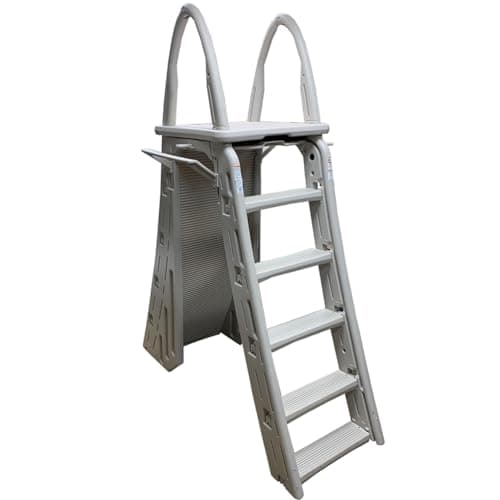
A-Frame Above-Ground Pool Ladder
Various
Read the published weight limit before anything else. It is frequently lower than buyers assume, and it is the one spec on a ladder that genuinely matters.
#ad how this is funded · price as of October 8, 2026
Key specs
- Critical spec
- Published weight capacity — check it against every adult who will use it
- Height match
- Must match your wall height, not approximate it
- Safety feature
- Removable or lockable outer steps on better models
How it scoresour reading of published specs, not a test result
- Sizing fit
- 8.5
- Running cost
- 10.0
- Maintenance
- 8.5
- Build
- 7.5
- Value
- 8.5
Overall 8.4 / 10
What works
- Removable outer steps genuinely prevent unsupervised access, which is a real safety layer
- Resin frames do not corrode the way early steel ladders did
- Correctly matched height is far more stable than a too-tall ladder
What doesn't
- Weight limits are often lower than people expect and are easy to overlook in a listing
- A ladder sized for a 42-inch wall is wrong on a 52-inch wall and vice versa
- Cheap models flex enough to feel alarming
Skip it if: Being a barrier on its own. The CPSC's guidance treats barriers, supervision and alarms as layers; a removable step is one layer, not the answer.
What it costs to run: Buy it with the pool. Kits that include a ladder are frequently cheaper than the pool-plus-ladder bought separately, and this is one of the accessories that makes a cheap-looking kit expensive.
Several seasons: Buy-once. Built and warranted to come back out of the box for a few years, if you store it properly.
Specs from: CPSC — Pool Safely
Small children, with adult supervision
Toddler Swim Vest / Puddle Jumper Style Flotation
Various
If you want flotation for a small child, buy something that is genuinely rated for it rather than an inflatable seat. Look for US Coast Guard approval printed on the product, not a picture of a child on the box.
Key specs
- What to check
- US Coast Guard approval statement, printed on the product
- Weight range
- Printed on the label — match it to the child
- Not a substitute for
- Supervision or a barrier
How it scoresour reading of published specs, not a test result
- Material
- 8.0
- Valve
- 8.0
- Capacity
- 8.5
- Storage
- 8.5
- Value
- 8.5
Overall 8.3 / 10
What works
- A Coast Guard-approved device is a fundamentally different product from a pool toy
- Weight-rated, so there is an objective way to check it fits your child
- Frees a child's arms, which an inflatable ring does not
What doesn't
- Not all products marketed for toddlers carry Coast Guard approval — you have to read the label
- Children outgrow the weight range quickly
- Can create false confidence in both child and adult
Skip it if: Replacing supervision. The CPSC's pool safety guidance is built on layers — barriers, supervision and appropriate flotation — and no single item substitutes for the others.
One honest season: The cheapest setup that genuinely works for a season of real swimming. Nothing spare, nothing missing.
Specs from: CPSC — Pool Safely
Five months of weather, not one night
Winter Cover for Above-Ground Pools
Various
A structural product, not a summer one. Its job is carrying snow and blocking light for a whole winter, and a solar cover pressed into that role will be in shreds by February.
Key specs
- Construction
- Woven polyethylene, weight published in mil or scrim count
- Securing
- Cable and winch, or wraparound straps
- Overlap
- Needs genuine overlap past the wall — check the stated size against your pool
- Not the same as
- A solar cover or a safety cover
How it scoresour reading of published specs, not a test result
- Retention
- 8.5
- Durability
- 8.0
- Handling
- 6.5
- Running cost
- 9.0
- Value
- 8.5
Overall 8.3 / 10
What works
- Blocks light for the whole winter, which is what stops algae in a closed pool
- Cable-and-winch securing survives wind that lifts a strapped cover
- Buying the heavier scrim genuinely doubles the number of winters you get
What doesn't
- Needs a way to shed or pump off standing water, or the weight tears it
- Bulky to store in summer
- Not a safety cover — it will not support a person and must not be treated as if it will
Skip it if: A pool you take down each autumn. If the pool comes apart, the cover is money spent on nothing.
What it costs to run: This is insurance rather than a saving. A torn cover in January means an opening in April that costs a full shock treatment and a week of filtration to fix, which is more than the better cover cost.
Several seasons: Buy-once. Built and warranted to come back out of the box for a few years, if you store it properly.
Questions people actually ask
Do you need a permit for an above-ground pool?
Does an above-ground pool need a fence?
Will an above-ground pool affect my home insurance?
Can my HOA stop me putting up an above-ground pool?
Sources
Read next
- Above-ground pools for ordinary backyardsSoft-side, metal-frame and steel-wall pools compared by what they cost across a whole season, not at the till.
- How to set up an above-ground pool properlyLeveling, ground protection, filling and priming - the afternoon that decides how the rest of the season goes.
- What an above-ground pool can and cannot sit onEvery common surface assessed, with the load per square foot each pool size actually applies - the number that rules a deck in or out.
- Above-ground pool ladders, and the spec everyone skipsWeight capacity, height matching, and removable outer steps - the three things that decide whether a ladder is right.
- Swim vests and floaties: the label that separates them from toysHow to tell an approved flotation device from a pool toy, what the weight range on the label means, and why neither replaces supervision.
- Are backyard pools worth it?The four questions that decide whether a pool is a good buy for your household - argued honestly in both directions.