Pool Equipment
Pool steps, and the weight rating that is not what it looks like
Four hundred pounds or three hundred pounds, one person at a time: two manufacturers publish their limits in different units of meaning. That difference, and a recall, are what this category turns on.
Heads up: we earn a commission if you buy through the links on this page, at no extra cost to you. It never decides the ranking — here is how we pick and here is the full disclosure. Prices are checked automatically; last verified October 8, 2026.
Quick picks
Segmented before it is ranked — the right answer depends on which of these you actually are. Tap any row for the full write-up.
Highest published weight limit
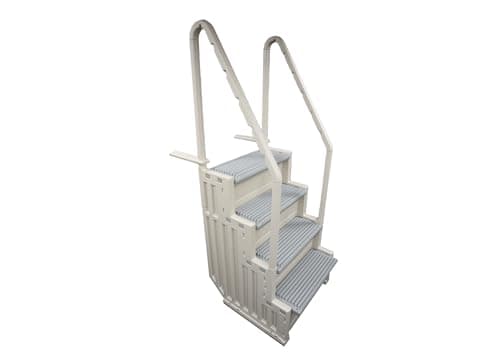
Four hundred pounds, two handrails and a five-year warranty, held down by 40 lb of sand. Confer publishes the limit without a one-person qualifier.
| # | Product | Best for | Score | Price |
|---|---|---|---|---|
| 1 | Confer Plastics Step-1X Above-Ground Entry System Four hundred pounds, two handrails, a five-year warranty and forty pounds of sand to hold it down. The published weight limit is the highest here, and Confer states it without a one-person qualifier. | The highest published weight ratingSeveral seasons | 8.3out of 10 |
The one with a lockable gate
A self-closing, self-latching, lockable gate at the top, and the widest wall-height adjustment here. The closest thing in this category to a barrier.
| # | Product | Best for | Score | Price |
|---|---|---|---|---|
| 1 | 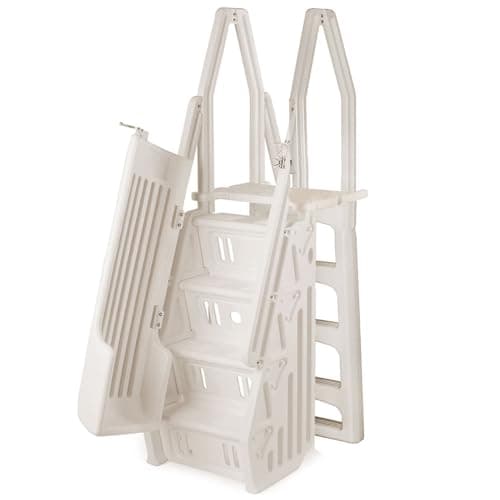 Vinyl Works Model CE Entry System with Gate The only entry system here with a self-closing, self-latching, lockable gate — the feature that turns pool access from a habit into a mechanism. Adjustable from 47.5 to 56.25 inches of wall. | A lockable gate at the topSeveral seasons | 8.5out of 10 |
Takes the least pool
Thirty-two inches wide and only twenty-two into the water, bolted to the deck through two sets of flanges.
| # | Product | Best for | Score | Price |
|---|---|---|---|---|
| 1 | 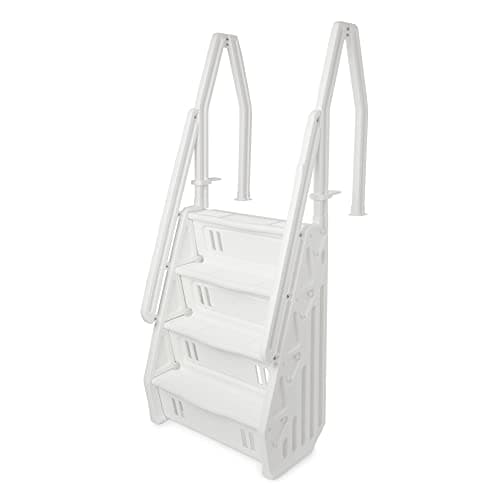 Vinyl Works Deluxe In-Pool Step Ladder, 32 in Thirty-two inches wide and only twenty-two into the water, deck-mounted through two sets of flanges. It is ballasted with gravel rather than sand, and Vinyl Works recommends a step pad underneath. | Taking up the least poolSeveral seasons | 8.4out of 10 |
No deck, no ballast, lowest cost
The A-frame answer: anchored to the top rail, anti-entrapment barrier in the box, and an exterior section that slides up and padlocks.
| # | Product | Best for | Score | Price |
|---|---|---|---|---|
| 1 | 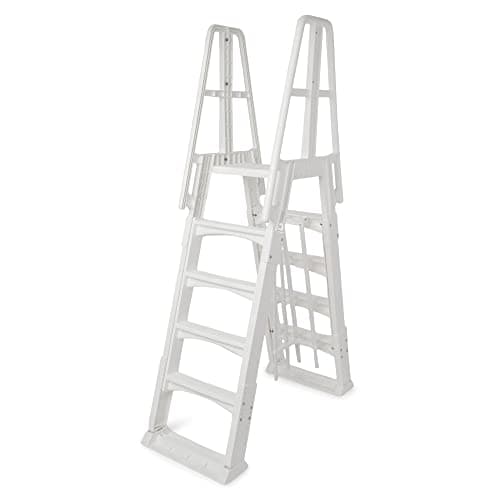 Vinyl Works SLA A-Frame Adjustable Pool Ladder The A-frame comparison point: no ballast, no deck, anchored to the top rail, with an anti-entrapment barrier in the box and an exterior section that slides up and padlocks. | The pool with no deck, and the lock-out that mattersOne honest season | 8.6out of 10 |
The short version
- Three hundred pounds does not mean the same as four hundred. Vinyl Works publishes 300 lb one person at a time; Confer publishes a bare 400 lb.
- Drop-in steps float unless you ballast them. Forty pounds of sand for the Confer, ten to fifteen pounds of gravel per stringer for the Vinyl Works.
- CPSC guidance is about securing the entry, not the steps themselves. The ladder or steps should be securable, lockable or removable.
- A widely sold step range was recalled in 2018. Confer’s Curve systems were recalled for limb entrapment and redesigned; date codes matter.
Steps, entry systems and ladders are three different products
A drop-in step sits on the pool floor inside the wall and is held down by sand or gravel poured into its hollow sides. An entry system spans the wall with an outside staircase and an inside one, often with a gate on the platform. A ladder hangs on the top rail with treads either side and no ballast at all.
They fail in different ways and they suit different pools, which is why this page covers all three. Our ladder roundup goes deeper on the A-frame class, and our in-wall steps guide covers the fourth option, which is built into the pool wall and cannot be retrofitted.
The recall every buyer of this category should know about
We have not included the Curve models in the picks above for that reason. The recall is not a judgment on Confer, whose Step-1X we rate highly, and the side openings that caused it are — in Confer’s own words — used by virtually every manufacturer of plastic in-pool step systems. It is a reason to look at any drop-in step with a child’s arm in mind.
Weight ratings: read the qualifier, not the number
Confer publishes 400 lb for the Step-1X. Vinyl Works publishes 300 lb for every product in its range, and adds four words that change the meaning entirely: one person at a time.
So a 400 lb rating without a qualifier and a 300 lb rating with one are not directly comparable, and neither tells you what happens when two children stand on the same tread. This is a difference in publishing convention rather than proof of a difference in engineering, and it is worth knowing before you conclude that one product is a third stronger than another.
| Product | Published rating | Fits | Held down by | Warranty |
|---|---|---|---|---|
| Confer Step-1X | 400 lb | Decks up to 60 in (retailers conflict) | 40 lb of sand | 5 years |
| Vinyl Works Model CE | 300 lb, one person | 47.5-56.25 in wall | Spans the wall; gate at top | 5 years, registration required |
| Vinyl Works IN-32 | 300 lb, one person | 46-60 in deck height | 10-15 lb gravel per stringer, plus deck flanges | 5 years, resin |
| Vinyl Works SLA | 300 lb, one person | 48-56 in wall | Anchored to the top rail | 5 years, resin |
Ballast: the part nobody expects
Plastic steps are hollow, and hollow plastic floats. Every drop-in step in this category has to be weighted down after it is assembled and before anyone uses it.
Confer’s Step-1X manual calls for 40 lb of dry sand, about 10 lb into each of four openings. Vinyl Works’ IN-32 instructions call for 10 to 15 lb of clean gravel in each of the left and right stringers, and require both sets of deck flanges, front and rear, to be secured.
Plan for this on install day. Dry play sand, a funnel and a second pair of hands turn a frustrating afternoon into twenty minutes, and a step that has not been ballasted is not merely annoying — it is a step that can lift under a swimmer.
Do you need a pad underneath?
Not required, universally recommended. Confer’s own FAQ says plainly that “it is never a bad idea to offer this extra protection device for your liner”, notes that liner material has become thinner over the years, and — unusually for a manufacturer — suggests a simple bath mat as a low-cost alternative because Confer does not sell pads itself. Vinyl Works calls a step pad “highly recommended” in its IN-32 instructions.
The logic is the same as our liner pad roundup: a hard plastic edge and 400 lb of intermittent load, pressing on vinyl, over a base that may contain a stone. A pad is a few dollars against a liner.
What CPSC guidance actually asks of your entry
The CPSC’s Safety Barrier Guidelines for Residential Pools treat the pool wall itself as the barrier on an above-ground pool, which makes the entry point the weak link. The guidance is that the steps or ladder should be capable of being secured, locked or removed to prevent access — and that when they are, any opening left behind should not allow the passage of a 4 inch diameter sphere.
In practice that rules out a fixed staircase with no gate and no lock-out, unless it sits inside a fence. The Vinyl Works SLA answers it directly with a slide-up exterior section and a padlock point; the Model CE answers it with a self-closing, self-latching gate whose latch sits 55 inches above the ground. In both cases the lock is not included, which is the single cheapest thing you will forget to buy.
A barrier is a bigger subject than an entry point, and our pool fence roundup and permits guide cover what your local code is likely to require.
Choosing between them
No deck, tight budget: the A-frame ladder. It needs no ballast, no deck and no groundwork, it has the anti-entrapment barrier in the box, and the slide-and-lock section does what the safety guidance asks.
A deck around the pool: the IN-32. Twenty-two inches of intrusion is the least here, and two sets of flanges make a deck-mounted step feel like part of the structure rather than a thing balanced in the water.
Children, or anyone who finds ladders hard: the Model CE. A real staircase on both sides and a gate that closes and latches itself is a different experience from climbing a ladder backwards, and the gate is the part that matters when nobody is watching.
Heavier swimmers or a busy pool: the Step-1X, for the published 400 lb rating and the five-year warranty, with sand and a pad budgeted from the start.
How we picked
We have not tested these steps. Scores are our reading of published specifications, with weight given to manufacturers who publish installation requirements in full — ballast quantities, flange requirements, code conformance. Confer does not publish a wall-height range for the Step-1X, and the retailers that fill that gap disagree with each other, which is reflected in its sizing score. The recalled Curve models were excluded from the picks.
Getting them out again at the end of the season
This is the question nobody asks until October. A drop-in step has been weighted with 40 lb of sand and, on some designs, deliberately flooded so the cavities fill with water. Confer addresses it directly in its own FAQ, because the answer is not obvious: the step has to be tipped and drained before it will come out, and lifting a water-filled step straight up is how people hurt their backs and tear liners.
Plan for it at installation. A step you can drain and move is a step that gets taken out for the close, and a step left in a pool over winter is exposed to ice pressure in the one place the wall is already working hardest. Our winterizing guide sequences the close, and our equipment storage guide covers where everything goes afterwards.
A-frame ladders avoid the problem entirely, which is part of their appeal on a pool that is closed and reopened every year rather than left permanently set up.
Assembly, and what the manuals actually require
None of these are unbox-and-drop products. The published tool lists give a fair picture of the job: Confer’s Step-1X manual asks for a mallet, a screwdriver, a cordless drill and a 1/8 inch bit, a knife, pliers and lubricant. Vinyl Works’ IN-32 instructions call for a 7/16 inch socket or nut driver, a tape measure, a screwdriver and a utility knife, with drill bits for the deck flanges.
Two requirements are easy to overlook and both are structural. The IN-32 must be secured using both sets of deck flanges, front and rear — the instructions say so explicitly, and a step mounted on one set moves under load. And the SLA ladder’s manual requires the anti-entrapment barrier to be assembled and fitted before the ladder goes into the pool, which is a genuinely different order of operations from how most people would do it.
Confer’s sand ballast is specified per opening rather than as a total: about 10 lb into each of four openings for the Step-1X. A funnel and dry play sand turn that into a ten-minute job; damp sand bridges and jams halfway down.
The add-on that cannot be used on its own
Codes, and what conformance claims actually mean
Both manufacturers here publish conformance statements. Vinyl Works states that its ladders conform to the current ANSI, APSP, ISPSC and ICC standards for above-ground pool ladders, and that its steps conform to the APSP and ANSI standards for above-ground pool steps; its Model CE spec sheet claims to meet or exceed current code requirements for entry systems, in-pool steps, ladders and ladder enclosures. Confer states that its Curve systems are built in compliance with ISPSC 2021.
Those statements are useful, and they are not the same as your local requirement. Pool barriers are regulated locally, and an entry product that conforms to a national standard can still leave you short of what your town asks for. Our permits and rules guide covers the calls worth making before you buy, and it is a much shorter conversation before the pool goes up than after.
It is also worth noting that this category is under active review. The CPSC has an open petition concerning a mandatory standard for child-resistant above-ground and portable pool ladders, and an ASTM working group has been meeting on portable pool ladder safety. Nothing in that changes what you should buy today, but it does suggest the entry point is the part of an above-ground pool regulators are looking at hardest.
The picks, in full
Scores are our own reading of published specifications. They are not test results — we have not tested these products and we do not claim to.
Pick #1 · The highest published weight rating
Confer Plastics Step-1X Above-Ground Entry System
Confer Plastics
Four hundred pounds, two handrails, a five-year warranty and forty pounds of sand to hold it down. The published weight limit is the highest here, and Confer states it without a one-person qualifier.
Key specs
- Weight limit
- 400 lb
- Width
- 31 in; step treads 10 x 27 in
- Height to top step
- 47 in; handrail 38 in; projection into pool 32 in
- Riser height
- 11 in
- Ballast
- 40 lb of dry sand — about 10 lb into each of four openings
- Material
- Blow-molded high-density polyethylene
- Pool floor
- For above-ground pools with flat bottoms
- Fits
- Confer publishes only 'fits decks up to 60 in'; retailers quote 48-54 in and 48-58 in, which conflict
- Warranty
- 5 years on manufacturing defects and workmanship
How it scoresour reading of published specs, not a test result
- Sizing fit
- 7.5
- Running cost
- 9.0
- Maintenance
- 8.0
- Build
- 8.5
- Value
- 8.5
Overall 8.3 / 10
What works
- A published 400 lb limit, the highest of the entry systems here
- Five-year warranty, the longest published in this roundup
- Snap-together assembly with mounting brackets to secure it to the pool or deck
- Sand ballast means it stays put rather than floating, which is the usual complaint about drop-in steps
What doesn't
- Confer does not publish a pool wall height range, and retailers disagree about what it fits
- Forty pounds of dry sand has to be bought, carried and funnelled in
- Flat-bottomed pools only
- Confer does not sell a liner pad, and suggests a bath mat as a substitute
Skip it if: Dished pool floors. The Step-1X is specified for flat-bottom pools, and a pool floor that has developed a dish under the steps is outside what Confer describes.
What it costs to run: Add the cost of 40 lb of play sand and a liner pad to the sticker. Both are small, and the pad is the one that protects the expensive part underneath.
Several seasons: Buy-once. Built and warranted to come back out of the box for a few years, if you store it properly.
Specs from: Confer Plastics — Step-1X in-pool step, published dimensions, weight limit and warranty, Confer Plastics — Step-1X installation manual (sand ballast, tools)
Pick #2 · A lockable gate at the top
Vinyl Works Model CE Entry System with Gate
Vinyl Works
The only entry system here with a self-closing, self-latching, lockable gate — the feature that turns pool access from a habit into a mechanism. Adjustable from 47.5 to 56.25 inches of wall.
#ad how this is funded · price as of October 8, 2026
Key specs
- Weight capacity
- 300 lb, one person at a time
- Wall height
- Adjusts from 47.5 in to 56.25 in
- In-pool treads
- Five treads, 4.75 x 18 in
- Exterior treads
- 7.5 x 20 in
- Top platform
- 12 in deep x 20.25 in wide; 20.25 in between handrails
- Gate
- Self-closing, self-latching and lockable; latch 55 in above ground, lock not included
- Material
- Maintenance-free resin with stainless hardware
- Codes
- Stated to meet or exceed APSP / ANSI / ICC-ISPSC entry-system requirements
- Warranty
- 5 years on resin parts; registration required within 90 days
How it scoresour reading of published specs, not a test result
- Sizing fit
- 9.0
- Running cost
- 8.5
- Maintenance
- 8.5
- Build
- 8.5
- Value
- 8.0
Overall 8.5 / 10
What works
- A self-closing, self-latching gate, which is the single most useful safety feature in this category
- The widest published wall-height adjustment here, to 56.25 in
- Explicit code conformance statement covering entry systems and ladder enclosures
- Snap-together assembly with stainless hardware
What doesn't
- 300 lb, one person at a time — a real constraint with children who climb together
- The lock is not included, and without it the gate is a convenience rather than a barrier
- Warranty covers replacement parts only and must be registered within 90 days
- A full entry system takes up more deck space than a drop-in step
Skip it if: Being a barrier on its own. CPSC guidance is that the steps be securable, lockable or removable, and an unlocked self-latching gate meets the letter of that and not the spirit.
What it costs to run: Budget for the padlock on the same order. Our pool fence cost guide covers the wider barrier question, of which the entry point is one part.
Several seasons: Buy-once. Built and warranted to come back out of the box for a few years, if you store it properly.
Specs from: Vinyl Works Canada — Model CE entry system, published specifications, Vinyl Works Canada — Model CE combo entry with gate, features and specifications sheet
Pick #3 · Taking up the least pool
Vinyl Works Deluxe In-Pool Step Ladder, 32 in
Vinyl Works
Thirty-two inches wide and only twenty-two into the water, deck-mounted through two sets of flanges. It is ballasted with gravel rather than sand, and Vinyl Works recommends a step pad underneath.
#ad how this is funded · price as of October 8, 2026
Key specs
- Weight capacity
- 300 lb, one person at a time, properly installed
- Deck height
- Adjustable for 46 in to 60 in
- Width
- 32 in
- Intrusion
- Occupies only 22 in of the pool
- Treads
- Manual describes three tread-riser combinations; the retail listing claims four steps
- Ballast
- 10-15 lb of clean gravel in each of the left and right stringers
- Mounting
- Both sets of deck flanges, front and rear, must be used
- Liner pad
- Highly recommended, sold separately
- Codes
- Conforms to current APSP and ANSI standards for above-ground pool steps
How it scoresour reading of published specs, not a test result
- Sizing fit
- 8.5
- Running cost
- 8.5
- Maintenance
- 8.5
- Build
- 8.5
- Value
- 8.0
Overall 8.4 / 10
What works
- Intrudes only 22 in into the pool, which on a small pool is real swimming space
- Widest deck-height adjustment here at 46 to 60 in
- Two sets of deck flanges rather than one, which is what makes a deck-mounted step feel solid
- Non-slip treads and a rounded base designed to protect the liner
What doesn't
- The manufacturer manual and the retail listing disagree on how many steps it has
- Needs a deck to mount to — this is not a free-standing drop-in step
- Gravel ballast rather than sand, which is a separate trip to a different aisle
- 300 lb, one person at a time
Skip it if: Pools without a deck. Both flange sets have to be secured to a deck surface, so on a free-standing pool this is the wrong product and an A-frame ladder is the right one.
What it costs to run: Add gravel and a step pad. Our decks and surrounds guide covers what a deck changes about a pool, and step mounting is one of the things it makes possible.
Several seasons: Buy-once. Built and warranted to come back out of the box for a few years, if you store it properly.
Specs from: Vinyl Works Canada — Model IN-32 deluxe in-pool step ladder, published specifications, Vinyl Works Canada — IN-24 and IN-32 installation instructions (ballast, flanges, liner pad)
Pick #4 · The pool with no deck, and the lock-out that matters
Vinyl Works SLA A-Frame Adjustable Pool Ladder
Vinyl Works
The A-frame comparison point: no ballast, no deck, anchored to the top rail, with an anti-entrapment barrier in the box and an exterior section that slides up and padlocks.
#ad how this is funded · price as of October 8, 2026
Key specs
- Weight capacity
- 300 lb, one person at a time, properly installed
- Wall height
- Adjustable from 48 in to 56 in
- Ballast
- None — it is secured to the pool's top rail instead
- Anti-entrapment
- Barrier included, and the manual requires fitting it before installation
- Lock-out
- Exterior section slides up and locks; padlock not included
- Material
- Resin with stainless hardware, per the product line description
- Codes
- Conforms to current ANSI / APSP / ISPSC / ICC standards for above-ground pool ladders
- Tread count
- Not published as a total by the manufacturer
How it scoresour reading of published specs, not a test result
- Sizing fit
- 8.0
- Running cost
- 9.5
- Maintenance
- 8.5
- Build
- 8.0
- Value
- 9.0
Overall 8.6 / 10
What works
- No sand, no gravel, no deck — the least installation work of anything here
- Anti-entrapment barrier supplied, and the manual makes fitting it a pre-installation step
- Slide-and-lock exterior section directly answers the CPSC guidance on securing access
- Cheapest route to safe, code-conforming pool access
What doesn't
- An A-frame is a ladder, not a staircase — harder work for children and older swimmers than steps
- The manufacturer never publishes a total tread count, and sources disagree
- The padlock that makes the lock-out real is not included
- 300 lb, one person at a time
Skip it if: Comfort. This is the answer for access and safety at low cost, not for the walk-in feel that drop-in steps and entry systems are bought for.
What it costs to run: Buy the padlock with it. The lock is what converts a ladder into a barrier when the pool is unattended, and CPSC guidance is built around exactly that.
One honest season: The cheapest setup that genuinely works for a season of real swimming. Nothing spare, nothing missing.
Specs from: Vinyl Works Canada — Model SLA A-frame ladder, published specifications, Vinyl Works Canada — Model SLA installation instructions (barrier, lock-out, codes)
Questions people actually ask
Why do pool steps float, and how much sand do they need?
Were Confer Curve pool steps recalled?
Do I need a pad under pool steps?
Can pool steps be locked or removed at night?
What weight can above-ground pool steps take?
Sources
- Confer Plastics — Step-1X published dimensions, weight limit and warranty
- Confer Plastics — Curve in-pool step systems recall notice (CPSC, August 2018)
- Vinyl Works Canada — Model CE entry system with gate, published specifications
- Vinyl Works Canada — IN-24 and IN-32 installation instructions
- CPSC — Safety Barrier Guidelines for Residential Pools (Publication 362)
Read next
- Equipment, sized to your pool and costed by the wattPumps, filters, vacuums, heaters and ladders - matched to your gallons and priced by what they draw.
- Above-ground pool ladders, and the spec everyone skipsWeight capacity, height matching, and removable outer steps - the three things that decide whether a ladder is right.
- In-wall steps are a pool decision, not a step decisionWhat in-wall pool steps actually involve - concrete cap blocks, a poured trench, liner face plates - why retrofitting voids warranties, and the drop-in alternatives.
- The fence is the only thing here that prevents anythingRemovable mesh pool fencing compared on height, mesh, fixings and the certification worth paying for — plus the gate specification that matters most.
- Building around the pool, and what it changes about the poolDecks, platforms and steps around an above-ground pool - what they change about safety and maintenance, and the cheaper options that work.
- The pad under the liner is the cheapest part of the buildGeotextile floor pads compared on the numbers makers actually publish: fabric weight, woven or non-woven, pre-cut sizes and what the warranty quietly excludes.
- Permits, fences and the calls to make before you buyThe questions that decide whether you need a permit or a barrier, who to ask, and the safety layers that apply regardless of what the rules say.
- The alarm removes the silence. That is its whole job.Subsurface, surface-wave and gate alarms compared for above-ground pools, and why the false-alarm rate is the specification that decides which one works.
- A pool for older swimmers starts at the steps, not the waterChoosing an above-ground pool for older swimmers: wall height, entry systems with handrails and gates, the published weight ratings, and what to fit before the pool is filled.
- Steps or a ladder: comfort against the thing you can lockDrop-in entry steps against A-frame ladders on weight rating, ballast, install requirements and the CPSC principle that pool entry should be securable.