Above-Ground Pools
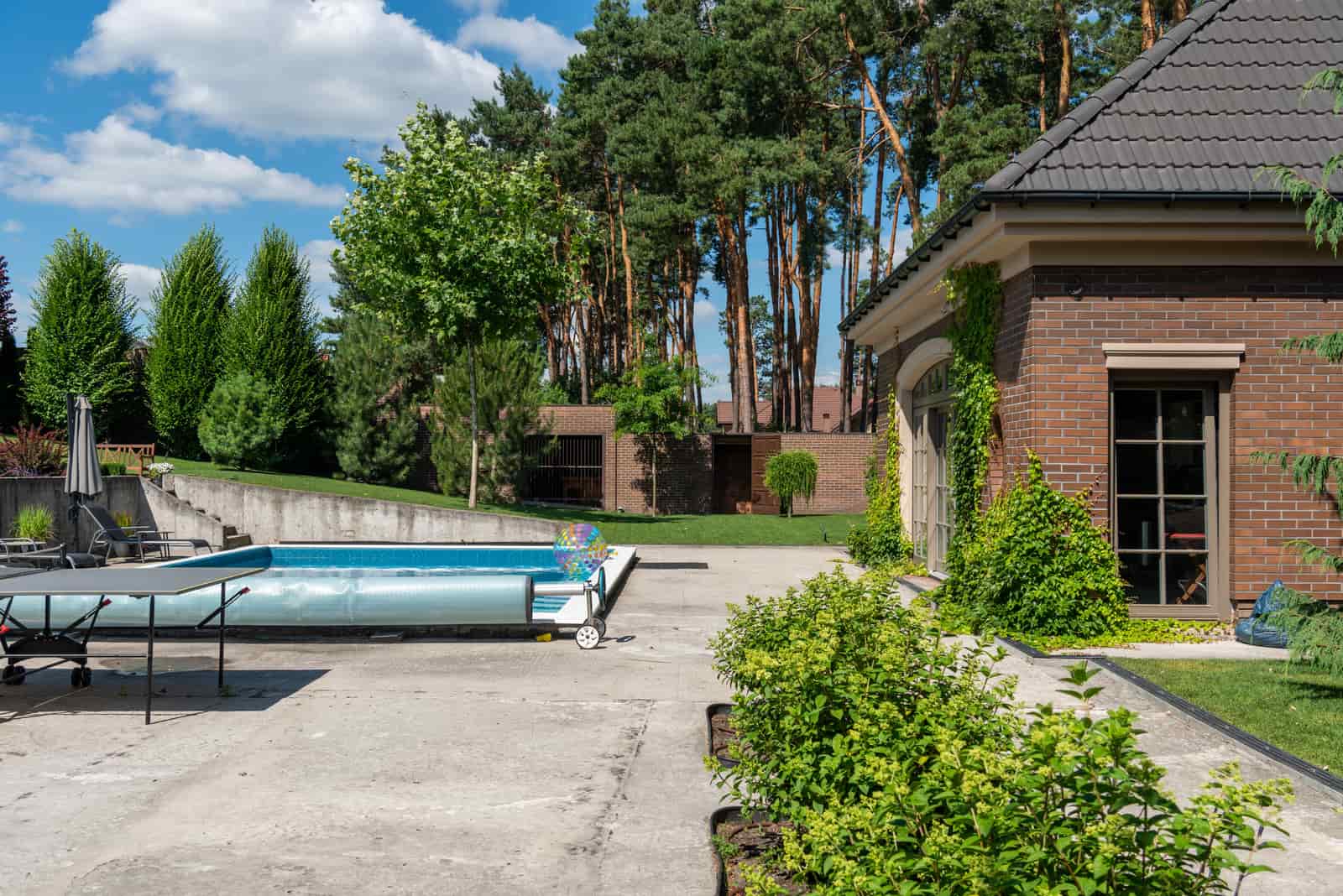
What an above-ground pool can and cannot sit on
The answer is decided by one number nobody publishes: pounds per square foot. Once you have it, most of the internet's advice about decks sorts itself out.
Heads up: we earn a commission if you buy through the links on this page, at no extra cost to you. It never decides the ranking — here is how we pick and here is the full disclosure. Prices are checked automatically; last verified October 8, 2026.
The short version
- Prepared soil is the default and the best answer for almost every above-ground pool. Everything else is a compromise with a specific reason.
- These pools apply 110 to 230 pounds per square foot depending on size. That single number is what rules a deck in or out.
- Gravel and asphalt are the two genuine no answers — gravel punctures liners from below, asphalt softens in heat and can mark vinyl.
- Concrete works, with a cushion. It is flat and stable, and it is also abrasive and holds no drainage, so the ground cloth stops being optional.
The number that answers most of the question
Ask whether a pool can go on a deck or a patio and you get opinions. The way to get an answer is to work out what the pool actually weighs per square foot, because that is the figure any surface has to carry. A US gallon of water weighs 8.34 pounds, and the manufacturers publish the gallons.
Load per square foot, from published capacity
- Published capacity, Bestway Steel Pro MAX 15ft [Bestway]
- 3,955 gallons
- Weight of one US gallon
- 8.34 lb
- Footprint of a 15ft circle
- 176.7 sq ft
3,955 × 8.34 = 32,985 lb 32,985 ÷ 176.7 = 187 lb/sq ft
About 187 pounds on every square foot, continuously
| Pool | Gallons | Total weight | Load |
|---|---|---|---|
| Intex Easy Set 12ft x 30in | 1,485 | ≈ 12,400 lb | ≈ 110 lb/sq ft |
| Intex Prism Frame 12ft x 30in | 1,718 | ≈ 14,300 lb | ≈ 127 lb/sq ft |
| Bestway Steel Pro MAX 15ft x 42in | 3,955 | ≈ 33,000 lb | ≈ 187 lb/sq ft |
| Intex Ultra XTR 18ft x 52in | 6,981 | ≈ 58,200 lb | ≈ 229 lb/sq ft |
Surface by surface
Prepared soil. The default, and genuinely the best surface for almost every pool in this category. It drains, it has some give, and it can be made genuinely level by cutting down into undisturbed ground. It needs the sod stripped and every stone removed — our leveling guide is the method.
Concrete slab or patio. Works well and has real advantages: it is already flat, it does not settle, and nothing grows through it. Two cautions. Concrete is abrasive, so a ground cloth or pad between slab and liner is not optional. And a slab does not drain, so water that gets under the liner has nowhere to go — check that the slab is not dished in the middle before you commit.
Pavers or flagstones. Only if they are bedded properly and the joints are tight. The failure mode is individual pavers settling at different rates under load, which turns a flat surface into a series of small steps under the liner. If the paving is old and has already moved, it will move again.
Gravel or hardcore. No. It is the one surface that is actively hostile to a vinyl liner — every stone is a point load carrying the full weight of the water, and no ground cloth is meant to survive that. If gravel is what you have, it needs excavating and replacing, not covering.
Asphalt or blacktop. No, for two reasons. It softens in summer heat and deforms under sustained load, and the oils in it can mark and degrade vinyl over a season.
A wooden deck. See the callout above. This is a structural question with a real answer, and the answer is not ours to give.
| Surface | Verdict | The catch |
|---|---|---|
| Prepared soil | Best answer | Needs the sod and every stone removed |
| Concrete slab | Works well | Abrasive and does not drain — cloth required |
| Bedded pavers | Usually fine | Individual pavers settle at different rates |
| Compacted sand over soil | Cushion only | Migrates and washes out if used to level |
| Gravel or hardcore | No | Every stone is a point load on the liner |
| Asphalt | No | Softens under heat and load; can mark vinyl |
| Wooden deck | Ask an engineer | 110-230 lb/sq ft, static, for months |
The two things every surface needs
A barrier under the liner. On soil it stops roots and grit; on concrete it stops abrasion; on sand it stops migration reaching the vinyl. A ground cloth is inexpensive and it is the single item most frequently left out of pool kits — check what is in the box, as our kit versus separate guide covers.
Somewhere for the ladder to stand. A ladder needs firm, level footing outside the pool, and on soft ground it sinks unevenly over a season, which is a safety problem rather than an inconvenience. On grass, put a paver or a board under each foot. Our ladder guide covers the weight-capacity spec that matters most.
Drainage, which nobody thinks about until September
Whatever the pool stands on, the ground around it will be wet all season from splash-out and from the day you drain it. On soil that means a permanently soggy ring and, if the ground slopes toward the house, water finding a wall. On a slab it means a slip hazard where people are walking barefoot.
Neither is difficult to plan for, and both are impossible to fix once the pool is full. Look at where the water goes before you choose the spot, not after — and when you eventually take it down, our take-down guide covers draining several thousand gallons without saturating one patch of ground.
What to buy
Scores are our own reading of published specifications. They are not test results — we have not tested these products and we do not claim to.
Protecting the liner from below
Pool Ground Cloth / Under-Pool Pad
Various
Most liner punctures come from underneath, from a stone or a root you did not see. A ground cloth is the cheapest way to avoid the most expensive repair in above-ground pool ownership.
Key specs
- Function
- Barrier between ground and liner
- Sizing
- Should extend past the pool footprint
- Included with
- Some kits — check before buying separately
How it scoresour reading of published specs, not a test result
- Retention
- 8.0
- Durability
- 7.5
- Handling
- 8.5
- Running cost
- 10.0
- Value
- 9.0
Overall 8.5 / 10
What works
- Prevents the failure mode that ends pools: a puncture in the floor you cannot reach to patch
- Also slows grass and weeds growing up under the pool
- Included free in better kits, so check before you buy one
What doesn't
- Not a substitute for actually clearing stones and roots first
- Thin ones tear during installation before the pool is even up
- Traps moisture, which kills the grass underneath regardless
Skip it if: Fixing uneven ground. It protects against punctures; it does nothing about level, and level is the bigger problem.
What it costs to run: Compare its cost to a liner replacement, which is the single largest unplanned expense in above-ground pool ownership. It is not a close call.
Several seasons: Buy-once. Built and warranted to come back out of the box for a few years, if you store it properly.
Water in the yard this weekend
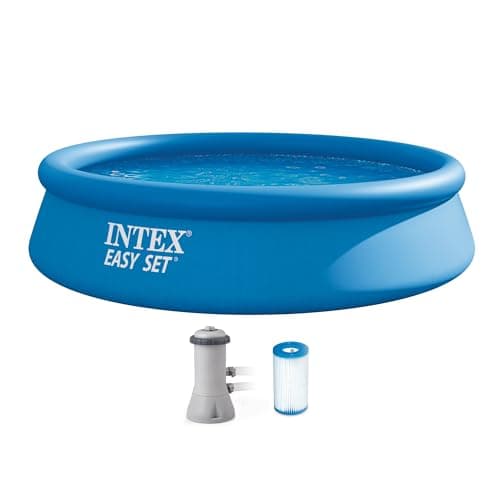
Intex Easy Set Pool Set, 12ft x 30in
Intex
Inflate the ring, add water, done. It is the fastest route from box to swimming that exists, and it is honest about being a seasonal item rather than a fixture.
#ad how this is funded · price as of October 8, 2026
Key specs
- Water capacity
- 1,485 gallons (80% full)
- Water depth
- 23 inches
- Pump supplied
- 530 GPH Krystal Clear cartridge pump
- Material
- 3-ply, puncture resistant
- Manufacturer setup claim
- Ready for water in about 10 minutes
- Pump wattage
- Not published by Intex
How it scoresour reading of published specs, not a test result
- Build
- 5.5
- Setup
- 9.8
- Upkeep
- 8.5
- Running cost
- 9.2
- Value
- 8.8
Overall 8.3 / 10
What works
- Genuinely 10 minutes to set up — the top ring rises with the water and there is no frame to assemble
- 1,485 gallons at 80% is a real, filterable pool rather than a paddling pool
- Comes down as fast as it goes up, which makes mid-season relocation possible
- Cheapest way to find out whether your family actually wants a pool before committing to a frame one
What doesn't
- The inflated ring is the single point of failure and it is exposed to sun all season
- 23 inches of water is shallow — this is for cooling off, not swimming
- Soft walls flex, so it needs level ground as much as a frame pool does
Skip it if: Lasting. Treat this as a two-or-three-season item at best and you will not be disappointed; expect five years and you will be.
What it costs to run: A fill at the EPA WaterSense average of $6.06 per 1,000 gallons is about $9. The 530 GPH pump moves 1,485 gallons in under three hours, so this is a pool where a genuinely short daily run does the job — which is where the running-cost saving actually comes from.
One honest season: The cheapest setup that genuinely works for a season of real swimming. Nothing spare, nothing missing.
Specs from: Intex — Easy Set 12' x 30' pool set, EPA WaterSense — cost per 1,000 gallons
Small yards and first-time owners
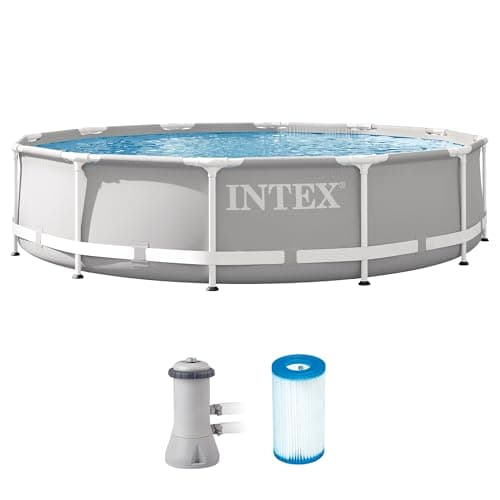
Intex Prism Frame Pool Set, 12ft x 30in
Intex
The size most people should buy first and the one most people talk themselves out of. 1,718 gallons is cheap to fill, cheap to treat, and forgiving of every mistake you are about to make.
Key specs
- Water capacity
- 1,718 gallons
- Pump supplied
- Krystal Clear C530 — 530 GPH pump / 475 GPH system
- Frame
- Powder-coated metal, tool-free Easy Lock
- Liner
- 3-ply, puncture resistant
- Manufacturer setup claim
- Ready in 30 minutes
- Pump wattage
- Not published by Intex
How it scoresour reading of published specs, not a test result
- Build
- 7.0
- Setup
- 9.0
- Upkeep
- 9.0
- Running cost
- 9.0
- Value
- 9.0
Overall 8.6 / 10
What works
- A 12-foot circle fits in a yard where a 15 or 18 will not, once you allow three feet of walking space
- 1,718 gallons turns over in about 3.6 hours on the supplied 475 GPH system flow — so a short daily run genuinely filters it
- Cheapest of the frame pools to make a mistake in: a bad chemical week costs a few dollars, not a few tens
- Tool-free assembly is real, not marketing — this is a genuinely one-afternoon job
What doesn't
- 30-inch wall means shallow water and it warms and cools fast
- Small enough that three adults fill it
- The C530 is sized for exactly this pool and nothing bigger, so it does not carry over if you upgrade
Skip it if: Anyone planning to swim rather than sit. This is a cooling-off and playing pool and it is very good at that.
What it costs to run: The cheapest frame pool here to run, and the gap is not small. At the EPA WaterSense average of $6.06 per 1,000 gallons a fill is about $10. Its turnover math — 1,718 gallons at 475 GPH system flow — means roughly 3.6 hours per full turnover, so a 7-8 hour daily run is two full turnovers rather than a partial one.
One honest season: The cheapest setup that genuinely works for a season of real swimming. Nothing spare, nothing missing.
Specs from: Intex — Prism Frame 12' x 30' pool set, Intex — Krystal Clear cartridge filter pumps
Getting in and out safely
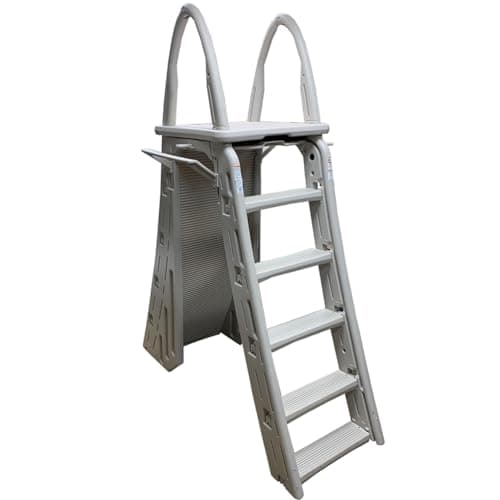
A-Frame Above-Ground Pool Ladder
Various
Read the published weight limit before anything else. It is frequently lower than buyers assume, and it is the one spec on a ladder that genuinely matters.
#ad how this is funded · price as of October 8, 2026
Key specs
- Critical spec
- Published weight capacity — check it against every adult who will use it
- Height match
- Must match your wall height, not approximate it
- Safety feature
- Removable or lockable outer steps on better models
How it scoresour reading of published specs, not a test result
- Sizing fit
- 8.5
- Running cost
- 10.0
- Maintenance
- 8.5
- Build
- 7.5
- Value
- 8.5
Overall 8.4 / 10
What works
- Removable outer steps genuinely prevent unsupervised access, which is a real safety layer
- Resin frames do not corrode the way early steel ladders did
- Correctly matched height is far more stable than a too-tall ladder
What doesn't
- Weight limits are often lower than people expect and are easy to overlook in a listing
- A ladder sized for a 42-inch wall is wrong on a 52-inch wall and vice versa
- Cheap models flex enough to feel alarming
Skip it if: Being a barrier on its own. The CPSC's guidance treats barriers, supervision and alarms as layers; a removable step is one layer, not the answer.
What it costs to run: Buy it with the pool. Kits that include a ladder are frequently cheaper than the pool-plus-ladder bought separately, and this is one of the accessories that makes a cheap-looking kit expensive.
Several seasons: Buy-once. Built and warranted to come back out of the box for a few years, if you store it properly.
Specs from: CPSC — Pool Safely
Questions people actually ask
Can you put an above-ground pool on concrete?
Can an above-ground pool go on a deck?
Can you put a pool on gravel?
Do I need a pad under an above-ground pool?
Sources
Read next
- Above-ground pools for ordinary backyardsSoft-side, metal-frame and steel-wall pools compared by what they cost across a whole season, not at the till.
- Leveling the ground, and the weight that makes it matterThe tolerance manufacturers publish, the weight of water that enforces it, and the method for getting a circle genuinely flat with hand tools.
- How to set up an above-ground pool properlyLeveling, ground protection, filling and priming - the afternoon that decides how the rest of the season goes.
- Pools for a small yardRound versus rectangular in a narrow yard, the smallest sizes worth filtering, and why smaller is cheaper twice over.
- How long an above-ground pool actually lastsRealistic lifespans by pool type, the four failure modes that account for nearly all of them, and the cheap items that add seasons.
- Liner replacement: the big occasional cost, and how to avoid itOverlap, beaded and unibead are not interchangeable - plus the three habits that decide whether you ever need a replacement.
- The pad under the liner is the cheapest part of the buildGeotextile floor pads compared on the numbers makers actually publish: fabric weight, woven or non-woven, pre-cut sizes and what the warranty quietly excludes.