Above-Ground Pools
A pool for older swimmers starts at the steps, not the water
Water is excellent for stiff joints and a pool wall is a climbing problem. Pick the entry system first and let it decide the pool, rather than the other way round.

Heads up: we earn a commission if you buy through the links on this page, at no extra cost to you. It never decides the ranking — here is how we pick and here is the full disclosure. Prices are checked automatically; last verified October 8, 2026.
The short version
- Choose the entry system first. It constrains the wall height, which constrains the pool.
- Handrails on both sides beat a ladder every time for anyone with balance, knee or shoulder problems.
- Read the weight rating’s wording. Vinyl Works publishes 300 lb “one person at a time”; Confer publishes a bare 400 lb.
- A lower wall is easier to enter and colder to swim in. That trade-off is the whole sizing decision here.
What to look for
1. Steps, not a ladder. An A-frame ladder asks you to climb up, turn around and go down backwards using arm strength. Entry steps have real treads and handrails on both sides, and you walk down facing forwards. For older swimmers this is the single biggest difference between a pool that gets used daily and one that does not.
2. Wall height you can manage. Our 52-inch guide explains why deeper water is better for swimming. It is also a taller outside climb. A 42-inch wall with a good entry system is often the better compromise than 52 inches with a ladder.
3. The weight rating, and its qualifier. Vinyl Works publishes 300 lb one person at a time across its range; Confer publishes 400 lb with no person-count wording. Those are different kinds of statement, and if a carer may steady someone on the steps it matters.
4. A gate at the top. The Vinyl Works Model CE has a self-closing, self-latching, lockable gate with the latch published at 55 inches above the ground. That suits a household where grandchildren visit, and it satisfies the CPSC principle that entry should be securable when the pool is unattended.
5. Somewhere to hold on outside the pool. A deck or a handrail at the top of the steps changes the experience more than any pool feature — our decks guide covers what building around the pool changes.
The picks
These are chosen for entry first. The pool is the last decision, not the first.
The Model CE entry system is the one to start from: steps on both sides of the wall, a top platform 20.25 inches wide between handrails, adjustment from 47.5 to 56.25 inches of wall, and the gate. The constraint is its 300 lb one-person rating and the fact that the lock is not included.
The Confer Step-1X is the in-pool option where a full entry system will not fit or the budget will not stretch: 400 lb published, two handrails, a 47-inch height to the top step and 40 lb of sand ballast to stop it floating. It does not solve the outside climb, so it suits a pool with a deck.
For the pool itself, a 42-inch frame pool keeps the outside climb modest while still giving genuine water depth, and ships with a ladder and cover in the box. Match the entry system’s published wall range to the pool before ordering either.
What makes a pool worse for older swimmers
A 52-inch wall with no deck. A ladder as the only way in. A soft-side pool, whose wall flexes when you put weight on it. And any entry that cannot be secured, because a pool that is easy for a grandparent to enter is easy for a three-year-old to enter too — the reason our fence roundup exists.
Water temperature is the quiet one. Cold water stiffens exactly the joints the pool is meant to help, and a bigger pool warms more slowly. A cover is the cheapest fix, and our solar cover guide shows how much it actually holds overnight.
Before the pool is filled
Fit the entry system first
Drop-in steps need ballast and entry systems need assembly. Doing it before the water is in is far easier than standing in a full pool.Put a pad under the steps
Both makers recommend a step pad to protect the liner under the hard plastic base. Our liner pad roundup covers the options.Buy the padlock at the same time
Gates and slide-up ladders both publish a lock point, and neither includes the lock.Check the handrail reach from outside
Stand where you will stand. If there is nothing to hold at the top of the outside steps, add a rail or a deck before the first swim.Plan the exit, not just the entry
Getting out is harder than getting in, with wet hands and no buoyancy help at the last step. That is what the second handrail is for.
Water temperature matters more than you expect
Warm water loosens stiff joints; cold water does the opposite, and a larger pool is a colder pool for longer. That makes a cover the single most useful accessory here, not for cost reasons but for comfort — our solar cover guide covers how much it holds overnight.
It also argues quietly against buying the biggest pool the yard will take. A 15-foot pool that is comfortable in June beats an 18-foot pool that is only comfortable in August.
What to skip
A deep pool with no deck. Fifty-two inches is a serious outside climb, and the entry systems that suit it are the expensive ones.
Soft-side pools. The wall flexes when you lean on it, which is exactly what you do not want when you are steadying yourself getting out.
Slippery surrounds. Wet decking and smooth pavers are the actual hazard in most backyard pool injuries, and they are outside the pool where nobody thinks to look.
Questions worth asking before buying
Can the entry system I want fit this pool?
Match the published wall-height range to the pool before ordering either. The Model CE publishes 47.5 to 56.25 inches.Is there something to hold at the top, outside?
A deck, a rail, or a wide platform. The unsupported moment is the step over the wall, not the steps themselves.What does the weight rating actually say?
300 lb one person at a time is a different statement from a bare 400 lb, and it matters if anyone may need steadying.Can the entry be locked when nobody is watching?
A gate with a padlock, or a ladder that slides up and locks. CPSC guidance is built on securing the entry point.Who assembles it, and who drains the steps in autumn?
Ballasted steps full of water are heavy. Plan that job before the close rather than during it.
Get those five answers and the pool itself becomes a straightforward choice. Our entry steps roundup compares the systems in detail, including a recall every buyer in that category should know about.
The surround matters as much as the steps
Most pool injuries happen outside the water, on the surface beside it, and that surface is rarely chosen with wet feet in mind. Smooth pavers, decking boards laid smooth-side up and anything with a slick finish all become hazards the moment somebody climbs out.
Two cheap interventions do most of the work: a textured mat at the foot of the steps, and a handhold at the top of the outside climb. Our decks and surrounds guide covers building around a pool properly, including the access that makes a deck worth having.
Lighting is the other one nobody budgets for. A pool used in the evening needs the route to and from it lit, not just the water — and our pool light roundup is about the water rather than the path, which is a distinction worth making before you buy.
None of this is specific to older swimmers. It simply matters more when a fall is a longer recovery.
Once you are in the water safely, the pool itself becomes the low-impact exercise equipment. Our pool exercise gear roundup covers what to add to it, and makes one point worth repeating here: foam barbells and buoyancy cuffs resist being pushed down rather than lifted, so they load the muscle without loading the joint at the bottom of the movement.
What to buy
Scores are our own reading of published specifications. They are not test results — we have not tested these products and we do not claim to.
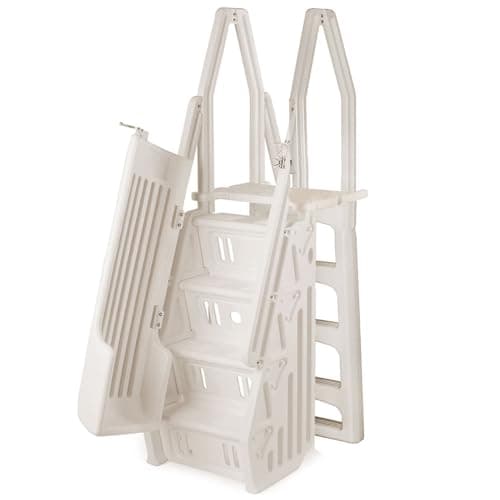
A lockable gate at the top
Vinyl Works Model CE Entry System with Gate
Vinyl Works
The only entry system here with a self-closing, self-latching, lockable gate — the feature that turns pool access from a habit into a mechanism. Adjustable from 47.5 to 56.25 inches of wall.
#ad how this is funded · price as of October 8, 2026
Key specs
- Weight capacity
- 300 lb, one person at a time
- Wall height
- Adjusts from 47.5 in to 56.25 in
- In-pool treads
- Five treads, 4.75 x 18 in
- Exterior treads
- 7.5 x 20 in
- Top platform
- 12 in deep x 20.25 in wide; 20.25 in between handrails
- Gate
- Self-closing, self-latching and lockable; latch 55 in above ground, lock not included
- Material
- Maintenance-free resin with stainless hardware
- Codes
- Stated to meet or exceed APSP / ANSI / ICC-ISPSC entry-system requirements
- Warranty
- 5 years on resin parts; registration required within 90 days
How it scoresour reading of published specs, not a test result
- Sizing fit
- 9.0
- Running cost
- 8.5
- Maintenance
- 8.5
- Build
- 8.5
- Value
- 8.0
Overall 8.5 / 10
What works
- A self-closing, self-latching gate, which is the single most useful safety feature in this category
- The widest published wall-height adjustment here, to 56.25 in
- Explicit code conformance statement covering entry systems and ladder enclosures
- Snap-together assembly with stainless hardware
What doesn't
- 300 lb, one person at a time — a real constraint with children who climb together
- The lock is not included, and without it the gate is a convenience rather than a barrier
- Warranty covers replacement parts only and must be registered within 90 days
- A full entry system takes up more deck space than a drop-in step
Skip it if: Being a barrier on its own. CPSC guidance is that the steps be securable, lockable or removable, and an unlocked self-latching gate meets the letter of that and not the spirit.
What it costs to run: Budget for the padlock on the same order. Our pool fence cost guide covers the wider barrier question, of which the entry point is one part.
Several seasons: Buy-once. Built and warranted to come back out of the box for a few years, if you store it properly.
Specs from: Vinyl Works Canada — Model CE entry system, published specifications, Vinyl Works Canada — Model CE combo entry with gate, features and specifications sheet
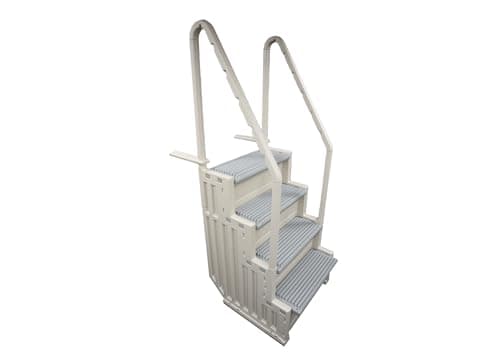
The highest published weight rating
Confer Plastics Step-1X Above-Ground Entry System
Confer Plastics
Four hundred pounds, two handrails, a five-year warranty and forty pounds of sand to hold it down. The published weight limit is the highest here, and Confer states it without a one-person qualifier.
Key specs
- Weight limit
- 400 lb
- Width
- 31 in; step treads 10 x 27 in
- Height to top step
- 47 in; handrail 38 in; projection into pool 32 in
- Riser height
- 11 in
- Ballast
- 40 lb of dry sand — about 10 lb into each of four openings
- Material
- Blow-molded high-density polyethylene
- Pool floor
- For above-ground pools with flat bottoms
- Fits
- Confer publishes only 'fits decks up to 60 in'; retailers quote 48-54 in and 48-58 in, which conflict
- Warranty
- 5 years on manufacturing defects and workmanship
How it scoresour reading of published specs, not a test result
- Sizing fit
- 7.5
- Running cost
- 9.0
- Maintenance
- 8.0
- Build
- 8.5
- Value
- 8.5
Overall 8.3 / 10
What works
- A published 400 lb limit, the highest of the entry systems here
- Five-year warranty, the longest published in this roundup
- Snap-together assembly with mounting brackets to secure it to the pool or deck
- Sand ballast means it stays put rather than floating, which is the usual complaint about drop-in steps
What doesn't
- Confer does not publish a pool wall height range, and retailers disagree about what it fits
- Forty pounds of dry sand has to be bought, carried and funnelled in
- Flat-bottomed pools only
- Confer does not sell a liner pad, and suggests a bath mat as a substitute
Skip it if: Dished pool floors. The Step-1X is specified for flat-bottom pools, and a pool floor that has developed a dish under the steps is outside what Confer describes.
What it costs to run: Add the cost of 40 lb of play sand and a liner pad to the sticker. Both are small, and the pad is the one that protects the expensive part underneath.
Several seasons: Buy-once. Built and warranted to come back out of the box for a few years, if you store it properly.
Specs from: Confer Plastics — Step-1X in-pool step, published dimensions, weight limit and warranty, Confer Plastics — Step-1X installation manual (sand ballast, tools)
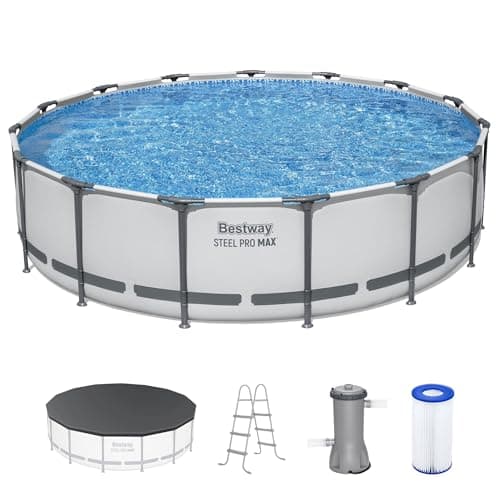
The honest middle of the market
Bestway Steel Pro MAX Pool Set, 15ft x 42in
Bestway
Fewer gallons and a shallower wall than the Intex flagship, which makes it easier to level, cheaper to fill and cheaper to keep clean. For most first-pool families this is the right size, not the compromise size.
#ad how this is funded · price as of October 8, 2026
Key specs
- Water capacity
- 3,955 gallons (90% full)
- Pump supplied
- 1,000 gal filter pump, Type III cartridge
- Liner
- Tritech 3-layer
- Included
- Ladder and cover
- Wall height
- 42 inches
- Pump wattage
- Not published by Bestway (US listing)
How it scoresour reading of published specs, not a test result
- Build
- 7.5
- Setup
- 8.0
- Upkeep
- 8.0
- Running cost
- 7.5
- Value
- 8.8
Overall 8.2 / 10
What works
- 3,955 gallons is roughly 43% less water than the 18ft Intex — that is 43% less chemical spend, every season, forever
- 42-inch wall is far more forgiving of a yard that is nearly-but-not-quite level
- Ladder and cover included
- Cartridge filtration means no sand to buy or change
What doesn't
- Cartridges are a recurring consumable, and in a busy pool you will rinse one weekly
- 42 inches is shallow for adults who want to actually swim rather than sit
- Wattage is not published, so the running-cost math needs the label on the box
Skip it if: Adults who want to swim lengths. At 42 inches you are sitting in it, not swimming in it.
What it costs to run: The gallons are the story. Chemical dosing scales with volume, so 3,955 gallons costs meaningfully less to sanitize all season than 6,981 does. Filling it once at the EPA WaterSense national average of $6.06 per 1,000 gallons is about $24 of water; the same fill on the 18ft Intex is about $42.
Several seasons: Buy-once. Built and warranted to come back out of the box for a few years, if you store it properly.
Specs from: Bestway USA — Steel Pro MAX 15' x 42' pool set, EPA WaterSense — how the calculator works ($6.06 per 1,000 gallons)
Questions people actually ask
What is the easiest above-ground pool to get into?
Are pool steps strong enough for two people?
Is a deeper pool better or worse for older swimmers?
Do pool steps need to be anchored?
Sources
Read next
- Above-ground pools for ordinary backyardsSoft-side, metal-frame and steel-wall pools compared by what they cost across a whole season, not at the till.
- Pool exercise gear: your wall height decides what worksWater aerobics gear ranked by how it creates resistance and how much depth it needs - because an above-ground wall decides which half of this category is usable.
- Pool steps, and the weight rating that is not what it looks likeAbove-ground entry steps compared on weight rating conventions, wall-height range, sand or gravel ballast, deck mounting and the lock-out that CPSC guidance actually asks for.
- In-wall steps are a pool decision, not a step decisionWhat in-wall pool steps actually involve - concrete cap blocks, a poured trench, liner face plates - why retrofitting voids warranties, and the drop-in alternatives.
- Above-ground pool ladders, and the spec everyone skipsWeight capacity, height matching, and removable outer steps - the three things that decide whether a ladder is right.
- Building around the pool, and what it changes about the poolDecks, platforms and steps around an above-ground pool - what they change about safety and maintenance, and the cheaper options that work.
- You cannot swim lengths. You can swim continuously.What above-ground depth and diameter actually allow for swimming, and the tether that turns a round pool into a continuous-swim pool.
- Fifty-two inches is where the pool becomes chest-deepDeep-wall 52-inch above-ground pools compared on what the extra depth buys, what it costs in water and ground preparation, and who it suits.