Floats & Fun
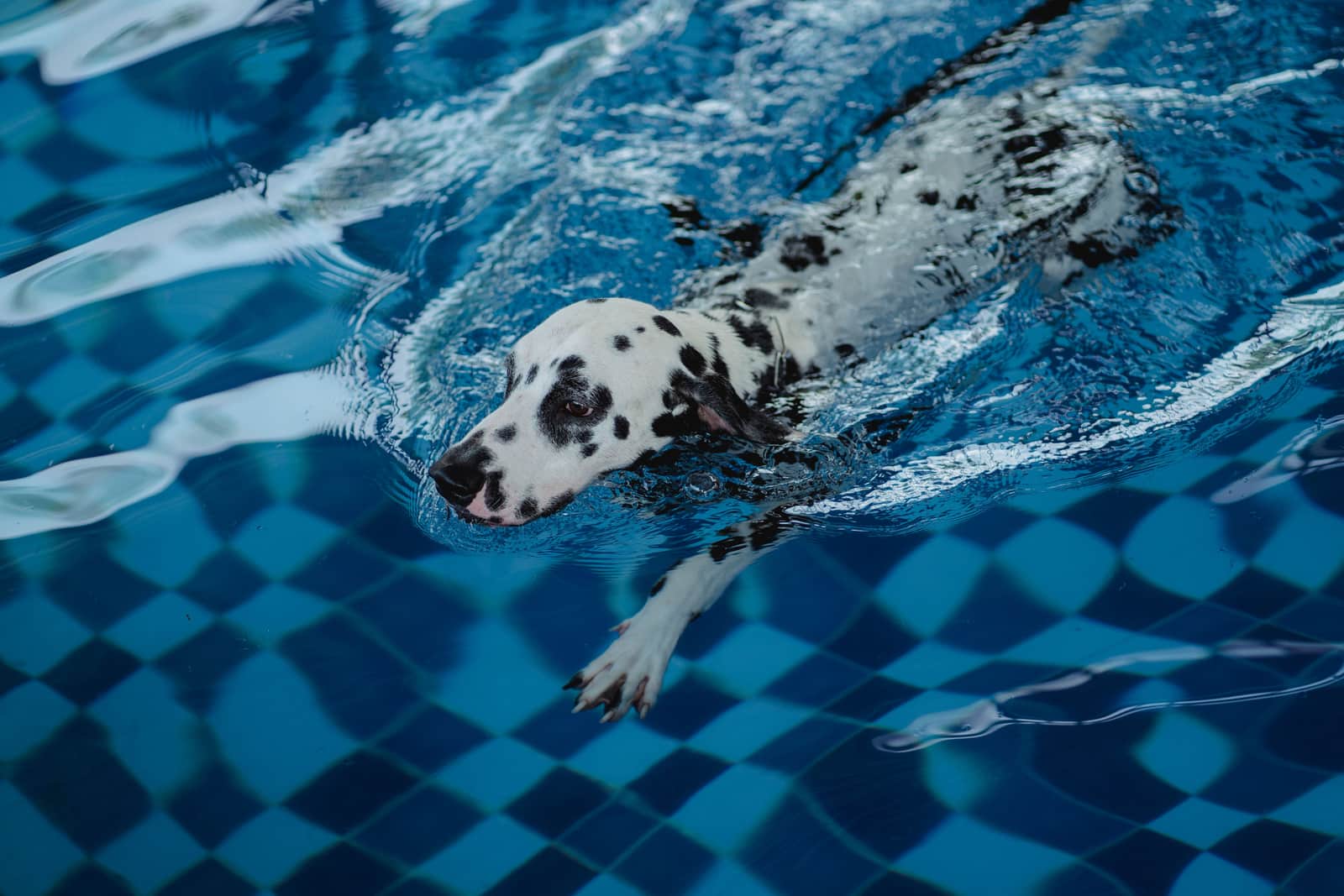
The dog can swim. Here is what it costs the water.
Nobody is going to tell you not to let the dog in. But a dog is a large bather load with fur and claws attached, and the pool notices in three specific ways.
Heads up: we earn a commission if you buy through the links on this page, at no extra cost to you. It never decides the ranking — here is how we pick and here is the full disclosure. Prices are checked automatically; last verified October 8, 2026.
The short version
- A dog is a heavy bather load. Fur, dander and skin oils all consume chlorine, and one dog is commonly reckoned to be worth several people in the water.
- Fur is a filter problem before it is a chemistry problem. Expect to rinse or replace cartridges noticeably more often.
- Claws and vinyl are the real risk on an above-ground pool, and it is worst at the point where the dog tries to get out.
- Getting out is the safety issue, not getting in. A dog that cannot find the exit in a four-foot-walled pool is in genuine trouble.
Three separate consequences, in order of how fast you notice them
Letting a dog swim is a completely reasonable thing to do, and this page is not an argument against it. It is an account of what changes, because all three consequences are manageable if you expect them and unpleasant if you do not.
| Effect | How soon you notice | What to do |
|---|---|---|
| Chlorine demand rises | Same day, or the next test | Test after swims; shock at dusk if needed |
| Fur loads the filter | Within a day or two | Skim before and after; rinse the cartridge |
| Claw marks on the liner | Weeks to months | Control the exit; use a ramp or platform |
| Hair around the skimmer | Immediately | Empty the basket every time |
Chemistry: a dog is a crowd
Chlorine is consumed by whatever organic material enters the water, and a dog brings a lot of it: loose fur, dander, skin oils, and whatever was on the coat before the swim. The rule of thumb in the industry — and it is a rule of thumb rather than a published standard, so treat it as one — is that one dog is worth several human swimmers in terms of load.
Practically, that means testing after a swim rather than on your usual schedule. The CDC publishes a minimum of 1 ppm free chlorine for pools, and at least 2 ppm where a stabilizer such as trichlor tablets is in use. If the reading has dropped or the water starts to smell, that smell is chloramines telling you the pool needs more sanitizer, not less — our chlorine smell guide explains why that is counter-intuitive and what to do.
A brush before the swim removes a surprising amount of the loose coat that would otherwise end up in the water, and it is the single highest-return habit on this page.
Filtration: fur is the problem, not the dirt
Hair does not behave like other debris. It floats, then sinks, then wraps around anything it meets — which in a small pool means the skimmer basket, the pump basket and the pleats of the cartridge. A cartridge loaded with hair loses flow quickly, and lost flow is what turns clear water cloudy two days later.
The routine that keeps this manageable is not complicated. Skim the surface immediately after the swim while the fur is still floating — that is the easiest it will ever be to remove. Empty both baskets rather than assuming. And expect the cartridge interval to shorten: Intex guidance is already roughly every two weeks in heavy use, and a swimming dog counts as heavy use. Our cartridge guide covers rinsing versus replacing, and the replacement parts guide covers what the extra cartridges add up to across a season.
The liner, and where claws actually do damage
A dog swimming in open water is not a threat to a liner. The damage happens at the edges: scrabbling at the wall trying to get out, pushing off the floor in shallow water, and climbing on and off anything you have put in there. On an above-ground pool with a vinyl liner and no shallow end to walk out of, that scrabbling is close to inevitable unless you give the dog a route.
That is the real argument for a purpose-made dog float or ramp: not comfort, but a defined exit. A reinforced platform or poolside ramp with a puncture-resistant deck gives the dog somewhere to aim for, and it takes the claws off the liner. Match the published weight capacity to the dog — our dog float roundup covers what to look for, and it is one of the few float categories where deck material genuinely matters.
A ladder is not a solution here. Above-ground pool ladders are built for people, the published weight capacity is frequently lower than owners assume, and a dog cannot use one anyway — see our ladder guide.
The practical routine
Brush the dog before the swim. Rinse off after, away from the pool, so what came out of the water does not go straight back in. Skim immediately while the fur floats. Empty both baskets. Test that evening rather than waiting for the usual day, and shock at dusk if the reading has dropped or the water smells. Then rinse the cartridge sooner than the calendar says.
None of that is onerous, and it slots into the ordinary week — our weekly schedule is the baseline it attaches to. What it prevents is the pattern people actually report: clear water on Sunday, cloudy water on Tuesday, and a fortnight spent wondering what went wrong. Our cloudy water guide is the recovery if you are already there, and the answer is usually the cartridge.
Whether to allow it at all
Honestly assessed: on a large frame pool with a sand filter, a dog is a minor inconvenience. On a small inflatable pool with a 530 GPH cartridge pump, one enthusiastic retriever is a significant fraction of the system’s capacity, and the liner is thinner. Neither is a reason not to, but they are different amounts of work, and the smaller and cheaper the pool, the more the answer tilts toward a dedicated dog pool instead.
If you are still choosing the pool rather than working out how to share one, the construction matters more than anything on this page. Our pools for dogs roundup covers which wall types survive claws and why a separate dog pool is usually the right answer.
What to buy
Scores are our own reading of published specifications. They are not test results — we have not tested these products and we do not claim to.
Dogs, and the claws that come with them
Reinforced Dog Pool Float / Ramp
Various
Ordinary vinyl loses to a dog on the first attempt. Anything sold for dogs needs a reinforced or coated deck, and if the listing does not say what the deck is made of, assume it is ordinary vinyl.
Key specs
- What matters
- Puncture-resistant or coated deck material
- Weight capacity
- Published per model — match it to the dog
- Common form
- Flat platform or poolside ramp
How it scoresour reading of published specs, not a test result
- Material
- 8.0
- Valve
- 7.0
- Capacity
- 8.0
- Storage
- 7.0
- Value
- 7.0
Overall 7.5 / 10
What works
- Reinforced decks survive claws in a way that standard float vinyl simply does not
- Ramp versions solve the real problem, which is a dog that can get in and not out
- Flat platforms are more stable than ring shapes for an animal that will not sit still
What doesn't
- Materials are frequently unspecified in listings, so verification is hard
- Considerably more expensive than a human float of the same size
- A determined dog will eventually beat any inflatable
Skip it if: Being left unattended with a dog on it. And no float is a substitute for knowing your dog can get out of the pool.
One honest season: The cheapest setup that genuinely works for a season of real swimming. Nothing spare, nothing missing.
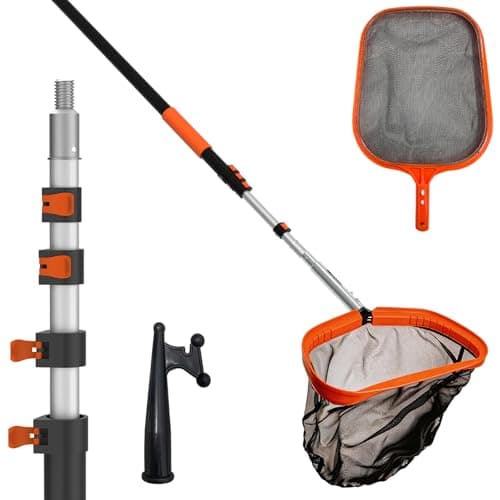
The five-dollar tool you use most
Skimmer Net with Telescopic Pole
Various
Catching leaves while they float is a two-minute job. Catching them after they sink is a vacuum session and a filter clean. Buy this first.
Key specs
- Type
- Flat skimmer or deep leaf rake
- Pole
- Telescopic, sized to reach the middle of your pool
- Frame
- Plastic or aluminum
How it scoresour reading of published specs, not a test result
- Retention
- 8.5
- Durability
- 7.0
- Handling
- 9.0
- Running cost
- 10.0
- Value
- 9.5
Overall 8.8 / 10
What works
- The single most-used tool in pool ownership and among the cheapest
- Removing debris before it sinks prevents most of the work that follows
- A deep leaf rake handles far more per pass than a flat skimmer
What doesn't
- Cheap plastic frames snap where the pole attaches, which is the standard failure
- Telescopic poles seize with hard water unless rinsed
- A too-short pole means you cannot reach the middle, which makes it useless
Skip it if: Anything on the floor. This is a surface tool and pretending otherwise is how debris ends up in the filter.
What it costs to run: Free to use and it directly reduces your chemical bill: organic debris consumes chlorine as it breaks down, so removing leaves is the cheapest sanitizer saving there is.
Several seasons: Buy-once. Built and warranted to come back out of the box for a few years, if you store it properly.
The consumable you will actually buy repeatedly
Type A Replacement Filter Cartridges (multipack)
Various
Buy them in a multipack before you need them. A pool running on an exhausted cartridge is a cloudy pool, and the fix is a two-dollar part you did not have.
Key specs
- Type
- Type A — the most common Intex format
- Replacement interval
- Every 2 weeks in heavy use, per Intex guidance
- Between changes
- Rinse, do not scrub
How it scoresour reading of published specs, not a test result
- Sizing fit
- 9.0
- Running cost
- 7.0
- Maintenance
- 8.5
- Build
- 7.0
- Value
- 8.5
Overall 8.2 / 10
What works
- Type A is the most widely stocked cartridge format in the US
- Multipacks cost a fraction of buying singles
- Having a spare turns a cloudy week into a five-minute fix
What doesn't
- It is a genuine recurring cost that nobody includes in the purchase price
- Aftermarket quality varies noticeably
- Rinsing extends life but does not restore a cartridge that is done
Skip it if: Being restored. Once the pleats are permanently gray and stiff, rinsing is not saving it.
What it costs to run: The line item most people leave out of their pool budget. Count how many you use in your first season and you have your real annual filtration cost — this is exactly the number the cost-to-run guide asks you to record.
One honest season: The cheapest setup that genuinely works for a season of real swimming. Nothing spare, nothing missing.
Actually clearing a green pool
Calcium Hypochlorite Pool Shock
Various (compare available chlorine %)
Unstabilized, fast-acting and strong. This is the tool for an algae bloom precisely because it does not add more cyanuric acid to a pool that probably already has too much.
Key specs
- Type
- Calcium hypochlorite, unstabilized
- Adds stabilizer
- No
- Adds
- Calcium hardness
- Dosing
- By pool volume, per the bag
How it scoresour reading of published specs, not a test result
- Effectiveness
- 9.5
- Ease
- 6.5
- Water impact
- 7.0
- Cost per season
- 9.0
- Value
- 8.8
Overall 8.6 / 10
What works
- No cyanuric acid added, so it does not worsen the problem it is usually solving
- Fast and strong enough to actually break an algae bloom in one treatment when dosed properly
- Cheap per pound of available chlorine
What doesn't
- Adds calcium hardness, which matters in hard-water areas
- Must be dissolved properly or it will bleach a vinyl liner where it settles
- Needs careful storage — it is a genuine oxidizer, not a household product
Skip it if: Routine daily chlorination. This is the emergency tool; tablets are the routine.
What it costs to run: The single most cost-effective way to fix a green pool, and the most commonly under-dosed. Half a dose twice does not equal a full dose once — it just wastes the bag.
One honest season: The cheapest setup that genuinely works for a season of real swimming. Nothing spare, nothing missing.
The default first test kit
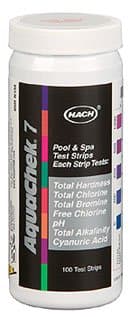
AquaChek Silver 7-Way Test Strips (100 count)
AquaChek
Seven readings in fifteen seconds, including the two that beginners never measure and then fight all summer: total alkalinity and cyanuric acid.
#ad how this is funded · price as of October 8, 2026
Key specs
- Tests
- Free chlorine, total chlorine, bromine, pH, total alkalinity, total hardness, cyanuric acid
- Free chlorine range
- 0-20 ppm
- pH range
- 6.2-8.4
- Total alkalinity range
- 0-240 ppm
- Cyanuric acid range
- 0-300 ppm
- Read time
- 15 seconds
- Count
- 100 strips
How it scoresour reading of published specs, not a test result
- Accuracy
- 7.0
- Ease
- 9.5
- Coverage
- 9.5
- Cost per use
- 9.0
- Value
- 9.2
Overall 8.9 / 10
What works
- Covers cyanuric acid, which most cheap strips omit and which is the reason chlorine stops working in a stabilized pool
- pH range spans 6.2-8.4, comfortably bracketing the CDC's recommended 7.0-7.8
- 15 seconds and a color chart printed on the bottle — no separate booklet to lose
- 100 strips is a full season of twice-weekly testing with room to spare
What doesn't
- Strips are a comparison against a printed color chart, so they are directional rather than precise
- Reading them in bright sun is harder than it should be
- The bottle must be kept sealed and dry or the strips degrade quietly
Skip it if: Fine adjustment. If you are chasing a stubborn problem and need a number rather than a color band, a liquid reagent kit is the tool.
What it costs to run: 100 strips at twice-weekly testing covers roughly two seasons for one pool. The real saving is upstream: knowing your alkalinity stops you buying pH adjuster you did not need.
One honest season: The cheapest setup that genuinely works for a season of real swimming. Nothing spare, nothing missing.
Specs from: CDC — home pool and hot tub water treatment and testing
Questions people actually ask
Is it bad for a dog to swim in a chlorinated pool?
How much does a dog affect pool chemistry?
Will a dog damage an above-ground pool liner?
How do I get dog hair out of my pool?
Sources
Read next
- Floats, loungers and the stuff that makes the pool worth havingFloats for adults, toddlers and dogs - ranked on seam and valve construction, which is what actually decides how long they last.
- Pool floats and ramps for dogsClaw-resistant decks, ramps for getting out, and the safety question that matters more than any product here.
- The weekly pool routine, and how little time it really takesThe daily, weekly and monthly jobs written as a schedule, with the kit each one needs and roughly how long it takes.
- Cloudy pool water: work out which of four problems you haveA diagnostic decision tree for cloudy water - four causes, how to tell them apart, and the correct fix for each.
- Filter cartridges: the consumable nobody budgets forThe replacement interval, the rinse-versus-scrub question, and how the cartridge treadmill compares with a sand filter across a season.
- Above-ground pool ladders, and the spec everyone skipsWeight capacity, height matching, and removable outer steps - the three things that decide whether a ladder is right.
- Liner replacement: the big occasional cost, and how to avoid itOverlap, beaded and unibead are not interchangeable - plus the three habits that decide whether you ever need a replacement.