Pool Care & Chemistry
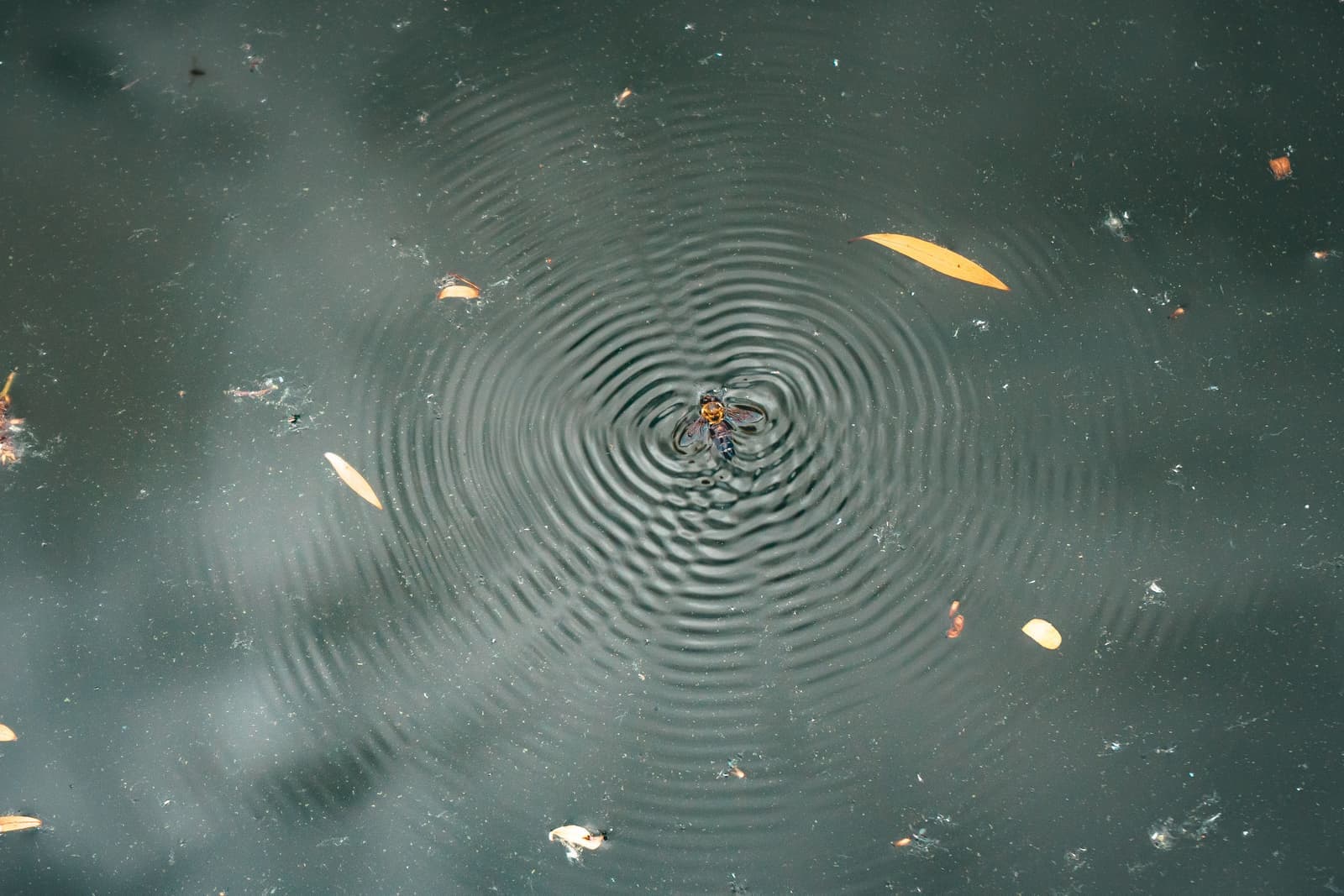
Bugs in the pool are a symptom, not an infestation
Insects do not colonize a pool because it is a pool. They arrive because something in it is worth eating, or because the water stopped moving.
Heads up: we earn a commission if you buy through the links on this page, at no extra cost to you. It never decides the ranking — here is how we pick and here is the full disclosure. Prices are checked automatically; last verified October 8, 2026.
The short version
- Never put insecticide in a pool. It is not designed for water people swim in, it will not fix the cause, and it makes the water a bigger problem than the bugs.
- Water boatmen mean algae. They eat it. Clear the algae and they leave, because the food went.
- Mosquito larvae mean still water. They cannot develop in water that is circulating and sanitized, so their presence is a filtration report.
- A cover and a net between them solve most of this, and neither adds anything to the water.
Read the insect, then fix the cause
A pool is a large, warm, open body of water in a garden, so insects will visit it. The question is not whether you see them, it is whether they are staying, because something that stays has found either food or a place to breed. Both of those are things you can remove, and neither of them is removed by a chemical aimed at the insect.
| What you see | What it means | What to do |
|---|---|---|
| Small oval swimmers, back-side up, darting | Water boatmen — they are grazing on algae | Clear the algae; they lose the food source |
| Similar but swimming on their backs | Backswimmers — they eat the boatmen | Same fix, one level up the chain |
| Wriggling larvae hanging at the surface | Mosquitoes — the water is standing still | Run the pump, hold chlorine, cover it |
| Beetles and bugs floating dead | They flew in and could not get out | Skim daily; this is normal and harmless |
| Foam and film with insects in it | Organic load, often after rain or heavy use | Shock, filter, and check the routine |
Water boatmen: an algae report with legs
These are the ones that produce panicked searches. They are small, oval, they swim in quick darting bursts, and there are suddenly dozens of them. The important thing about them is what they are doing there: they are grazing, and what they are grazing on is algae growing on your walls and floor — frequently algae you have not noticed yet, because it is still a film rather than a color.
That makes them genuinely useful. They are an early warning that your sanitizer has been losing to something for a week or two. The treatment is the algae treatment, not an insect treatment: brush every surface so the film is disturbed, shock in the evening with the pump running, filter continuously until it clears, then dose a preventive algaecide. Our algae guide is the full sequence.
Backswimmers arrive after the boatmen because they eat them. If you have backswimmers you have had the problem longer than you thought, and the fix is identical.
Mosquito larvae: a filtration problem
Mosquitoes need still water to complete their cycle, and a pool that is circulating and carrying free chlorine does not offer it. So larvae in a pool are a report on two things: the pump is not running enough, or chlorine has been at zero long enough for it to stop mattering.
The fix is the routine rather than a product. Run the pump enough to turn the water over — our run-time guide derives the hours from your own gallons rather than from folklore. Get free chlorine back to the CDC’s published minimum of at least 1 ppm, or at least 2 ppm if you are using stabilized tablets. And meter the chlorine steadily with a floating dispenser instead of dosing in a weekly burst, which is what leaves the mid-week gap they exploit.
The place people miss is not the pool. It is the puddle on top of the cover, the bucket beside the ladder, and the water sitting in a folded tarp. Those are genuinely still, and they are far better mosquito habitat than your pool ever was.
The two items that prevent most of it
A skimmer net. Two minutes a day, and it is the highest-value tool in this hub for exactly this problem. Insects that land and drown are organic material, and organic material in the water consumes chlorine and feeds the algae that attracts the next round of visitors. Removing them while they float breaks the loop.
A cover. A bubble solar cover on the pool overnight stops almost everything from arriving in the first place, cuts evaporation and holds heat, which is three benefits from one inexpensive item. Bubbles face down. Our solar cover roundup covers fit and thickness, and our manual tools page covers the net and pole.
When bugs arrive with something else
Insects rarely turn up alone. If they came with cloudy water, the cause is usually the filter rather than chemistry — our cloudy water guide and cartridge guide cover that. If they came after a storm, the pool has just been diluted and loaded with organic runoff at the same time, which is its own recovery — see what to do after heavy rain. And if they came with a smell, that is chloramines telling you the pool needs more sanitizer rather than less, which our chlorine smell guide explains.
In every one of those cases the insects are the least important part of the report. They are just the most visible.
What to buy
Scores are our own reading of published specifications. They are not test results — we have not tested these products and we do not claim to.
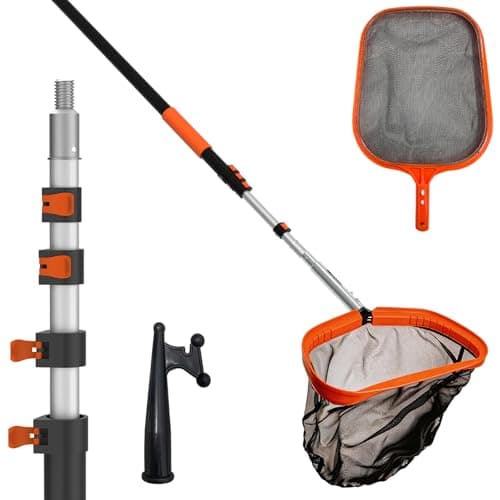
The five-dollar tool you use most
Skimmer Net with Telescopic Pole
Various
Catching leaves while they float is a two-minute job. Catching them after they sink is a vacuum session and a filter clean. Buy this first.
Key specs
- Type
- Flat skimmer or deep leaf rake
- Pole
- Telescopic, sized to reach the middle of your pool
- Frame
- Plastic or aluminum
How it scoresour reading of published specs, not a test result
- Retention
- 8.5
- Durability
- 7.0
- Handling
- 9.0
- Running cost
- 10.0
- Value
- 9.5
Overall 8.8 / 10
What works
- The single most-used tool in pool ownership and among the cheapest
- Removing debris before it sinks prevents most of the work that follows
- A deep leaf rake handles far more per pass than a flat skimmer
What doesn't
- Cheap plastic frames snap where the pole attaches, which is the standard failure
- Telescopic poles seize with hard water unless rinsed
- A too-short pole means you cannot reach the middle, which makes it useless
Skip it if: Anything on the floor. This is a surface tool and pretending otherwise is how debris ends up in the filter.
What it costs to run: Free to use and it directly reduces your chemical bill: organic debris consumes chlorine as it breaks down, so removing leaves is the cheapest sanitizer saving there is.
Several seasons: Buy-once. Built and warranted to come back out of the box for a few years, if you store it properly.
Actually clearing a green pool
Calcium Hypochlorite Pool Shock
Various (compare available chlorine %)
Unstabilized, fast-acting and strong. This is the tool for an algae bloom precisely because it does not add more cyanuric acid to a pool that probably already has too much.
Key specs
- Type
- Calcium hypochlorite, unstabilized
- Adds stabilizer
- No
- Adds
- Calcium hardness
- Dosing
- By pool volume, per the bag
How it scoresour reading of published specs, not a test result
- Effectiveness
- 9.5
- Ease
- 6.5
- Water impact
- 7.0
- Cost per season
- 9.0
- Value
- 8.8
Overall 8.6 / 10
What works
- No cyanuric acid added, so it does not worsen the problem it is usually solving
- Fast and strong enough to actually break an algae bloom in one treatment when dosed properly
- Cheap per pound of available chlorine
What doesn't
- Adds calcium hardness, which matters in hard-water areas
- Must be dissolved properly or it will bleach a vinyl liner where it settles
- Needs careful storage — it is a genuine oxidizer, not a household product
Skip it if: Routine daily chlorination. This is the emergency tool; tablets are the routine.
What it costs to run: The single most cost-effective way to fix a green pool, and the most commonly under-dosed. Half a dose twice does not equal a full dose once — it just wastes the bag.
One honest season: The cheapest setup that genuinely works for a season of real swimming. Nothing spare, nothing missing.
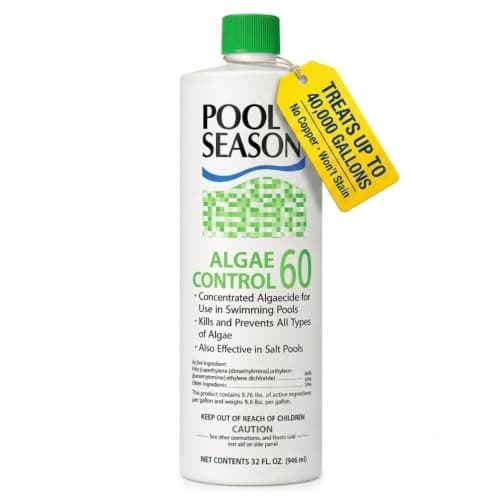
Preventing algae, not curing it
Pool Algaecide (polyquat 60)
Various
Polyquat is the non-foaming, non-staining choice and it is far better at stopping algae than at killing an established bloom. Use it as insurance and as part of closing.
Key specs
- Type
- Polyquaternium (polyquat 60)
- Foaming
- Non-foaming, unlike quat algaecides
- Metal content
- None, unlike copper-based algaecides
How it scoresour reading of published specs, not a test result
- Effectiveness
- 7.5
- Ease
- 9.0
- Water impact
- 9.0
- Cost per season
- 7.5
- Value
- 8.0
Overall 8.0 / 10
What works
- Does not foam, which the cheaper quat products do
- No copper, so no risk of the metal staining a vinyl liner
- The standard product in a winterizing routine, for good reason
What doesn't
- Poor at killing an established bloom — shock does that job
- More expensive than copper-based alternatives
- Easy to over-rely on instead of maintaining chlorine
Skip it if: Rescuing a green pool. Brush and shock first; algaecide is what stops it coming back.
What it costs to run: One of the few chemicals where buying the better version is clearly right — a copper algaecide that stains a liner costs vastly more than the few dollars it saved.
One honest season: The cheapest setup that genuinely works for a season of real swimming. Nothing spare, nothing missing.
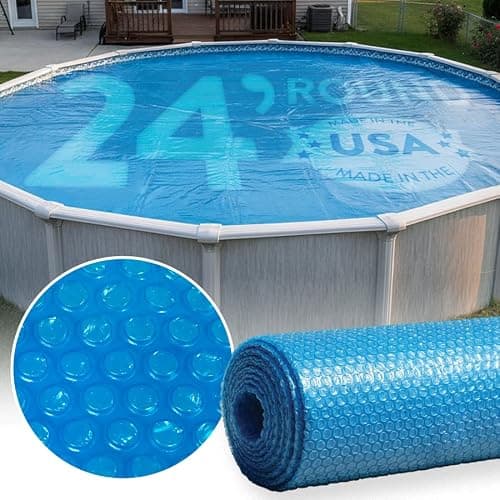
The single highest-return accessory here
Bubble Solar Cover for Above-Ground Pools
Various
It cuts evaporation, and evaporation is simultaneously your water bill, your chemical bill and your heat loss. Nothing else on this site reduces three costs at once.
#ad how this is funded · price as of October 8, 2026
Key specs
- Construction
- Bubble sheet, thickness published in mil
- Thickness
- Higher mil lasts longer — 12 mil and 16 mil are common
- Fit
- Cut to size; buy oversize and trim
- Orientation
- Bubbles face down, toward the water
How it scoresour reading of published specs, not a test result
- Retention
- 9.0
- Durability
- 7.0
- Handling
- 6.0
- Running cost
- 9.8
- Value
- 9.5
Overall 9.0 / 10
What works
- Reduces evaporation, which is the mechanism behind the water, chemical and heat savings all at once
- Cheap relative to everything it saves
- Can be cut to fit any pool shape, so sizing is forgiving
What doesn't
- Awkward to get on and off without a reel, and awkward is how covers end up unused
- Degrades in UV like every vinyl product
- Not a safety cover and will not support weight — this is important
Skip it if: Being a safety barrier. A solar cover looks solid and is not; a child or pet on it goes through and under.
What it costs to run: The one accessory with a clear payback. Every gallon that does not evaporate is a gallon you do not replace at the EPA WaterSense national average of $6.06 per 1,000 gallons, and it is chlorine you do not re-dose. If you buy one thing from this hub, buy this.
Several seasons: Buy-once. Built and warranted to come back out of the box for a few years, if you store it properly.
Specs from: EPA WaterSense — cost per 1,000 gallons
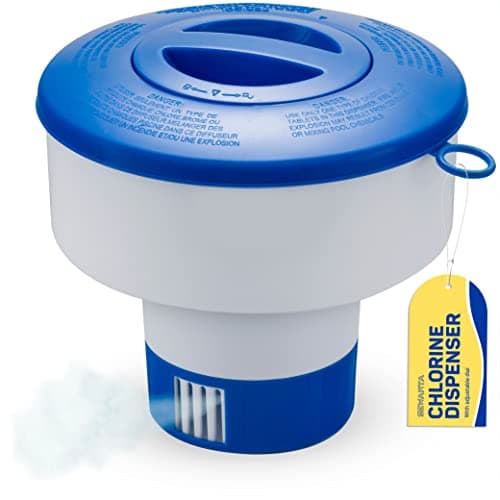
Making tablets work properly
Floating Chlorine Tablet Dispenser
Various
Two dollars of plastic that decides whether your chlorine dissolves evenly over days or sits in a corner bleaching your liner. Buy it with the tablets, not after.
#ad how this is funded · price as of October 8, 2026
Key specs
- Function
- Holds 3-inch tablets, meters dissolution rate
- Adjustment
- Vented base, adjustable on most models
- Compatibility
- Standard 3-inch tablets
How it scoresour reading of published specs, not a test result
- Effectiveness
- 8.0
- Ease
- 9.5
- Water impact
- 9.0
- Cost per season
- 9.8
- Value
- 9.5
Overall 9.0 / 10
What works
- Adjustable venting lets you slow or speed dissolution to match the weather
- Keeps tablets off the liner, which is what causes bleach spots
- Trivially cheap and lasts years
What doesn't
- Drifts to one end of the pool in wind, so distribution is uneven without circulation
- Must be removed before swimming with small children
- Cheap ones crack after a season in UV
Skip it if: Being left in an empty or unfiltered pool. Without circulation it creates a concentrated pocket rather than an even dose.
What it costs to run: The cheapest item on this site and one of the highest-return: even dissolution means you use fewer tablets to hold the same free chlorine level.
One honest season: The cheapest setup that genuinely works for a season of real swimming. Nothing spare, nothing missing.
Questions people actually ask
Why are there tiny bugs swimming in my pool?
Can I put insecticide in my pool?
How do I stop mosquitoes breeding in my pool?
Do pool covers keep bugs out?
Sources
Read next
- Pool care, from someone who assumes you have never done thisThe weekly routine, the four numbers that matter, and the fix for the week the water turns.
- Pool algae: brush, shock, filter, then rebalanceThe correct order for clearing green water, how to tell algae from pollen, and why algaecide prevents rather than cures.
- The weekly pool routine, and how little time it really takesThe daily, weekly and monthly jobs written as a schedule, with the kit each one needs and roughly how long it takes.
- The morning after a storm, in the right orderWhy rain wrecks pool chemistry three ways at once, and the recovery sequence that gets the water back in a day rather than a week.
- The manual pool tools that do most of the real workNets, poles and vacuum heads compared against powered cleaners for a seasonal above-ground pool, on running cost as well as capability.
- The best solar covers, and why this is the one thing to buyBubble covers compared on thickness and sizing, plus the arithmetic that makes this the highest-return purchase in the hub.
- How long to run the pump, worked out rather than repeatedRun time derived from your own turnover time, when in the day to run it, and what each hour a day costs across a season.