Seasonal Care
A freeze is forecast and the pool is still open
The pool is not the fragile part. The pump housing, the hoses and the filter are, and they will fail long before the water in a 4,000-gallon pool becomes a problem.

Heads up: we earn a commission if you buy through the links on this page, at no extra cost to you. It never decides the ranking — here is how we pick and here is the full disclosure. Prices are checked automatically; last verified October 8, 2026.
The short version
- The equipment freezes before the pool does. A few gallons in a pump housing and a hose reach freezing far faster than several thousand gallons in the pool.
- Water expands as it freezes, and a rigid plastic pump housing full of it is the classic overnight write-off.
- Two valid strategies, and you must pick one: keep water moving continuously, or drain the equipment completely. Doing neither is what breaks things.
- Never break ice that has already formed. Broken ice edges are sharp and the liner is directly underneath.
What is actually at risk, in order
The instinct when a freeze is forecast is to worry about the pool. That is the wrong end of the problem. Several thousand gallons of water has enormous thermal mass and takes a long, sustained cold spell to freeze meaningfully. A pump housing holding a few gallons, and hoses holding less, do not.
| Item | Risk | Why |
|---|---|---|
| Hoses | Highest | Smallest volume, most exposed, thin walls |
| Pump and filter housing | Highest | Rigid plastic; expanding ice has nowhere to go |
| Skimmer and fittings | High | Small volumes in rigid components |
| Surface of the pool | Moderate | A skin of ice is normal and mostly harmless |
| The pool body and wall | Low, over one night | Thermal mass; this is a sustained-freeze problem |
Strategy one: keep it moving
Moving water is far more resistant to freezing than still water, and a pump running continuously keeps water moving through the components that are most at risk. For a single unexpected night this is usually the simplest answer, and it is what most owners reach for.
Two conditions. The pump has to actually run all night, which means overriding any timer rather than trusting it — a timer that switches the pump off at midnight has created exactly the still-water situation you were avoiding, in the coldest hours. And the system has to be healthy: a pump that is struggling, losing prime or running against a blocked cartridge may stop on its own, which is worse than never having relied on it. Our pump troubleshooting guide is the check.
There is a cost, and it is small: at the EIA US residential average of 18.34 cents per kWh, a 300 W pump run for twelve extra hours is about 3.6 kWh, or roughly 66 cents. Against a cracked pump housing that is not a difficult decision. Our pump electricity guide has the wider arithmetic.
Strategy two: drain the equipment
The alternative, and the better answer if the cold is going to last more than one night or if you do not trust the pump to keep running. Disconnect the hoses, drain the pump and filter housing completely, and leave the drain plugs out. Water that is not there cannot freeze.
Store the removed components somewhere that does not freeze rather than beside the pool. And remember to put the plugs somewhere you will find them — a drain plug lost in October is a genuinely annoying spring problem, and the same principle as the frame hardware in our storage guide.
The trade-off is that the pool is now not circulating, so if the cold snap runs for several days the water will need attention afterwards. That is a chemistry job, and a much cheaper one than a pump.
The pool itself
For a single cold night, a thin skin of ice on the surface is normal and does no harm. The things to actually do are all cheap:
Put the solar cover on. It reduces overnight heat loss substantially, which is its main job the rest of the year too — our season extension guide covers the mechanism.
Leave the water level alone. Do not lower it in a panic; a lower level is part of a proper close, not a response to one cold night, and a level below the skimmer will make the pump draw air at exactly the wrong moment.
Do not break the ice. This is the one active mistake people make. Broken ice has sharp edges, the liner is directly beneath it, and a punctured liner is a far more expensive outcome than a frozen surface. Let it melt.
Take the floats out. Vinyl goes stiff and brittle in cold, and anything trapped in forming ice is likely to tear. Our float storage guide covers why cold and vinyl are a bad combination.
When a sustained freeze is coming
If the forecast is for several consecutive freezing days rather than one night, stop improvising and close the pool. The risk profile changes: sustained cold does eventually reach the pool body, and a pool left up over a real freeze without an air pillow gives expanding ice nowhere to go except outward against the wall. That is the one failure on this subject that is not recoverable, and our cost of a bad close guide prices it.
An early close is not a wasted afternoon. If the pool is a take-down pool, the cold is also working against you — vinyl folded in freezing weather cracks along the folds, so getting it down before a hard freeze is better than getting it down after one. Our take-down guide covers that sequence.
Doing it properly next time
The reason an unexpected freeze is stressful is that it forces a decision at short notice with the equipment still connected. Two habits remove most of that. Watch the water temperature rather than the calendar as the season winds down, because closing while the water is still warm is the most expensive mistake in this hub. And have the closing items — cover, air pillow, closing chemicals — on the shelf before you need them, rather than buying them the week everyone else is. Our closing kit guide is the list.
What to buy
Scores are our own reading of published specifications. They are not test results — we have not tested these products and we do not claim to.
Small frame and inflatable pools
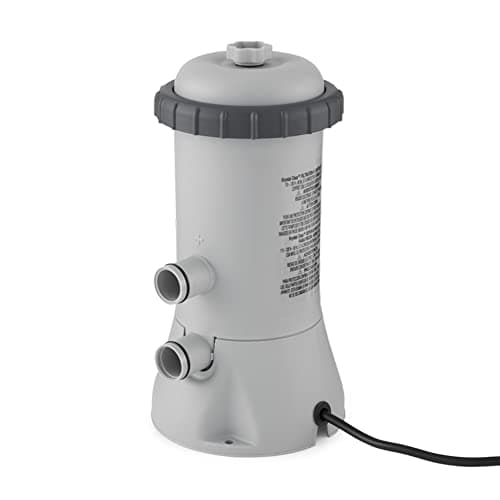
Intex Krystal Clear C530 Cartridge Filter Pump
Intex
530 GPH pump flow, 475 GPH through the system. The right pump for a 12-foot pool and badly undersized for anything much bigger.
#ad how this is funded · price as of October 8, 2026
Key specs
- Pump flow rate
- 530 GPH
- System flow rate
- 475 GPH
- Cartridge
- Type A
- Wattage
- Not published by Intex
How it scoresour reading of published specs, not a test result
- Sizing fit
- 8.0
- Running cost
- 9.0
- Maintenance
- 7.0
- Build
- 7.0
- Value
- 8.5
Overall 8.0 / 10
What works
- Correctly matched to the 12ft Prism Frame and Easy Set pools it ships with
- Smallest pump here that will still genuinely turn over a real pool
- Type A cartridges, which are everywhere
What doesn't
- Undersized the moment you upgrade the pool, and it will not carry over
- No wattage published
- Cartridge needs rinsing frequently in a busy small pool
Skip it if: Anything over about 2,000 gallons. Below that it is right; above it you are running it all day for one turnover.
What it costs to run: 475 GPH system flow turns over 1,718 gallons in about 3.6 hours, so a 7-hour daily run is two full turnovers. That is a genuinely short run time and it is where a small pool's low running cost actually comes from.
One honest season: The cheapest setup that genuinely works for a season of real swimming. Nothing spare, nothing missing.
Specs from: Intex — Krystal Clear cartridge filter pumps
The single highest-return accessory here
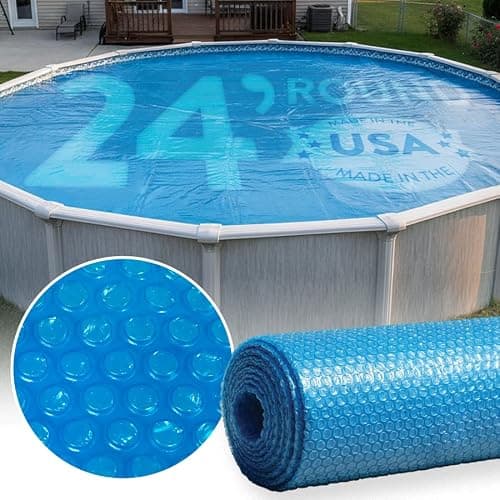
Bubble Solar Cover for Above-Ground Pools
Various
It cuts evaporation, and evaporation is simultaneously your water bill, your chemical bill and your heat loss. Nothing else on this site reduces three costs at once.
#ad how this is funded · price as of October 8, 2026
Key specs
- Construction
- Bubble sheet, thickness published in mil
- Thickness
- Higher mil lasts longer — 12 mil and 16 mil are common
- Fit
- Cut to size; buy oversize and trim
- Orientation
- Bubbles face down, toward the water
How it scoresour reading of published specs, not a test result
- Retention
- 9.0
- Durability
- 7.0
- Handling
- 6.0
- Running cost
- 9.8
- Value
- 9.5
Overall 9.0 / 10
What works
- Reduces evaporation, which is the mechanism behind the water, chemical and heat savings all at once
- Cheap relative to everything it saves
- Can be cut to fit any pool shape, so sizing is forgiving
What doesn't
- Awkward to get on and off without a reel, and awkward is how covers end up unused
- Degrades in UV like every vinyl product
- Not a safety cover and will not support weight — this is important
Skip it if: Being a safety barrier. A solar cover looks solid and is not; a child or pet on it goes through and under.
What it costs to run: The one accessory with a clear payback. Every gallon that does not evaporate is a gallon you do not replace at the EPA WaterSense national average of $6.06 per 1,000 gallons, and it is chlorine you do not re-dose. If you buy one thing from this hub, buy this.
Several seasons: Buy-once. Built and warranted to come back out of the box for a few years, if you store it properly.
Specs from: EPA WaterSense — cost per 1,000 gallons
Five months of weather, not one night
Winter Cover for Above-Ground Pools
Various
A structural product, not a summer one. Its job is carrying snow and blocking light for a whole winter, and a solar cover pressed into that role will be in shreds by February.
Key specs
- Construction
- Woven polyethylene, weight published in mil or scrim count
- Securing
- Cable and winch, or wraparound straps
- Overlap
- Needs genuine overlap past the wall — check the stated size against your pool
- Not the same as
- A solar cover or a safety cover
How it scoresour reading of published specs, not a test result
- Retention
- 8.5
- Durability
- 8.0
- Handling
- 6.5
- Running cost
- 9.0
- Value
- 8.5
Overall 8.3 / 10
What works
- Blocks light for the whole winter, which is what stops algae in a closed pool
- Cable-and-winch securing survives wind that lifts a strapped cover
- Buying the heavier scrim genuinely doubles the number of winters you get
What doesn't
- Needs a way to shed or pump off standing water, or the weight tears it
- Bulky to store in summer
- Not a safety cover — it will not support a person and must not be treated as if it will
Skip it if: A pool you take down each autumn. If the pool comes apart, the cover is money spent on nothing.
What it costs to run: This is insurance rather than a saving. A torn cover in January means an opening in April that costs a full shock treatment and a week of filtration to fix, which is more than the better cover cost.
Several seasons: Buy-once. Built and warranted to come back out of the box for a few years, if you store it properly.
Stopping ice from pushing on the wall
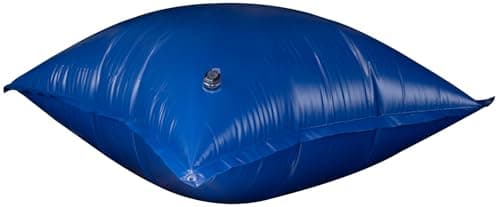
Winter Air Pillow for Above-Ground Pools
Various
A few dollars of inflatable that gives expanding ice something compressible to push against instead of your pool wall. In a freezing climate this is not optional.
#ad how this is funded · price as of October 8, 2026
Key specs
- Function
- Absorbs ice expansion; centers the load away from the wall
- Inflation
- Inflate to roughly 60% — a fully inflated pillow bursts
- Placement
- Centered under the winter cover
How it scoresour reading of published specs, not a test result
- Retention
- 8.0
- Durability
- 6.5
- Handling
- 9.0
- Running cost
- 10.0
- Value
- 9.0
Overall 8.4 / 10
What works
- Extremely cheap relative to the wall or liner it protects
- Also stops rainwater and snowmelt pooling in the center of the cover
- Reusable for several winters if it survives one
What doesn't
- Cheap ones deflate mid-winter, which is when it matters
- Must be tethered or it drifts to the edge and does nothing
- Over-inflating is the most common mistake and it destroys the pillow
Skip it if: Climates that do not freeze. If your water never ices over, this is solving a problem you do not have.
What it costs to run: The cheapest insurance in this entire site against the most expensive winter failure. Inflate to about 60% and tether it.
One honest season: The cheapest setup that genuinely works for a season of real swimming. Nothing spare, nothing missing.
When the liner has failed, not before
Replacement Above-Ground Pool Liner
Various
The one repair that is genuinely worth doing rather than replacing the whole pool, provided the frame is sound. Measure twice: liner fit is unforgiving.
Key specs
- Types
- Overlap, beaded and unibead — they are not interchangeable
- Measure
- Diameter and wall height, exactly
- Gauge
- Published in mil — thicker lasts longer and is harder to fit
How it scoresour reading of published specs, not a test result
- Retention
- 8.0
- Durability
- 8.0
- Handling
- 5.5
- Running cost
- 9.0
- Value
- 8.0
Overall 7.9 / 10
What works
- Far cheaper than replacing a pool whose frame is still good
- A thicker gauge liner outlasts the original on most budget kits
- Beaded liners can be replaced without dismantling the top rail
What doesn't
- Overlap, beaded and unibead are different fitting systems and buying the wrong one is a total loss
- Fitting is a warm-day job — cold vinyl will not stretch into place
- A liner failure often reveals a frame or base problem that caused it
Skip it if: A pool whose frame is corroded. Replacing the liner in a failing frame just moves the failure a few months out.
What it costs to run: The largest single unplanned expense of above-ground pool ownership, and it is mostly preventable: a ground cloth, a level base and a winter close done properly are what decide whether you ever buy one.
Several seasons: Buy-once. Built and warranted to come back out of the box for a few years, if you store it properly.
Questions people actually ask
Will one freezing night damage my above-ground pool?
Should I leave the pool pump running in a freeze?
Should I break the ice on my pool?
Do I need to lower the water level for a cold snap?
Sources
Read next
- Closing, covering and opening againWinterizing, covers and spring opening - the four weeks of the year that decide whether you own a pool next summer.
- How to winterize an above-ground poolThe correct closing sequence, the freeze damage that ends pools, and why a cracked pump housing is entirely preventable.
- Pool closing kits: buy one the first year, then stopWhat is in a closing kit, whether the bundle premium is justified, and how to buy separately once you know your water.
- Taking the pool down without ruining itThe take-down sequence for a seasonal pool: draining responsibly, drying completely, folding warm, and storing where rodents are not.
- Adding weeks to the season, starting with the cheapest thing firstCover, placement and timing before hardware, plus the kilowatt arithmetic that shows what running an electric heater actually costs.
- Pool pump problems, diagnosed in the cheapest orderThe five-check diagnostic sequence for an above-ground pool pump, from free fixes to the point at which it is genuinely the motor.
- The bill a bad close sends you in AprilThe spring bill produced by a bad autumn close, priced line by line, and the three cheap items that prevent nearly all of it.
- A cold climate does not stop you owning a pool. It picks which one.How a freezing winter changes the buying decision: which pools manufacturers allow to stay up, which must be drained and stored, and the closing kit that protects either.