Pool Equipment
The feeder turns a guess into a dial
A floating dispenser releases chlorine at whatever rate the water decides. A plumbed feeder releases it at the rate you set, which is the entire difference and it is a real one.
Heads up: we earn a commission if you buy through the links on this page, at no extra cost to you. It never decides the ranking — here is how we pick and here is the full disclosure. Prices are checked automatically; last verified October 8, 2026.
Quick picks
Segmented before it is ranked — the right answer depends on which of these you actually are. Tap any row for the full write-up.
The feeder
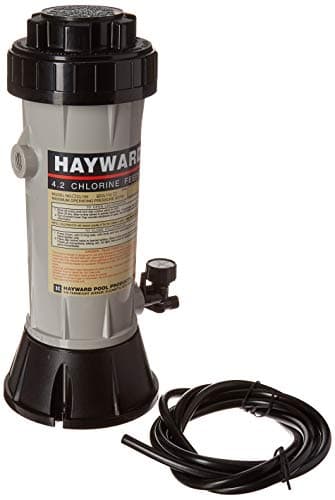
Off-line, 4.2 lb of 3-inch tablets, adjustable dial. The above-ground version ships with adapters for the common filter systems.
| # | Product | Best for | Score | Price |
|---|---|---|---|---|
| 1 | Off-Line Automatic Chlorine Feeder A tablet canister plumbed into the return line with an adjustable feed dial. It does what a floating dispenser does, with a rate you set rather than one the tablet decides. | Steady chlorination without a floaterSeveral seasons | 7.8out of 10 |
The cheaper way to do the same job
A floating dispenser costs a fraction as much and needs no plumbing. It gives up control in exchange.
| # | Product | Best for | Score | Price |
|---|---|---|---|---|
| 1 | 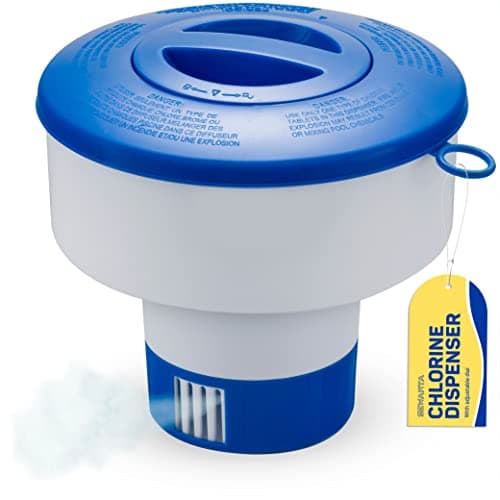 Floating Chlorine Tablet Dispenser Two dollars of plastic that decides whether your chlorine dissolves evenly over days or sits in a corner bleaching your liner. Buy it with the tablets, not after. | Making tablets work properlyOne honest season | 9.0out of 10 |
What goes in either of them
The same 3-inch stabilized tablets. Changing the delivery does not change the chemistry or the cyanuric acid that comes with it.
| # | Product | Best for | Score | Price |
|---|---|---|---|---|
| 1 | 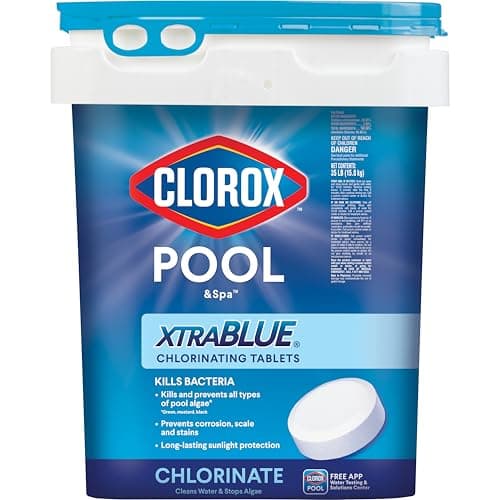 Clorox Pool&Spa 3-Inch Chlorinating Tablets Stabilized trichlor tablets in a floating dispenser is the standard answer for a seasonal above-ground pool, and this is the standard version of it. | The default chlorine sourceOne honest season | 8.5out of 10 |
The short version
- Off-line, not in-line. It sits beside the return rather than in the pressure path, which is the safer arrangement.
- The dial is the product. Everything else a floater already does for a fraction of the price.
- It does not change the chemistry. Same trichlor tablets, same cyanuric acid accumulation.
- It is an installation, not a purchase — and it only pays back on a pool that stays plumbed.
What it is and where it goes
An automatic chlorine feeder is a sealed canister holding 3-inch tablets, plumbed into the circulation so that a controlled fraction of the flow passes through it, dissolves some tablet, and returns to the pool.
The important distinction is off-line versus in-line. An in-line feeder sits in the main return path, so everything the pump moves goes through it. An off-line feeder is plumbed as a bypass beside the return, taking a small diverted flow. Off-line is the common above-ground arrangement and it is the better one: if the feeder fails or fouls, the pool keeps circulating.
The common above-ground unit holds 4.2 lb of tablets and ships with a universal adapter kit for the usual filter systems — which matters, because fitting is exactly where these go wrong. Our hoses and fittings guide is the general version of that warning.
What it actually buys you
| Floating dispenser | Off-line feeder | |
|---|---|---|
| Dose control | Vent adjustment, approximate | Dial valve, repeatable |
| Capacity | A few tablets | 4.2 lb |
| Installation | Drop it in | Plumbed to the equipment pad |
| In the way | Yes — it drifts, kids grab it | No, it is off the pool entirely |
| Fails how | Drifts into the skimmer | Fouls or leaks at a fitting |
| At closing | Lift it out | Drain and clear it like any plumbing |
| Cost | Very low | Meaningfully higher, plus fitting |
Two rows carry the argument. Dose control is genuinely better — a dial you can turn a quarter-turn and leave is repeatable in a way a floating dispenser’s vent ring is not. And capacity changes the routine from topping up the floater every few days to loading the feeder weekly.
Everything else in the table is a point against, which is why our floating dispenser roundup remains the default recommendation for most readers of this site.
The seasonal-pool question
This is the honest crux for this site’s readers, and it is the same shape as the argument in our salt system payback guide.
A feeder is an installation. You plumb it in, you set it, and from then on it saves you a task every few days. On a pool that stays up and plumbed year after year, that installation is amortized over many seasons and the convenience compounds.
On a pool that is drained, dismantled and stored every autumn — the situation our storing a pool guide describes — you are fitting and unfitting it annually, and a floating dispenser you lift out in thirty seconds starts looking considerably better.
Fitting notes
Downstream of the filter, before the return. Concentrated tablet solution should not be passing through the filter media.
Set the dial low and raise it. Over-feeding is hard on fittings and produces a pool with high chlorine and dropping pH — trichlor is acidic. Start at the lowest useful setting, test after a few days, and adjust once. Our weekly schedule covers the testing cadence.
Never mix chemistries in it. Trichlor and cal-hypo in the same canister is a genuinely dangerous combination. One product, and flush the unit before ever changing type.
It is plumbing at closing. Drain and clear it like any other line — our winterizing guide and antifreeze guide both apply.
What we are scoring
We have not tested these and do not claim to. The scores reflect published specifications — capacity, feed control, off-line versus in-line design, construction and supplied adapters — against an above-ground pool with a standard filter system. Our methodology page explains how our scoring works.
The picks, in full
Scores are our own reading of published specifications. They are not test results — we have not tested these products and we do not claim to.
Pick #1 · Steady chlorination without a floater
Off-Line Automatic Chlorine Feeder
Hayward
A tablet canister plumbed into the return line with an adjustable feed dial. It does what a floating dispenser does, with a rate you set rather than one the tablet decides.
Key specs
- Capacity
- 4.2 lb of tablets on the common above-ground unit
- Tablets
- 3 in trichlor
- Type
- Off-line — plumbed beside the return, not into it
- Control
- Dial valve sets the feed rate
- Fitting
- Universal adapter kit for above-ground filter systems
- Construction
- Corrosion-resistant housing
How it scoresour reading of published specs, not a test result
- Sizing fit
- 7.0
- Running cost
- 8.5
- Maintenance
- 7.5
- Build
- 8.5
- Value
- 7.5
Overall 7.8 / 10
What works
- Feed rate is a dial rather than a guess, which a floating dispenser cannot offer
- Holds several days of tablets, so the routine becomes weekly rather than daily
- Off-line design means it is not in the pressure path if it fails
- The above-ground version ships with adapters for the common filter systems
What doesn't
- It is plumbing — a permanent installation on the equipment pad, not a purchase you drop in
- Trichlor tablets add cyanuric acid, exactly as a floater does
- Concentrated tablet solution is hard on fittings if the feed rate is set too high
- Has to be drained and cleared at closing like everything else in the line
Skip it if: A pool that is dismantled every autumn. The installation only pays back on a pool that stays plumbed year after year.
What it costs to run: It changes how tablets are delivered, not how many you use. The tablet bill is the same one our chlorine tablet roundup prices; what you are buying is control and fewer trips to the pool.
Several seasons: Buy-once. Built and warranted to come back out of the box for a few years, if you store it properly.
Specs from: Hayward CL110ABG off-line above-ground chemical feeder — Amazon listing
Pick #2 · Making tablets work properly
Floating Chlorine Tablet Dispenser
Various
Two dollars of plastic that decides whether your chlorine dissolves evenly over days or sits in a corner bleaching your liner. Buy it with the tablets, not after.
#ad how this is funded · price as of October 8, 2026
Key specs
- Function
- Holds 3-inch tablets, meters dissolution rate
- Adjustment
- Vented base, adjustable on most models
- Compatibility
- Standard 3-inch tablets
How it scoresour reading of published specs, not a test result
- Effectiveness
- 8.0
- Ease
- 9.5
- Water impact
- 9.0
- Cost per season
- 9.8
- Value
- 9.5
Overall 9.0 / 10
What works
- Adjustable venting lets you slow or speed dissolution to match the weather
- Keeps tablets off the liner, which is what causes bleach spots
- Trivially cheap and lasts years
What doesn't
- Drifts to one end of the pool in wind, so distribution is uneven without circulation
- Must be removed before swimming with small children
- Cheap ones crack after a season in UV
Skip it if: Being left in an empty or unfiltered pool. Without circulation it creates a concentrated pocket rather than an even dose.
What it costs to run: The cheapest item on this site and one of the highest-return: even dissolution means you use fewer tablets to hold the same free chlorine level.
One honest season: The cheapest setup that genuinely works for a season of real swimming. Nothing spare, nothing missing.
Pick #3 · The default chlorine source
Clorox Pool&Spa 3-Inch Chlorinating Tablets
Clorox Pool&Spa
Stabilized trichlor tablets in a floating dispenser is the standard answer for a seasonal above-ground pool, and this is the standard version of it.
#ad how this is funded · price as of October 8, 2026
Key specs
- Type
- Stabilized trichlor, 3-inch tablets
- Contains stabilizer
- Yes — cyanuric acid is part of trichlor
- Dosing
- Per manufacturer instructions, by pool volume
- CDC target
- At least 2 ppm free chlorine when using a stabilizer
How it scoresour reading of published specs, not a test result
- Effectiveness
- 9.0
- Ease
- 9.0
- Water impact
- 6.0
- Cost per season
- 8.5
- Value
- 8.5
Overall 8.5 / 10
What works
- Dissolves slowly, so a floating dispenser meters chlorine out over days rather than hours
- Stabilized, so sunlight does not destroy your chlorine within an afternoon
- Widely stocked, so you are never hunting for it in July
What doesn't
- Every tablet adds cyanuric acid, and in a pool you never fully drain that accumulates until chlorine stops responding
- Trichlor is acidic and will pull your pH down over a season
- Tablets must be kept dry and sealed or they degrade and gas off
Skip it if: A small pool that is topped up rather than drained. Cyanuric acid only leaves with the water, so in a 1,500-gallon pool it climbs fast.
What it costs to run: The standing chemical cost of the season, and it scales directly with gallons. Watch the cyanuric acid reading on your test strip: once it is high, you are buying chlorine that cannot work, which is the most common invisible waste in a first pool year.
One honest season: The cheapest setup that genuinely works for a season of real swimming. Nothing spare, nothing missing.
Specs from: CDC — free chlorine target with cyanuric acid
Questions people actually ask
What is the difference between an in-line and an off-line chlorinator?
Is a chlorine feeder better than a floating dispenser?
Does a chlorine feeder stop cyanuric acid building up?
Can I put different chemicals in the same feeder?
Sources
Read next
- Equipment, sized to your pool and costed by the wattPumps, filters, vacuums, heaters and ladders - matched to your gallons and priced by what they draw.
- Automating a small pool: one thing is obvious, the rest is notWhich pool automation genuinely pays on a seasonal above-ground pool, ranked, and which items are solving inground problems.
- Nothing in this category is standardized, and the hoses are where you find outHow to measure your own hose and fitting sizes, why suction-side air leaks matter so much, and what to check before ordering a replacement pump.
- Salt systems for an above-ground poolHow a chlorine generator works, what the cell costs over time, and why draining the pool each autumn changes the answer entirely.
- The floating dispenser, and why it prevents more than it costsWhat to look for in a floating chlorine dispenser, why loose tablets damage liners, and the tablet arithmetic by pool size.
- The best chlorine tablets for an above-ground poolTrichlor tablets compared on available chlorine and stabilizer load, with the season-quantity arithmetic for your pool size.
- Cyanuric acid: the reading that explains your chlorineWhy an outdoor pool needs stabilizer, why tablets add it whether you want them to or not, and the only way to bring it back down.
- The weekly pool routine, and how little time it really takesThe daily, weekly and monthly jobs written as a schedule, with the kit each one needs and roughly how long it takes.
- The salt system pays back, eventually, on some poolsThe honest payback arithmetic on a salt chlorine generator for a seasonal above-ground pool, including the cell replacement most buyers do not budget for.
- Floater or feeder: the same tablets, metered two different waysFloating dispensers against off-line tablet feeders: capacity, dose control, what each does to a vinyl liner, and why neither belongs in the skimmer basket.