Pool Costs
The deck costs more than the pool
Almost everyone works this out after they have bought the pool. It is the single largest follow-on cost in above-ground ownership and it is entirely optional.

Heads up: we earn a commission if you buy through the links on this page, at no extra cost to you. It never decides the ranking — here is how we pick and here is the full disclosure. Prices are checked automatically; last verified October 8, 2026.
The short version
- A deck is usually the larger of the two purchases. People budget for the pool and discover the deck afterwards.
- Four cost drivers, in order: square footage, height off the ground, material, and whether a permit and an inspection are involved.
- Height is the expensive variable, not area. A deck at 52 inches needs footings, framing, rails and stairs; a ground-level platform needs almost none of it.
- Three cheaper things solve most of what a deck solves — and one of them is a $40 mat.
Why this page exists
The category talks about deck cost as a single number, which is useless, because the same deck around the same pool can differ by a factor of five depending on how high it sits and what it is made of. What follows is the structure of the number rather than the number itself — work it against quotes from your own area, because labor is the largest line and labor is local.
It matters because this is the biggest way an above-ground pool stops being the cheap option. Our above-ground pool cost guide prices the pool itself, and a full surround deck routinely exceeds it. A family who budgeted from that page and then added a deck has doubled the project without noticing the decision being made.
The four things that set the price
| Driver | Why it matters | Where it bites |
|---|---|---|
| Height off the ground | Above about 30 in, guardrails and proper footings become structural requirements | The single biggest step change in the whole budget |
| Square footage | Full wrap-around versus a landing at the ladder | Wrap-around is several times the material of a landing |
| Material | Pressure-treated lumber, cedar, or composite | Composite costs far more up front and far less per year |
| Permit and inspection | Many jurisdictions require both above a height threshold | Adds fees, drawings and a schedule you do not control |
| Stairs and gate | A deck at pool height needs safe access and a closing gate | Often quoted separately and always necessary |
| Ground preparation | Footings need to be below frost depth in cold climates | Invisible work; it is dug, poured and buried |
Height is the one to internalize. A Bestway Steel Pro MAX at 42 inches and an Intex Ultra XTR at 52 inches are not a 10-inch difference in decking — they can be the difference between a structure that needs guardrails, engineered footings and a permit and one that does not. Our permits and rules guide covers why the threshold is a local question you have to ask before you buy lumber, not after.
Where the money actually goes
On a built deck, materials are usually the minority of the bill. Framing labor, footings and the stairs dominate, which is why the DIY-versus-hired gap is so wide here — wider than on any other pool purchase. Our DIY versus paying guide makes the general case; decking is the extreme version of it.
The second thing worth knowing is that a deck is a maintenance commitment. Pressure-treated lumber near a chlorinated pool needs sealing on a cycle, and the boards nearest the water are the ones that go first. Composite removes that and costs substantially more at the start — a real trade, not a marketing one, and it turns on how many years you plan to keep the pool. Our pool lifespan guide is the other half of that arithmetic: a deck outliving the pool it was built for is a common and expensive outcome.
What a deck is actually solving
This is the question that saves people the most money, because a deck is usually bought to solve three specific problems, and all three have cheaper answers.
Problem one: getting in and out safely. A proper A-frame ladder with a lockable or removable outer section does this for a fraction of the cost. Our ladder roundup covers weight ratings and the barrier function, which is the part of a ladder that matters most.
Problem two: not walking grass and grit into the pool. This is the real reason most pools get dirty, and it is solved by a mat at the base of the ladder, not by a structure. Under $50 against several thousand.
Problem three: somewhere to sit. A paver patio beside the pool, at ground level, does this with no footings, no permit, no guardrails and no annual sealing. It is the option our decks and surrounds guide ends up recommending most often.
Things that quietly add to the quote
Ground that is not level. The pool needs level ground and so does the deck, and they are two separate leveling problems. Our leveling guide covers the first; sloped ground makes the second considerably more expensive because posts get longer and footings get deeper.
Electrical work. Lights and outlets on a deck beside water are a GFCI-protected circuit installed by an electrician, not an extension lead. Our electrical safety guide is clear on where that line sits.
Removal later. A deck is a permanent structure attached to a temporary pool. When the pool goes — and our resale and disposal guide covers when that happens — the deck either stays as a deck to nowhere or becomes a demolition job.
How to budget this honestly
Get three written quotes for the specific deck you want, in your own area, and treat anything you read online as structure rather than price. Then run the total through our budget worksheet alongside the pool, the chemicals and the first season of electricity from the annual cost guide.
If the combined number changes how you feel about the project, that is the worksheet doing its job. The deck is the one line on it that is genuinely optional.
What to buy
Scores are our own reading of published specifications. They are not test results — we have not tested these products and we do not claim to.
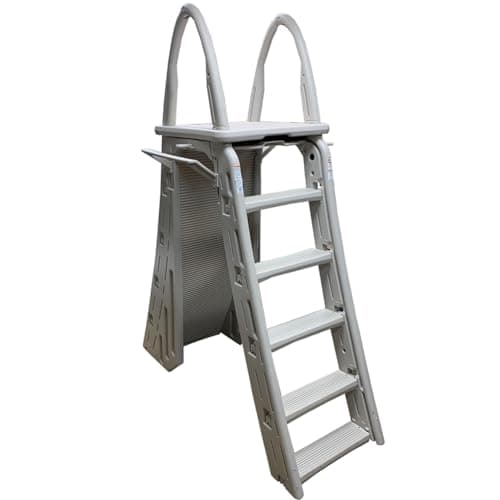
Getting in and out safely
A-Frame Above-Ground Pool Ladder
Various
Read the published weight limit before anything else. It is frequently lower than buyers assume, and it is the one spec on a ladder that genuinely matters.
#ad how this is funded · price as of October 8, 2026
Key specs
- Critical spec
- Published weight capacity — check it against every adult who will use it
- Height match
- Must match your wall height, not approximate it
- Safety feature
- Removable or lockable outer steps on better models
How it scoresour reading of published specs, not a test result
- Sizing fit
- 8.5
- Running cost
- 10.0
- Maintenance
- 8.5
- Build
- 7.5
- Value
- 8.5
Overall 8.4 / 10
What works
- Removable outer steps genuinely prevent unsupervised access, which is a real safety layer
- Resin frames do not corrode the way early steel ladders did
- Correctly matched height is far more stable than a too-tall ladder
What doesn't
- Weight limits are often lower than people expect and are easy to overlook in a listing
- A ladder sized for a 42-inch wall is wrong on a 52-inch wall and vice versa
- Cheap models flex enough to feel alarming
Skip it if: Being a barrier on its own. The CPSC's guidance treats barriers, supervision and alarms as layers; a removable step is one layer, not the answer.
What it costs to run: Buy it with the pool. Kits that include a ladder are frequently cheaper than the pool-plus-ladder bought separately, and this is one of the accessories that makes a cheap-looking kit expensive.
Several seasons: Buy-once. Built and warranted to come back out of the box for a few years, if you store it properly.
Specs from: CPSC — Pool Safely
Protecting the liner from below
Pool Ground Cloth / Under-Pool Pad
Various
Most liner punctures come from underneath, from a stone or a root you did not see. A ground cloth is the cheapest way to avoid the most expensive repair in above-ground pool ownership.
Key specs
- Function
- Barrier between ground and liner
- Sizing
- Should extend past the pool footprint
- Included with
- Some kits — check before buying separately
How it scoresour reading of published specs, not a test result
- Retention
- 8.0
- Durability
- 7.5
- Handling
- 8.5
- Running cost
- 10.0
- Value
- 9.0
Overall 8.5 / 10
What works
- Prevents the failure mode that ends pools: a puncture in the floor you cannot reach to patch
- Also slows grass and weeds growing up under the pool
- Included free in better kits, so check before you buy one
What doesn't
- Not a substitute for actually clearing stones and roots first
- Thin ones tear during installation before the pool is even up
- Traps moisture, which kills the grass underneath regardless
Skip it if: Fixing uneven ground. It protects against punctures; it does nothing about level, and level is the bigger problem.
What it costs to run: Compare its cost to a liner replacement, which is the single largest unplanned expense in above-ground pool ownership. It is not a close call.
Several seasons: Buy-once. Built and warranted to come back out of the box for a few years, if you store it properly.
A barrier between the yard and the water
Removable Mesh Pool Safety Fence
Various
Sectional mesh panels on stainless pegs that go in without concrete and come out for winter. The only item on this site that does anything about the risk that matters most.
Key specs
- Panel height
- 4 ft is the common residential size
- Panel length
- Sold in 12 ft and 15 ft sections
- Mesh
- UV-stabilized, chlorine-resistant, around 320 GSM
- Poles
- Powder-coated aluminum, roughly 36 in spacing
- Fixings
- Stainless steel pegs into sleeved ground holes
- Certification
- Look for ASTM F2286 on the listing
How it scoresour reading of published specs, not a test result
- Sizing fit
- 8.0
- Running cost
- 10.0
- Maintenance
- 8.5
- Build
- 8.0
- Value
- 8.5
Overall 8.6 / 10
What works
- Removable — the sleeves stay in the ground, the fence does not
- Mesh is see-through, so a child at the fence is still visible from the house
- No footings, no concrete, and no permanent change to the yard
- Sections can be reconfigured if the pool moves or the yard changes
What doesn't
- Only certain listings state ASTM F2286 compliance, and that is the line worth paying for
- Needs drilling sleeve holes into whatever surface surrounds the pool
- A self-closing, self-latching gate is usually a separate purchase
- Soft ground and sloped lawns both make a taut, secure run harder
Skip it if: Being a substitute for an adult watching. A fence buys time to notice; it does not remove the need to notice.
What it costs to run: Priced per linear foot, so the cost is set by your perimeter, not your pool. Measure the run you actually need to enclose before comparing listings — a 4-sided enclosure and a 3-sided one using the house wall are very different numbers.
Several seasons: Buy-once. Built and warranted to come back out of the box for a few years, if you store it properly.
Specs from: Removable mesh pool fences — current Amazon category listing
Questions people actually ask
Does an above-ground pool deck cost more than the pool?
What makes a pool deck expensive?
Do I need a deck for an above-ground pool?
Does a deck change pool safety?
Sources
Read next
- What a pool actually costs, with the arithmetic shownPurchase, electricity, chemicals, water and replacement parts - added up, sourced, and shown as arithmetic you can redo.
- What an above-ground pool costs to buyThe purchase side: what is in the kit, what is not, and the day-one spend that turns a cheap pool into a not-cheap one.
- What an above-ground pool actually costs to run for a yearElectricity, chemicals, water and consumables for a full season - every input sourced, every calculation shown, and every assumption named.
- What is worth doing yourself, and the two things that are notEvery above-ground pool task sorted into do-it-yourself, worth paying for, and not a DIY decision - with the reasoning for each.
- The fence is priced by your yard, not your poolHow pool fence cost is actually calculated, what drives it up, and where the other layers of protection sit on price.
- Building around the pool, and what it changes about the poolDecks, platforms and steps around an above-ground pool - what they change about safety and maintenance, and the cheaper options that work.
- Permits, fences and the calls to make before you buyThe questions that decide whether you need a permit or a barrier, who to ask, and the safety layers that apply regardless of what the rules say.
- Leveling the ground, and the weight that makes it matterThe tolerance manufacturers publish, the weight of water that enforces it, and the method for getting a circle genuinely flat with hand tools.
- Above-ground pool ladders, and the spec everyone skipsWeight capacity, height matching, and removable outer steps - the three things that decide whether a ladder is right.