Pool Costs
What happens at the end: selling it, giving it away, or getting rid of it
Above-ground pools depreciate steeply and cost a lot to ship, which makes the secondhand market strange - and it is why a sound pool is worth listing rather than skipping.

Heads up: we earn a commission if you buy through the links on this page, at no extra cost to you. It never decides the ranking — here is how we pick and here is the full disclosure. Prices are checked automatically; last verified October 8, 2026.
The short version
- The liner decides the price. A supple liner makes it a pool; a brittle one makes it a frame with a free problem attached.
- Complete hardware is worth more than condition. Frame pins and connectors are model-specific and frequently unavailable separately.
- Sell it dry, clean and photographed laid out. Nobody buys a heap of vinyl from a photograph of a heap of vinyl.
- Disposal is by material, not as one item. Steel frame, vinyl liner and a small electrical appliance go to three different places.
Why the secondhand market for these is odd
Two forces pull in opposite directions. These pools are bulky and heavy, so shipping one is expensive relative to its price — which suppresses what anyone will pay. But a buyer who can collect gets something that would otherwise cost a great deal more new, and the depreciation curve is steep in the first two seasons.
The result is a genuinely active local market for sound pools, and almost none at all for questionable ones. There is very little middle ground: a pool with a supple liner and all its hardware sells quickly to someone with a van, and a pool with a brittle liner does not sell at any price, because the buyer is really buying a replacement liner.
| Feature | Effect on value | Why |
|---|---|---|
| Liner supple at the water line | Decides everything | Brittle vinyl is age, not damage, and is unrepairable |
| All frame hardware present | Large | Pins and connectors are model-specific |
| Original manual or parts list | Surprisingly large | Assembly without it is guesswork |
| Frame joints free of deep rust | Large | That is the load path |
| Working pump with known model | Moderate | Replaceable, but it is one less purchase |
| Ladder matching the wall height | Moderate | A mismatched ladder is worth nothing |
| Ground cloth and cover | Small but real | Both are things the buyer must otherwise buy |
| Age in seasons | Moderate | One or two seasons sells; five is a frame |
Making it saleable, which is mostly presentation
The single biggest thing you can do is take it down properly rather than hurriedly, and that is the same routine as storing it for winter — clean the liner while the wall is still supported, dry it fully on both sides, fold it loosely on a mild day, and keep every piece of hardware together. Our take-down guide is the sequence.
Then photograph it laid out rather than bagged. A buyer for a used pool is trying to answer three questions from a listing: is the liner sound, is the frame complete, and is the pump included. Photographs of the liner unrolled flat, the frame components laid in groups, and the pump label are worth more than any description.
State the pool’s exact model, diameter and wall height in the listing. That is what a buyer needs in order to check whether a replacement liner, ladder or cover is available for it — and our buying used guide is the checklist they will arrive with.
Giving it away, and being honest about it
A pool with a tired liner but a sound frame genuinely has value to someone who wants the frame and intends to buy a liner — and being explicit about that is what makes the transaction work rather than becoming a complaint.
Say what is wrong. “Frame is complete and sound; liner is at the end of its life and needs replacing” is an attractive listing at the right price, because the buyer knows what they are pricing. Our liner replacement guide covers why liner types are not interchangeable and why the buyer will need the exact dimensions.
Disposal, which is three separate jobs
If it has genuinely failed, it does not go out as one item. It is a steel structure, a large sheet of vinyl and a small electrical appliance, and most collection services treat those differently.
| Component | Category | Notes |
|---|---|---|
| Steel frame and uprights | Scrap metal | Frequently collected free, sometimes paid for |
| Vinyl liner | General waste, usually | Bulky — cut into manageable sections first |
| Pump and motor | Small electrical appliance | Drain it fully first; do not bin it whole |
| Cartridges and chemicals | Household hazardous waste | Never bin part-used pool chemicals |
| Ground cloth | General waste | Rinse and dry so it is not sodden |
| Ladder | Metal or general, by construction | Worth listing separately — they sell |
The water, which is the first job
Before any of this, the pool has to be emptied, and several thousand gallons has to go somewhere. Let the chlorine level fall over several days first, drain slowly through the plug rather than tipping the wall, and spread the discharge — water released in one place saturates ground, can undermine a path and on a slope finds a building or a boundary.
Local rules on discharging pool water vary and we cannot look yours up. The same caution applies here as in our take-down guide, and the ground underneath will need the recovery covered in our pool and lawn guide.
Keeping the parts that outlive the pool
Several things survive the pool they came with and are worth keeping or listing separately rather than skipping.
The pump, if it works, is sized by gallons rather than by pool brand and will suit a similar-volume pool. The ladder sells readily if you state the wall height it fits. Unopened cartridges in a common format such as Type A are worth passing on. And the solar cover and reel, if the cover is not brittle, are among the most useful things any pool owner can be given.
That is also the argument for buying those items well in the first place: they are durables that outlast the pool, which is exactly the case our cheap versus expensive guide makes, and the year two guide counts them as one-off purchases for the same reason.
What to buy
Scores are our own reading of published specifications. They are not test results — we have not tested these products and we do not claim to.
When the liner has failed, not before
Replacement Above-Ground Pool Liner
Various
The one repair that is genuinely worth doing rather than replacing the whole pool, provided the frame is sound. Measure twice: liner fit is unforgiving.
Key specs
- Types
- Overlap, beaded and unibead — they are not interchangeable
- Measure
- Diameter and wall height, exactly
- Gauge
- Published in mil — thicker lasts longer and is harder to fit
How it scoresour reading of published specs, not a test result
- Retention
- 8.0
- Durability
- 8.0
- Handling
- 5.5
- Running cost
- 9.0
- Value
- 8.0
Overall 7.9 / 10
What works
- Far cheaper than replacing a pool whose frame is still good
- A thicker gauge liner outlasts the original on most budget kits
- Beaded liners can be replaced without dismantling the top rail
What doesn't
- Overlap, beaded and unibead are different fitting systems and buying the wrong one is a total loss
- Fitting is a warm-day job — cold vinyl will not stretch into place
- A liner failure often reveals a frame or base problem that caused it
Skip it if: A pool whose frame is corroded. Replacing the liner in a failing frame just moves the failure a few months out.
What it costs to run: The largest single unplanned expense of above-ground pool ownership, and it is mostly preventable: a ground cloth, a level base and a winter close done properly are what decide whether you ever buy one.
Several seasons: Buy-once. Built and warranted to come back out of the box for a few years, if you store it properly.
Protecting the liner from below
Pool Ground Cloth / Under-Pool Pad
Various
Most liner punctures come from underneath, from a stone or a root you did not see. A ground cloth is the cheapest way to avoid the most expensive repair in above-ground pool ownership.
Key specs
- Function
- Barrier between ground and liner
- Sizing
- Should extend past the pool footprint
- Included with
- Some kits — check before buying separately
How it scoresour reading of published specs, not a test result
- Retention
- 8.0
- Durability
- 7.5
- Handling
- 8.5
- Running cost
- 10.0
- Value
- 9.0
Overall 8.5 / 10
What works
- Prevents the failure mode that ends pools: a puncture in the floor you cannot reach to patch
- Also slows grass and weeds growing up under the pool
- Included free in better kits, so check before you buy one
What doesn't
- Not a substitute for actually clearing stones and roots first
- Thin ones tear during installation before the pool is even up
- Traps moisture, which kills the grass underneath regardless
Skip it if: Fixing uneven ground. It protects against punctures; it does nothing about level, and level is the bigger problem.
What it costs to run: Compare its cost to a liner replacement, which is the single largest unplanned expense in above-ground pool ownership. It is not a close call.
Several seasons: Buy-once. Built and warranted to come back out of the box for a few years, if you store it properly.
Getting in and out safely
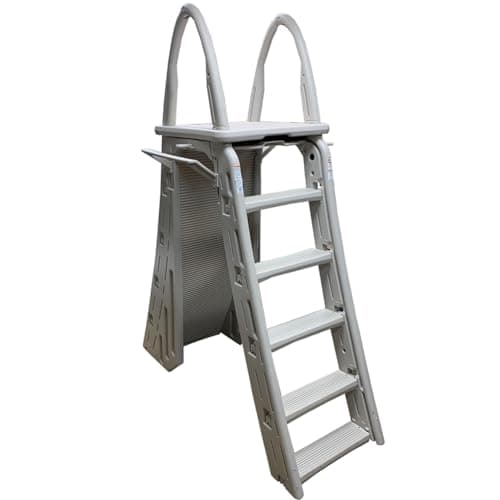
A-Frame Above-Ground Pool Ladder
Various
Read the published weight limit before anything else. It is frequently lower than buyers assume, and it is the one spec on a ladder that genuinely matters.
#ad how this is funded · price as of October 8, 2026
Key specs
- Critical spec
- Published weight capacity — check it against every adult who will use it
- Height match
- Must match your wall height, not approximate it
- Safety feature
- Removable or lockable outer steps on better models
How it scoresour reading of published specs, not a test result
- Sizing fit
- 8.5
- Running cost
- 10.0
- Maintenance
- 8.5
- Build
- 7.5
- Value
- 8.5
Overall 8.4 / 10
What works
- Removable outer steps genuinely prevent unsupervised access, which is a real safety layer
- Resin frames do not corrode the way early steel ladders did
- Correctly matched height is far more stable than a too-tall ladder
What doesn't
- Weight limits are often lower than people expect and are easy to overlook in a listing
- A ladder sized for a 42-inch wall is wrong on a 52-inch wall and vice versa
- Cheap models flex enough to feel alarming
Skip it if: Being a barrier on its own. The CPSC's guidance treats barriers, supervision and alarms as layers; a removable step is one layer, not the answer.
What it costs to run: Buy it with the pool. Kits that include a ladder are frequently cheaper than the pool-plus-ladder bought separately, and this is one of the accessories that makes a cheap-looking kit expensive.
Several seasons: Buy-once. Built and warranted to come back out of the box for a few years, if you store it properly.
Specs from: CPSC — Pool Safely
Pools up to about 6,000 gallons
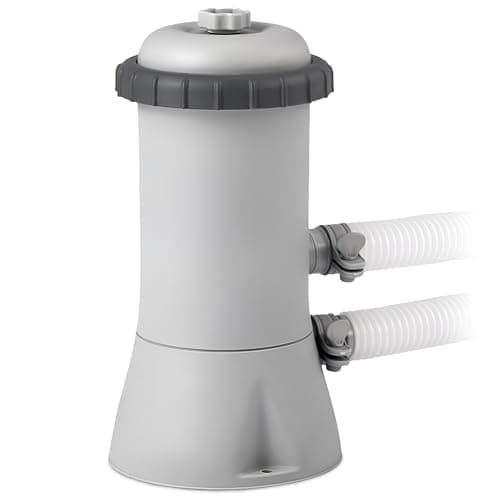
Intex Krystal Clear C1000 Cartridge Filter Pump
Intex
The workhorse replacement pump for mid-size frame pools. 1,000 GPH pump flow, 750 GPH through the system once the cartridge is in the way — and that second number is the one your turnover math needs.
#ad how this is funded · price as of October 8, 2026
Key specs
- Pump flow rate
- 1,000 GPH
- System flow rate
- 750 GPH
- Rated pool size
- Up to 6,000 gallons
- Cartridge
- Type A
- Wattage
- Not published by Intex
How it scoresour reading of published specs, not a test result
- Sizing fit
- 9.0
- Running cost
- 7.0
- Maintenance
- 7.5
- Build
- 7.5
- Value
- 8.5
Overall 8.3 / 10
What works
- Intex publishes both pump flow and system flow, which is more honesty than most of this category offers
- Type A cartridges are the most widely stocked filter consumable in the US
- Sized correctly for the 12ft-15ft frame pools most families own
What doesn't
- Wattage is not published anywhere on the Intex site, so you cannot cost it before purchase
- Cartridge-only, so there is a consumable every few weeks in a busy pool
- GFCI cord length dictates where the pool can go more than people expect
Skip it if: Pools over about 6,000 gallons. Above that you are asking it to run all day to achieve one turnover, which is the expensive way to filter.
What it costs to run: Do the turnover math before you buy: 750 GPH system flow moves 4,000 gallons in 5.3 hours. Two turnovers a day is therefore about 11 hours of running. At the EIA's June 2026 US residential average of 18.34 cents per kWh, every 100 watts of pump draw running 11 hours a day for a 120-day season costs about $24. Find your wattage on the pump label and multiply.
Several seasons: Buy-once. Built and warranted to come back out of the box for a few years, if you store it properly.
Specs from: Intex — Krystal Clear cartridge filter pumps, EIA Electric Power Monthly, Table 5.6.A — US residential average price
The consumable you will actually buy repeatedly
Type A Replacement Filter Cartridges (multipack)
Various
Buy them in a multipack before you need them. A pool running on an exhausted cartridge is a cloudy pool, and the fix is a two-dollar part you did not have.
Key specs
- Type
- Type A — the most common Intex format
- Replacement interval
- Every 2 weeks in heavy use, per Intex guidance
- Between changes
- Rinse, do not scrub
How it scoresour reading of published specs, not a test result
- Sizing fit
- 9.0
- Running cost
- 7.0
- Maintenance
- 8.5
- Build
- 7.0
- Value
- 8.5
Overall 8.2 / 10
What works
- Type A is the most widely stocked cartridge format in the US
- Multipacks cost a fraction of buying singles
- Having a spare turns a cloudy week into a five-minute fix
What doesn't
- It is a genuine recurring cost that nobody includes in the purchase price
- Aftermarket quality varies noticeably
- Rinsing extends life but does not restore a cartridge that is done
Skip it if: Being restored. Once the pleats are permanently gray and stiff, rinsing is not saving it.
What it costs to run: The line item most people leave out of their pool budget. Count how many you use in your first season and you have your real annual filtration cost — this is exactly the number the cost-to-run guide asks you to record.
One honest season: The cheapest setup that genuinely works for a season of real swimming. Nothing spare, nothing missing.
Questions people actually ask
What is a used above-ground pool worth?
How do I make my old pool easier to sell?
How do you dispose of an above-ground pool?
Can I put pool chemicals in the bin?
Sources
Read next
- What a pool actually costs, with the arithmetic shownPurchase, electricity, chemicals, water and replacement parts - added up, sourced, and shown as arithmetic you can redo.
- Year two, and the lines that disappearWhich pool costs are one-off and which recur, with a year-one and year-two comparison for the same pool.
- What actually wears out, and when you will be buying itThe replacement schedule for an above-ground pool - cartridges, covers, liners and hardware - and which spares are worth keeping on the shelf.
- Buying a used pool without buying somebody else's problemThe inspection checklist for a secondhand pool, which faults are cheap and which end the deal, and the parts you will have to buy anyway.
- Moving a pool, and the two things that decide whether it survivesThe sequence for relocating an above-ground pool across the garden or to a new house, and an honest read on when it is not worth it.
- Taking the pool down without ruining itThe take-down sequence for a seasonal pool: draining responsibly, drying completely, folding warm, and storing where rodents are not.
- How long an above-ground pool actually lastsRealistic lifespans by pool type, the four failure modes that account for nearly all of them, and the cheap items that add seasons.