Pool Care & Chemistry
Pool losing water: the bucket test answers this for free
Before you buy anything, you can find out whether you have a leak with a bucket and two pen marks. The published evaporation figures tell you what normal looks like, and most dropping water levels are normal.
Heads up: we earn a commission if you buy through the links on this page, at no extra cost to you. It never decides the ranking — here is how we pick and here is the full disclosure. Prices are checked automatically; last verified October 8, 2026.
The short version
- Diagnose before you buy anything. The bucket test costs nothing and settles the question in two days.
- Wind, not heat, is the biggest evaporation variable. Published rates go from 0.20 in a day in still air to 1.06 in at 10 mph in otherwise identical conditions.
- Pump off is the second test. A leak that slows when the pump stops is a fitting or a hose, not the liner.
- The real cost is chemistry, not water. Constant top-up dilutes stabilizer and alkalinity, so nothing you add ever holds.
What normal water loss looks like
Almost every “my pool is leaking” worry starts with the same observation: the water is lower than it was. That is also what a pool that is working correctly looks like, so the first job is knowing what normal is before you go looking for a hole.
| Wind | Rate published | 10 ft pool (79 sq ft) | 15 ft pool (177 sq ft) | 24 ft pool (452 sq ft) |
|---|---|---|---|---|
| Still air | 0.20 in/day | about 10 gal/day | about 22 gal/day | about 56 gal/day |
| 5 mph | 0.62 in/day | about 31 gal/day | about 68 gal/day | about 175 gal/day |
| 10 mph | 1.06 in/day | about 52 gal/day | about 117 gal/day | about 299 gal/day |
The headline figure the same source quotes from the California Spa and Pool Industry Education Council is half an inch to two inches of evaporation per week. Note how wide that is, and note that the three rows above differ only in wind speed — same water temperature, same air temperature, same humidity. An exposed pool in a breezy yard loses five times what the same pool loses in still air.
Which is why “it went down two inches this week” is not evidence of anything on its own. Two inches is the top of the published normal range. The test below is what turns an observation into an answer.
The bucket test, in full
This is the whole diagnosis and it costs nothing. Both sources on this page publish essentially the same procedure; the version in the steps below is the water district’s, which is the more complete of the two because it tells you to turn the autofill off first.
Turn off anything that adds water
Switch off an automatic filler and stop topping up by hose. The test measures water loss, so any water going in invalidates it.Stand a bucket at pool level
Put a bucket on a step or a ladder tread so it is not submerged, and fill it with pool water to the same level as the pool.Mark both levels
Mark the water level inside the bucket and the pool level outside it with a wax pen or a strip of tape. Two marks, one surface each.Leave it two to three days
Avoid rainy or very windy days, which move the two levels unevenly. Do not swim, and do not move the bucket.Compare the two drops
If both dropped the same amount, you do not have a leak and what you are seeing is evaporation. If the pool dropped more than the bucket, the difference is your leak rate.Run it again with the pump off
This splits the problem in half. A leak that slows or stops with the pump off is in the plumbing; one that continues at the same rate is in the pool itself.
Two to three days is enough for a leak big enough to notice. Orenda’s version suggests leaving it a week, which is more sensitive and is worth doing if your first test comes back ambiguous. Either way the test needs settled weather: rain adds to the pool and to the bucket at different rates, and a windy day exaggerates the bucket’s loss because it is a smaller, more exposed surface.
The second test tells you where to look
If the pool lost more than the bucket, run it again with the pump switched off and the valves closed. This is the single most useful thing you can do before spending any money, because it splits the problem in half.
| Result with the pump off | Where the leak is | What to do next |
|---|---|---|
| Loss stops or slows a lot | Plumbing: hose unions, pump seals, filter fittings | Check every union dry, in daylight, with the pump running |
| Loss continues at the same rate | The pool: liner, or a wall fitting below water | Dye test the fittings and the liner seams |
| Loss only happens when the pump runs | Pressure side: return fitting, hose to the pool | Look for a wet patch that appears minutes after startup |
This matters more on an above-ground pool than on an inground one, because the plumbing is all above ground and visible. There is no buried pipe to excavate. If the pump-off test says plumbing, you can find it with a torch and a dry hand — a union that is wet when everything around it is dry. Our fittings guide covers what tightens and what needs a new gasket.
Dye, and what it cannot do
Dye is for the second half of the job: you know there is a leak, you know it is in the pool rather than the plumbing, and you need to find the actual hole. With the pump off and the water completely still, a syringe of dye released near a suspect fitting or seam will draw into the hole visibly.
The honest limitation is the pool floor. An above-ground liner leaking through its base has no sideways flow — the water goes straight down into the sand — so there is nothing for the dye to follow. The symptom for that is outside the pool: a soft or sinking patch at the wall, or water appearing at the lowest point of the yard. That is also the leak that does structural damage, because it is washing out the base the wall stands on.
Why a slow leak costs more than the water
The water bill is almost irrelevant. A quarter-inch a day over a 15 ft pool is about 275 gallons a week, which at the EPA WaterSense average of $6.06 per 1,000 gallons is around $1.70. Nobody fixes a pool for $1.70 a week.
The expensive part is that every gallon of fresh water you add is a gallon of dilution. Your cyanuric acid drops, so chlorine stops being protected; your alkalinity drops, so pH stops holding still; your calcium drops if you are on hard fill water and climbs if you are not. A pool that is quietly topping up two inches a week is a pool whose chemistry you will never get to settle, and that reads as a chemistry problem rather than a plumbing one. Our pH and alkalinity guide is the page people end up on when the real answer was a leaking union.
The second cost is an automatic filler, which is a genuinely good product doing a genuinely bad thing here: it hides the symptom. If you have one, our auto-fill roundup says the same thing the bucket test does — turn it off before you measure anything.
The cheapest fix is usually the cover
If the bucket test says there is no leak and the loss is still annoying, the problem is evaporation and the product is a cover, not a sealant. The wind column in the table above is the argument: a cover removes the wind-driven term entirely, which is the variable with the five-fold range.
A bubble solar cover does that and adds heat, which is why it is the one we point at in our solar cover roundup rather than a plain tarp. The payback arithmetic is on our solar cover payback page, and on a windy site it is faster than most people expect because it is water and chemicals, not just heat.
What to buy
Scores are our own reading of published specifications. They are not test results — we have not tested these products and we do not claim to.
Finding the hole once the bucket test says there is one
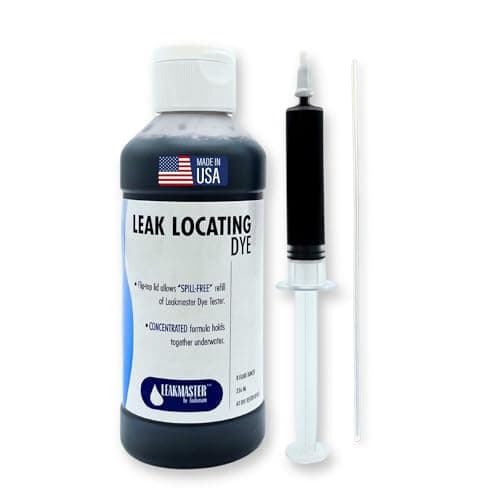
Leakmaster Pool Leak Detection Kit, 8 oz Dye with Syringe
Leakmaster
Eight ounces of dye and a reusable syringe. It does not tell you whether you have a leak — the bucket test does that for free — it tells you where the leak is.
Key specs
- Volume
- 8 oz, published
- Color
- Blue, high-visibility, published
- Applicator
- Reusable syringe, published
- Use
- Published for pools, spas and hot tubs
- What it is not
- Not a sealant and not a repair — it only shows flow direction
How it scoresour reading of published specs, not a test result
- Effectiveness
- 8.0
- Ease
- 8.5
- Water impact
- 9.0
- Cost per season
- 9.5
- Value
- 8.5
Overall 8.4 / 10
What works
- A syringe rather than a squeeze bottle, which is the difference between a readable plume and a cloud
- Reusable applicator, so one kit covers several seasons of checks
- Works on the above-ground suspects — liner seams, the skimmer and return gaskets, hose unions
- Cheap enough to own before you need it, which matters because you test with the pump off and the water still
What doesn't
- Useless until you have already confirmed a leak, and the confirmation step costs nothing
- Needs still water and a steady hand; any circulation and the plume tells you nothing
- Will not find a leak under the pool, which is where an above-ground liner leak most often is
- Dye in the water is dye in the water — expect to see it for a while
Skip it if: Leaks below the waterline floor. If the liner is weeping through the base, there is no flow for dye to follow and you are looking for a wet patch outside the wall instead.
What it costs to run: The thing this saves is water. A quarter-inch a day over a 15 ft pool is roughly 275 gallons a week, about $1.70 at the EPA WaterSense average — small weekly, and the reason people ignore a leak until the liner fails.
Several seasons: Buy-once. Built and warranted to come back out of the box for a few years, if you store it properly.
Specs from: Olivenhain Municipal Water District — pool bucket test procedure and published evaporation rates
A pinhole leak without draining the pool
Vinyl Liner Patch Kit
Various
Vinyl patches and an adhesive rated to cure underwater. The difference between a fifteen-minute job and a new liner, which is the largest single bill in above-ground pool ownership.
Key specs
- Application
- Wet or dry — the adhesive cures under water
- Adhesive
- Commonly 4 oz of vinyl cement per kit
- Patches
- Pre-cut vinyl; some kits include 20 or more
- Also fits
- Inflatable pools, floats, loungers, covers
- Format
- Glue-down, or peel-and-stick on some kits
- Shelf life
- The adhesive, not the patches, is what expires
How it scoresour reading of published specs, not a test result
- Value
- 9.5
Overall 8.8 / 10
What works
- No draining, which on a 3,955-gallon pool is both the water bill and the whole weekend
- One kit covers the liner, the floats and the solar cover
- Round the patch corners and it holds for seasons, not weeks
- Cheap enough that having one before you need one is the obvious move
What doesn't
- Only fixes punctures and pinholes — a split seam or a tear at a fitting is a liner job
- Underwater application is fiddly and you get one attempt per patch
- The adhesive goes off in the tube, so a kit bought three seasons ago may be dead
- Peel-and-stick patches are easier and do not last as long as glued ones
Skip it if: Structural damage. If the liner has failed at a seam or pulled out of its track, patching it is deferring the replacement rather than avoiding it.
What it costs to run: Set against a liner replacement, which our liner replacement cost guide prices as the single largest bill an above-ground pool produces. A kit is a rounding error against that.
Several seasons: Buy-once. Built and warranted to come back out of the box for a few years, if you store it properly.
Specs from: Vinyl liner patch kits — current Amazon category listing
A hole you cannot drain down to
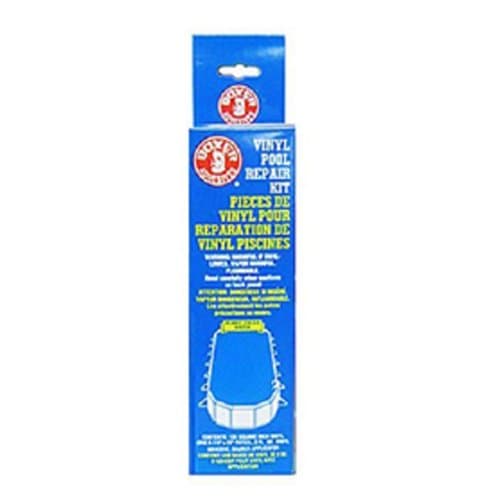
Boxer 859 Underwater Vinyl Pool Repair Kit, 2 oz
Boxer Adhesives
The kit with published underwater technique: fold the glued patch on itself, carry it down, unfold it on the tear. It is slower to cure than anything else here, and that is the point.
#ad how this is funded · price as of October 8, 2026
Key specs
- Underwater
- Yes — published method for applying below the waterline
- Adhesive
- 2 oz tube of #100 vinyl adhesive with dauber applicator (one retailer lists 4 fl oz)
- Patch supplied
- 130 sq in of patching vinyl (6 x 22 in)
- Cure, dry
- Allow 24 hours
- Cure, underwater
- Do not disturb 48 hours; 4 to 7 days for full cure (one retailer states 24 hours)
- Prep
- Clean surfaces; round the corners of the patch
- Shelf life
- Not published
How it scoresour reading of published specs, not a test result
- Value
- 8.5
Overall 8.3 / 10
What works
- Published, specific instructions for a repair made below the waterline rather than vague 'wet or dry' copy
- 130 square inches of patch vinyl, enough for several repairs
- Bonds inflatables as well as liners, so one kit covers the pool and the floats
- Cheap enough to keep in the shed before you need it
What doesn't
- Full cure is measured in days, not minutes, so a leaking pool stays leaking for a while
- Sources disagree on both the adhesive volume and the undisturbed time
- Solvent adhesive needs care around children and a mask or goggles for the dive
- Shelf life is not published, and an opened tube does not keep indefinitely
Skip it if: Speed. If you want the hole closed in half an hour, this is the wrong product in the range — the peel-and-stick patch is the one for that.
What it costs to run: A patch kit competes with a replacement liner, not with another patch kit. Our liner replacement guide prices the alternative; the kit is a rounding error against it.
One honest season: The cheapest setup that genuinely works for a season of real swimming. Nothing spare, nothing missing.
Specs from: INYOPools — Boxer 859 underwater vinyl repair kit, published contents and instructions, Pool Geek — Boxer 859 vinyl pool repair kit listing
A pool that keeps dropping below the skimmer
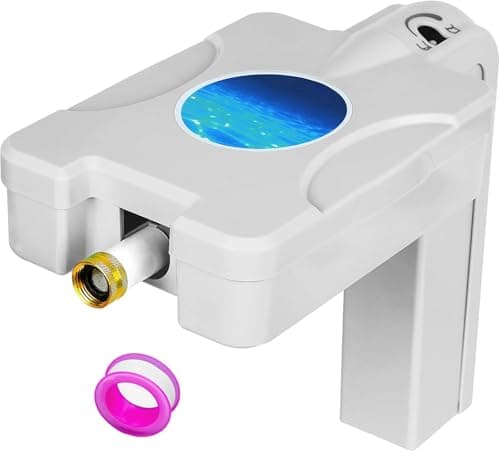
Automatic Pool Filler / Water Leveler
Various
A float valve on a hose that tops the pool up to a set level. It exists because a pool that drops below the skimmer mouth starves the pump, and that is how pumps die.
#ad how this is funded · price as of October 8, 2026
Key specs
- Operation
- Float valve — no power, no electronics
- Supply
- Standard garden hose connection
- Level
- Adjustable set point
- Fitting
- Above-ground versions hang on the wall or rail
- Also suits
- Spas, ponds and inflatable pools
- Requirement
- A hose left connected, which is the real trade
How it scoresour reading of published specs, not a test result
- Value
- 7.5
Overall 7.5 / 10
What works
- Removes the single most common cause of pump damage on a seasonal pool
- Purely mechanical — nothing to power, nothing to fail electronically
- Adjustable set point, so it holds the level the skimmer actually needs
- Useful during a heatwave when evaporation outruns your attention
What doesn't
- It needs a hose permanently connected and live, which not every yard allows
- A stuck float means an overflowing pool and a very large water bill
- It hides a leak — the pool stops dropping, so you stop noticing
- Above-ground mounting options are limited compared with inground
Skip it if: Telling you why the water is going. Evaporation and a liner leak look identical to a float valve, and only one of them is normal.
What it costs to run: The water is the cost, and it is the same water you would have added by hand. Check the pool against the mark occasionally anyway — a filler that has quietly replaced 2,000 gallons is reporting a leak, not doing its job.
Several seasons: Buy-once. Built and warranted to come back out of the box for a few years, if you store it properly.
Specs from: Automatic pool fillers and water levelers — current Amazon category listing
The single highest-return accessory here
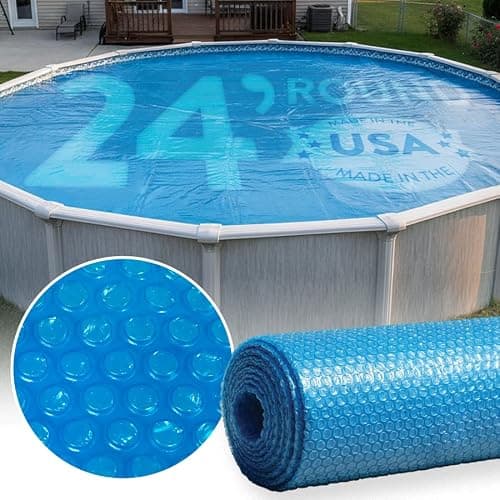
Bubble Solar Cover for Above-Ground Pools
Various
It cuts evaporation, and evaporation is simultaneously your water bill, your chemical bill and your heat loss. Nothing else on this site reduces three costs at once.
#ad how this is funded · price as of October 8, 2026
Key specs
- Construction
- Bubble sheet, thickness published in mil
- Thickness
- Higher mil lasts longer — 12 mil and 16 mil are common
- Fit
- Cut to size; buy oversize and trim
- Orientation
- Bubbles face down, toward the water
How it scoresour reading of published specs, not a test result
- Value
- 9.5
Overall 9.0 / 10
What works
- Reduces evaporation, which is the mechanism behind the water, chemical and heat savings all at once
- Cheap relative to everything it saves
- Can be cut to fit any pool shape, so sizing is forgiving
What doesn't
- Awkward to get on and off without a reel, and awkward is how covers end up unused
- Degrades in UV like every vinyl product
- Not a safety cover and will not support weight — this is important
Skip it if: Being a safety barrier. A solar cover looks solid and is not; a child or pet on it goes through and under.
What it costs to run: The one accessory with a clear payback. Every gallon that does not evaporate is a gallon you do not replace at the EPA WaterSense national average of $6.06 per 1,000 gallons, and it is chlorine you do not re-dose. If you buy one thing from this hub, buy this.
Several seasons: Buy-once. Built and warranted to come back out of the box for a few years, if you store it properly.
Specs from: EPA WaterSense — cost per 1,000 gallons
Questions people actually ask
How much water should a pool lose in a day?
How do I know if my pool has a leak?
Where do above-ground pools usually leak?
Does a dye test find a leak in an above-ground pool?
Is it worth fixing a slow pool leak?
Sources
Read next
- Pool care, from someone who assumes you have never done thisThe weekly routine, the four numbers that matter, and the fix for the week the water turns.
- The patch kit is the difference between a hole and a new linerUnderwater vinyl repair kits compared on cure time, patch material supplied and what each maker actually publishes — plus the one that sets in thirty minutes.
- Nothing in this category is standardized, and the hoses are where you find outHow to measure your own hose and fitting sizes, why suction-side air leaks matter so much, and what to check before ordering a replacement pump.
- The pump does not die of old age. It dies of low water.Automatic pool fillers and float-valve water levelers — what they prevent, what they cost, and the leak they can quietly conceal.
- What it costs to fill a pool, and to keep it fullOne fill priced for four common pool volumes at the national average water rate, plus why every gallon you add has to be re-balanced.
- Pool pump problems, diagnosed in the cheapest orderThe five-check diagnostic sequence for an above-ground pool pump, from free fixes to the point at which it is genuinely the motor.
- The best solar covers, and why this is the one thing to buyBubble covers compared on thickness and sizing, plus the arithmetic that makes this the highest-return purchase in the hub.
- Liner replacement: the big occasional cost, and how to avoid itOverlap, beaded and unibead are not interchangeable - plus the three habits that decide whether you ever need a replacement.
- The skimmer is the cheapest part of the system and the one that stops itHow a skimmer actually works, the water level it needs, and the three silent faults that get blamed on the pump.