Pool Equipment
The skimmer is the cheapest part of the system and the one that stops it
Nearly every 'the pump has failed' message starts at the skimmer. It has one moving part, one basket and one requirement - and the requirement is a water level nobody checks.
Heads up: we earn a commission if you buy through the links on this page, at no extra cost to you. It never decides the ranking — here is how we pick and here is the full disclosure. Prices are checked automatically; last verified October 8, 2026.
The short version
- The skimmer only works at one water level — roughly the middle of its opening. Too low and it draws air; too high and it stops skimming entirely.
- Most floating debris is caught here, not in the filter. The cartridge handles what the skimmer missed.
- A full basket produces the exact symptoms of a failing pump: weak return, gurgling, lost prime.
- Empty it every time you swim, not weekly. It takes ten seconds and it is the highest-value habit in this hub.
What it is actually doing
A skimmer is a box set into the pool wall with an opening at water level. The pump draws through it, so water flows off the surface, over a hinged flap called a weir, into a basket and then on to the pump and filter.
The reason this arrangement exists rather than simply drawing from mid-water is that almost everything you want removed floats, at least at first: leaves, insects, pollen, sunscreen film, hair. Catching them at the surface means they never sink, never decompose and never become chlorine demand — which is why skimming is a chemistry measure as much as a tidiness one, as our manual tools page argues about the net.
The water level, which is the whole thing
A skimmer has a narrow operating window and it is defined by the water level, not by anything you can adjust.
| Water level | What happens | Symptom |
|---|---|---|
| Above the top of the opening | The opening is submerged; surface flow stops | Debris sits on the surface and never leaves |
| Middle of the opening | Correct — surface water flows over the weir | None; this is the target |
| At the bottom of the opening | Intermittent; air gets drawn in with the water | Gurgling, bubbles at the return |
| Below the opening | The pump draws air instead of water | Lost prime; pump runs and moves nothing |
The last row is the one that generates the most alarm and the least actual damage — although a pump running dry can be damaged, because these pumps are cooled by the water passing through them. It is also the first check in our pump troubleshooting guide, before anything is opened or unplugged.
Evaporation and splash-out both lower the level continuously, and a hot week does it faster than people expect. A solar cover cuts evaporation substantially while it is on, which means fewer top-ups and fewer occasions when the skimmer quietly stops working — another reason it is the highest-return item in this hub.
The basket, and the ten-second habit
The basket exists so leaves stop before the pump rather than at it. When it fills, flow drops, and the pump begins to strain against a restriction — drawing roughly the same power to move less water.
The symptoms of a full basket are indistinguishable from the symptoms of a failing pump without opening it: weak return, new noise, sometimes gurgling. Which is why the habit is not weekly, it is every time you are at the pool. Lift, tip, replace. Our weekly schedule has it in the routine, and in autumn it becomes a daily job — see the leaf season guide.
The weir flap, and the fault nobody looks for
The hinged flap across the skimmer mouth is not decoration. It accelerates the surface flow across it and, importantly, it stops debris washing back out into the pool when the pump switches off.
Two failure modes, both easy to miss. It can stick open, in which case everything the skimmer caught floats straight back out the moment the pump stops — and you will notice only that the pool never seems to get clean. Or it can stick closed, in which case surface flow is throttled and the skimmer is doing a fraction of its job. Check that it swings freely whenever you empty the basket.
Above-ground skimmers specifically
Most above-ground pools use a wall-mounted skimmer that clamps through the liner, or on the smallest pools a simple inlet fitting with a strainer. Three practical consequences.
Fittings are not standardized. Skimmer sizes, hose diameters and thread types differ between manufacturers, which matters if you are replacing a pump from a different brand. Our hoses and fittings guide covers the mismatches.
The gasket is a leak point. Anything clamped through a vinyl liner has seals, and a slow seep at a skimmer is one of the more common causes of a level that keeps dropping. It is also the first place to look before assuming the liner has a puncture.
The position is fixed, so the dead spot is fixed. Water circulates from the return jet toward the skimmer, which means there is a low-flow area somewhere — usually the section furthest from both. That is where algae establishes first, and it is why our mustard algae guide tells you to look at shaded, low-circulation areas.
Improving what the skimmer catches
Aim the return jet. Angle it so the surface flow pushes toward the skimmer rather than away from it. This costs nothing and it measurably changes how much debris ends up in the basket rather than on the floor.
Run the pump when debris arrives. Windy afternoons and evenings under trees are when the skimmer earns its keep. Two shorter runs across the active part of the day beat one long overnight block — our run-time guide covers scheduling.
Keep the level right. Everything above depends on it, and it is the single check that takes no equipment at all.
When the skimmer is not the problem
If the basket is clear, the weir swings freely and the level is correct, and the return flow is still weak, the next thing upstream is the filter media. A cartridge loaded past the point where rinsing helps produces exactly the same weak-return symptom — our cartridge guide covers the replacement interval, and Intex guidance is roughly every two weeks in heavy use.
Only after all of that is the pump itself a reasonable suspect, which is the order our troubleshooting guide works in: cheapest checks first, every time.
The other half of keeping a skimmer working is keeping the water above its mouth. Our automatic pool filler roundup covers the float valve that does it, and the leak it can quietly hide if you never turn it off.
What to buy
Scores are our own reading of published specifications. They are not test results — we have not tested these products and we do not claim to.
The five-dollar tool you use most
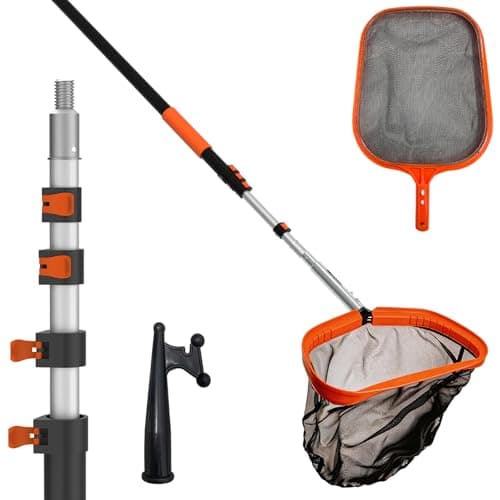
Skimmer Net with Telescopic Pole
Various
Catching leaves while they float is a two-minute job. Catching them after they sink is a vacuum session and a filter clean. Buy this first.
Key specs
- Type
- Flat skimmer or deep leaf rake
- Pole
- Telescopic, sized to reach the middle of your pool
- Frame
- Plastic or aluminum
How it scoresour reading of published specs, not a test result
- Retention
- 8.5
- Durability
- 7.0
- Handling
- 9.0
- Running cost
- 10.0
- Value
- 9.5
Overall 8.8 / 10
What works
- The single most-used tool in pool ownership and among the cheapest
- Removing debris before it sinks prevents most of the work that follows
- A deep leaf rake handles far more per pass than a flat skimmer
What doesn't
- Cheap plastic frames snap where the pole attaches, which is the standard failure
- Telescopic poles seize with hard water unless rinsed
- A too-short pole means you cannot reach the middle, which makes it useless
Skip it if: Anything on the floor. This is a surface tool and pretending otherwise is how debris ends up in the filter.
What it costs to run: Free to use and it directly reduces your chemical bill: organic debris consumes chlorine as it breaks down, so removing leaves is the cheapest sanitizer saving there is.
Several seasons: Buy-once. Built and warranted to come back out of the box for a few years, if you store it properly.
Small frame and inflatable pools
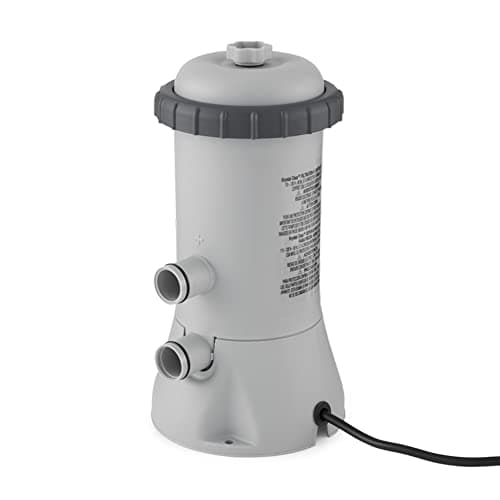
Intex Krystal Clear C530 Cartridge Filter Pump
Intex
530 GPH pump flow, 475 GPH through the system. The right pump for a 12-foot pool and badly undersized for anything much bigger.
#ad how this is funded · price as of October 8, 2026
Key specs
- Pump flow rate
- 530 GPH
- System flow rate
- 475 GPH
- Cartridge
- Type A
- Wattage
- Not published by Intex
How it scoresour reading of published specs, not a test result
- Sizing fit
- 8.0
- Running cost
- 9.0
- Maintenance
- 7.0
- Build
- 7.0
- Value
- 8.5
Overall 8.0 / 10
What works
- Correctly matched to the 12ft Prism Frame and Easy Set pools it ships with
- Smallest pump here that will still genuinely turn over a real pool
- Type A cartridges, which are everywhere
What doesn't
- Undersized the moment you upgrade the pool, and it will not carry over
- No wattage published
- Cartridge needs rinsing frequently in a busy small pool
Skip it if: Anything over about 2,000 gallons. Below that it is right; above it you are running it all day for one turnover.
What it costs to run: 475 GPH system flow turns over 1,718 gallons in about 3.6 hours, so a 7-hour daily run is two full turnovers. That is a genuinely short run time and it is where a small pool's low running cost actually comes from.
One honest season: The cheapest setup that genuinely works for a season of real swimming. Nothing spare, nothing missing.
Specs from: Intex — Krystal Clear cartridge filter pumps
Pools up to about 6,000 gallons
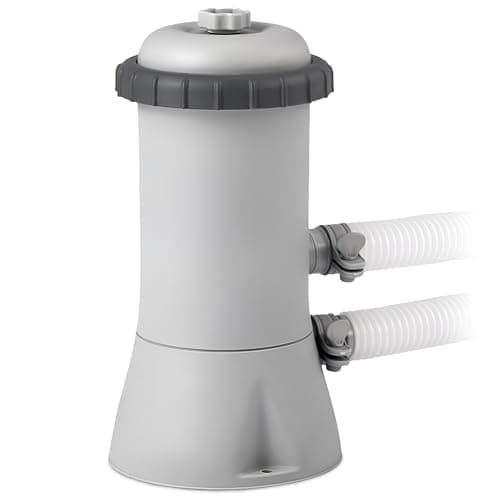
Intex Krystal Clear C1000 Cartridge Filter Pump
Intex
The workhorse replacement pump for mid-size frame pools. 1,000 GPH pump flow, 750 GPH through the system once the cartridge is in the way — and that second number is the one your turnover math needs.
#ad how this is funded · price as of October 8, 2026
Key specs
- Pump flow rate
- 1,000 GPH
- System flow rate
- 750 GPH
- Rated pool size
- Up to 6,000 gallons
- Cartridge
- Type A
- Wattage
- Not published by Intex
How it scoresour reading of published specs, not a test result
- Sizing fit
- 9.0
- Running cost
- 7.0
- Maintenance
- 7.5
- Build
- 7.5
- Value
- 8.5
Overall 8.3 / 10
What works
- Intex publishes both pump flow and system flow, which is more honesty than most of this category offers
- Type A cartridges are the most widely stocked filter consumable in the US
- Sized correctly for the 12ft-15ft frame pools most families own
What doesn't
- Wattage is not published anywhere on the Intex site, so you cannot cost it before purchase
- Cartridge-only, so there is a consumable every few weeks in a busy pool
- GFCI cord length dictates where the pool can go more than people expect
Skip it if: Pools over about 6,000 gallons. Above that you are asking it to run all day to achieve one turnover, which is the expensive way to filter.
What it costs to run: Do the turnover math before you buy: 750 GPH system flow moves 4,000 gallons in 5.3 hours. Two turnovers a day is therefore about 11 hours of running. At the EIA's June 2026 US residential average of 18.34 cents per kWh, every 100 watts of pump draw running 11 hours a day for a 120-day season costs about $24. Find your wattage on the pump label and multiply.
Several seasons: Buy-once. Built and warranted to come back out of the box for a few years, if you store it properly.
Specs from: Intex — Krystal Clear cartridge filter pumps, EIA Electric Power Monthly, Table 5.6.A — US residential average price
The consumable you will actually buy repeatedly
Type A Replacement Filter Cartridges (multipack)
Various
Buy them in a multipack before you need them. A pool running on an exhausted cartridge is a cloudy pool, and the fix is a two-dollar part you did not have.
Key specs
- Type
- Type A — the most common Intex format
- Replacement interval
- Every 2 weeks in heavy use, per Intex guidance
- Between changes
- Rinse, do not scrub
How it scoresour reading of published specs, not a test result
- Sizing fit
- 9.0
- Running cost
- 7.0
- Maintenance
- 8.5
- Build
- 7.0
- Value
- 8.5
Overall 8.2 / 10
What works
- Type A is the most widely stocked cartridge format in the US
- Multipacks cost a fraction of buying singles
- Having a spare turns a cloudy week into a five-minute fix
What doesn't
- It is a genuine recurring cost that nobody includes in the purchase price
- Aftermarket quality varies noticeably
- Rinsing extends life but does not restore a cartridge that is done
Skip it if: Being restored. Once the pleats are permanently gray and stiff, rinsing is not saving it.
What it costs to run: The line item most people leave out of their pool budget. Count how many you use in your first season and you have your real annual filtration cost — this is exactly the number the cost-to-run guide asks you to record.
One honest season: The cheapest setup that genuinely works for a season of real swimming. Nothing spare, nothing missing.
Questions people actually ask
What water level should a pool skimmer be at?
How often should I empty the skimmer basket?
What does the flap in the pool skimmer do?
Can I put chlorine tablets in the skimmer?
Sources
Read next
- Equipment, sized to your pool and costed by the wattPumps, filters, vacuums, heaters and ladders - matched to your gallons and priced by what they draw.
- Pool pump problems, diagnosed in the cheapest orderThe five-check diagnostic sequence for an above-ground pool pump, from free fixes to the point at which it is genuinely the motor.
- The manual pool tools that do most of the real workNets, poles and vacuum heads compared against powered cleaners for a seasonal above-ground pool, on running cost as well as capability.
- Filter cartridges: the consumable nobody budgets forThe replacement interval, the rinse-versus-scrub question, and how the cartridge treadmill compares with a sand filter across a season.
- Nothing in this category is standardized, and the hoses are where you find outHow to measure your own hose and fitting sizes, why suction-side air leaks matter so much, and what to check before ordering a replacement pump.
- The weekly pool routine, and how little time it really takesThe daily, weekly and monthly jobs written as a schedule, with the kit each one needs and roughly how long it takes.
- Leaf season, and the three weeks that decide next AprilHow to keep a pool usable through autumn leaf fall, and why what you let sink now decides how your spring opening goes.