Above-Ground Pools
Stock tank pools: the liner is not optional
A feed trough is cheaper and tougher than a frame pool, and it lasts a decade in a field. Put chlorine in it and the industry that makes the coating says it is not a recommended application.

Heads up: we earn a commission if you buy through the links on this page, at no extra cost to you. It never decides the ranking — here is how we pick and here is the full disclosure. Prices are checked automatically; last verified October 8, 2026.
The short version
- The galvanizers do not recommend it unlined. Published immersion corrosion in chlorinated water is 10 to 50-plus micrometers a year against 0.1 to 0.5 in rural air, and the source calls it “NOT a recommended application”.
- Buy the liner first, not last. It is the part that makes the tank a pool rather than a tank you are slowly dissolving.
- It is not the cheap option once finished. Tank plus liner plus cover plus plug plus pump beats the price of a 10 ft frame pool with a pump in the box.
- Small volume, full sun. An 8 ft tank has the worst surface-to-volume ratio of any pool on this site, so the cover is doing real work.
Why people want one, and they are not wrong
A galvanized stock tank is a genuinely better object than a frame pool. It is rolled steel with a hot-dip coating, built to sit in a field full of water and be shoved around by livestock for ten years. Nothing about an inflatable ring or a powder-coated tube frame is in the same category, and the look — bare metal, no printed vinyl — is most of the appeal.
The problem is not the tank. It is what we want to put in it. A trough holds drinking water that gets dumped and refilled; a pool holds chlorinated water for months. Those are different chemical environments, and the industry that applies the coating has published what the second one does to it.
The published numbers that decide this
| Exposure | Published rate | What that is |
|---|---|---|
| Atmospheric, rural | 0.1 to 0.5 um/yr | The job galvanizing is designed for |
| Chlorinated pool splash zone | 5 to 15 um/yr | The rim and the first inch of waterline |
| Direct immersion in pool water | 10 to 50+ um/yr | The inside of an unlined stock tank pool |
That is a range of twenty to a hundred times the rate the coating was specified for. The same source notes that pool pH, typically 7.2 to 7.8, “provides less alkalinity than ideal for zinc passivation” — so running your water inside the CDC’s published pH range does not help the metal. There is no version of correct pool chemistry that is also correct for bare galvanizing.
None of which means a stock tank pool is a bad idea. It means the liner is the product, and the tank is the structure. Once the chlorinated water never touches zinc, the published numbers above stop applying to the inside and only the rim and splash zone are exposed.
What it actually costs to finish one
The appeal of a stock tank is that the tank is cheap. The arithmetic people skip is everything after the tank, so here it is as a list rather than a feeling.
| Part | Why it is not optional | Where it is priced |
|---|---|---|
| The tank itself | The structure. Farm store or freight, not Amazon | Farm supply, by diameter |
| Overlap liner | Keeps chlorinated water off the galvanizing | Priced below |
| Fitted cover | Small volume, full sun, no filtration margin | Priced below |
| Drain plug kit | No bottom drain means no seasonal water change | Priced below |
| Small cartridge pump | Only if you are chlorinating rather than changing | Priced below |
Water, which is the running cost a stock tank actually has
- An 8 ft round tank at 27.5 in of water
- about 700 gallons
- Drain and refill twice a season
- 1,400 gallons
- US average water cost [EPA WaterSense]
- $6.06 per 1,000 gal
1,400 gal ÷ 1,000 × $6.06
About $8 of water per season, if you change it rather than chlorinate it
That is the fork in the road. Seven hundred gallons is small enough that changing the water is a real strategy, and it costs single-digit dollars a season. Chlorinating it instead means a pump, a test kit, the full first-time owner routine, and the liner becomes mandatory rather than merely wise.
Evaporation is the thing nobody prices
An 8 ft tank is about 50 sq ft of surface over 700 gallons. A 15 ft frame pool is 177 sq ft over about 4,400 gallons. Per gallon held, the tank has roughly twice the exposed surface, and evaporation scales with surface area, not volume.
| Wind | Published rate | Per day on 50 sq ft | Share of a 700 gal tank |
|---|---|---|---|
| None | 0.20 in/day | about 6 gallons | under 1% |
| 5 mph | 0.62 in/day | about 19 gallons | under 3% |
| 10 mph | 1.06 in/day | about 33 gallons | almost 5% |
At 10 mph that is a third of the tank gone in ten days. The rates above are published by a water district, and the California Spa and Pool Industry Education Council figure quoted on the same page is half an inch to two inches a week. On a pool this small, a cover is not about heat — it is about not topping up the whole thing every fortnight. Our evaporation-or-leak guide uses the same table to answer the other question a dropping water level raises.
Where a stock tank genuinely wins
Three situations. A yard too small or too awkward for a frame pool, where a rigid 8 ft circle goes places a 15 ft ring cannot — our tight-access guide covers getting it there. A cold plunge or a soak rather than a swim, where 27.5 in of depth is the point rather than the limitation. And a yard where the pool has to look like something other than a pool, which is a real constraint and the one frame pools are worst at.
Where it loses is swimming. Twenty-seven and a half inches is not deep enough to swim in and eight feet is not long enough to try, and our lap-swimming guide is blunt about what above-ground dimensions can and cannot support. If anyone in the household wants to actually swim, this is the wrong format and a 15-foot pool is the right one.
What to buy
Scores are our own reading of published specifications. They are not test results — we have not tested these products and we do not claim to.
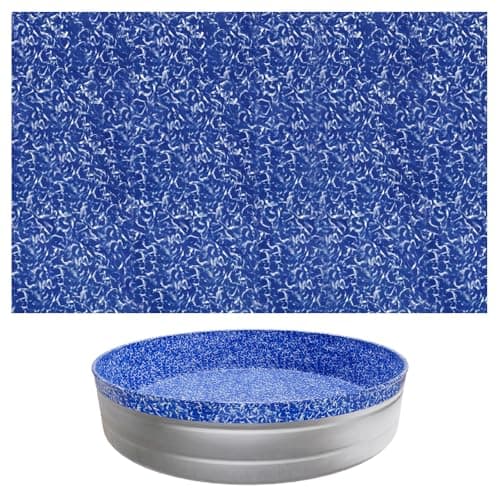
Keeping chlorinated water off the galvanizing
VEVOR 8 ft Round Stock Tank Pool Liner, Overlap
VEVOR
The part that turns a feed trough into a pool you can chlorinate. The galvanizing industry's own guidance says zinc should not be immersed in pool water, and a liner is the only way around that.
#ad how this is funded · price as of October 8, 2026
Key specs
- Fits
- 8 ft round tank, 27.5 in wall height, published
- Style
- Overlap — folds over the rim and clamps, published
- Material
- Vinyl; described as "extra thick heavy gauge"
- Gauge
- Not published — no mil figure appears anywhere on the listing
- Included
- Leak-proof patches, published
- Intended use
- Published as "designed for steel sided above-ground"
How it scoresour reading of published specs, not a test result
- Build
- 6.5
- Setup
- 6.0
- Upkeep
- 7.5
- Running cost
- 8.5
- Value
- 7.0
Overall 7.1 / 10
What works
- Solves the one real problem with a stock tank pool: zinc is not stable in chlorinated water
- Overlap fit means no drilling and no beaded track to match
- Published for the exact 27.5 in wall height the common 8 ft tanks use
- Ships with patches, which is the right expectation for a liner in a metal tank
What doesn't
- No gauge is published, so you cannot compare its thickness against a real pool liner
- An overlap liner in a round tank will wrinkle unless the base is genuinely flat
- Adds roughly a third again to the cost of the tank itself
- Nothing about a stock tank is designed around a liner, so trimming and clamping is on you
Skip it if: Hiding a dented tank. An overlap liner follows the wall it is pressed against, so a kinked rim telegraphs straight through and becomes a wear point.
What it costs to run: The honest arithmetic is tank plus liner plus cover plus a plug kit before any pump. On the published prices of the parts on this page that is well past what a 10 ft frame pool costs with a pump in the box, which is the comparison to make before you start.
One honest season: The cheapest setup that genuinely works for a season of real swimming. Nothing spare, nothing missing.
Specs from: V&S Galvanizing — hot-dip galvanizing in chlorinated water (corrosion rates, immersion not recommended)
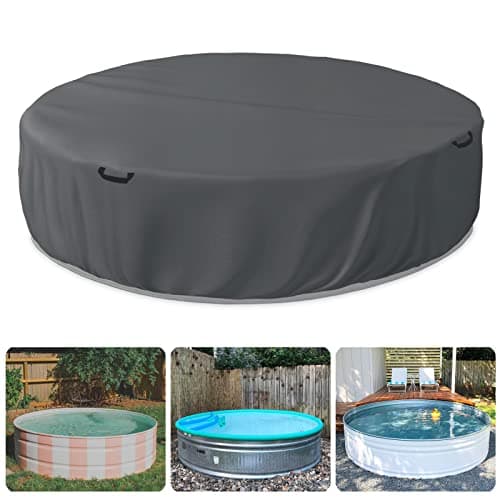
The evaporation and debris problem a stock tank has worst
Bitubi 8 ft Round Stock Tank Pool Cover
Bitubi
A stock tank is a small volume with a fully exposed surface, which is the worst possible ratio for evaporation and leaves. A fitted cover is not an accessory here, it is load-bearing.
#ad how this is funded · price as of October 8, 2026
Key specs
- Fits
- 8 ft round steel stock tank, published
- Coverage
- Published as "upgraded to full coverage"
- Claimed purpose
- Published as protection from debris and to prevent rust and aging
- Fabric weight
- Not published
- Anchoring
- Not published for this version; the maker's winch variant publishes a wire rope
How it scoresour reading of published specs, not a test result
- Build
- 6.0
- Setup
- 8.5
- Upkeep
- 8.0
- Running cost
- 9.5
- Value
- 7.5
Overall 7.4 / 10
What works
- Cut for the tank diameter rather than trimmed from a round pool cover
- A cover is the single highest-return purchase on a small surface, because evaporation scales with area not volume
- Keeps sun off the waterline, which is where a galvanized tank corrodes first
- Cheap relative to the tank and the liner
What doesn't
- No fabric weight published, so durability cannot be compared with a real pool cover
- Anchoring detail is unpublished on this version, and an unanchored cover on a 4 ft rim is a sail
- A solid cover on a tank with no filtration means you are covering water you are not circulating
- Full coverage also means a child cannot be seen through it, which changes nothing about supervision
Skip it if: Being a safety cover. Nothing here is tested to ASTM F1346 and it must never be treated as something that will hold weight.
What it costs to run: The saving is water, not electricity. Our evaporation table on the stock tank page puts a windy 8 ft tank at well over an inch a day uncovered, and on a 700 gallon tank that is a measurable share of the whole pool every week.
One honest season: The cheapest setup that genuinely works for a season of real swimming. Nothing spare, nothing missing.
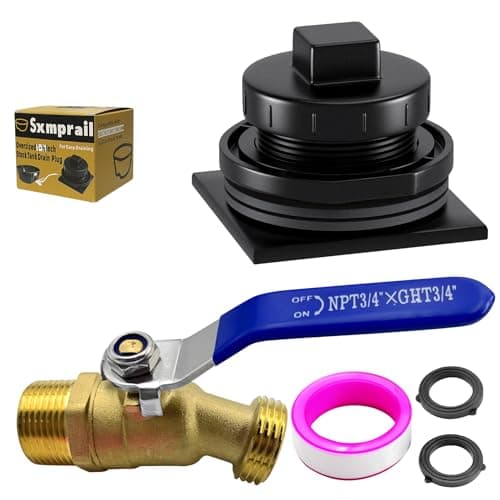
Draining a tank without tipping 700 gallons onto the lawn
Stock Tank Drain Plug Kit with Reducer and Hose Bib
Generic
The part that makes a stock tank drainable on purpose. Without it you are siphoning or tipping, and a tank you cannot drain is a tank you will not change the water in.
#ad how this is funded · price as of October 8, 2026
Key specs
- Fits
- Published as Rubbermaid-style stock tanks, 50 to 300 gallon
- Included
- 1-1/4 in x 3/4 in pipe reducer bushing and a 3/4 in brass faucet, published
- Thread
- 3/4 in hose thread at the outlet, published
- Material
- Brass faucet; bushing material not published
- Note
- Galvanized tanks and poly tanks use different plug bosses — check yours before ordering
How it scoresour reading of published specs, not a test result
- Build
- 7.0
- Setup
- 7.0
- Upkeep
- 8.5
- Running cost
- 9.5
- Value
- 8.5
Overall 8.0 / 10
What works
- Turns the existing drain boss into a garden-hose outlet, so the water goes where you point it
- Brass at the wetted fitting rather than plated steel
- Cheap enough that it is not a decision
- Makes the seasonal water change realistic, which is what a tank with no filter depends on
What doesn't
- Published fitment is for Rubbermaid-style tanks; galvanized tanks vary and the listing does not cover them all
- A brass fitting bolted through a galvanized wall is two dissimilar metals in wet contact
- No flow rate is published, so how long a drain takes is unknown until you do it
- Still drains at hose-bib rate — this is an afternoon, not a minute
Skip it if: Replacing a real pool drain. There is no bottom suction here; you are emptying a tank through a sidewall bib and the last inch comes out with a bucket.
What it costs to run: The running cost this fits into is water. If you are draining and refilling an 8 ft tank twice a season, that is roughly 1,400 gallons, or about $8 at the EPA WaterSense average of $6.06 per 1,000 gallons.
Several seasons: Buy-once. Built and warranted to come back out of the box for a few years, if you store it properly.
Specs from: EPA WaterSense — how the calculator works (water cost average)
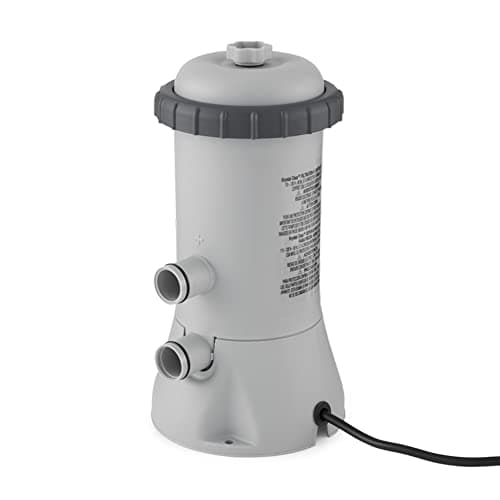
Small frame and inflatable pools
Intex Krystal Clear C530 Cartridge Filter Pump
Intex
530 GPH pump flow, 475 GPH through the system. The right pump for a 12-foot pool and badly undersized for anything much bigger.
#ad how this is funded · price as of October 8, 2026
Key specs
- Pump flow rate
- 530 GPH
- System flow rate
- 475 GPH
- Cartridge
- Type A
- Wattage
- Not published by Intex
How it scoresour reading of published specs, not a test result
- Build
- 7.0
- Running cost
- 9.0
- Value
- 8.5
Overall 8.0 / 10
What works
- Correctly matched to the 12ft Prism Frame and Easy Set pools it ships with
- Smallest pump here that will still genuinely turn over a real pool
- Type A cartridges, which are everywhere
What doesn't
- Undersized the moment you upgrade the pool, and it will not carry over
- No wattage published
- Cartridge needs rinsing frequently in a busy small pool
Skip it if: Anything over about 2,000 gallons. Below that it is right; above it you are running it all day for one turnover.
What it costs to run: 475 GPH system flow turns over 1,718 gallons in about 3.6 hours, so a 7-hour daily run is two full turnovers. That is a genuinely short run time and it is where a small pool's low running cost actually comes from.
One honest season: The cheapest setup that genuinely works for a season of real swimming. Nothing spare, nothing missing.
Specs from: Intex — Krystal Clear cartridge filter pumps
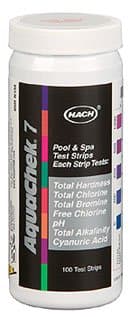
The default first test kit
AquaChek Silver 7-Way Test Strips (100 count)
AquaChek
Seven readings in fifteen seconds, including the two that beginners never measure and then fight all summer: total alkalinity and cyanuric acid.
#ad how this is funded · price as of October 8, 2026
Key specs
- Tests
- Free chlorine, total chlorine, bromine, pH, total alkalinity, total hardness, cyanuric acid
- Free chlorine range
- 0-20 ppm
- pH range
- 6.2-8.4
- Total alkalinity range
- 0-240 ppm
- Cyanuric acid range
- 0-300 ppm
- Read time
- 15 seconds
- Count
- 100 strips
How it scoresour reading of published specs, not a test result
- Value
- 9.2
Overall 8.9 / 10
What works
- Covers cyanuric acid, which most cheap strips omit and which is the reason chlorine stops working in a stabilized pool
- pH range spans 6.2-8.4, comfortably bracketing the CDC's recommended 7.0-7.8
- 15 seconds and a color chart printed on the bottle — no separate booklet to lose
- 100 strips is a full season of twice-weekly testing with room to spare
What doesn't
- Strips are a comparison against a printed color chart, so they are directional rather than precise
- Reading them in bright sun is harder than it should be
- The bottle must be kept sealed and dry or the strips degrade quietly
Skip it if: Fine adjustment. If you are chasing a stubborn problem and need a number rather than a color band, a liquid reagent kit is the tool.
What it costs to run: 100 strips at twice-weekly testing covers roughly two seasons for one pool. The real saving is upstream: knowing your alkalinity stops you buying pH adjuster you did not need.
One honest season: The cheapest setup that genuinely works for a season of real swimming. Nothing spare, nothing missing.
Specs from: CDC — home pool and hot tub water treatment and testing
Questions people actually ask
Can you put chlorine in a galvanized stock tank?
Is a stock tank pool cheaper than an above-ground pool?
What size stock tank do you need for a pool?
Do stock tank pools need a filter?
How long does a stock tank pool last?
Sources
- V&S Galvanizing — hot-dip galvanizing performance in chlorinated water (published corrosion rates)
- Tractor Supply — CountyLine round galvanized stock tank, 6 ft x 2 ft, 390 gal published capacity
- Olivenhain Municipal Water District — published pool evaporation rates by wind speed
- CDC — home pool and hot tub water treatment and testing (published pH range)
- EPA WaterSense — how the calculator works
Read next
- Above-ground pools for ordinary backyardsSoft-side, metal-frame and steel-wall pools compared by what they cost across a whole season, not at the till.
- Ten feet is the floor of the categoryThe smallest practical above-ground pool size — what a 10-foot pool holds, what it costs across a season, and when to go smaller or bigger.
- Pools for a small yardRound versus rectangular in a narrow yard, the smallest sizes worth filtering, and why smaller is cheaper twice over.
- The types of backyard pool, and who each is forInflatable, metal frame, permanent steel wall and inground - what separates them and which one you are actually shopping for.
- Leveling the ground, and the weight that makes it matterThe tolerance manufacturers publish, the weight of water that enforces it, and the method for getting a circle genuinely flat with hand tools.
- The cheapest pool setup that actually works for a yearA complete, deliberately minimal first-year setup: the pool, the pump, the testing, the chlorine and the one tool you will use most.
- Equipment for a small pool, where most advice is written for a big oneThe equipment a small above-ground pool actually needs, what to skip, and why turnover arithmetic makes the supplied pump adequate more often than people expect.
- First-time pool owner: the complete first monthThe pillar guide: day-one shopping list, the four water readings, the weekly routine and the week-three problem everybody gets.
- The semi-inground pool solves the yard you actually haveSemi-inground pool kits explained: resin-coated steel walls, how far they can be buried, and the excavation and barrier obligations that come with them.