Above-Ground Pools
The types of backyard pool, and who each is for
Four categories get blurred into one aisle. They have different lifespans, different running costs and different owners.
Heads up: we earn a commission if you buy through the links on this page, at no extra cost to you. It never decides the ranking — here is how we pick and here is the full disclosure. Prices are checked automatically; last verified October 19, 2026.
The short version
- Four categories, not four price points. They differ in lifespan and commitment, not just in cost.
- Soft-side pools are consumable; frame pools are seasonal equipment; steel-wall pools are installations.
- The most common mistake is buying a consumable expecting equipment, or vice versa.
- Running cost tracks gallons across all four categories. The arithmetic does not change with the type.
1. Inflatable and soft-side
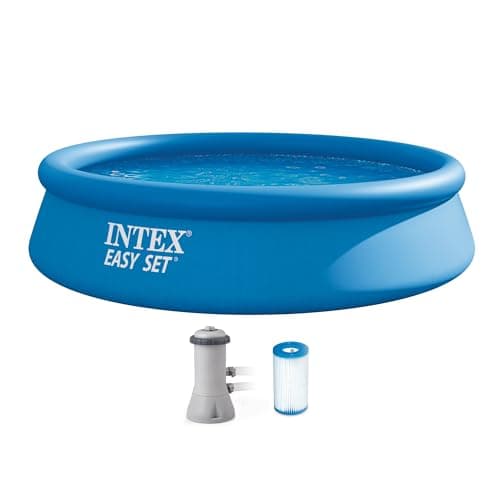
An inflated top ring or a simple fabric wall holds the shape; the water does the rest. Intex publishes about ten minutes to water for the Easy Set and 1,485 gallons at 80% full for the 12-foot version.
Lifespan: two to three seasons of hard use is normal. The top ring sits in direct sun and is the single point of failure. Who it is for: families with young children who want water in the yard quickly and cheaply. The mistake: expecting it to last five years and feeling cheated when it does not.
2. Metal frame
A liner hung inside a bolted steel or aluminum frame. This is the volume center of the market: proper filtration, holds its shape, comes apart for winter storage. Capacities run from about 1,700 gallons at 12 feet to nearly 7,000 at 18 feet.
Lifespan: several seasons with careful handling and proper winter storage. Who it is for: most families. This is the default answer and the bulk of our main roundup. The mistake: putting one on ground that is not level, which undermines every other quality in the product.
3. Permanent steel wall
Stays up year-round, often with a deck built around it. Real filtration, a proper skimmer, and a closing routine that is genuinely not optional in a freezing climate.
Lifespan: years, with the liner as the wearing part. Who it is for: households committed to a pool as a permanent feature. The mistake: not getting inground quotes first — at this budget the categories start to overlap, which is what above-ground versus inground covers.
4. Inground
A different purchase entirely: excavation, permitting, a contractor, and a permanent change to the property. The functional difference that matters is depth — this is the only category where swimming lengths and diving are realistic.
Lifespan: decades. Who it is for: households who want swimming rather than cooling off, and who are certain. The mistake: the irreversibility. There is no undo.
| Type | Setup | Typical life | Reversible? |
|---|---|---|---|
| Inflatable / soft-side | ~10 minutes | 2–3 seasons | Completely |
| Metal frame | An afternoon | Several seasons | Completely |
| Permanent steel wall | Days, often installed | Years | With effort |
| Inground | Weeks, contractor | Decades | No |
Whichever category you land in, the running-cost arithmetic is the same and only the gallons change. Work through the annual cost guide before committing, and size to the yard rather than to the ambition.
Two categories sit just outside this list and are worth knowing about. An inflatable hot tub is not a pool at all — it is heated year-round rather than seasonally, which inverts the running cost — and a saltwater setup is one of the pools above with a chlorine generator added, not a different kind of water.
If the permanent steel-wall category is the one you are shopping in, our permanent above-ground pool roundup compares actual models on the specifications that decide how long one lasts — the wall coating, the liner gauge and the warranty.
What to buy
Scores are our own reading of published specifications. They are not test results — we have not tested these products and we do not claim to.
Water in the yard this weekend
Intex Easy Set Pool Set, 12ft x 30in
Intex
Inflate the ring, add water, done. It is the fastest route from box to swimming that exists, and it is honest about being a seasonal item rather than a fixture.
#ad how this is funded · price as of October 19, 2026
Key specs
- Water capacity
- 1,485 gallons (80% full)
- Water depth
- 23 inches
- Pump supplied
- 530 GPH Krystal Clear cartridge pump
- Material
- 3-ply, puncture resistant
- Manufacturer setup claim
- Ready for water in about 10 minutes
- Pump wattage
- Not published by Intex
How it scoresour reading of published specs, not a test result
- Build
- 5.5
- Setup
- 9.8
- Upkeep
- 8.5
- Running cost
- 9.2
- Value
- 8.8
Overall 8.3 / 10
What works
- Genuinely 10 minutes to set up — the top ring rises with the water and there is no frame to assemble
- 1,485 gallons at 80% is a real, filterable pool rather than a paddling pool
- Comes down as fast as it goes up, which makes mid-season relocation possible
- Cheapest way to find out whether your family actually wants a pool before committing to a frame one
What doesn't
- The inflated ring is the single point of failure and it is exposed to sun all season
- 23 inches of water is shallow — this is for cooling off, not swimming
- Soft walls flex, so it needs level ground as much as a frame pool does
Skip it if: Lasting. Treat this as a two-or-three-season item at best and you will not be disappointed; expect five years and you will be.
What it costs to run: A fill at the EPA WaterSense average of $6.06 per 1,000 gallons is about $9. The 530 GPH pump moves 1,485 gallons in under three hours, so this is a pool where a genuinely short daily run does the job — which is where the running-cost saving actually comes from.
One honest season: The cheapest setup that genuinely works for a season of real swimming. Nothing spare, nothing missing.
Specs from: Intex — Easy Set 12' x 30' pool set, EPA WaterSense — cost per 1,000 gallons
Small yards and first-time owners
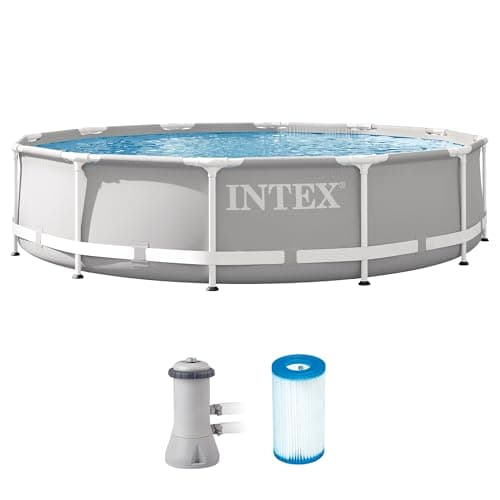
Intex Prism Frame Pool Set, 12ft x 30in
Intex
The size most people should buy first and the one most people talk themselves out of. 1,718 gallons is cheap to fill, cheap to treat, and forgiving of every mistake you are about to make.
Key specs
- Water capacity
- 1,718 gallons (90%), published by Intex
- Pump supplied
- Krystal Clear C530 — 530 GPH pump / 475 GPH system
- Frame
- Powder-coated metal, tool-free Easy Lock
- Liner
- 3-ply, puncture resistant
- Manufacturer setup claim
- Ready in 30 minutes
- Pump wattage
- Not published by Intex
How it scoresour reading of published specs, not a test result
- Build
- 7.0
- Setup
- 9.0
- Upkeep
- 9.0
- Running cost
- 9.0
- Value
- 9.0
Overall 8.6 / 10
What works
- A 12-foot circle fits in a yard where a 15 or 18 will not, once you allow three feet of walking space
- 1,718 gallons turns over in about 3.6 hours on the supplied 475 GPH system flow — so a short daily run genuinely filters it
- Cheapest of the frame pools to make a mistake in: a bad chemical week costs a few dollars, not a few tens
- Tool-free assembly is real, not marketing — this is a genuinely one-afternoon job
What doesn't
- 30-inch wall means shallow water and it warms and cools fast
- Small enough that three adults fill it
- The C530 is sized for exactly this pool and nothing bigger, so it does not carry over if you upgrade
Skip it if: Anyone planning to swim rather than sit. This is a cooling-off and playing pool and it is very good at that.
What it costs to run: The cheapest frame pool here to run, and the gap is not small. At the EPA WaterSense average of $6.06 per 1,000 gallons a fill is about $10. Its turnover math — 1,718 gallons at 475 GPH system flow — means roughly 3.6 hours per full turnover, so a 7-8 hour daily run is two full turnovers rather than a partial one.
One honest season: The cheapest setup that genuinely works for a season of real swimming. Nothing spare, nothing missing.
Specs from: Intex — Prism Frame 12' x 30' pool set, Intex — Krystal Clear cartridge filter pumps
The honest middle of the market
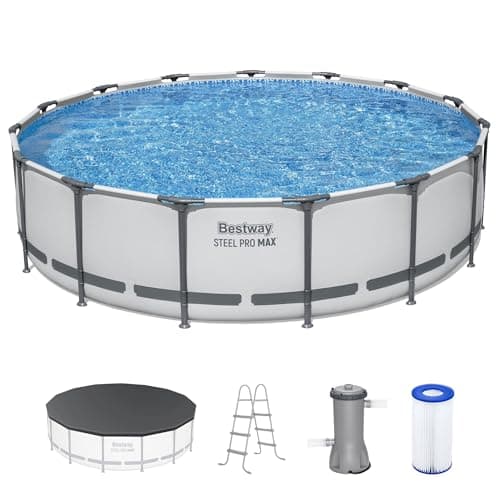
Bestway Steel Pro MAX Pool Set, 15ft x 42in
Bestway
Fewer gallons and a shallower wall than the Intex flagship, which makes it easier to level, cheaper to fill and cheaper to keep clean. For most first-pool families this is the right size, not the compromise size.
#ad how this is funded · price as of October 19, 2026
Key specs
- Water capacity
- 3,955 gallons (90% full)
- Pump supplied
- 1,000 gal filter pump, Type III cartridge
- Liner
- Tritech 3-layer
- Included
- Ladder and cover
- Wall height
- 42 inches
- Pump wattage
- Not published by Bestway (US listing)
How it scoresour reading of published specs, not a test result
- Build
- 7.5
- Setup
- 8.0
- Upkeep
- 8.0
- Running cost
- 7.5
- Value
- 8.8
Overall 8.2 / 10
What works
- 3,955 gallons is roughly 43% less water than the 18ft Intex — that is 43% less chemical spend, every season, forever
- 42-inch wall is far more forgiving of a yard that is nearly-but-not-quite level
- Ladder and cover included
- Cartridge filtration means no sand to buy or change
What doesn't
- Cartridges are a recurring consumable, and in a busy pool you will rinse one weekly
- 42 inches is shallow for adults who want to actually swim rather than sit
- Wattage is not published, so the running-cost math needs the label on the box
Skip it if: Adults who want to swim lengths. At 42 inches you are sitting in it, not swimming in it.
What it costs to run: The gallons are the story. Chemical dosing scales with volume, so 3,955 gallons costs meaningfully less to sanitize all season than 6,981 does. Filling it once at the EPA WaterSense national average of $6.06 per 1,000 gallons is about $24 of water; the same fill on the 18ft Intex is about $42.
Several seasons: Buy-once. Built and warranted to come back out of the box for a few years, if you store it properly.
Specs from: Bestway USA — Steel Pro MAX 15' x 42' pool set, EPA WaterSense — how the calculator works ($6.06 per 1,000 gallons)
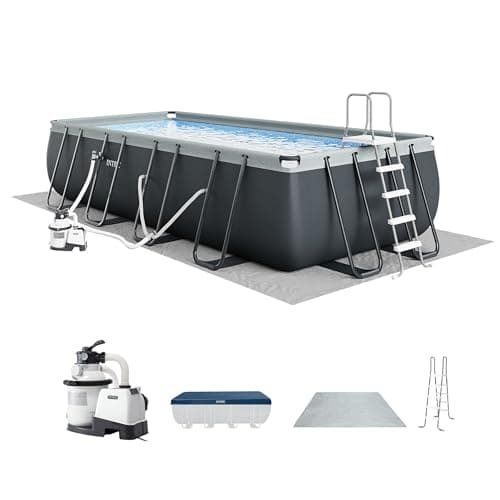
A family that will still be using it in year three
Intex Ultra XTR Frame Pool Set, 18ft x 52in
Intex
The biggest, sturdiest thing in this class that a homeowner can still put up in a weekend. It is also, by a wide margin, the most expensive one to run.
#ad how this is funded · price as of October 19, 2026
Key specs
- Water capacity
- 6,981 gallons; Intex publishes no fill percentage for this model
- Pump supplied
- 2,100 GPH sand filter
- Frame
- Galvanized steel, powder-coated inside and out
- Liner
- 3-ply, puncture and tear resistant
- Manufacturer setup claim
- Ready for water in 60 minutes
- Pump wattage
- Not published by Intex
How it scoresour reading of published specs, not a test result
- Build
- 9.0
- Setup
- 6.0
- Upkeep
- 7.5
- Running cost
- 5.0
- Value
- 8.5
Overall 8.4 / 10
What works
- 6,981 gallons is genuinely swimmable for adults, not just a cooling-off pool
- Sand filter rather than a cartridge, so there is no cartridge to buy every few weeks
- Galvanized frame with inner and outer powder coating is the most corrosion-resistant construction in this price class
- Ships with the ladder, cover and ground cloth that cheaper kits make you buy separately
What doesn't
- 52 inches of wall on an 18-foot circle is a lot of water pressure — the ground under it has to be genuinely level
- Intex publishes flow rate but not wattage, so you cannot compute your running cost until the pump is in your hands
- Too heavy and too large to take down and put up casually
Skip it if: Your yard is not close to level, or you want a pool you can pack away mid-season. Nearly 7,000 gallons is not a thing you move.
What it costs to run: It is the most water in this roundup, so it is the most chemicals, the most evaporation and the largest pump. Using ENERGY STAR's own published figures for above-ground pool pumps (an ENERGY STAR model saves about $20 a year, being 11% more efficient), a standard above-ground pump implies roughly $182 a year in electricity — and that is before you scale for a 2,100 GPH sand filter running on a pool this size. Price the season before you price the pool.
Several seasons: Buy-once. Built and warranted to come back out of the box for a few years, if you store it properly.
Specs from: Intex — Ultra XTR Frame 18' x 52' specifications, ENERGY STAR — Pool Pumps
Questions people actually ask
What are the different types of backyard pools?
Which type of above-ground pool lasts longest?
Do different pool types cost different amounts to run?
Sources
Read next
- Above-ground pools for ordinary backyardsSoft-side, metal-frame and steel-wall pools compared by what they cost across a whole season, not at the till.
- The best above-ground pools for an ordinary backyardFrame pools ranked on published specs and season running cost, from a 1,700-gallon first pool to a 7,000-gallon family one.
- Above-ground vs inground: which one you are actually shopping forCost, commitment, depth and reversibility compared - plus the budget point where the two categories genuinely start to overlap.
- What size pool your backyard can actually takeThe three-foot rule, the level-ground tolerance, and a table matching yard size to pool size with the running cost attached.
- Are backyard pools worth it?The four questions that decide whether a pool is a good buy for your household - argued honestly in both directions.
- Above-ground pool brands, and what each one is actually good atIntex, Bestway, Summer Waves, Blue Wave, Lake Effect, In The Swim and AquaDoc compared on published warranty, what ships in the box and the segment each brand actually serves.
- Easy Set or Prism Frame: ten minutes, or a pool that lastsIntex's two 12-foot pools compared on published capacity, set-up time, warranty term and what each one is realistically worth after one season.