Above-Ground Pools
Ten feet is the floor of the category
Below this you are buying a paddling pool with a filter attached. At ten feet the routine, the chemistry and the equipment all still apply — on a much smaller scale.
Heads up: we earn a commission if you buy through the links on this page, at no extra cost to you. It never decides the ranking — here is how we pick and here is the full disclosure. Prices are checked automatically; last verified October 8, 2026.
Quick picks
Segmented before it is ranked — the right answer depends on which of these you actually are. Tap any row for the full write-up.
The 10-foot frame pool
A metal frame at this size assembles in an afternoon, holds a real filtration system, and comes back out of the box next year.
| # | Product | Best for | Score | Price |
|---|---|---|---|---|
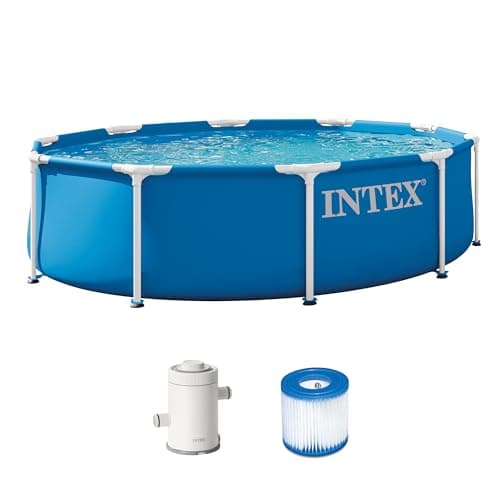
| 1 | Intex Metal Frame Pool, 10ft x 30in Below this size you are buying a paddling pool with a pump attached. At 10 feet you still get a real frame and real filtration, in a footprint that fits almost any yard. | The smallest pool worth filteringOne honest season | 7.8out of 10 |
One size up, for comparison
Twelve feet is the more common size and the more common recommendation. It is worth knowing what the extra two feet actually buys.
| # | Product | Best for | Score | Price |
|---|---|---|---|---|
| 1 | 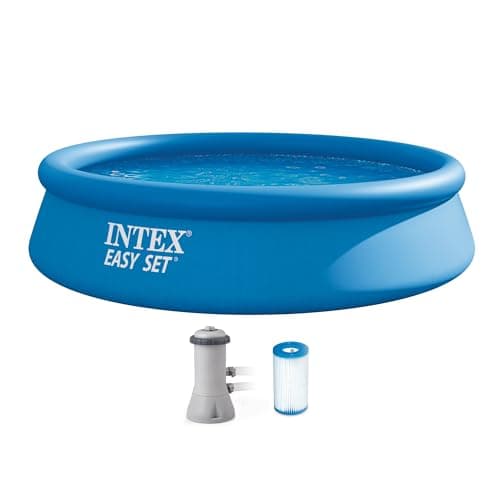 Intex Easy Set Pool Set, 12ft x 30in Inflate the ring, add water, done. It is the fastest route from box to swimming that exists, and it is honest about being a seasonal item rather than a fixture. | Water in the yard this weekendOne honest season | 8.3out of 10 | |
| 2 | 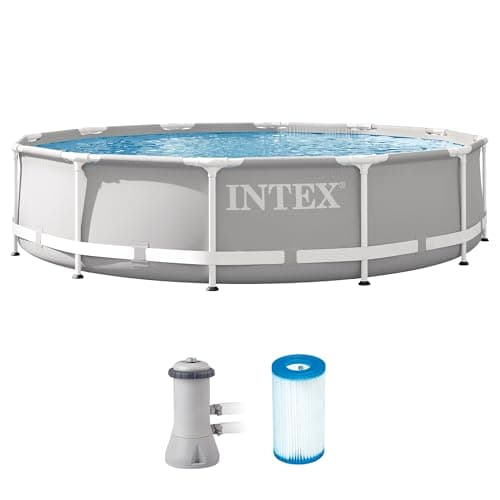 Intex Prism Frame Pool Set, 12ft x 30in The size most people should buy first and the one most people talk themselves out of. 1,718 gallons is cheap to fill, cheap to treat, and forgiving of every mistake you are about to make. | Small yards and first-time ownersOne honest season | 8.6out of 10 |
One step down, honestly
If nobody in the household is going to swim, a hard-sided kiddie pool needs no chemistry, no pump and no season.
| # | Product | Best for | Score | Price |
|---|---|---|---|---|
| 1 | 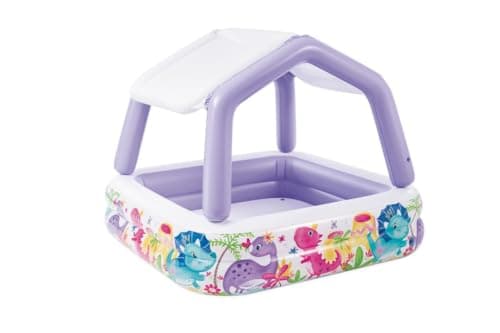 Intex Sun Shade Inflatable Kiddie Pool A small inflatable pool with an integrated canopy. For toddlers the shade matters more than the water does, and most kiddie pools do not have any. | Under-fives, with shade built inA few weekends | 7.6out of 10 |
The short version
- A 10-foot pool is still a pool. It needs the same four readings, the same filtration and the same weekly routine as a 15-foot one.
- Everything costs less because everything scales with gallons. That is the whole argument for buying small.
- Level ground still matters, and 79 square feet is far easier to get right than 254.
- It is not a swimming pool. At this diameter you sit, stand and cool off — and that is a perfectly good purchase.
What ten feet actually is
About 79 square feet of ground, and depending on wall height somewhere in the low four figures of gallons. For comparison, our sizing guide puts a 12-foot Easy Set at 1,485 gallons at its 23-inch fill line and a 12-foot Prism Frame at 1,718.
That is a small enough body of water that a couple of things change in your favor and one thing changes against you.
| At 10 ft | Compared with 15-18 ft | |
|---|---|---|
| Ground to level | About 79 sq ft | 254 sq ft at 18 ft — three times the work |
| Filling | Low four figures of gallons | 6,981 gal on an 18 ft Ultra XTR |
| Chemicals | Scales directly with gallons | Several times the dose |
| Pump | Smallest cartridge pump is enough | Sand filtration becomes necessary |
| Chemistry stability | Swings faster — less water to buffer | Slower and more forgiving |
| What you can do in it | Sit, stand, cool off | Treading and real strokes at 52 in |
The row that argues against small is chemistry stability. A small volume responds faster to everything — sun, rain, one enthusiastic afternoon with four children in it. Our swimmer load guide explains why bather load per gallon is the number that matters, and at this size the ratio is unfavorable. In practice that means testing more often, not dosing more heavily.
The honest comparison with a kiddie pool
This is where most of the money gets wasted in this size bracket, so it is worth being direct.
A hard-sided kiddie pool has no pump, no chemistry and no season. You fill it, use it, empty it, and that is the whole product. If the household’s realistic use is small children splashing on hot afternoons, that is the correct purchase and a 10-foot frame pool is an expensive way to do the same thing with homework attached.
A 10-foot frame pool earns its place when the water needs to stay in it for weeks rather than hours — which means filtration, chemistry and a routine. Our first-time owner guide is the honest list of what that routine involves, and it does not get shorter because the pool is small.
When to go up to twelve instead
Two feet of diameter is a bigger jump than it sounds, because area grows with the square of the radius. Twelve feet is roughly 113 square feet against 79 — about 43 percent more water for 20 percent more diameter.
Go to twelve if two adults will be in it at once, if you want any float bigger than a noodle, or if the ground is easy. Stay at ten if the space is genuinely tight, if you are testing whether the household will use a pool at all, or if the yard is awkward enough that 79 square feet is the most you can reliably level. Our 12-foot roundup covers the size up and our small yards guide covers placement.
What to buy alongside it
The same short list as any pool, at the smallest sizes available: test strips, a chlorine source, a skimmer net and a cover. Our cheapest setup guide prices exactly that, and it is the cheapest complete pool on the site.
One size-specific note: most floats do not fit. A 10-foot pool holds people or it holds a lounger, not both. Our small pool floats guide is built around that constraint, and the answer is mostly noodles.
What we are scoring
We have not tested these and do not claim to. The scores reflect published specifications — frame type, wall height, rated capacity and supplied pump — read against a small yard and a first-time owner. Our methodology page explains how our scoring works.
The picks, in full
Scores are our own reading of published specifications. They are not test results — we have not tested these products and we do not claim to.
Pick #1 · The smallest pool worth filtering
Intex Metal Frame Pool, 10ft x 30in
Intex
Below this size you are buying a paddling pool with a pump attached. At 10 feet you still get a real frame and real filtration, in a footprint that fits almost any yard.
#ad how this is funded · price as of October 8, 2026
Key specs
- Nominal size
- 10ft diameter x 30in wall
- Water capacity
- Not published on the current Intex spec page
- Frame
- Powder-coated steel
- Pump supplied
- Varies by SKU — check the box, not the listing photo
- Pump wattage
- Not published by Intex
How it scoresour reading of published specs, not a test result
- Build
- 6.5
- Setup
- 9.0
- Upkeep
- 9.0
- Running cost
- 9.5
- Value
- 8.0
Overall 7.8 / 10
What works
- Fits a genuinely small yard with walking space left over
- Small enough to drain, dry and store indoors in one afternoon at season's end
- Lowest chemical bill of anything with a real frame
What doesn't
- Intex does not publish a capacity figure for every variant of this size, which makes dosing guesswork until you measure it yourself
- Some SKUs ship without a pump and the listings do not always make that obvious
- Two adults is a crowd
Skip it if: Anything involving more than about three people at once, or an adult who wants to lie on a lounger in it.
What it costs to run: Cheapest thing here to own. If your SKU does not state gallons, measure it: a round pool is roughly diameter squared x average depth x 5.9 gallons, so a 10ft pool filled to 24 inches is about 1,180 gallons. Do that once and every chemical dose for the rest of the pool's life is correct.
One honest season: The cheapest setup that genuinely works for a season of real swimming. Nothing spare, nothing missing.
Specs from: Intex — above-ground pools
Pick #2 · Water in the yard this weekend
Intex Easy Set Pool Set, 12ft x 30in
Intex
Inflate the ring, add water, done. It is the fastest route from box to swimming that exists, and it is honest about being a seasonal item rather than a fixture.
#ad how this is funded · price as of October 8, 2026
Key specs
- Water capacity
- 1,485 gallons (80% full)
- Water depth
- 23 inches
- Pump supplied
- 530 GPH Krystal Clear cartridge pump
- Material
- 3-ply, puncture resistant
- Manufacturer setup claim
- Ready for water in about 10 minutes
- Pump wattage
- Not published by Intex
How it scoresour reading of published specs, not a test result
- Build
- 5.5
- Setup
- 9.8
- Upkeep
- 8.5
- Running cost
- 9.2
- Value
- 8.8
Overall 8.3 / 10
What works
- Genuinely 10 minutes to set up — the top ring rises with the water and there is no frame to assemble
- 1,485 gallons at 80% is a real, filterable pool rather than a paddling pool
- Comes down as fast as it goes up, which makes mid-season relocation possible
- Cheapest way to find out whether your family actually wants a pool before committing to a frame one
What doesn't
- The inflated ring is the single point of failure and it is exposed to sun all season
- 23 inches of water is shallow — this is for cooling off, not swimming
- Soft walls flex, so it needs level ground as much as a frame pool does
Skip it if: Lasting. Treat this as a two-or-three-season item at best and you will not be disappointed; expect five years and you will be.
What it costs to run: A fill at the EPA WaterSense average of $6.06 per 1,000 gallons is about $9. The 530 GPH pump moves 1,485 gallons in under three hours, so this is a pool where a genuinely short daily run does the job — which is where the running-cost saving actually comes from.
One honest season: The cheapest setup that genuinely works for a season of real swimming. Nothing spare, nothing missing.
Specs from: Intex — Easy Set 12' x 30' pool set, EPA WaterSense — cost per 1,000 gallons
Pick #3 · Small yards and first-time owners
Intex Prism Frame Pool Set, 12ft x 30in
Intex
The size most people should buy first and the one most people talk themselves out of. 1,718 gallons is cheap to fill, cheap to treat, and forgiving of every mistake you are about to make.
Key specs
- Water capacity
- 1,718 gallons
- Pump supplied
- Krystal Clear C530 — 530 GPH pump / 475 GPH system
- Frame
- Powder-coated metal, tool-free Easy Lock
- Liner
- 3-ply, puncture resistant
- Manufacturer setup claim
- Ready in 30 minutes
- Pump wattage
- Not published by Intex
How it scoresour reading of published specs, not a test result
- Build
- 7.0
- Setup
- 9.0
- Upkeep
- 9.0
- Running cost
- 9.0
- Value
- 9.0
Overall 8.6 / 10
What works
- A 12-foot circle fits in a yard where a 15 or 18 will not, once you allow three feet of walking space
- 1,718 gallons turns over in about 3.6 hours on the supplied 475 GPH system flow — so a short daily run genuinely filters it
- Cheapest of the frame pools to make a mistake in: a bad chemical week costs a few dollars, not a few tens
- Tool-free assembly is real, not marketing — this is a genuinely one-afternoon job
What doesn't
- 30-inch wall means shallow water and it warms and cools fast
- Small enough that three adults fill it
- The C530 is sized for exactly this pool and nothing bigger, so it does not carry over if you upgrade
Skip it if: Anyone planning to swim rather than sit. This is a cooling-off and playing pool and it is very good at that.
What it costs to run: The cheapest frame pool here to run, and the gap is not small. At the EPA WaterSense average of $6.06 per 1,000 gallons a fill is about $10. Its turnover math — 1,718 gallons at 475 GPH system flow — means roughly 3.6 hours per full turnover, so a 7-8 hour daily run is two full turnovers rather than a partial one.
One honest season: The cheapest setup that genuinely works for a season of real swimming. Nothing spare, nothing missing.
Specs from: Intex — Prism Frame 12' x 30' pool set, Intex — Krystal Clear cartridge filter pumps
Pick #4 · Under-fives, with shade built in
Intex Sun Shade Inflatable Kiddie Pool
Intex
A small inflatable pool with an integrated canopy. For toddlers the shade matters more than the water does, and most kiddie pools do not have any.
#ad how this is funded · price as of October 8, 2026
Key specs
- Type
- Inflatable kiddie pool with canopy
- Capacity
- Published per SKU by Intex
- Filtration
- None — drain and refill
- Age guidance
- Check the SKU; these are toddler-rated products
How it scoresour reading of published specs, not a test result
- Build
- 5.0
- Setup
- 9.8
- Upkeep
- 8.0
- Running cost
- 8.0
- Value
- 8.0
Overall 7.6 / 10
What works
- Built-in shade is genuinely the right feature for the age group this is for
- No filtration means no chemistry to learn — you empty it and refill it
- Small enough to tip out and dry every evening, which is the correct way to run one
What doesn't
- No filtration means the water is only clean because you keep replacing it
- Canopies are the first thing to tear
- Refilling every day or two is a real water cost people do not budget for
Skip it if: Anything beyond toddlers. There is no filtration, so this is a bath you empty, not a pool you maintain.
What it costs to run: The cost here is water, not electricity. Emptying and refilling 60 gallons every other day for a 90-day summer is roughly 2,700 gallons, or about $16 at the EPA WaterSense average of $6.06 per 1,000 gallons — more than most people assume for something this small.
A few weekends: Fine for a heatwave and a toddler. Treat it as consumable, not as a pool — it will not survive a winter in the yard.
Specs from: EPA WaterSense — cost per 1,000 gallons
Questions people actually ask
Is a 10-foot pool big enough?
How much water does a 10-foot above-ground pool hold?
Is a small pool easier to look after?
Should I buy a 10-foot pool or a kiddie pool?
Sources
Read next
- Above-ground pools for ordinary backyardsSoft-side, metal-frame and steel-wall pools compared by what they cost across a whole season, not at the till.
- The best 12-foot pools, and why 12 feet is the sensible sizeFrame and inflatable 12-foot pools side by side, with the fill cost and season chlorine bill computed from published gallons.
- Pools for a small yardRound versus rectangular in a narrow yard, the smallest sizes worth filtering, and why smaller is cheaper twice over.
- What size pool your backyard can actually takeThe three-foot rule, the level-ground tolerance, and a table matching yard size to pool size with the running cost attached.
- The best backyard pools for kidsPools chosen for young children - depth, shade and securability rank above capacity and construction here.
- Leveling the ground, and the weight that makes it matterThe tolerance manufacturers publish, the weight of water that enforces it, and the method for getting a circle genuinely flat with hand tools.
- The cheapest pool setup that actually works for a yearA complete, deliberately minimal first-year setup: the pool, the pump, the testing, the chlorine and the one tool you will use most.
- What an above-ground pool actually costs to run for a yearElectricity, chemicals, water and consumables for a full season - every input sourced, every calculation shown, and every assumption named.
- Floats that work in a small pool, where the big ones ground outWhat actually floats in 23 to 24 inches of water, what grounds out, and the small-pool kit that gets used instead.
- If it will not fit through the gate, nothing else about the pool mattersHow narrow access changes which above-ground pool you can buy: what to measure, which types come in manageable packages, and the working room the build still needs.