Above-Ground Pools
You cannot swim lengths. You can swim continuously.
Those are different things, and conflating them is why people buy a pool for exercise and then stop using it for exercise in week three.

Heads up: we earn a commission if you buy through the links on this page, at no extra cost to you. It never decides the ranking — here is how we pick and here is the full disclosure. Prices are checked automatically; last verified October 8, 2026.
The short version
- Depth is the binding constraint, not diameter. At 42 to 52 inches your hand reaches the floor on most strokes.
- No above-ground pool supports lengths. At 18 feet a stroke and a half crosses it.
- A tether solves it for the price of a belt — continuous effort, in place, in any pool over about 12 feet.
- Diving is out at every size. This is a fixed safety limit, not a preference.
Start with the honest answer
No above-ground pool in this category lets you swim lengths. An 18-foot pool — the largest common size, covered in our 18-foot roundup — is crossed in about a stroke and a half. Turning that into laps means turning more often than swimming, which is not exercise, it is a series of push-offs.
If lengths are genuinely the point, our pool versus membership guide is the honest page to read, because a lane at a local pool costs a fraction of a backyard pool and is 25 meters long.
What follows is what you can do, which is more than people assume.
Why depth matters more than width
Above-ground pools run 42 to 52 inches of wall, and the water line sits below that. Call it three and a half to four feet of actual water.
At that depth, a freestyle pull brings your hand close to the floor at the bottom of the stroke, which shortens the pull and changes the stroke. Breaststroke kick has the same problem. In practice you end up swimming higher in the water than you would normally, which is tiring in a way that is not productive.
| Pool | Water depth | What is possible |
|---|---|---|
| 12 ft x 30 in | About 23 in | Standing, cooling off, play |
| 15 ft x 42 in | About 34 in | Treading, gentle strokes, water walking |
| 18 ft x 52 in | About 44 in | Real strokes across the pool; tethered swimming |
| Any of the above | — | No diving, at any size, ever |
The thing that actually works: a tether
A swim tether is a waist belt on a bungee cord anchored to the pool. You swim, the cord stretches, you stay put. It converts a round pool into a continuous-swim pool for a fraction of the price of a pool long enough to do it properly.
It is genuinely effective and worth understanding before buying. Dedicated systems quote a 12-foot minimum pool length, and the belts commonly fit to a 44-inch waist. The resistance is not constant — the cord pulls harder the further out you get, which takes a few sessions to adjust to and is why people either love it or give up in week one.
The other honest limitation is that the depth problem does not go away. A tether gives you continuous effort; it does not give you a deeper pool. On an 18-foot, 52-inch pool that combination works well. On a 12-foot pool it is exercise in a barrel.
What else the pool is good for, exercise-wise
Water walking and resistance work. Chest-deep water at 44 inches is the right depth for this, and it is the use case that suits the shape of the pool rather than fighting it.
Treading and interval work. No depth problem, no length problem, and it works in a 15-foot pool.
Recovery and mobility. Warm, shallow, supported movement is what a backyard pool is genuinely excellent at, and it is available every evening for a whole season rather than during opening hours.
That last point is where the cost arithmetic turns in the pool’s favor. Our cost per swim guide is built on the denominator, and a pool used most evenings for exercise has a very large denominator. Extending the usable season with a cover makes it larger still — our season extension guide covers that.
If exercise is the main reason you are buying
Buy the biggest pool you can genuinely level, which our sizing guide helps you work out, take the 52-inch wall over the 42-inch one, and buy the tether at the same time rather than later.
And be honest with yourself about the alternative first. A pool bought for exercise that becomes a pool used for cooling off is not a failure — it is just a different purchase than the one you budgeted for, and our are they worth it guide exists to have that conversation before the money is spent.
And if the honest answer is that you cannot swim laps in it but you still want the pool to be exercise, that is a different and much more achievable purchase. Our pool exercise gear roundup covers water aerobics equipment ranked by the depth each format needs — and unlike lap swimming, shallow-water work is something a 48 or 52 inch above-ground pool is genuinely well suited to.
What to buy
Scores are our own reading of published specifications. They are not test results — we have not tested these products and we do not claim to.
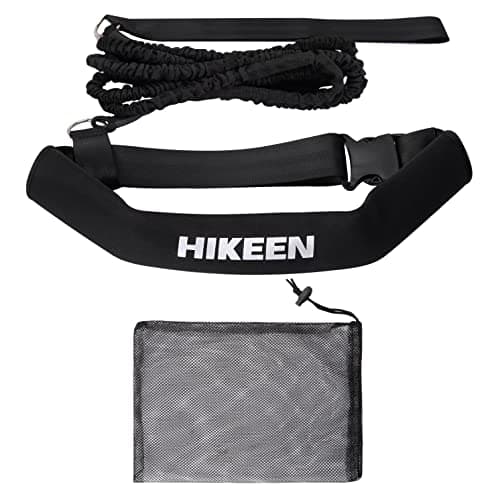
Swimming in a pool too short to swim in
Swim Tether / Resistance Belt
Various
A waist belt on a bungee anchored to the pool. It is the only honest way to get a continuous swim out of a 15-foot circle, and it costs a fraction of a pool big enough to do it properly.
Key specs
- Cord
- 2 m latex bungee with a PE coating is the common spec
- Belt
- Nylon with neoprene backing; many fit to a 44 in waist
- Anchor
- Strap to a post, ladder or supplied above-ground adapter
- Pool length
- Dedicated systems quote a 12 ft minimum
- Installation
- No tools, no modification to the pool
- Variants
- Some add a drag parachute instead of a fixed cord
How it scoresour reading of published specs, not a test result
- Build
- 7.0
- Setup
- 8.5
- Upkeep
- 7.0
- Running cost
- 10.0
- Value
- 8.5
Overall 8.0 / 10
What works
- Turns any pool over about 12 feet into a continuous-swim pool
- Nothing is fixed to the pool, so it comes out with everything else at close
- Adjustable resistance by shortening the anchor rather than buying a new cord
- A fraction of the cost and the yard of a pool actually long enough to swim lengths in
What doesn't
- The cord is the wear item and latex degrades in sun and chlorine
- Anchoring to an above-ground pool needs a genuinely solid point, which not every pool has
- The pull is not constant — it increases as you swim out, which takes getting used to
- Shallow above-ground depth still limits stroke regardless of the tether
Skip it if: Replacing a lap pool. It gives you continuous effort, not a length — turns, push-offs and real distance are not part of it.
What it costs to run: No running cost. Budget for a replacement cord every couple of seasons, which is the only consumable.
Several seasons: Buy-once. Built and warranted to come back out of the box for a few years, if you store it properly.
Specs from: Swim tethers and resistance belts — current Amazon category listing
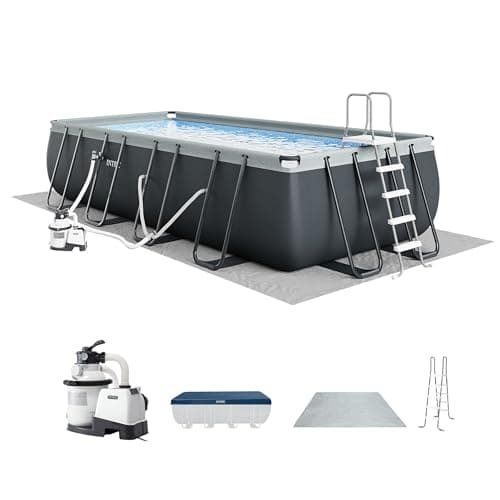
A family that will still be using it in year three
Intex Ultra XTR Frame Pool Set, 18ft x 52in
Intex
The biggest, sturdiest thing in this class that a homeowner can still put up in a weekend. It is also, by a wide margin, the most expensive one to run.
#ad how this is funded · price as of October 8, 2026
Key specs
- Water capacity
- 6,981 gallons
- Pump supplied
- 2,100 GPH sand filter
- Frame
- Galvanized steel, powder-coated inside and out
- Liner
- 3-ply, puncture and tear resistant
- Manufacturer setup claim
- Ready for water in 60 minutes
- Pump wattage
- Not published by Intex
How it scoresour reading of published specs, not a test result
- Build
- 9.0
- Setup
- 6.0
- Upkeep
- 7.5
- Running cost
- 5.0
- Value
- 8.5
Overall 8.4 / 10
What works
- 6,981 gallons is genuinely swimmable for adults, not just a cooling-off pool
- Sand filter rather than a cartridge, so there is no cartridge to buy every few weeks
- Galvanized frame with inner and outer powder coating is the most corrosion-resistant construction in this price class
- Ships with the ladder, cover and ground cloth that cheaper kits make you buy separately
What doesn't
- 52 inches of wall on an 18-foot circle is a lot of water pressure — the ground under it has to be genuinely level
- Intex publishes flow rate but not wattage, so you cannot compute your running cost until the pump is in your hands
- Too heavy and too large to take down and put up casually
Skip it if: Your yard is not close to level, or you want a pool you can pack away mid-season. Nearly 7,000 gallons is not a thing you move.
What it costs to run: It is the most water in this roundup, so it is the most chemicals, the most evaporation and the largest pump. Using ENERGY STAR's own published figures for above-ground pool pumps (an ENERGY STAR model saves about $20 a year, being 11% more efficient), a standard above-ground pump implies roughly $182 a year in electricity — and that is before you scale for a 2,100 GPH sand filter running on a pool this size. Price the season before you price the pool.
Several seasons: Buy-once. Built and warranted to come back out of the box for a few years, if you store it properly.
Specs from: Intex — Ultra XTR Frame 18' x 52' specifications, ENERGY STAR — Pool Pumps
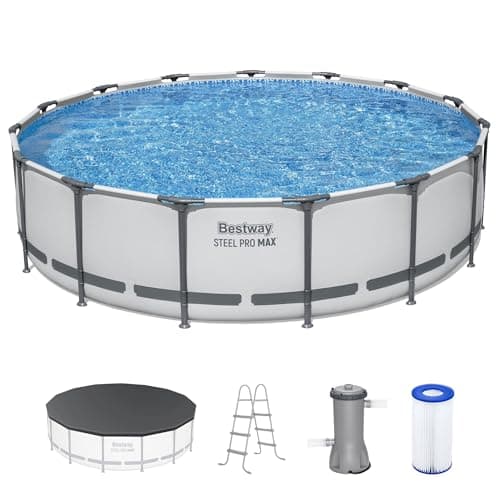
The honest middle of the market
Bestway Steel Pro MAX Pool Set, 15ft x 42in
Bestway
Fewer gallons and a shallower wall than the Intex flagship, which makes it easier to level, cheaper to fill and cheaper to keep clean. For most first-pool families this is the right size, not the compromise size.
#ad how this is funded · price as of October 8, 2026
Key specs
- Water capacity
- 3,955 gallons (90% full)
- Pump supplied
- 1,000 gal filter pump, Type III cartridge
- Liner
- Tritech 3-layer
- Included
- Ladder and cover
- Wall height
- 42 inches
- Pump wattage
- Not published by Bestway (US listing)
How it scoresour reading of published specs, not a test result
- Build
- 7.5
- Setup
- 8.0
- Upkeep
- 8.0
- Running cost
- 7.5
- Value
- 8.8
Overall 8.2 / 10
What works
- 3,955 gallons is roughly 43% less water than the 18ft Intex — that is 43% less chemical spend, every season, forever
- 42-inch wall is far more forgiving of a yard that is nearly-but-not-quite level
- Ladder and cover included
- Cartridge filtration means no sand to buy or change
What doesn't
- Cartridges are a recurring consumable, and in a busy pool you will rinse one weekly
- 42 inches is shallow for adults who want to actually swim rather than sit
- Wattage is not published, so the running-cost math needs the label on the box
Skip it if: Adults who want to swim lengths. At 42 inches you are sitting in it, not swimming in it.
What it costs to run: The gallons are the story. Chemical dosing scales with volume, so 3,955 gallons costs meaningfully less to sanitize all season than 6,981 does. Filling it once at the EPA WaterSense national average of $6.06 per 1,000 gallons is about $24 of water; the same fill on the 18ft Intex is about $42.
Several seasons: Buy-once. Built and warranted to come back out of the box for a few years, if you store it properly.
Specs from: Bestway USA — Steel Pro MAX 15' x 42' pool set, EPA WaterSense — how the calculator works ($6.06 per 1,000 gallons)
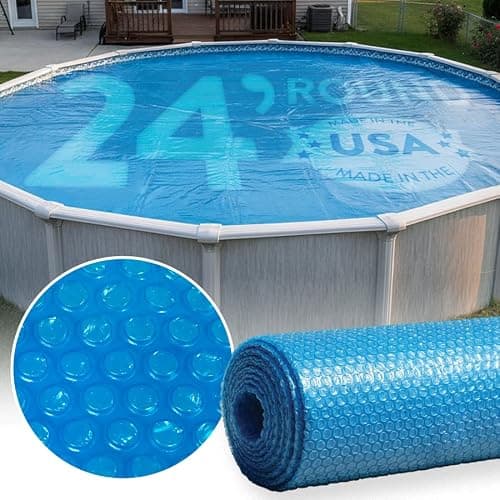
The single highest-return accessory here
Bubble Solar Cover for Above-Ground Pools
Various
It cuts evaporation, and evaporation is simultaneously your water bill, your chemical bill and your heat loss. Nothing else on this site reduces three costs at once.
#ad how this is funded · price as of October 8, 2026
Key specs
- Construction
- Bubble sheet, thickness published in mil
- Thickness
- Higher mil lasts longer — 12 mil and 16 mil are common
- Fit
- Cut to size; buy oversize and trim
- Orientation
- Bubbles face down, toward the water
How it scoresour reading of published specs, not a test result
- Retention
- 9.0
- Durability
- 7.0
- Handling
- 6.0
- Running cost
- 9.8
- Value
- 9.5
Overall 9.0 / 10
What works
- Reduces evaporation, which is the mechanism behind the water, chemical and heat savings all at once
- Cheap relative to everything it saves
- Can be cut to fit any pool shape, so sizing is forgiving
What doesn't
- Awkward to get on and off without a reel, and awkward is how covers end up unused
- Degrades in UV like every vinyl product
- Not a safety cover and will not support weight — this is important
Skip it if: Being a safety barrier. A solar cover looks solid and is not; a child or pet on it goes through and under.
What it costs to run: The one accessory with a clear payback. Every gallon that does not evaporate is a gallon you do not replace at the EPA WaterSense national average of $6.06 per 1,000 gallons, and it is chlorine you do not re-dose. If you buy one thing from this hub, buy this.
Several seasons: Buy-once. Built and warranted to come back out of the box for a few years, if you store it properly.
Specs from: EPA WaterSense — cost per 1,000 gallons
Questions people actually ask
Can you swim laps in an above-ground pool?
How deep is an above-ground pool really?
Does a swim tether work in an above-ground pool?
Can you dive into an above-ground pool?
Sources
Read next
- Above-ground pools for ordinary backyardsSoft-side, metal-frame and steel-wall pools compared by what they cost across a whole season, not at the till.
- Pool exercise gear: your wall height decides what worksWater aerobics gear ranked by how it creates resistance and how much depth it needs - because an above-ground wall decides which half of this category is usable.
- The 18-foot pool, and the three things that change with itWhat an 18-foot above-ground pool actually commits you to — ground preparation, sand filtration and a season of running cost that scales with the gallons.
- What size pool your backyard can actually takeThe three-foot rule, the level-ground tolerance, and a table matching yard size to pool size with the running cost attached.
- Pool shape is a yard decision, not a taste decisionHow round, oval and rectangular pools compare on water per square foot, parts availability and how hard they are to level.
- Above-ground pools for adults who want to swim, not sitThe published gallons converted into actual inches of water, so you can see which pools an adult can swim in before you buy one.
- Backyard pool or a membership: how to actually compare themThe owned-pool side computed in full, a worksheet for the membership side, and the non-financial factors that usually decide it anyway.
- Cost per swim, and why it is the only number that settles the argumentThe running cost divided by realistic use, worked out for three pool sizes, and why the denominator matters more than the numerator.
- Adding weeks to the season, starting with the cheapest thing firstCover, placement and timing before hardware, plus the kilowatt arithmetic that shows what running an electric heater actually costs.
- Rectangular pools, and the hoop strength they give upRectangular frame pools compared on published gallons, wall height and included filtration, with the extra leveling and support the shape genuinely requires.