Above-Ground Pools
Seven things people say about above-ground pools, checked
Some of these are wrong, some are right for the wrong reason, and two of them are true and worth taking more seriously than people do.

Heads up: we earn a commission if you buy through the links on this page, at no extra cost to you. It never decides the ranking — here is how we pick and here is the full disclosure. Prices are checked automatically; last verified October 8, 2026.
The short version
- “They only last a season” is wrong for framed pools and roughly right for soft-side ones — construction decides it, and so do you.
- “The chlorine smell means too much chlorine” is backwards, and it is the most consequential mistake on this list.
- “Level ground matters” is true and understated. A 15-foot pool is about 16 tons.
- “A bigger pool is barely more expensive” is false. Every recurring cost scales with gallons, permanently.
1. “Above-ground pools only last one season”
Partly true, and it depends entirely on which pool. A soft-side inflatable holds its shape with an inflated ring and takes the whole load in the wall material; treating it as consumable is realistic. A bolted metal-frame pool with a three-ply liner is designed to be dismantled and re-erected, which is a different product with a different expectation.
What is genuinely true is that no manufacturer we checked publishes a service life, and that the owner decides most of it — ground preparation, water chemistry and winter storage, in that order. Our lifespan guide covers the four things that actually end them.
2. “The strong chlorine smell means too much chlorine”
Backwards, and it is the costliest belief here. Clean chlorinated water barely smells. The sharp public-pool smell is chloramines — chlorine that has already reacted and is no longer sanitizing.
So the smell reports spent sanitizer, which means the pool needs more chlorine rather than less. Acting on the instinct — stopping the tablets — is a reliable way to turn a working pool into a green one over about a fortnight. Our chlorine smell guide is the full explanation.
3. “Clear water means the pool is safe”
False, and the failure mode is invisible. Clarity is produced by the filter and safety by the sanitizer. They are different systems that fail independently, and a pool that ran out of chlorine on Tuesday can look completely clear on Friday while a biofilm establishes.
The corollary is also true and less alarming: hazy water with correct chemistry is usually a filtration nuisance rather than a hazard. Our clear versus safe guide covers all four combinations.
4. “A bigger pool costs about the same to run”
Comprehensively false. Water volume scales with the square of the radius, so three feet of extra diameter is not incremental. The Intex Prism Frame 12-footer publishes 1,718 gallons; the Bestway Steel Pro MAX 15-footer publishes 3,955. That is 2.3 times the water.
And essentially every recurring cost tracks that number rather than the purchase price: chemicals at the published dosing rate, water for the fill and top-ups, pump size and daily run hours. It is a permanent multiplier, not a one-off premium — our cost of going bigger guide prices it line by line.
5. “Level ground is a nice-to-have”
True and understated, which is unusual. Manufacturers commonly ask for level within one to two inches across the whole footprint, and it reads like caution until you weigh the water: a gallon is 8.34 pounds, so 3,955 gallons is about 16 tons.
Two inches of slope across a 15-foot circle concentrates roughly 918 pounds of extra water against one arc of wall, continuously, all season. That is the mechanism behind almost every dramatic failure in this category, and it is decided before any water arrives. Our leveling guide is the method.
6. “You need to shock the pool every week”
Not on a schedule — on a trigger. Shock is a deliberately heavy dose that resets water, and it is the right response to a specific event: a busy weekend, a heatwave, a storm, a chloramine smell, or a bloom starting.
Dosing it weekly regardless is spending money on a pool that did not need it, and if you are using stabilized shock it is also raising cyanuric acid every time. What genuinely does need to be constant is the maintenance level, which is a dispenser job rather than a shock job — our shock guide covers the distinction.
7. “An above-ground pool is safer than an inground one”
True in one respect and dangerously misread in another. A four-foot vertical wall is a genuine barrier in a way that a flush inground edge is not, and that is a real advantage.
But the barrier only exists while the ladder is out or locked. Leave the ladder down and you have a climbable structure and no barrier at all — and a deck around the pool removes it permanently. The CPSC frames pool safety as layers of protection, and the wall is one layer that is trivially easy to switch off. Our ladder guide and permits and rules guide cover it.
| Claim | Verdict |
|---|---|
| They only last one season | Depends on construction — and on you |
| Chlorine smell means too much chlorine | Backwards |
| Clear water means safe water | False |
| A bigger pool costs about the same | False — 2.3x from 12ft to 15ft |
| Level ground matters | True, and understated |
| Shock weekly | Only on a trigger, not a schedule |
| Safer than inground | Only while the ladder is out |
What to buy
Scores are our own reading of published specifications. They are not test results — we have not tested these products and we do not claim to.
Small yards and first-time owners
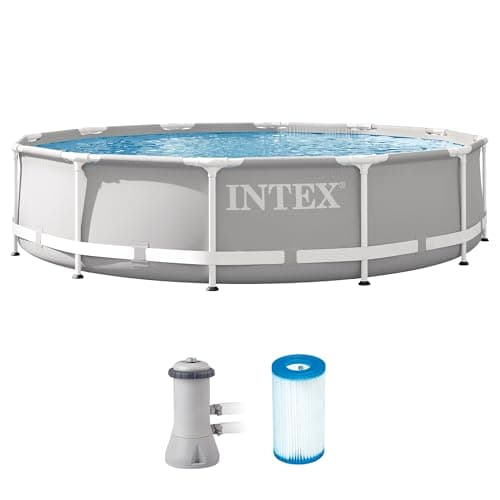
Intex Prism Frame Pool Set, 12ft x 30in
Intex
The size most people should buy first and the one most people talk themselves out of. 1,718 gallons is cheap to fill, cheap to treat, and forgiving of every mistake you are about to make.
Key specs
- Water capacity
- 1,718 gallons
- Pump supplied
- Krystal Clear C530 — 530 GPH pump / 475 GPH system
- Frame
- Powder-coated metal, tool-free Easy Lock
- Liner
- 3-ply, puncture resistant
- Manufacturer setup claim
- Ready in 30 minutes
- Pump wattage
- Not published by Intex
How it scoresour reading of published specs, not a test result
- Build
- 7.0
- Setup
- 9.0
- Upkeep
- 9.0
- Running cost
- 9.0
- Value
- 9.0
Overall 8.6 / 10
What works
- A 12-foot circle fits in a yard where a 15 or 18 will not, once you allow three feet of walking space
- 1,718 gallons turns over in about 3.6 hours on the supplied 475 GPH system flow — so a short daily run genuinely filters it
- Cheapest of the frame pools to make a mistake in: a bad chemical week costs a few dollars, not a few tens
- Tool-free assembly is real, not marketing — this is a genuinely one-afternoon job
What doesn't
- 30-inch wall means shallow water and it warms and cools fast
- Small enough that three adults fill it
- The C530 is sized for exactly this pool and nothing bigger, so it does not carry over if you upgrade
Skip it if: Anyone planning to swim rather than sit. This is a cooling-off and playing pool and it is very good at that.
What it costs to run: The cheapest frame pool here to run, and the gap is not small. At the EPA WaterSense average of $6.06 per 1,000 gallons a fill is about $10. Its turnover math — 1,718 gallons at 475 GPH system flow — means roughly 3.6 hours per full turnover, so a 7-8 hour daily run is two full turnovers rather than a partial one.
One honest season: The cheapest setup that genuinely works for a season of real swimming. Nothing spare, nothing missing.
Specs from: Intex — Prism Frame 12' x 30' pool set, Intex — Krystal Clear cartridge filter pumps
The honest middle of the market
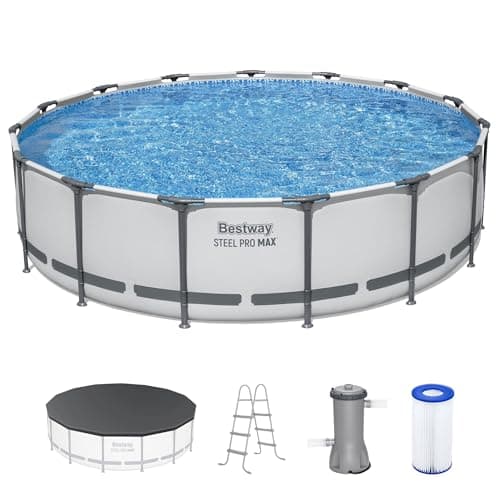
Bestway Steel Pro MAX Pool Set, 15ft x 42in
Bestway
Fewer gallons and a shallower wall than the Intex flagship, which makes it easier to level, cheaper to fill and cheaper to keep clean. For most first-pool families this is the right size, not the compromise size.
#ad how this is funded · price as of October 8, 2026
Key specs
- Water capacity
- 3,955 gallons (90% full)
- Pump supplied
- 1,000 gal filter pump, Type III cartridge
- Liner
- Tritech 3-layer
- Included
- Ladder and cover
- Wall height
- 42 inches
- Pump wattage
- Not published by Bestway (US listing)
How it scoresour reading of published specs, not a test result
- Build
- 7.5
- Setup
- 8.0
- Upkeep
- 8.0
- Running cost
- 7.5
- Value
- 8.8
Overall 8.2 / 10
What works
- 3,955 gallons is roughly 43% less water than the 18ft Intex — that is 43% less chemical spend, every season, forever
- 42-inch wall is far more forgiving of a yard that is nearly-but-not-quite level
- Ladder and cover included
- Cartridge filtration means no sand to buy or change
What doesn't
- Cartridges are a recurring consumable, and in a busy pool you will rinse one weekly
- 42 inches is shallow for adults who want to actually swim rather than sit
- Wattage is not published, so the running-cost math needs the label on the box
Skip it if: Adults who want to swim lengths. At 42 inches you are sitting in it, not swimming in it.
What it costs to run: The gallons are the story. Chemical dosing scales with volume, so 3,955 gallons costs meaningfully less to sanitize all season than 6,981 does. Filling it once at the EPA WaterSense national average of $6.06 per 1,000 gallons is about $24 of water; the same fill on the 18ft Intex is about $42.
Several seasons: Buy-once. Built and warranted to come back out of the box for a few years, if you store it properly.
Specs from: Bestway USA — Steel Pro MAX 15' x 42' pool set, EPA WaterSense — how the calculator works ($6.06 per 1,000 gallons)
Protecting the liner from below
Pool Ground Cloth / Under-Pool Pad
Various
Most liner punctures come from underneath, from a stone or a root you did not see. A ground cloth is the cheapest way to avoid the most expensive repair in above-ground pool ownership.
Key specs
- Function
- Barrier between ground and liner
- Sizing
- Should extend past the pool footprint
- Included with
- Some kits — check before buying separately
How it scoresour reading of published specs, not a test result
- Retention
- 8.0
- Durability
- 7.5
- Handling
- 8.5
- Running cost
- 10.0
- Value
- 9.0
Overall 8.5 / 10
What works
- Prevents the failure mode that ends pools: a puncture in the floor you cannot reach to patch
- Also slows grass and weeds growing up under the pool
- Included free in better kits, so check before you buy one
What doesn't
- Not a substitute for actually clearing stones and roots first
- Thin ones tear during installation before the pool is even up
- Traps moisture, which kills the grass underneath regardless
Skip it if: Fixing uneven ground. It protects against punctures; it does nothing about level, and level is the bigger problem.
What it costs to run: Compare its cost to a liner replacement, which is the single largest unplanned expense in above-ground pool ownership. It is not a close call.
Several seasons: Buy-once. Built and warranted to come back out of the box for a few years, if you store it properly.
The single highest-return accessory here
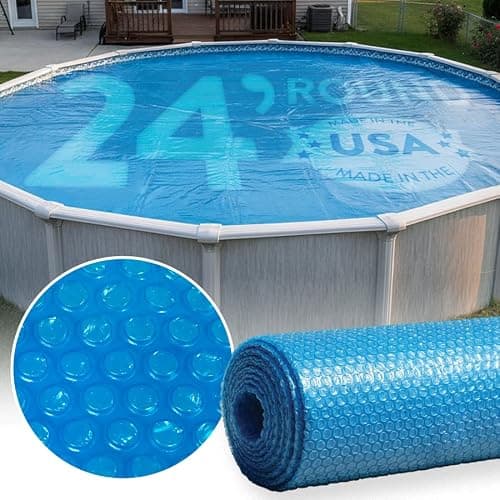
Bubble Solar Cover for Above-Ground Pools
Various
It cuts evaporation, and evaporation is simultaneously your water bill, your chemical bill and your heat loss. Nothing else on this site reduces three costs at once.
#ad how this is funded · price as of October 8, 2026
Key specs
- Construction
- Bubble sheet, thickness published in mil
- Thickness
- Higher mil lasts longer — 12 mil and 16 mil are common
- Fit
- Cut to size; buy oversize and trim
- Orientation
- Bubbles face down, toward the water
How it scoresour reading of published specs, not a test result
- Retention
- 9.0
- Durability
- 7.0
- Handling
- 6.0
- Running cost
- 9.8
- Value
- 9.5
Overall 9.0 / 10
What works
- Reduces evaporation, which is the mechanism behind the water, chemical and heat savings all at once
- Cheap relative to everything it saves
- Can be cut to fit any pool shape, so sizing is forgiving
What doesn't
- Awkward to get on and off without a reel, and awkward is how covers end up unused
- Degrades in UV like every vinyl product
- Not a safety cover and will not support weight — this is important
Skip it if: Being a safety barrier. A solar cover looks solid and is not; a child or pet on it goes through and under.
What it costs to run: The one accessory with a clear payback. Every gallon that does not evaporate is a gallon you do not replace at the EPA WaterSense national average of $6.06 per 1,000 gallons, and it is chlorine you do not re-dose. If you buy one thing from this hub, buy this.
Several seasons: Buy-once. Built and warranted to come back out of the box for a few years, if you store it properly.
Specs from: EPA WaterSense — cost per 1,000 gallons
Getting in and out safely
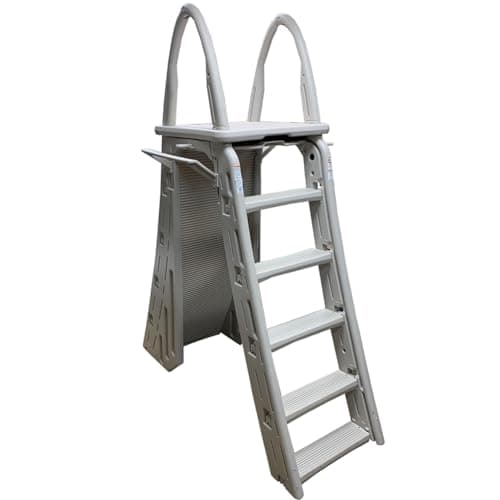
A-Frame Above-Ground Pool Ladder
Various
Read the published weight limit before anything else. It is frequently lower than buyers assume, and it is the one spec on a ladder that genuinely matters.
#ad how this is funded · price as of October 8, 2026
Key specs
- Critical spec
- Published weight capacity — check it against every adult who will use it
- Height match
- Must match your wall height, not approximate it
- Safety feature
- Removable or lockable outer steps on better models
How it scoresour reading of published specs, not a test result
- Sizing fit
- 8.5
- Running cost
- 10.0
- Maintenance
- 8.5
- Build
- 7.5
- Value
- 8.5
Overall 8.4 / 10
What works
- Removable outer steps genuinely prevent unsupervised access, which is a real safety layer
- Resin frames do not corrode the way early steel ladders did
- Correctly matched height is far more stable than a too-tall ladder
What doesn't
- Weight limits are often lower than people expect and are easy to overlook in a listing
- A ladder sized for a 42-inch wall is wrong on a 52-inch wall and vice versa
- Cheap models flex enough to feel alarming
Skip it if: Being a barrier on its own. The CPSC's guidance treats barriers, supervision and alarms as layers; a removable step is one layer, not the answer.
What it costs to run: Buy it with the pool. Kits that include a ladder are frequently cheaper than the pool-plus-ladder bought separately, and this is one of the accessories that makes a cheap-looking kit expensive.
Several seasons: Buy-once. Built and warranted to come back out of the box for a few years, if you store it properly.
Specs from: CPSC — Pool Safely
Questions people actually ask
Do above-ground pools really only last one season?
Does a strong chlorine smell mean the pool has too much chlorine?
Is a bigger above-ground pool much more expensive to run?
Do I need to shock my pool every week?
Sources
Read next
- Above-ground pools for ordinary backyardsSoft-side, metal-frame and steel-wall pools compared by what they cost across a whole season, not at the till.
- How long an above-ground pool actually lastsRealistic lifespans by pool type, the four failure modes that account for nearly all of them, and the cheap items that add seasons.
- Leveling the ground, and the weight that makes it matterThe tolerance manufacturers publish, the weight of water that enforces it, and the method for getting a circle genuinely flat with hand tools.
- What an above-ground pool actually costs to run for a yearElectricity, chemicals, water and consumables for a full season - every input sourced, every calculation shown, and every assumption named.
- The chlorine smell means you need more chlorine, not lessWhat the chlorine smell actually is, why it means the opposite of what people assume, and the test that distinguishes free from combined chlorine.
- Clear water and safe water are two different thingsWhy a pool can look perfect and be unsanitized, why haze is often harmless, and the four readings that answer the question clarity cannot.
- Buy cheap and replace, or buy once: the actual arithmeticWhether a more expensive pool pays for itself over several seasons, and the four cheap purchases that reliably do.