Pool Costs
Buy cheap and replace, or buy once: the actual arithmetic
Spending more on the pool itself rarely pays back, because the recurring costs go up with it. Spending more on four specific accessories almost always does.
Heads up: we earn a commission if you buy through the links on this page, at no extra cost to you. It never decides the ranking — here is how we pick and here is the full disclosure. Prices are checked automatically; last verified October 8, 2026.
The short version
- A more expensive pool is usually a bigger pool, and bigger pools cost more to run permanently — so the “buy once” saving is fighting a recurring cost increase.
- Within a size class, better construction genuinely does last longer, and there the argument works.
- Four cheap items reliably pay for themselves: a ground cloth, a solar cover, a reel and a floating dispenser.
- The thing that most extends a pool’s life costs almost nothing — correct ground preparation, which is free if you do it yourself.
Separating two questions that get merged
“Is the expensive pool better value?” hides two different questions, and merging them is why the answer feels murky.
Question one is about size. Most of the price difference between a cheap pool and an expensive one is gallons, and gallons carry a permanent recurring cost. That question is answered in our cost of going bigger guide, and the short version is that it is a lifestyle decision rather than a value one.
Question two is about construction at the same size — a soft-side 12-footer against a framed 12-footer, say. That is a genuine durability comparison, and it is the one this page is about.
Same size, different construction
At 12 feet you can buy an inflatable holding 1,485 gallons at 80 percent full with a published ten-minute setup, or a bolted frame pool holding 1,718 gallons with a thirty-minute setup. The frame costs more. Does it pay back?
| Soft-side 12ft | Frame 12ft | |
|---|---|---|
| Published capacity | 1,485 gal (80%) | 1,718 gal |
| Setup claim | ≈ 10 minutes | ≈ 30 minutes |
| Water per fill | $9.00 | $10.41 |
| Tablets per season | ≈ 5 | ≈ 6 |
| Designed to be re-erected | Occasionally | Yes, every season |
| Main failure mode | UV on the wall material, seams | Liner punctures; frame joints |
| Realistic ownership | Treat as consumable | Several seasons with care |
The recurring costs are nearly identical, because the volumes are close. So the whole argument rests on lifespan — and lifespan in this category is decided far more by ground preparation, water chemistry and winter storage than by which of the two you bought. Our lifespan guide is explicit that no manufacturer publishes a service life, and that the owner decides most of it.
Which produces an unsatisfying but honest answer: the frame pool is more likely to last, and a soft-side pool stored properly will outlast a frame pool stored badly. If you will do the storage routine, the frame pool is the better buy. If you know you will not, you are buying a consumable either way and the cheaper one is correct.
Where spending more reliably pays
Four items, all cheap in absolute terms, all with a clear mechanism.
A ground cloth. The most common failure in the category is a puncture from underneath, and the liner is the most expensive replacement you may face. This is a very small cost protecting a much larger one, and it is frequently left out of kits — check the box, as our kit versus separate guide covers.
A solar cover. Saves water lost to evaporation, chemicals that would be consumed or diluted, and heat you would otherwise pay for. It is the only item on this page that reduces three lines at once. Bubbles face down.
A reel for it. Not a luxury. The failure mode of a solar cover is disuse, and an unused cover saves nothing.
A floating dispenser. The cheapest item in the hub and the one that prevents the most problems, because it holds a chlorine level rather than delivering a spike that decays into a mid-week trough. Our liquid versus tablets guide covers why that trough is where cloudy water starts.
| Spend | Returns | Verdict |
|---|---|---|
| Ground cloth | Protects the liner from the commonest failure | Always |
| Solar cover and reel | Water, chemicals, heat, and more swims | Always |
| Floating dispenser | Steady chlorine; prevents cloudy water | Always |
| Time spent leveling the ground | Decides whether the pool survives | Always — and it is free |
| A larger pool | Depth and buffer, at a permanent recurring cost | Only if you need depth or capacity |
| An electric heater | Season extension, at the largest bill on the site | Only with a cover, and eyes open |
The purchase that is free and matters most
Nothing on this page extends a pool’s life as much as preparing the ground properly, and it costs an afternoon rather than money. Cut down into undisturbed soil rather than building the low side up, check level across every diameter, compact it, and sweep the pad by hand before the cloth goes down.
A 15-foot pool puts about 16 tons on that pad, and two inches of slope concentrates roughly 918 pounds against one arc of wall for the whole season. That is the mechanism behind most of the dramatic failures in this category, and it is entirely within your control — our leveling guide is the method.
The honest summary
Spending more on the pool itself buys size and, within a size class, a somewhat better chance of a third season. Neither is a saving; the first carries a permanent cost increase and the second is dominated by how you treat it.
Spending more on the ground cloth, the cover, the reel and the dispenser is genuinely cheaper over any timeframe longer than one summer — and all four together cost less than the gap between two pool sizes. Our year two guide shows why: those items are one-off purchases that keep paying into every subsequent season.
What to buy
Scores are our own reading of published specifications. They are not test results — we have not tested these products and we do not claim to.
Water in the yard this weekend
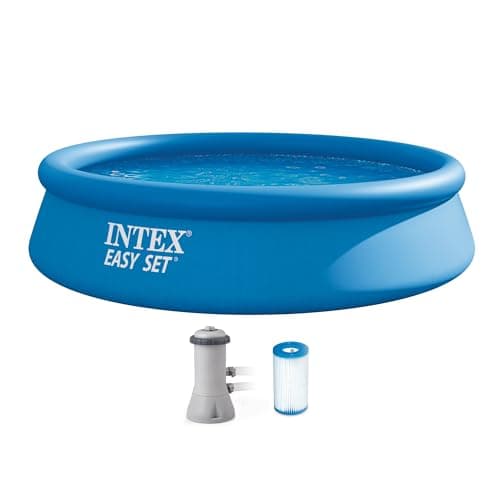
Intex Easy Set Pool Set, 12ft x 30in
Intex
Inflate the ring, add water, done. It is the fastest route from box to swimming that exists, and it is honest about being a seasonal item rather than a fixture.
#ad how this is funded · price as of October 8, 2026
Key specs
- Water capacity
- 1,485 gallons (80% full)
- Water depth
- 23 inches
- Pump supplied
- 530 GPH Krystal Clear cartridge pump
- Material
- 3-ply, puncture resistant
- Manufacturer setup claim
- Ready for water in about 10 minutes
- Pump wattage
- Not published by Intex
How it scoresour reading of published specs, not a test result
- Build
- 5.5
- Setup
- 9.8
- Upkeep
- 8.5
- Running cost
- 9.2
- Value
- 8.8
Overall 8.3 / 10
What works
- Genuinely 10 minutes to set up — the top ring rises with the water and there is no frame to assemble
- 1,485 gallons at 80% is a real, filterable pool rather than a paddling pool
- Comes down as fast as it goes up, which makes mid-season relocation possible
- Cheapest way to find out whether your family actually wants a pool before committing to a frame one
What doesn't
- The inflated ring is the single point of failure and it is exposed to sun all season
- 23 inches of water is shallow — this is for cooling off, not swimming
- Soft walls flex, so it needs level ground as much as a frame pool does
Skip it if: Lasting. Treat this as a two-or-three-season item at best and you will not be disappointed; expect five years and you will be.
What it costs to run: A fill at the EPA WaterSense average of $6.06 per 1,000 gallons is about $9. The 530 GPH pump moves 1,485 gallons in under three hours, so this is a pool where a genuinely short daily run does the job — which is where the running-cost saving actually comes from.
One honest season: The cheapest setup that genuinely works for a season of real swimming. Nothing spare, nothing missing.
Specs from: Intex — Easy Set 12' x 30' pool set, EPA WaterSense — cost per 1,000 gallons
Small yards and first-time owners
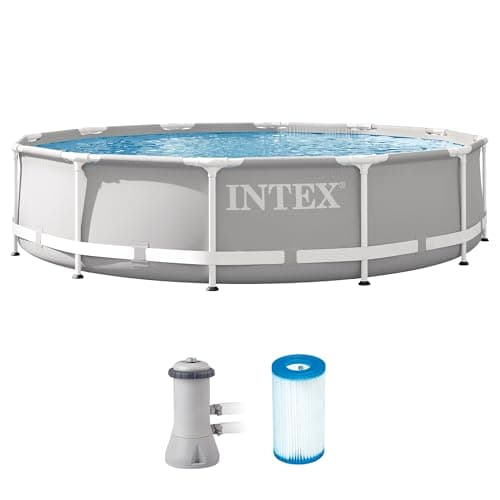
Intex Prism Frame Pool Set, 12ft x 30in
Intex
The size most people should buy first and the one most people talk themselves out of. 1,718 gallons is cheap to fill, cheap to treat, and forgiving of every mistake you are about to make.
Key specs
- Water capacity
- 1,718 gallons
- Pump supplied
- Krystal Clear C530 — 530 GPH pump / 475 GPH system
- Frame
- Powder-coated metal, tool-free Easy Lock
- Liner
- 3-ply, puncture resistant
- Manufacturer setup claim
- Ready in 30 minutes
- Pump wattage
- Not published by Intex
How it scoresour reading of published specs, not a test result
- Build
- 7.0
- Setup
- 9.0
- Upkeep
- 9.0
- Running cost
- 9.0
- Value
- 9.0
Overall 8.6 / 10
What works
- A 12-foot circle fits in a yard where a 15 or 18 will not, once you allow three feet of walking space
- 1,718 gallons turns over in about 3.6 hours on the supplied 475 GPH system flow — so a short daily run genuinely filters it
- Cheapest of the frame pools to make a mistake in: a bad chemical week costs a few dollars, not a few tens
- Tool-free assembly is real, not marketing — this is a genuinely one-afternoon job
What doesn't
- 30-inch wall means shallow water and it warms and cools fast
- Small enough that three adults fill it
- The C530 is sized for exactly this pool and nothing bigger, so it does not carry over if you upgrade
Skip it if: Anyone planning to swim rather than sit. This is a cooling-off and playing pool and it is very good at that.
What it costs to run: The cheapest frame pool here to run, and the gap is not small. At the EPA WaterSense average of $6.06 per 1,000 gallons a fill is about $10. Its turnover math — 1,718 gallons at 475 GPH system flow — means roughly 3.6 hours per full turnover, so a 7-8 hour daily run is two full turnovers rather than a partial one.
One honest season: The cheapest setup that genuinely works for a season of real swimming. Nothing spare, nothing missing.
Specs from: Intex — Prism Frame 12' x 30' pool set, Intex — Krystal Clear cartridge filter pumps
The honest middle of the market
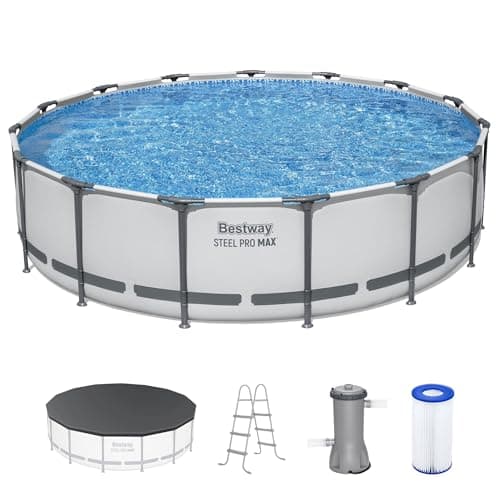
Bestway Steel Pro MAX Pool Set, 15ft x 42in
Bestway
Fewer gallons and a shallower wall than the Intex flagship, which makes it easier to level, cheaper to fill and cheaper to keep clean. For most first-pool families this is the right size, not the compromise size.
#ad how this is funded · price as of October 8, 2026
Key specs
- Water capacity
- 3,955 gallons (90% full)
- Pump supplied
- 1,000 gal filter pump, Type III cartridge
- Liner
- Tritech 3-layer
- Included
- Ladder and cover
- Wall height
- 42 inches
- Pump wattage
- Not published by Bestway (US listing)
How it scoresour reading of published specs, not a test result
- Build
- 7.5
- Setup
- 8.0
- Upkeep
- 8.0
- Running cost
- 7.5
- Value
- 8.8
Overall 8.2 / 10
What works
- 3,955 gallons is roughly 43% less water than the 18ft Intex — that is 43% less chemical spend, every season, forever
- 42-inch wall is far more forgiving of a yard that is nearly-but-not-quite level
- Ladder and cover included
- Cartridge filtration means no sand to buy or change
What doesn't
- Cartridges are a recurring consumable, and in a busy pool you will rinse one weekly
- 42 inches is shallow for adults who want to actually swim rather than sit
- Wattage is not published, so the running-cost math needs the label on the box
Skip it if: Adults who want to swim lengths. At 42 inches you are sitting in it, not swimming in it.
What it costs to run: The gallons are the story. Chemical dosing scales with volume, so 3,955 gallons costs meaningfully less to sanitize all season than 6,981 does. Filling it once at the EPA WaterSense national average of $6.06 per 1,000 gallons is about $24 of water; the same fill on the 18ft Intex is about $42.
Several seasons: Buy-once. Built and warranted to come back out of the box for a few years, if you store it properly.
Specs from: Bestway USA — Steel Pro MAX 15' x 42' pool set, EPA WaterSense — how the calculator works ($6.06 per 1,000 gallons)
A family that will still be using it in year three
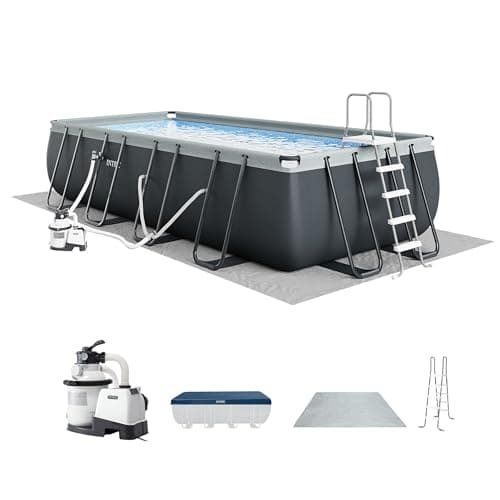
Intex Ultra XTR Frame Pool Set, 18ft x 52in
Intex
The biggest, sturdiest thing in this class that a homeowner can still put up in a weekend. It is also, by a wide margin, the most expensive one to run.
#ad how this is funded · price as of October 8, 2026
Key specs
- Water capacity
- 6,981 gallons
- Pump supplied
- 2,100 GPH sand filter
- Frame
- Galvanized steel, powder-coated inside and out
- Liner
- 3-ply, puncture and tear resistant
- Manufacturer setup claim
- Ready for water in 60 minutes
- Pump wattage
- Not published by Intex
How it scoresour reading of published specs, not a test result
- Build
- 9.0
- Setup
- 6.0
- Upkeep
- 7.5
- Running cost
- 5.0
- Value
- 8.5
Overall 8.4 / 10
What works
- 6,981 gallons is genuinely swimmable for adults, not just a cooling-off pool
- Sand filter rather than a cartridge, so there is no cartridge to buy every few weeks
- Galvanized frame with inner and outer powder coating is the most corrosion-resistant construction in this price class
- Ships with the ladder, cover and ground cloth that cheaper kits make you buy separately
What doesn't
- 52 inches of wall on an 18-foot circle is a lot of water pressure — the ground under it has to be genuinely level
- Intex publishes flow rate but not wattage, so you cannot compute your running cost until the pump is in your hands
- Too heavy and too large to take down and put up casually
Skip it if: Your yard is not close to level, or you want a pool you can pack away mid-season. Nearly 7,000 gallons is not a thing you move.
What it costs to run: It is the most water in this roundup, so it is the most chemicals, the most evaporation and the largest pump. Using ENERGY STAR's own published figures for above-ground pool pumps (an ENERGY STAR model saves about $20 a year, being 11% more efficient), a standard above-ground pump implies roughly $182 a year in electricity — and that is before you scale for a 2,100 GPH sand filter running on a pool this size. Price the season before you price the pool.
Several seasons: Buy-once. Built and warranted to come back out of the box for a few years, if you store it properly.
Specs from: Intex — Ultra XTR Frame 18' x 52' specifications, ENERGY STAR — Pool Pumps
Protecting the liner from below
Pool Ground Cloth / Under-Pool Pad
Various
Most liner punctures come from underneath, from a stone or a root you did not see. A ground cloth is the cheapest way to avoid the most expensive repair in above-ground pool ownership.
Key specs
- Function
- Barrier between ground and liner
- Sizing
- Should extend past the pool footprint
- Included with
- Some kits — check before buying separately
How it scoresour reading of published specs, not a test result
- Retention
- 8.0
- Durability
- 7.5
- Handling
- 8.5
- Running cost
- 10.0
- Value
- 9.0
Overall 8.5 / 10
What works
- Prevents the failure mode that ends pools: a puncture in the floor you cannot reach to patch
- Also slows grass and weeds growing up under the pool
- Included free in better kits, so check before you buy one
What doesn't
- Not a substitute for actually clearing stones and roots first
- Thin ones tear during installation before the pool is even up
- Traps moisture, which kills the grass underneath regardless
Skip it if: Fixing uneven ground. It protects against punctures; it does nothing about level, and level is the bigger problem.
What it costs to run: Compare its cost to a liner replacement, which is the single largest unplanned expense in above-ground pool ownership. It is not a close call.
Several seasons: Buy-once. Built and warranted to come back out of the box for a few years, if you store it properly.
The single highest-return accessory here
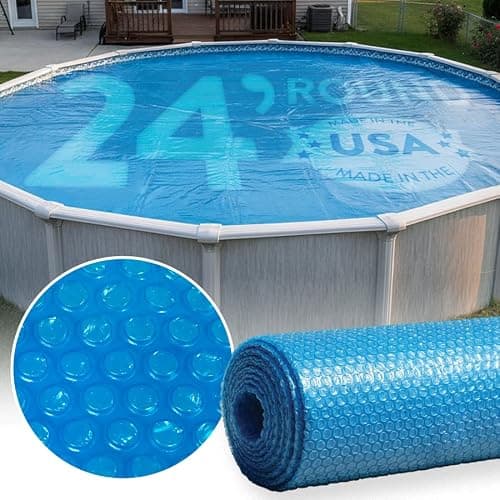
Bubble Solar Cover for Above-Ground Pools
Various
It cuts evaporation, and evaporation is simultaneously your water bill, your chemical bill and your heat loss. Nothing else on this site reduces three costs at once.
#ad how this is funded · price as of October 8, 2026
Key specs
- Construction
- Bubble sheet, thickness published in mil
- Thickness
- Higher mil lasts longer — 12 mil and 16 mil are common
- Fit
- Cut to size; buy oversize and trim
- Orientation
- Bubbles face down, toward the water
How it scoresour reading of published specs, not a test result
- Retention
- 9.0
- Durability
- 7.0
- Handling
- 6.0
- Running cost
- 9.8
- Value
- 9.5
Overall 9.0 / 10
What works
- Reduces evaporation, which is the mechanism behind the water, chemical and heat savings all at once
- Cheap relative to everything it saves
- Can be cut to fit any pool shape, so sizing is forgiving
What doesn't
- Awkward to get on and off without a reel, and awkward is how covers end up unused
- Degrades in UV like every vinyl product
- Not a safety cover and will not support weight — this is important
Skip it if: Being a safety barrier. A solar cover looks solid and is not; a child or pet on it goes through and under.
What it costs to run: The one accessory with a clear payback. Every gallon that does not evaporate is a gallon you do not replace at the EPA WaterSense national average of $6.06 per 1,000 gallons, and it is chlorine you do not re-dose. If you buy one thing from this hub, buy this.
Several seasons: Buy-once. Built and warranted to come back out of the box for a few years, if you store it properly.
Specs from: EPA WaterSense — cost per 1,000 gallons
Questions people actually ask
Is an expensive above-ground pool worth it?
Is it cheaper to buy a cheap pool and replace it?
What pool accessories are actually worth the money?
What is the best value thing I can do for my pool?
Sources
Read next
- What a pool actually costs, with the arithmetic shownPurchase, electricity, chemicals, water and replacement parts - added up, sourced, and shown as arithmetic you can redo.
- Year two, and the lines that disappearWhich pool costs are one-off and which recur, with a year-one and year-two comparison for the same pool.
- One size up is not a premium, it is a subscriptionThe recurring multiplier attached to each size step, priced out - and the two cases where paying it is clearly right.
- What actually wears out, and when you will be buying itThe replacement schedule for an above-ground pool - cartridges, covers, liners and hardware - and which spares are worth keeping on the shelf.
- The cheapest pool setup that actually works for a yearA complete, deliberately minimal first-year setup: the pool, the pump, the testing, the chlorine and the one tool you will use most.
- How long an above-ground pool actually lastsRealistic lifespans by pool type, the four failure modes that account for nearly all of them, and the cheap items that add seasons.
- The types of backyard pool, and who each is forInflatable, metal frame, permanent steel wall and inground - what separates them and which one you are actually shopping for.