Pool Costs
One size up is not a premium, it is a subscription
The extra you pay at the checkout is the small part. The 2.3x on water, chemicals, pump size and run time arrives every season for as long as you own it.
Heads up: we earn a commission if you buy through the links on this page, at no extra cost to you. It never decides the ranking — here is how we pick and here is the full disclosure. Prices are checked automatically; last verified October 8, 2026.
The short version
- 12 to 15 feet is a 2.3x step. 1,718 gallons to 3,955 — not a modest increase, a doubling and more.
- 15 to 18 feet is a further 1.77x, and it also changes the filtration class from cartridge to sand.
- Everything recurring scales with that multiplier — water, chlorine, shock, pump wattage, run hours, cartridges.
- The checkout difference is paid once. This is paid every year. That is the entire argument of this page.
The multiplier, stated first
Diameter is misleading because water scales with the square of the radius. Three feet of extra diameter sounds incremental; it is not.
What each size step multiplies
- Intex Prism Frame 12ft x 30in [Intex]
- 1,718 gallons
- Bestway Steel Pro MAX 15ft x 42in [Bestway]
- 3,955 gallons
- Intex Ultra XTR 18ft x 52in [Intex]
- 6,981 gallons
3,955 ÷ 1,718 = 2.30 6,981 ÷ 3,955 = 1.77 6,981 ÷ 1,718 = 4.06
12 to 15 feet is 2.3x. 12 to 18 feet is 4x.
| Line | 12ft (1,718 gal) | 15ft (3,955 gal) | 18ft (6,981 gal) |
|---|---|---|---|
| Water, one fill | $10.41 | $23.96 | $42.30 |
| Chlorine tablets per season | ≈ 6 | ≈ 14 | ≈ 24 |
| One turnover on the bundled pump | ≈ 3.6 h | ≈ 5.3 h | Sand filter |
| Sensible daily run time | 4-7 h | 5-10 h | 8 h and up |
| Filtration class | 530 GPH cartridge | 1,000 GPH cartridge | 2,100 GPH sand |
| Floor area to vacuum | ≈ 113 sq ft | ≈ 177 sq ft | ≈ 254 sq ft |
| Ground load | ≈ 127 lb/sq ft | ≈ 187 lb/sq ft | ≈ 229 lb/sq ft |
Where the money actually goes
Chemicals scale exactly. Published trichlor dosing is two three-inch tablets a week per 10,000 gallons, so this is arithmetic rather than estimate: 2.3 times the water is 2.3 times the tablets, every season, for the life of the pool. Shock and balancers scale the same way. Our chemical cost guide has the counts.
Electricity scales twice. A bigger pool needs a bigger pump, and a bigger pump run for longer. At the EIA US residential average of 18.34 cents per kWh, every 100 W of pump run 8 hours a day for a 120-day season is about $17.61 — so moving from a 200 W pump on four hours to a 300 W pump on eight is not a small adjustment. Our pump electricity guide has the table.
Water scales, and then scales again. The fill is the visible part. The invisible part is that a larger surface area evaporates more, so top-ups are larger too — and every gallon added has to be re-balanced.
Cartridges scale with load, not just volume. More water and more swimmers means more loading. Intex guidance is roughly every two weeks in heavy use, and a large family pool is heavy use.
What going bigger actually buys
It would be one-sided to leave it there, because the benefits are real and they are not only about comfort.
Chemical buffer. A larger volume absorbs a busy afternoon far more gracefully. Four people in 1,718 gallons is about 430 gallons each; in 3,955 it is nearly a thousand. That is the difference between a routine that flexes and one that breaks — our swimmer load guide covers the mechanism.
Depth, at 42 and 52-inch walls. Roughly 36 and 44 inches of water respectively, against about 24 inches on a 30-inch-wall 12-footer. If adults want to swim rather than sit, that is the whole decision — our pools for adults page does the conversion from published gallons.
Use. A pool that comfortably takes the whole family tends to get used more, which improves the cost per swim even as it worsens the cost per season. Our cost per swim guide is where those two pull against each other.
The two cases where paying the multiplier is clearly right
Adults who genuinely intend to swim. Depth is not available at the small end at any price, so if that is the requirement, the size is the answer and the recurring cost is the price of it.
A household that will regularly have several people in the water. The buffer argument is real, and a small pool with a heavy load is a pool that needs constant attention.
Outside those two, the honest default is the smaller pool. It is not a compromise: it costs a fraction to run, it is far more forgiving of ground that is not perfectly level, and on a seasonal pool it is cheap to drain and refill when the chemistry needs a reset — which our midsummer reset guide treats as a routine tool rather than an emergency.
How to make the decision in ten minutes
Measure the flattest rectangle in the garden and subtract three feet of access on every side; that sets the ceiling. Then take the honest number of swims you expect — not the optimistic one — and ask whether the extra depth or buffer changes it. If it does not, take the smaller pool and pocket a permanent 2.3x on the recurring lines.
Our sizing guide turns the measurement into a shortlist, and the 15-foot roundup covers what changes practically at the step above the volume size.
What to buy
Scores are our own reading of published specifications. They are not test results — we have not tested these products and we do not claim to.
Small yards and first-time owners
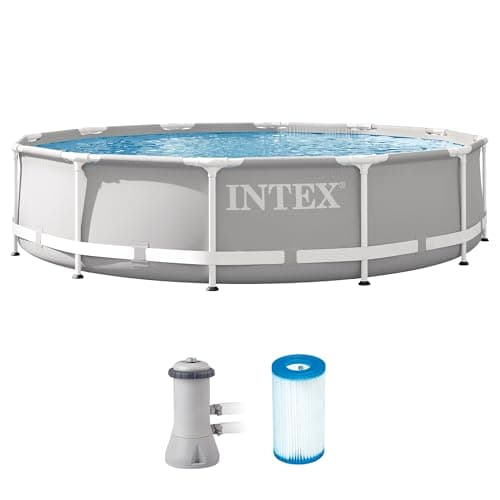
Intex Prism Frame Pool Set, 12ft x 30in
Intex
The size most people should buy first and the one most people talk themselves out of. 1,718 gallons is cheap to fill, cheap to treat, and forgiving of every mistake you are about to make.
Key specs
- Water capacity
- 1,718 gallons
- Pump supplied
- Krystal Clear C530 — 530 GPH pump / 475 GPH system
- Frame
- Powder-coated metal, tool-free Easy Lock
- Liner
- 3-ply, puncture resistant
- Manufacturer setup claim
- Ready in 30 minutes
- Pump wattage
- Not published by Intex
How it scoresour reading of published specs, not a test result
- Build
- 7.0
- Setup
- 9.0
- Upkeep
- 9.0
- Running cost
- 9.0
- Value
- 9.0
Overall 8.6 / 10
What works
- A 12-foot circle fits in a yard where a 15 or 18 will not, once you allow three feet of walking space
- 1,718 gallons turns over in about 3.6 hours on the supplied 475 GPH system flow — so a short daily run genuinely filters it
- Cheapest of the frame pools to make a mistake in: a bad chemical week costs a few dollars, not a few tens
- Tool-free assembly is real, not marketing — this is a genuinely one-afternoon job
What doesn't
- 30-inch wall means shallow water and it warms and cools fast
- Small enough that three adults fill it
- The C530 is sized for exactly this pool and nothing bigger, so it does not carry over if you upgrade
Skip it if: Anyone planning to swim rather than sit. This is a cooling-off and playing pool and it is very good at that.
What it costs to run: The cheapest frame pool here to run, and the gap is not small. At the EPA WaterSense average of $6.06 per 1,000 gallons a fill is about $10. Its turnover math — 1,718 gallons at 475 GPH system flow — means roughly 3.6 hours per full turnover, so a 7-8 hour daily run is two full turnovers rather than a partial one.
One honest season: The cheapest setup that genuinely works for a season of real swimming. Nothing spare, nothing missing.
Specs from: Intex — Prism Frame 12' x 30' pool set, Intex — Krystal Clear cartridge filter pumps
The honest middle of the market
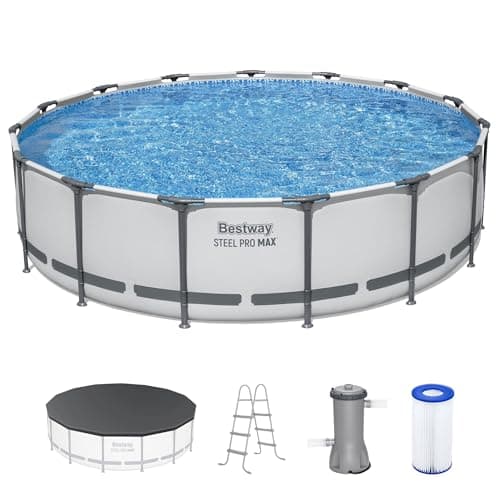
Bestway Steel Pro MAX Pool Set, 15ft x 42in
Bestway
Fewer gallons and a shallower wall than the Intex flagship, which makes it easier to level, cheaper to fill and cheaper to keep clean. For most first-pool families this is the right size, not the compromise size.
#ad how this is funded · price as of October 8, 2026
Key specs
- Water capacity
- 3,955 gallons (90% full)
- Pump supplied
- 1,000 gal filter pump, Type III cartridge
- Liner
- Tritech 3-layer
- Included
- Ladder and cover
- Wall height
- 42 inches
- Pump wattage
- Not published by Bestway (US listing)
How it scoresour reading of published specs, not a test result
- Build
- 7.5
- Setup
- 8.0
- Upkeep
- 8.0
- Running cost
- 7.5
- Value
- 8.8
Overall 8.2 / 10
What works
- 3,955 gallons is roughly 43% less water than the 18ft Intex — that is 43% less chemical spend, every season, forever
- 42-inch wall is far more forgiving of a yard that is nearly-but-not-quite level
- Ladder and cover included
- Cartridge filtration means no sand to buy or change
What doesn't
- Cartridges are a recurring consumable, and in a busy pool you will rinse one weekly
- 42 inches is shallow for adults who want to actually swim rather than sit
- Wattage is not published, so the running-cost math needs the label on the box
Skip it if: Adults who want to swim lengths. At 42 inches you are sitting in it, not swimming in it.
What it costs to run: The gallons are the story. Chemical dosing scales with volume, so 3,955 gallons costs meaningfully less to sanitize all season than 6,981 does. Filling it once at the EPA WaterSense national average of $6.06 per 1,000 gallons is about $24 of water; the same fill on the 18ft Intex is about $42.
Several seasons: Buy-once. Built and warranted to come back out of the box for a few years, if you store it properly.
Specs from: Bestway USA — Steel Pro MAX 15' x 42' pool set, EPA WaterSense — how the calculator works ($6.06 per 1,000 gallons)
A family that will still be using it in year three
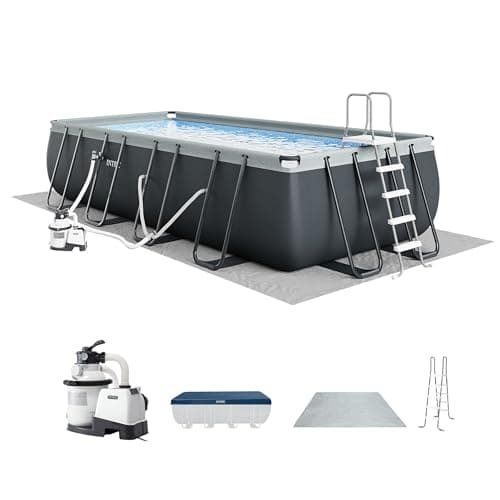
Intex Ultra XTR Frame Pool Set, 18ft x 52in
Intex
The biggest, sturdiest thing in this class that a homeowner can still put up in a weekend. It is also, by a wide margin, the most expensive one to run.
#ad how this is funded · price as of October 8, 2026
Key specs
- Water capacity
- 6,981 gallons
- Pump supplied
- 2,100 GPH sand filter
- Frame
- Galvanized steel, powder-coated inside and out
- Liner
- 3-ply, puncture and tear resistant
- Manufacturer setup claim
- Ready for water in 60 minutes
- Pump wattage
- Not published by Intex
How it scoresour reading of published specs, not a test result
- Build
- 9.0
- Setup
- 6.0
- Upkeep
- 7.5
- Running cost
- 5.0
- Value
- 8.5
Overall 8.4 / 10
What works
- 6,981 gallons is genuinely swimmable for adults, not just a cooling-off pool
- Sand filter rather than a cartridge, so there is no cartridge to buy every few weeks
- Galvanized frame with inner and outer powder coating is the most corrosion-resistant construction in this price class
- Ships with the ladder, cover and ground cloth that cheaper kits make you buy separately
What doesn't
- 52 inches of wall on an 18-foot circle is a lot of water pressure — the ground under it has to be genuinely level
- Intex publishes flow rate but not wattage, so you cannot compute your running cost until the pump is in your hands
- Too heavy and too large to take down and put up casually
Skip it if: Your yard is not close to level, or you want a pool you can pack away mid-season. Nearly 7,000 gallons is not a thing you move.
What it costs to run: It is the most water in this roundup, so it is the most chemicals, the most evaporation and the largest pump. Using ENERGY STAR's own published figures for above-ground pool pumps (an ENERGY STAR model saves about $20 a year, being 11% more efficient), a standard above-ground pump implies roughly $182 a year in electricity — and that is before you scale for a 2,100 GPH sand filter running on a pool this size. Price the season before you price the pool.
Several seasons: Buy-once. Built and warranted to come back out of the box for a few years, if you store it properly.
Specs from: Intex — Ultra XTR Frame 18' x 52' specifications, ENERGY STAR — Pool Pumps
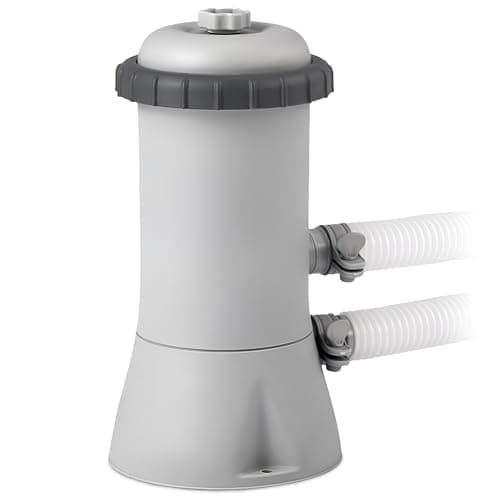
Pools up to about 6,000 gallons
Intex Krystal Clear C1000 Cartridge Filter Pump
Intex
The workhorse replacement pump for mid-size frame pools. 1,000 GPH pump flow, 750 GPH through the system once the cartridge is in the way — and that second number is the one your turnover math needs.
#ad how this is funded · price as of October 8, 2026
Key specs
- Pump flow rate
- 1,000 GPH
- System flow rate
- 750 GPH
- Rated pool size
- Up to 6,000 gallons
- Cartridge
- Type A
- Wattage
- Not published by Intex
How it scoresour reading of published specs, not a test result
- Sizing fit
- 9.0
- Running cost
- 7.0
- Maintenance
- 7.5
- Build
- 7.5
- Value
- 8.5
Overall 8.3 / 10
What works
- Intex publishes both pump flow and system flow, which is more honesty than most of this category offers
- Type A cartridges are the most widely stocked filter consumable in the US
- Sized correctly for the 12ft-15ft frame pools most families own
What doesn't
- Wattage is not published anywhere on the Intex site, so you cannot cost it before purchase
- Cartridge-only, so there is a consumable every few weeks in a busy pool
- GFCI cord length dictates where the pool can go more than people expect
Skip it if: Pools over about 6,000 gallons. Above that you are asking it to run all day to achieve one turnover, which is the expensive way to filter.
What it costs to run: Do the turnover math before you buy: 750 GPH system flow moves 4,000 gallons in 5.3 hours. Two turnovers a day is therefore about 11 hours of running. At the EIA's June 2026 US residential average of 18.34 cents per kWh, every 100 watts of pump draw running 11 hours a day for a 120-day season costs about $24. Find your wattage on the pump label and multiply.
Several seasons: Buy-once. Built and warranted to come back out of the box for a few years, if you store it properly.
Specs from: Intex — Krystal Clear cartridge filter pumps, EIA Electric Power Monthly, Table 5.6.A — US residential average price
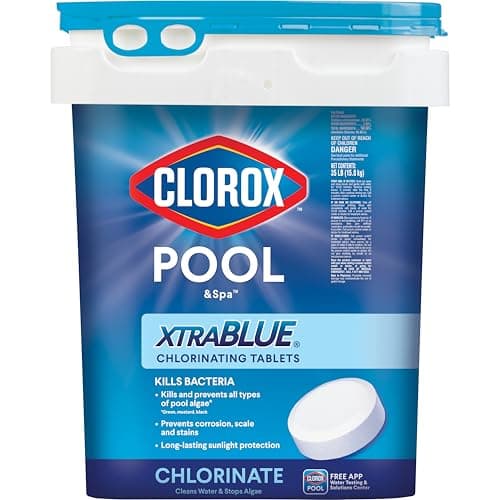
The default chlorine source
Clorox Pool&Spa 3-Inch Chlorinating Tablets
Clorox Pool&Spa
Stabilized trichlor tablets in a floating dispenser is the standard answer for a seasonal above-ground pool, and this is the standard version of it.
#ad how this is funded · price as of October 8, 2026
Key specs
- Type
- Stabilized trichlor, 3-inch tablets
- Contains stabilizer
- Yes — cyanuric acid is part of trichlor
- Dosing
- Per manufacturer instructions, by pool volume
- CDC target
- At least 2 ppm free chlorine when using a stabilizer
How it scoresour reading of published specs, not a test result
- Effectiveness
- 9.0
- Ease
- 9.0
- Water impact
- 6.0
- Cost per season
- 8.5
- Value
- 8.5
Overall 8.5 / 10
What works
- Dissolves slowly, so a floating dispenser meters chlorine out over days rather than hours
- Stabilized, so sunlight does not destroy your chlorine within an afternoon
- Widely stocked, so you are never hunting for it in July
What doesn't
- Every tablet adds cyanuric acid, and in a pool you never fully drain that accumulates until chlorine stops responding
- Trichlor is acidic and will pull your pH down over a season
- Tablets must be kept dry and sealed or they degrade and gas off
Skip it if: A small pool that is topped up rather than drained. Cyanuric acid only leaves with the water, so in a 1,500-gallon pool it climbs fast.
What it costs to run: The standing chemical cost of the season, and it scales directly with gallons. Watch the cyanuric acid reading on your test strip: once it is high, you are buying chlorine that cannot work, which is the most common invisible waste in a first pool year.
One honest season: The cheapest setup that genuinely works for a season of real swimming. Nothing spare, nothing missing.
Specs from: CDC — free chlorine target with cyanuric acid
Questions people actually ask
How much more does a bigger above-ground pool cost to run?
Is a 15-foot pool twice as expensive as a 12-foot one?
When is it worth buying the bigger pool?
Does a bigger pool need a different pump?
Sources
Read next
- What a pool actually costs, with the arithmetic shownPurchase, electricity, chemicals, water and replacement parts - added up, sourced, and shown as arithmetic you can redo.
- What an above-ground pool actually costs to run for a yearElectricity, chemicals, water and consumables for a full season - every input sourced, every calculation shown, and every assumption named.
- Cost per swim, and why it is the only number that settles the argumentThe running cost divided by realistic use, worked out for three pool sizes, and why the denominator matters more than the numerator.
- What a season of pool chemicals actually adds up toSeason chemical quantities computed from published dosing for four pool volumes, plus the shopping list that is genuinely necessary.
- What size pool your backyard can actually takeThe three-foot rule, the level-ground tolerance, and a table matching yard size to pool size with the running cost attached.
- The 15-foot class, and the three things that stop being optionalThe 14 and 15-foot pools compared, and what doubling the water from a 12-footer actually commits you to.
- Sizing a pump: the number on the box is not the number you useTurnover time computed from published system flow rates for common pool volumes, and why an oversized pump costs you money every day.
- The 24-foot pool, and the yard that has to hold it24 ft round pools from frame sets to steel-wall kits, compared on published gallons, what ships in the box, and the ground preparation the size actually demands.