Above-Ground Pools
In-wall steps are a pool decision, not a step decision
A walk-in step built into the wall is the closest an above-ground pool gets to feeling inground. It is also concrete, a trench and a decision you can only make once, before the liner goes in.

Heads up: we earn a commission if you buy through the links on this page, at no extra cost to you. It never decides the ranking — here is how we pick and here is the full disclosure. Prices are checked automatically; last verified October 8, 2026.
The short version
- In-wall steps are sold with the pool, not separately. They are part of a matching kit and pair with specific wall sub-assemblies.
- They cannot be retrofitted. Manufacturer literature warns that retrofits can void warranties and cause severe property damage or injury.
- They need concrete. One assembly instruction requires solid concrete cap blocks and states the warranty is void without them.
- They remove the lockable entry. A built-in staircase cannot be lifted out at night the way a ladder can.
What an in-wall step actually is
On most above-ground pools, entry is something you add: a ladder hooked over the rail, or a molded staircase dropped onto the floor. An in-wall step is different in kind. The step unit replaces a section of the pool wall, so the staircase is part of the structure and the liner runs over or around it.
ProPools describes the appeal accurately: it is the upgrade that makes an above-ground pool feel much more like an in-ground experience, with a cleaner look and a genuine walk-in entry. For older swimmers, small children, or anyone who dislikes climbing a ladder backwards, that is not a cosmetic difference.
There are two construction types in the market. Polymer step units are molded plastic assemblies that bolt into the wall opening. Steel step units, such as the 52 inch four-tread step in Pool Warehouse’s semi-inground kit, are made of 18 gauge steel with a G-235 zinc rust-preventative coating, with the liner running over the step so it matches the pool rather than standing out as a different color.
The sentence that decides this for most readers
You cannot add one later. ProPools states the buying rule directly: manufacturer literature advises against retrofitting an in-wall step into an existing pool installation, and retrofits can void warranties and/or cause severe property damage or personal injury.
The products themselves are sold accordingly. A CaliMar in-wall step is listed as usable only on matching 54 inch pool sub-assemblies and must be sold with the pool package. Royal Swimming Pools answers the question on its own product page: the in-wall step is designed specifically for use with particular sizes of one pool model.
So if you already own an above-ground pool, this page is telling you something useful and slightly disappointing: the decision was made when the pool was bought. What you can do is get most of the benefit from a drop-in entry system, which our pool steps roundup covers, and which is what the picks on this page are.
What the installation actually involves
This is the part the showroom photographs leave out. The assembly instructions for one in-wall step system require a foundation of solid concrete cap blocks and state, in capitals, that the warranty will be voided if they are not used — eight blocks of 4 by 8 by 16 inches, set level.
Beyond that, the same instructions call for a trench that is filled with quick-set concrete after the pool wall, verticals and top rails are installed and before the liner goes in, with the concrete cured before the pool is filled. A cove of around four inches is built at the base of the step, and on an 18 foot oval the step can only be positioned at the radius ends.
Ground preparation, as for any steel-wall pool
Level ground, base material and a cove. Our leveling guide covers the tolerance question; manufacturers ask for absolutely level rather than a published number.Concrete footing for the step
Solid concrete cap blocks set level under the step position. One published instruction voids the warranty if they are omitted.Wall, uprights and top rails first
The step section goes in as part of the wall. The trench is poured only after the structure is up.Pour, then wait
Quick-set concrete fills the trench, and it must cure before the pool is filled. This is the step that makes the build a multi-day project.Liner last, over face plates
The liner is fitted after the concrete, with face plate strips cut and fastened to seal the liner to the step. There is no way to do this stage twice.
None of that is beyond a competent DIY builder, but it is a different project from the afternoon a frame pool takes. It is closer to the work in our semi-inground guide, and the cost picture is closer to that too.
The safety trade nobody mentions
A built-in staircase is permanently in place. That is the entire point, and it is also a genuine safety consideration on an above-ground pool.
CPSC’s Safety Barrier Guidelines for Residential Pools treat the pool wall itself as the barrier on an above-ground pool, and ask that the ladder or steps be capable of being secured, locked or removed to prevent access when the pool is unattended. A ladder does that by sliding up and padlocking. An in-wall staircase cannot.
That does not make in-wall steps unsafe; it moves the barrier obligation somewhere else. A pool with a permanent walk-in entry needs a fence, a lockable gate or another barrier around the pool area to do the job the removable ladder was doing. Our fence roundup and permits guide cover what that usually means locally, and it belongs in the budget from the start rather than as a surprise.
| Option | When you can fit it | Groundwork | Can be secured or removed |
|---|---|---|---|
| In-wall step | Only at pool build, with a matching kit | Concrete cap blocks and a poured trench | No - it is part of the wall |
| Drop-in step | Any time | Ballast: 40 lb of sand or gravel | Not practically, once ballasted |
| Entry system with gate | Any time | None beyond level ground | Gate latches and locks |
| A-frame ladder | Any time | None | Yes - slides up and padlocks |
If you want the walk-in feel without the concrete
Two of the picks on this page get close. A full entry system with a gate gives you real treads on both sides of the wall and a self-latching gate at the top, which is the nearest thing to a built-in staircase that can be installed on a pool you already own. A drop-in step gives you the in-pool staircase without the outside one.
The compromises are honest ones. A drop-in step stands proud of the wall and is a different color from the liner, which is exactly the aesthetic difference the steel in-wall step is sold to solve. An entry system takes up more space outside the pool than a ladder. Neither requires concrete, a trench, or a decision made before the liner went in.
And if you are still choosing a pool, this is the moment to decide. An in-wall step changes which pools are on your list — it is a feature of specific kits from specific manufacturers, not an option you tick. Our permanent pools roundup and 52 inch class guide are where those pools live.
What to ask a dealer before committing
Because the step and the pool are sold together, the useful questions are about the package rather than the product. Four are worth asking before any money changes hands.
Which pool models does this step fit? In-wall steps pair with specific wall sub-assemblies, and one manufacturer’s listing states plainly that the step is sold only with the matching pool package.
What foundation does the installation instruction specify? One published instruction requires solid concrete cap blocks and voids the warranty without them, plus a concrete-filled trench that must cure before filling. Get the actual document, not a verbal summary.
Where can the step go on this shape? On an 18 ft oval, one instruction restricts the step to the radius ends. That constrains where the pool can sit relative to a deck or a gate.
Who is doing the install, and what does that cost? The step turns a pool build into a multi-day job with a concrete cure in the middle. Our DIY versus paying guide covers which parts of a pool project are worth handing over.
What to buy
Scores are our own reading of published specifications. They are not test results — we have not tested these products and we do not claim to.
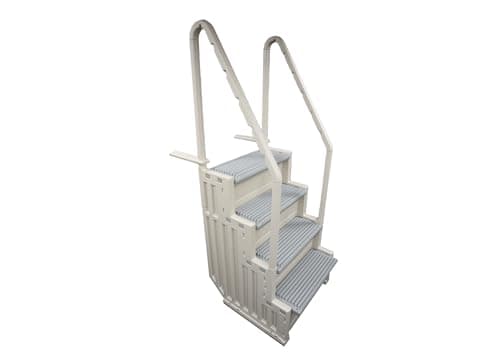
The highest published weight rating
Confer Plastics Step-1X Above-Ground Entry System
Confer Plastics
Four hundred pounds, two handrails, a five-year warranty and forty pounds of sand to hold it down. The published weight limit is the highest here, and Confer states it without a one-person qualifier.
Key specs
- Weight limit
- 400 lb
- Width
- 31 in; step treads 10 x 27 in
- Height to top step
- 47 in; handrail 38 in; projection into pool 32 in
- Riser height
- 11 in
- Ballast
- 40 lb of dry sand — about 10 lb into each of four openings
- Material
- Blow-molded high-density polyethylene
- Pool floor
- For above-ground pools with flat bottoms
- Fits
- Confer publishes only 'fits decks up to 60 in'; retailers quote 48-54 in and 48-58 in, which conflict
- Warranty
- 5 years on manufacturing defects and workmanship
How it scoresour reading of published specs, not a test result
- Sizing fit
- 7.5
- Running cost
- 9.0
- Maintenance
- 8.0
- Build
- 8.5
- Value
- 8.5
Overall 8.3 / 10
What works
- A published 400 lb limit, the highest of the entry systems here
- Five-year warranty, the longest published in this roundup
- Snap-together assembly with mounting brackets to secure it to the pool or deck
- Sand ballast means it stays put rather than floating, which is the usual complaint about drop-in steps
What doesn't
- Confer does not publish a pool wall height range, and retailers disagree about what it fits
- Forty pounds of dry sand has to be bought, carried and funnelled in
- Flat-bottomed pools only
- Confer does not sell a liner pad, and suggests a bath mat as a substitute
Skip it if: Dished pool floors. The Step-1X is specified for flat-bottom pools, and a pool floor that has developed a dish under the steps is outside what Confer describes.
What it costs to run: Add the cost of 40 lb of play sand and a liner pad to the sticker. Both are small, and the pad is the one that protects the expensive part underneath.
Several seasons: Buy-once. Built and warranted to come back out of the box for a few years, if you store it properly.
Specs from: Confer Plastics — Step-1X in-pool step, published dimensions, weight limit and warranty, Confer Plastics — Step-1X installation manual (sand ballast, tools)
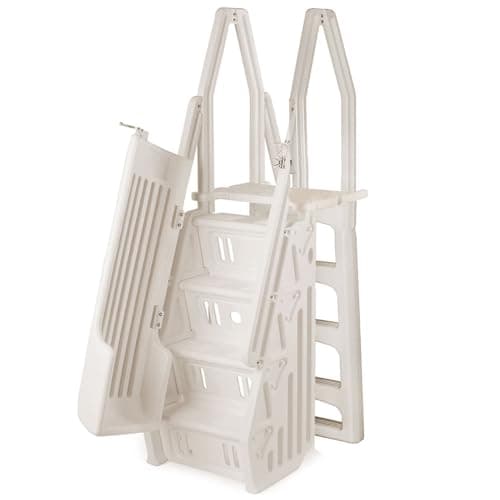
A lockable gate at the top
Vinyl Works Model CE Entry System with Gate
Vinyl Works
The only entry system here with a self-closing, self-latching, lockable gate — the feature that turns pool access from a habit into a mechanism. Adjustable from 47.5 to 56.25 inches of wall.
#ad how this is funded · price as of October 8, 2026
Key specs
- Weight capacity
- 300 lb, one person at a time
- Wall height
- Adjusts from 47.5 in to 56.25 in
- In-pool treads
- Five treads, 4.75 x 18 in
- Exterior treads
- 7.5 x 20 in
- Top platform
- 12 in deep x 20.25 in wide; 20.25 in between handrails
- Gate
- Self-closing, self-latching and lockable; latch 55 in above ground, lock not included
- Material
- Maintenance-free resin with stainless hardware
- Codes
- Stated to meet or exceed APSP / ANSI / ICC-ISPSC entry-system requirements
- Warranty
- 5 years on resin parts; registration required within 90 days
How it scoresour reading of published specs, not a test result
- Sizing fit
- 9.0
- Running cost
- 8.5
- Maintenance
- 8.5
- Build
- 8.5
- Value
- 8.0
Overall 8.5 / 10
What works
- A self-closing, self-latching gate, which is the single most useful safety feature in this category
- The widest published wall-height adjustment here, to 56.25 in
- Explicit code conformance statement covering entry systems and ladder enclosures
- Snap-together assembly with stainless hardware
What doesn't
- 300 lb, one person at a time — a real constraint with children who climb together
- The lock is not included, and without it the gate is a convenience rather than a barrier
- Warranty covers replacement parts only and must be registered within 90 days
- A full entry system takes up more deck space than a drop-in step
Skip it if: Being a barrier on its own. CPSC guidance is that the steps be securable, lockable or removable, and an unlocked self-latching gate meets the letter of that and not the spirit.
What it costs to run: Budget for the padlock on the same order. Our pool fence cost guide covers the wider barrier question, of which the entry point is one part.
Several seasons: Buy-once. Built and warranted to come back out of the box for a few years, if you store it properly.
Specs from: Vinyl Works Canada — Model CE entry system, published specifications, Vinyl Works Canada — Model CE combo entry with gate, features and specifications sheet
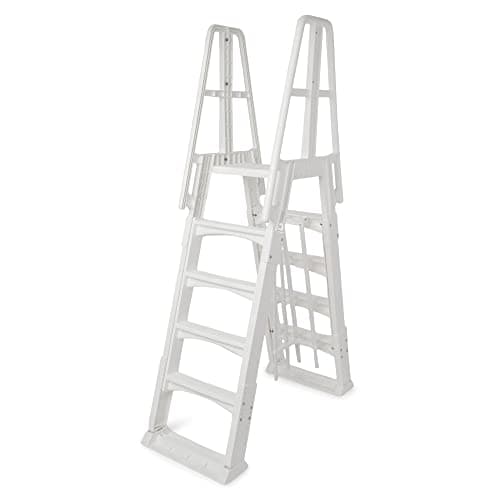
The pool with no deck, and the lock-out that matters
Vinyl Works SLA A-Frame Adjustable Pool Ladder
Vinyl Works
The A-frame comparison point: no ballast, no deck, anchored to the top rail, with an anti-entrapment barrier in the box and an exterior section that slides up and padlocks.
#ad how this is funded · price as of October 8, 2026
Key specs
- Weight capacity
- 300 lb, one person at a time, properly installed
- Wall height
- Adjustable from 48 in to 56 in
- Ballast
- None — it is secured to the pool's top rail instead
- Anti-entrapment
- Barrier included, and the manual requires fitting it before installation
- Lock-out
- Exterior section slides up and locks; padlock not included
- Material
- Resin with stainless hardware, per the product line description
- Codes
- Conforms to current ANSI / APSP / ISPSC / ICC standards for above-ground pool ladders
- Tread count
- Not published as a total by the manufacturer
How it scoresour reading of published specs, not a test result
- Sizing fit
- 8.0
- Running cost
- 9.5
- Maintenance
- 8.5
- Build
- 8.0
- Value
- 9.0
Overall 8.6 / 10
What works
- No sand, no gravel, no deck — the least installation work of anything here
- Anti-entrapment barrier supplied, and the manual makes fitting it a pre-installation step
- Slide-and-lock exterior section directly answers the CPSC guidance on securing access
- Cheapest route to safe, code-conforming pool access
What doesn't
- An A-frame is a ladder, not a staircase — harder work for children and older swimmers than steps
- The manufacturer never publishes a total tread count, and sources disagree
- The padlock that makes the lock-out real is not included
- 300 lb, one person at a time
Skip it if: Comfort. This is the answer for access and safety at low cost, not for the walk-in feel that drop-in steps and entry systems are bought for.
What it costs to run: Buy the padlock with it. The lock is what converts a ladder into a barrier when the pool is unattended, and CPSC guidance is built around exactly that.
One honest season: The cheapest setup that genuinely works for a season of real swimming. Nothing spare, nothing missing.
Specs from: Vinyl Works Canada — Model SLA A-frame ladder, published specifications, Vinyl Works Canada — Model SLA installation instructions (barrier, lock-out, codes)
Questions people actually ask
Can in-wall steps be added to an existing above-ground pool?
Do in-wall pool steps need concrete?
What is the difference between in-wall steps and drop-in steps?
Are in-wall steps safe with young children?
Are steel or polymer in-wall steps better?
Sources
- ProPools — above-ground pools with an in-wall pool step, what to know
- In-Wall Pool Step Assembly Instructions 573-4125 (concrete and cove requirements)
- Royal Swimming Pools — 24 ft round in-wall step pool listing
- Pool Warehouse — 18 ft round steel step semi-inground pool kit
- CPSC — Safety Barrier Guidelines for Residential Pools
Read next
- Above-ground pools for ordinary backyardsSoft-side, metal-frame and steel-wall pools compared by what they cost across a whole season, not at the till.
- Pool steps, and the weight rating that is not what it looks likeAbove-ground entry steps compared on weight rating conventions, wall-height range, sand or gravel ballast, deck mounting and the lock-out that CPSC guidance actually asks for.
- Above-ground pool ladders, and the spec everyone skipsWeight capacity, height matching, and removable outer steps - the three things that decide whether a ladder is right.
- The semi-inground pool solves the yard you actually haveSemi-inground pool kits explained: resin-coated steel walls, how far they can be buried, and the excavation and barrier obligations that come with them.
- The best permanent above-ground pools, and what makes one permanentSteel- and resin-wall above-ground pools built to stay up all year, compared on wall coating, liner gauge, what ships in the box and the warranty behind it.
- Building around the pool, and what it changes about the poolDecks, platforms and steps around an above-ground pool - what they change about safety and maintenance, and the cheaper options that work.
- Fifty-two inches is where the pool becomes chest-deepDeep-wall 52-inch above-ground pools compared on what the extra depth buys, what it costs in water and ground preparation, and who it suits.
- Permits, fences and the calls to make before you buyThe questions that decide whether you need a permit or a barrier, who to ask, and the safety layers that apply regardless of what the rules say.
- A pool for older swimmers starts at the steps, not the waterChoosing an above-ground pool for older swimmers: wall height, entry systems with handrails and gates, the published weight ratings, and what to fit before the pool is filled.
- Steps or a ladder: comfort against the thing you can lockDrop-in entry steps against A-frame ladders on weight rating, ballast, install requirements and the CPSC principle that pool entry should be securable.