Pool Equipment
Steps or a ladder: comfort against the thing you can lock
Steps are easier to use and harder to secure. A ladder is the opposite. On an above-ground pool that trade-off is a safety decision, not a comfort one.
Heads up: we earn a commission if you buy through the links on this page, at no extra cost to you. It never decides the ranking — here is how we pick and here is the full disclosure. Prices are checked automatically; last verified October 8, 2026.
Quick picks
Segmented before it is ranked — the right answer depends on which of these you actually are. Tap any row for the full write-up.
If comfort and confidence matter most
Real treads, two handrails and a published 400 lb limit. It needs 40 lb of sand to stay down and it cannot be removed at night.
| # | Product | Best for | Score | Price |
|---|---|---|---|---|
| 1 | 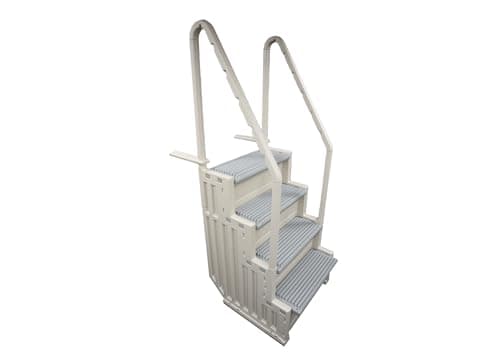 Confer Plastics Step-1X Above-Ground Entry System Four hundred pounds, two handrails, a five-year warranty and forty pounds of sand to hold it down. The published weight limit is the highest here, and Confer states it without a one-person qualifier. | The highest published weight ratingSeveral seasons | 8.3out of 10 |
If the pool must be secured when nobody is watching
An A-frame with an anti-entrapment barrier in the box and an exterior section that slides up and padlocks.
| # | Product | Best for | Score | Price |
|---|---|---|---|---|
| 1 | 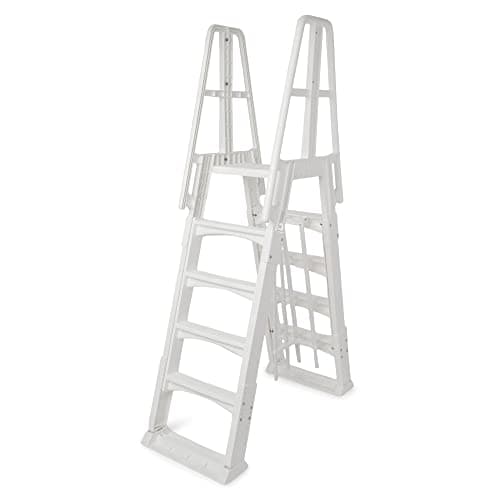 Vinyl Works SLA A-Frame Adjustable Pool Ladder The A-frame comparison point: no ballast, no deck, anchored to the top rail, with an anti-entrapment barrier in the box and an exterior section that slides up and padlocks. | The pool with no deck, and the lock-out that mattersOne honest season | 8.6out of 10 |
The short version
- A ladder can be secured; drop-in steps cannot. CPSC guidance asks that entry be securable, lockable or removable.
- Steps need ballast. 40 lb of dry sand for the Confer unit, or it floats.
- Read the rating’s wording. 400 lb with no qualifier against 300 lb “one person at a time”.
- Steps are far easier to use for children, older swimmers and anyone carrying something.
The safety difference, first
On an above-ground pool the wall is the barrier, which makes the entry point the weak link. The CPSC’s Safety Barrier Guidelines ask that the ladder or steps be capable of being secured, locked or removed when the pool is unattended, and that any opening left behind should not pass a 4-inch sphere.
A ladder does that: the Vinyl Works SLA has an exterior section that slides up and takes a padlock, and its manual requires an anti-entrapment barrier to be fitted before installation. A drop-in staircase, once ballasted with 40 lb of sand, is not going anywhere at bedtime.
That does not make steps unsafe — it means a pool with steps needs its barrier somewhere else, usually a fence with a lockable gate. Our fence roundup covers that, and it belongs in the budget from the start.
The usability difference
A ladder asks you to climb, turn at the top and descend backwards. Steps let you walk down facing forwards holding two rails. For children learning, for older swimmers, and for anyone getting out with cold hands, the difference is large — it is the reason our guide for older swimmers starts with the entry system rather than the pool.
| Drop-in steps | A-frame ladder | |
|---|---|---|
| Published rating | 400 lb (Confer Step-1X) | 300 lb, one person at a time |
| Held down by | 40 lb of dry sand ballast | Anchored to the top rail |
| Fits | Decks up to 60 in (retailers disagree on the range) | 48-56 in wall, adjustable |
| Can be secured | No | Yes - slide-up section with a padlock point |
| Anti-entrapment barrier | Not applicable | Included, required before install |
| Liner protection | Pad recommended under the base | No contact with the floor |
What steps cost you beyond the price
Sand, a pad and floor space. The Confer unit takes about 10 lb of dry sand into each of four openings and projects 32 inches into the pool, which on a 12 or 15 foot pool is a real bite out of the swimming area. Both makers recommend a pad underneath to protect the liner, which our liner pad roundup covers.
There is also the autumn job: a ballasted step full of water has to be drained and lifted out before the close, which our steps roundup goes into.
Who should buy which
Ladder if children can reach the pool unsupervised, if there is no fence, or if the pool is taken down each autumn. It is also far cheaper and needs no ballast.
Steps if the pool sits inside a fenced yard, if older swimmers or small children use it constantly, or if you have a deck to pair them with.
Both, in a sense, is the common answer on a decked pool: steps inside for comfort, and a gate that locks at the top of the deck doing the job the ladder’s padlock would have done.
Install day, and what each one actually needs
Neither is unbox-and-use. The published tool lists give a fair picture: Confer’s Step-1X manual asks for a mallet, a screwdriver, a drill with a 1/8 inch bit, a knife, pliers and lubricant, plus 40 lb of dry sand and a funnel. The Vinyl Works ladder needs a socket driver, a tape measure, a screwdriver, drill bits — and the anti-entrapment barrier fitted before the ladder goes into the pool.
Sand is the part people forget. Damp play sand bridges and jams halfway down a step cavity, so buy it dry and keep it dry until the day. A pad underneath is recommended by both makers, and our liner pad roundup covers why a hard plastic base on vinyl deserves one.
The autumn job nobody plans for
A ballasted step has been sitting full of water and sand all season. It has to be tipped, drained and lifted out before the pool is closed, and it is heavy and awkward in a way that surprises people every October. Confer addresses the question directly in its own FAQ, because the answer is not obvious.
A ladder unhooks from the top rail, drains in seconds and goes in the shed. On a pool that is closed and reopened every year, that difference is worth real consideration — our winterizing guide sequences the rest of the close.
Cost, honestly
A ladder is the cheaper purchase and it needs nothing else. Steps cost more, and then cost again in sand and a pad, and take up floor area inside a pool that may not have much to spare — the Confer unit projects 32 inches into the water.
What steps buy is the pool getting used by people who find a ladder difficult, which is the whole point for households with young children or older swimmers. Our guide for older swimmers makes that case properly, and our in-wall steps guide covers the fourth option — built into the wall, decided when you buy the pool.
The habit that makes the lock-out work
A ladder that slides up and padlocks only protects the pool if somebody actually does it, and the households where it works are the ones that made it part of leaving the pool rather than a decision taken each evening.
The practical version: the pool is not finished with until the ladder is up and locked, the same way a car is not parked until it is locked. That removes the judgment call, which is what fails on a warm evening when somebody might swim later.
If you have chosen steps and cannot secure them, the barrier has to come from a fence with a self-latching gate, and the same logic applies to the gate. CPSC’s guidance is built around preventing unsupervised access rather than around supervision itself, precisely because supervision lapses. Our fence roundup and permits guide cover what your local code is likely to require, which in many places is not optional.
The honest recommendation
If children can reach the pool, buy the ladder and use the lock. It is cheaper, it needs no sand, it comes out in ten seconds each autumn, and it is the only option on this page that answers the safety question by itself.
Buy the steps when the pool sits inside a fenced yard with a latching gate, or when somebody using the pool finds a ladder genuinely difficult. In that case the comfort is not a luxury — it is the difference between a pool that gets used and one that does not, which our guide for older swimmers is built around.
One thing to buy with either
A pad. Both makers recommend one, both sell the product separately or not at all, and it is the cheapest insurance on the most expensive thing in the pool. A hard plastic base resting on vinyl, over whatever is under the liner, is exactly the load a liner pad is designed to spread — our liner pad roundup covers what to look for, and Confer itself suggests a bath mat as a low-cost alternative because it does not sell pads.
What to buy
Scores are our own reading of published specifications. They are not test results — we have not tested these products and we do not claim to.
The highest published weight rating
Confer Plastics Step-1X Above-Ground Entry System
Confer Plastics
Four hundred pounds, two handrails, a five-year warranty and forty pounds of sand to hold it down. The published weight limit is the highest here, and Confer states it without a one-person qualifier.
Key specs
- Weight limit
- 400 lb
- Width
- 31 in; step treads 10 x 27 in
- Height to top step
- 47 in; handrail 38 in; projection into pool 32 in
- Riser height
- 11 in
- Ballast
- 40 lb of dry sand — about 10 lb into each of four openings
- Material
- Blow-molded high-density polyethylene
- Pool floor
- For above-ground pools with flat bottoms
- Fits
- Confer publishes only 'fits decks up to 60 in'; retailers quote 48-54 in and 48-58 in, which conflict
- Warranty
- 5 years on manufacturing defects and workmanship
How it scoresour reading of published specs, not a test result
- Sizing fit
- 7.5
- Running cost
- 9.0
- Maintenance
- 8.0
- Build
- 8.5
- Value
- 8.5
Overall 8.3 / 10
What works
- A published 400 lb limit, the highest of the entry systems here
- Five-year warranty, the longest published in this roundup
- Snap-together assembly with mounting brackets to secure it to the pool or deck
- Sand ballast means it stays put rather than floating, which is the usual complaint about drop-in steps
What doesn't
- Confer does not publish a pool wall height range, and retailers disagree about what it fits
- Forty pounds of dry sand has to be bought, carried and funnelled in
- Flat-bottomed pools only
- Confer does not sell a liner pad, and suggests a bath mat as a substitute
Skip it if: Dished pool floors. The Step-1X is specified for flat-bottom pools, and a pool floor that has developed a dish under the steps is outside what Confer describes.
What it costs to run: Add the cost of 40 lb of play sand and a liner pad to the sticker. Both are small, and the pad is the one that protects the expensive part underneath.
Several seasons: Buy-once. Built and warranted to come back out of the box for a few years, if you store it properly.
Specs from: Confer Plastics — Step-1X in-pool step, published dimensions, weight limit and warranty, Confer Plastics — Step-1X installation manual (sand ballast, tools)
The pool with no deck, and the lock-out that matters
Vinyl Works SLA A-Frame Adjustable Pool Ladder
Vinyl Works
The A-frame comparison point: no ballast, no deck, anchored to the top rail, with an anti-entrapment barrier in the box and an exterior section that slides up and padlocks.
#ad how this is funded · price as of October 8, 2026
Key specs
- Weight capacity
- 300 lb, one person at a time, properly installed
- Wall height
- Adjustable from 48 in to 56 in
- Ballast
- None — it is secured to the pool's top rail instead
- Anti-entrapment
- Barrier included, and the manual requires fitting it before installation
- Lock-out
- Exterior section slides up and locks; padlock not included
- Material
- Resin with stainless hardware, per the product line description
- Codes
- Conforms to current ANSI / APSP / ISPSC / ICC standards for above-ground pool ladders
- Tread count
- Not published as a total by the manufacturer
How it scoresour reading of published specs, not a test result
- Sizing fit
- 8.0
- Running cost
- 9.5
- Maintenance
- 8.5
- Build
- 8.0
- Value
- 9.0
Overall 8.6 / 10
What works
- No sand, no gravel, no deck — the least installation work of anything here
- Anti-entrapment barrier supplied, and the manual makes fitting it a pre-installation step
- Slide-and-lock exterior section directly answers the CPSC guidance on securing access
- Cheapest route to safe, code-conforming pool access
What doesn't
- An A-frame is a ladder, not a staircase — harder work for children and older swimmers than steps
- The manufacturer never publishes a total tread count, and sources disagree
- The padlock that makes the lock-out real is not included
- 300 lb, one person at a time
Skip it if: Comfort. This is the answer for access and safety at low cost, not for the walk-in feel that drop-in steps and entry systems are bought for.
What it costs to run: Buy the padlock with it. The lock is what converts a ladder into a barrier when the pool is unattended, and CPSC guidance is built around exactly that.
One honest season: The cheapest setup that genuinely works for a season of real swimming. Nothing spare, nothing missing.
Specs from: Vinyl Works Canada — Model SLA A-frame ladder, published specifications, Vinyl Works Canada — Model SLA installation instructions (barrier, lock-out, codes)
Questions people actually ask
Are pool steps safer than a ladder?
Do drop-in steps float?
How much weight can each hold?
Do steps damage the pool liner?
Sources
Read next
- Equipment, sized to your pool and costed by the wattPumps, filters, vacuums, heaters and ladders - matched to your gallons and priced by what they draw.
- Pool steps, and the weight rating that is not what it looks likeAbove-ground entry steps compared on weight rating conventions, wall-height range, sand or gravel ballast, deck mounting and the lock-out that CPSC guidance actually asks for.
- Above-ground pool ladders, and the spec everyone skipsWeight capacity, height matching, and removable outer steps - the three things that decide whether a ladder is right.
- In-wall steps are a pool decision, not a step decisionWhat in-wall pool steps actually involve - concrete cap blocks, a poured trench, liner face plates - why retrofitting voids warranties, and the drop-in alternatives.
- The fence is the only thing here that prevents anythingRemovable mesh pool fencing compared on height, mesh, fixings and the certification worth paying for — plus the gate specification that matters most.
- A pool for older swimmers starts at the steps, not the waterChoosing an above-ground pool for older swimmers: wall height, entry systems with handrails and gates, the published weight ratings, and what to fit before the pool is filled.
- The pad under the liner is the cheapest part of the buildGeotextile floor pads compared on the numbers makers actually publish: fabric weight, woven or non-woven, pre-cut sizes and what the warranty quietly excludes.