Seasonal Care
Pollen season: the three weeks the filter does all the work
Spring pollen is the one pool problem where shock is the wrong answer. It is not alive, chlorine does nothing to it, and the fix is mechanical - which makes it cheap if you buy the right ten-dollar thing.
Heads up: we earn a commission if you buy through the links on this page, at no extra cost to you. It never decides the ranking — here is how we pick and here is the full disclosure. Prices are checked automatically; last verified October 8, 2026.
The short version
- Chlorine does nothing to pollen. It is not alive and it is not a chlorine demand. Shocking a pollen film is money for nothing.
- It is a filtration problem. Longer run time, a skimmer sock, and skimming the surface before it sinks.
- Check the sock daily, not weekly. A loaded sock starves the pump, which turns a water problem into an equipment one.
- It is two to four weeks, once a year. The right answer is a temporary routine, not a permanent purchase.
The autumn mirror, running the other way
Our leaf season guide is about three weeks in autumn that decide how your spring goes, and the mechanism there is chlorine demand: every leaf that sinks is organic material the chlorine has to oxidise. Pollen season is the spring mirror and the mechanism is the opposite. Pollen is not a chlorine demand at all. It is a filter load.
That distinction decides every move on this page. Leaf season rewards shock and chemistry attention; pollen season rewards run time and mechanical capture. Treating one like the other is the single most common spring mistake, and it costs a bag of shock and a week of frustration.
Why chemicals are the wrong tool
Pollen is a plant’s reproductive dust: a hard-walled grain, mostly inert, usually 20 to 60 micrometers across. Three consequences follow, and they are the whole story.
| Property | Consequence | What it means for you |
|---|---|---|
| Not alive in any sense chlorine acts on | Shock has no visible effect | Do not reach for shock |
| Barely consumes chlorine | Your free chlorine reading stays normal | Normal chlorine plus visible film is the pollen signature |
| Roughly 20-60 um, with a hard wall | Small enough to pass a cartridge, slow to break down | It cycles through the filter and comes back |
| Floats first, then sinks | There is a window to skim it | Surface skimming beats vacuuming the floor later |
That second row is the diagnostic worth internalising. A pool with an algae problem usually has a chlorine problem underneath it — the reading is low, or the stabilizer is wrong, as our stabilizer page explains. A pool with a pollen problem reads perfectly inside the CDC’s published 1-4 ppm free chlorine range and still looks wrong. Normal chemistry plus a visible film is almost always pollen.
The two-week routine
Nothing here is a permanent change. It is a fortnight of doing four things differently, and then you stop.
Skim the surface daily, before it sinks
Pollen floats for a while and then sinks, and a surface film is far easier to remove than a floor dusting. One pass with a fine skimmer net in the morning removes more than ten minutes of vacuuming later.Fit a skimmer sock, and check it every day
A fine-mesh sleeve over the skimmer basket catches what the basket passes. This is the single highest-value thing on the page, and it needs checking daily during a bloom because a loaded one restricts flow.Increase filter run time, not chemical dose
Pollen cycles through the water until something catches it, so hours matter more than anything in a bottle. Our pump run time guide has the turnover arithmetic; through a bloom, aim for one extra turnover a day.Cover it on the worst two or three days
A bloom is not uniform. There are usually two or three days when the air is visibly yellow, and a cover on for those removes most of the season's total input in one move.Only then, consider a clarifier
If the water is still hazy after a week of the above, a clarifier groups the fine grains into particles your filter can actually hold. Second move, not first.
The sock is the whole trick
A skimmer sock is a stretch sleeve of fine mesh that goes over the skimmer basket. It catches pollen, fine silt, hair and lint that the basket passes straight through, before any of it reaches the cartridge or the sand bed.
The economics are the argument. A thirty-pack costs roughly what one replacement cartridge costs. If a pollen week would otherwise have you pulling and hosing the cartridge every other day — which both shortens its life and is the chore nobody enjoys — the sock has paid for the whole pack in one season. Our cartridge guide covers how much life a hosing actually costs.
None of the socks on the market publishes a micron rating, including the one here, so “ultra-fine” cannot be compared across brands. What you can compare is pack size and price, and at these prices the sensible approach is to buy a large pack and replace rather than rinse a torn one.
Why covering works better than anything else
A bloom is a few days of intensity inside a few weeks of background. Keeping the cover on through the intense days is the only move that addresses input rather than cleanup, and it costs nothing if you already own a cover.
A bubble solar cover is the right one here, because it is the one you can put on and take off daily without a reel — and the secondary effect helps too. Our solar cover roundup covers the products, and our evaporation page covers the water you are also saving: published rates run from 0.20 in a day in still air to 1.06 in at 10 mph, and a pollen-heavy spring day is usually a breezy one.
| Response | Targets | Cost | Worth it? |
|---|---|---|---|
| Cover on the worst days | Input | Nothing, if you own a cover | The single best move |
| Skimmer sock | Capture before the filter | About a cartridge, per 30 | Yes, every spring |
| Longer filter run time | Water already contaminated | Electricity | Yes, temporarily |
| Daily surface skim | Pollen before it sinks | Five minutes | Yes |
| Clarifier | Grains too fine for the filter | A bottle | If still hazy after a week |
| Shock | Nothing on this list | A bag of shock | No |
Pollen at opening, which is when it usually happens
The awkward overlap is that pollen season and pool opening land in the same few weeks in much of the country. That has one real implication: do not open into a bloom if you can avoid it.
An opening involves balancing water, running the filter hard and getting the chemistry settled, as our opening guide covers. Doing that while two or three pounds of pollen a day lands on the surface means you are fighting the clarity battle and the chemistry battle at once, and you will probably conclude the water is cloudy because something is chemically wrong. Waiting a week, or leaving the cover on for the worst days before you pull it for good, makes the whole opening cleaner and cheaper — and our opening cost page shows how much of an opening budget is chemicals you may not need.
The one thing not to do is interpret a pollen-hazy opening as a failed close. Our green pool opening guide is for water that actually went bad under the cover, which looks and behaves completely differently — green, slippery, and with a chlorine reading on the floor.
What to buy
Scores are our own reading of published specifications. They are not test results — we have not tested these products and we do not claim to.
Pollen weeks, when the filter is the thing under load
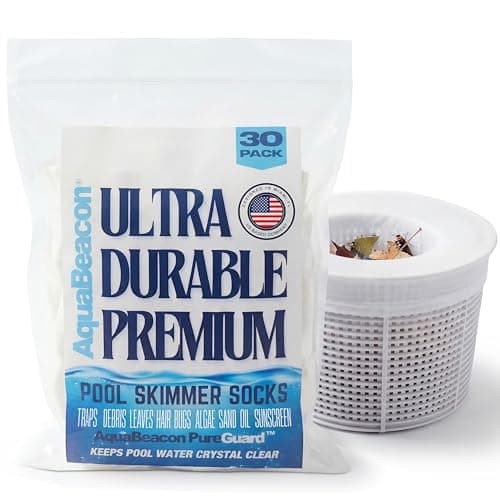
Aquabeacon Premium Pool Skimmer Socks, 30-Pack
Aquabeacon
Thirty fine-mesh sleeves that stretch over the skimmer basket and catch what a cartridge would otherwise have to. During pollen season they are the cheapest way to stop washing the filter every other day.
Key specs
- Pack
- 30, published
- Mesh
- Published as ultra-fine; no micron rating published
- Fits
- Published for skimmer baskets; stretch fit
- Reusable
- Rinse and reuse until torn — not single use
- What it catches
- Pollen, fine silt, hair and lint that passes a basket
- What it does not
- Nothing dissolved, and no effect on chlorine demand
How it scoresour reading of published specs, not a test result
- Retention
- 8.0
- Durability
- 6.5
- Handling
- 9.0
- Running cost
- 9.5
- Value
- 9.0
Overall 8.4 / 10
What works
- The only consumable here that reduces how often you clean the filter, which is the real pollen-week chore
- Fine enough to catch pollen that a basket passes straight through
- Thirty in a pack is a season, at a price that makes replacing a clogged one a non-decision
- Works the same on an Intex-style strainer basket as on a conventional skimmer
What doesn't
- No micron rating published, so "ultra-fine" cannot be compared across brands
- A loaded sock restricts flow, and a restricted skimmer starves the pump — they need checking daily during pollen
- Does nothing about pollen already on the pool floor
- Stretch fit means the fit on an unusually shaped basket is luck
Skip it if: Being left in. A sock that is full is a flow restriction on the suction side, and that is a pump problem rather than a water-clarity one.
What it costs to run: Thirty socks is roughly the price of one replacement cartridge. If a pollen week would otherwise have you cleaning the cartridge every other day, that is the whole argument.
A few weekends: Fine for a heatwave and a toddler. Treat it as consumable, not as a pool — it will not survive a winter in the yard.
The five-dollar tool you use most
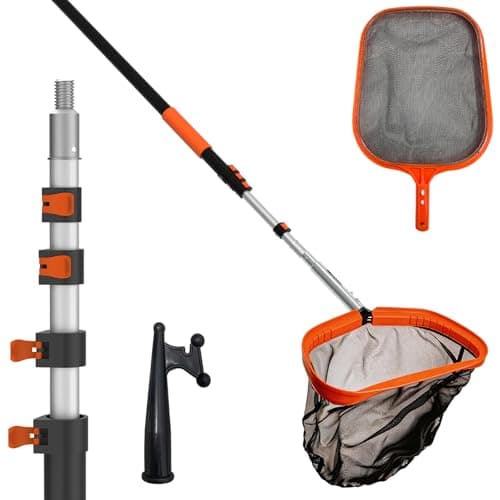
Skimmer Net with Telescopic Pole
Various
Catching leaves while they float is a two-minute job. Catching them after they sink is a vacuum session and a filter clean. Buy this first.
Key specs
- Type
- Flat skimmer or deep leaf rake
- Pole
- Telescopic, sized to reach the middle of your pool
- Frame
- Plastic or aluminum
How it scoresour reading of published specs, not a test result
- Retention
- 8.5
- Durability
- 7.0
- Handling
- 9.0
- Running cost
- 10.0
- Value
- 9.5
Overall 8.8 / 10
What works
- The single most-used tool in pool ownership and among the cheapest
- Removing debris before it sinks prevents most of the work that follows
- A deep leaf rake handles far more per pass than a flat skimmer
What doesn't
- Cheap plastic frames snap where the pole attaches, which is the standard failure
- Telescopic poles seize with hard water unless rinsed
- A too-short pole means you cannot reach the middle, which makes it useless
Skip it if: Anything on the floor. This is a surface tool and pretending otherwise is how debris ends up in the filter.
What it costs to run: Free to use and it directly reduces your chemical bill: organic debris consumes chlorine as it breaks down, so removing leaves is the cheapest sanitizer saving there is.
Several seasons: Buy-once. Built and warranted to come back out of the box for a few years, if you store it properly.
The consumable you will actually buy repeatedly
Type A Replacement Filter Cartridges (multipack)
Various
Buy them in a multipack before you need them. A pool running on an exhausted cartridge is a cloudy pool, and the fix is a two-dollar part you did not have.
Key specs
- Type
- Type A — the most common Intex format
- Replacement interval
- Every 2 weeks in heavy use, per Intex guidance
- Between changes
- Rinse, do not scrub
How it scoresour reading of published specs, not a test result
- Running cost
- 7.0
- Value
- 8.5
Overall 8.2 / 10
What works
- Type A is the most widely stocked cartridge format in the US
- Multipacks cost a fraction of buying singles
- Having a spare turns a cloudy week into a five-minute fix
What doesn't
- It is a genuine recurring cost that nobody includes in the purchase price
- Aftermarket quality varies noticeably
- Rinsing extends life but does not restore a cartridge that is done
Skip it if: Being restored. Once the pleats are permanently gray and stiff, rinsing is not saving it.
What it costs to run: The line item most people leave out of their pool budget. Count how many you use in your first season and you have your real annual filtration cost — this is exactly the number the cost-to-run guide asks you to record.
One honest season: The cheapest setup that genuinely works for a season of real swimming. Nothing spare, nothing missing.
Cloudy water that is chemically fine
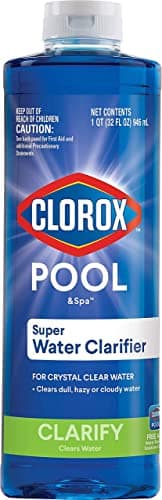
Pool Water Clarifier
Various
Clumps particles too small for your filter into ones it can catch. Genuinely useful for the specific case where your chemistry reads correct and the water is still milky.
Key specs
- Function
- Coagulant — aggregates fine particles for filtration
- Requires
- A running filter; it does nothing on its own
- Typical treatment
- Dose, then run the filter continuously
How it scoresour reading of published specs, not a test result
- Value
- 7.5
Overall 7.8 / 10
What works
- Fixes the exact case where chemistry is balanced and the water still will not clear
- Cheap and quick when it is the right tool
- Works with the filter you already have rather than needing a better one
What doesn't
- Does nothing at all if the actual problem is low chlorine or a blocked filter
- Overdosing makes cloudiness worse, which is a genuinely counterintuitive failure
- Loads the filter, so it needs cleaning right after
Skip it if: Being the first thing you reach for. Test the water before you use this — most cloudy pools are a chemistry problem wearing a clarity costume.
What it costs to run: A few dollars a bottle, and worth it only when the decision tree points here. Reaching for clarifier first is how people spend twenty dollars solving a problem that a longer pump run would have fixed for free.
A few weekends: Fine for a heatwave and a toddler. Treat it as consumable, not as a pool — it will not survive a winter in the yard.
The single highest-return accessory here
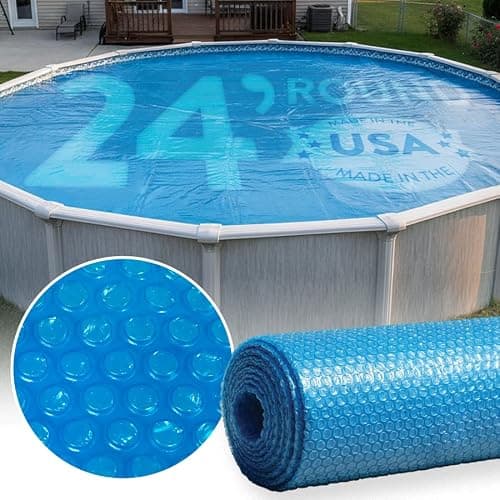
Bubble Solar Cover for Above-Ground Pools
Various
It cuts evaporation, and evaporation is simultaneously your water bill, your chemical bill and your heat loss. Nothing else on this site reduces three costs at once.
#ad how this is funded · price as of October 8, 2026
Key specs
- Construction
- Bubble sheet, thickness published in mil
- Thickness
- Higher mil lasts longer — 12 mil and 16 mil are common
- Fit
- Cut to size; buy oversize and trim
- Orientation
- Bubbles face down, toward the water
How it scoresour reading of published specs, not a test result
- Retention
- 9.0
- Durability
- 7.0
- Handling
- 6.0
- Running cost
- 9.8
- Value
- 9.5
Overall 9.0 / 10
What works
- Reduces evaporation, which is the mechanism behind the water, chemical and heat savings all at once
- Cheap relative to everything it saves
- Can be cut to fit any pool shape, so sizing is forgiving
What doesn't
- Awkward to get on and off without a reel, and awkward is how covers end up unused
- Degrades in UV like every vinyl product
- Not a safety cover and will not support weight — this is important
Skip it if: Being a safety barrier. A solar cover looks solid and is not; a child or pet on it goes through and under.
What it costs to run: The one accessory with a clear payback. Every gallon that does not evaporate is a gallon you do not replace at the EPA WaterSense national average of $6.06 per 1,000 gallons, and it is chlorine you do not re-dose. If you buy one thing from this hub, buy this.
Several seasons: Buy-once. Built and warranted to come back out of the box for a few years, if you store it properly.
Specs from: EPA WaterSense — cost per 1,000 gallons
A pool under trees in October
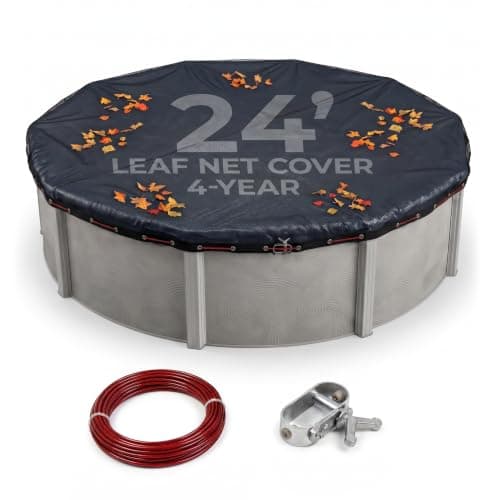
Leaf Net Cover
Various
A fine mesh net that sits over the winter cover and lifts off with the leaves on it. On a treed yard it is the difference between dragging a loaded cover and rolling one.
#ad how this is funded · price as of October 8, 2026
Key specs
- Sizing
- Sold by pool diameter, typically with 3 ft overlap
- Material
- Polyethylene or nylon fine mesh
- Binding
- Around 1.75 in nylon binding with sewn loops
- Fixing
- Grommets, and cable and winch on some
- Position
- Over the winter cover, not instead of it
- Weight
- Light — one person can lift it loaded
How it scoresour reading of published specs, not a test result
- Retention
- 5.0
- Durability
- 8.0
- Handling
- 9.0
- Running cost
- 10.0
- Value
- 8.5
Overall 8.0 / 10
What works
- Lifts off with the whole leaf fall on it, so the winter cover underneath stays clean
- Removes the single largest source of standing water weight on a cover
- Cheap, and it lasts several seasons because nothing stresses it
- Works over a solar cover in autumn too, before the pool is closed
What doesn't
- Useless on a yard with no trees, which is most of the argument against it
- Has to come off before the leaves are wet and heavy, so timing matters
- Fine mesh still passes needles and small debris
- Another large item to dry and store
Skip it if: Being a cover. It stops debris, it does not block light, hold heat, or keep anything out of the water on its own.
What it costs to run: Set against a torn winter cover and a spring opening full of leaf tannin. On a treed yard the payback is one autumn; on a clear yard there is none.
Several seasons: Buy-once. Built and warranted to come back out of the box for a few years, if you store it properly.
Specs from: Above-ground pool leaf nets — current Amazon category listing
Questions people actually ask
Is the yellow-green film on my pool algae or pollen?
Does chlorine get rid of pool pollen?
How do I keep pollen out of my pool?
Will a clarifier clear pollen?
How long does pool pollen season last?
Sources
Read next
- Closing, covering and opening againWinterizing, covers and spring opening - the four weeks of the year that decide whether you own a pool next summer.
- Leaf season, and the three weeks that decide next AprilHow to keep a pool usable through autumn leaf fall, and why what you let sink now decides how your spring opening goes.
- Opening an above-ground pool in springThe spring sequence in order, why cloudy water at opening is normal, and the two timing errors that cause green openings.
- Pool algae: brush, shock, filter, then rebalanceThe correct order for clearing green water, how to tell algae from pollen, and why algaecide prevents rather than cures.
- Pool clarifiers, and the three cases where one is the wrong answerClarifier, algaecide and shock compared for cloudy water, with the diagnostic that tells you which one your pool actually needs.
- Filter cartridges: the consumable nobody budgets forThe replacement interval, the rinse-versus-scrub question, and how the cartridge treadmill compares with a sand filter across a season.
- The skimmer is the cheapest part of the system and the one that stops itHow a skimmer actually works, the water level it needs, and the three silent faults that get blamed on the pump.
- The morning after a storm, in the right orderWhy rain wrecks pool chemistry three ways at once, and the recovery sequence that gets the water back in a day rather than a week.
- How long to run the pump, worked out rather than repeatedRun time derived from your own turnover time, when in the day to run it, and what each hour a day costs across a season.