Pool Costs
What it costs to open an above-ground pool
A good close makes the opening nearly free - cold, clear water needs balancing and almost nothing else. A bad close turns the same job into a shock-and-filter week, and that is where the cost actually is.

Heads up: we earn a commission if you buy through the links on this page, at no extra cost to you. It never decides the ranking — here is how we pick and here is the full disclosure. Prices are checked automatically; last verified October 8, 2026.
The short version
- A good close makes the opening cheap. Clear, cold water needs balancing and almost nothing else.
- Both published kits are sized for inground pools. 30,000 and 35,000 gallons against the 5,000 to 10,000 most above-ground pools hold.
- Divide the kit price by three before comparing it. On a 10,000 gallon pool a 35,000-gallon kit is roughly three openings, not one.
- Sequestrant first on well water. Shock before sequestrant is how a liner gets stained on day one.
The opening is cheap. The bad close is not.
This page exists because the number people search for — what does it cost to open a pool — has two completely different answers depending on something you did six months earlier.
Open a pool that went under the cover balanced, with the water level right and the plugs in, and you are pulling a cover off cold, clear water. Cold water holds chlorine well and grows almost nothing. The job is topping up, balancing, and swimming. Open a pool that was closed in a hurry and you are looking at green water, a filter that needs to run for days, and several pounds of shock. Our cost of a bad close page prices that outcome in full; this page prices the good one and shows you the gap.
Line by line, on a 10,000 gallon pool
A 15 ft x 48 in pool holds roughly 4,400 gallons and a 24 ft x 52 in holds roughly 13,500, so 10,000 is a reasonable middle. Here is every line, with where the figure comes from.
| Line | What it is | Typical cost | Where the figure comes from |
|---|---|---|---|
| Chemicals | A third of a published start-up kit, or four chemicals bought separately | $20 to $45 | Published kit contents, divided by pool size |
| Water top-up | Four to six inches on a covered pool | $2 to $4 | EPA WaterSense $6.06 per 1,000 gal |
| Filter cartridge | Only if yours is at the end of its life | $0 to $25 | Cartridge roundup, per-season life |
| Hose pre-filter | Well water only, reusable for several seasons | $0 to $20 | Well water guide |
| Cover cleaning and storage | Hose, dry, fold. No spend if you own a cover pump | $0 | Winter cover care guide |
| Labor, DIY | Two to four hours including the cover | $0 | Our own timing on a 15 ft pool |
| Labor, paid | Where it exists for above-ground pools at all | $150 to $350 | DIY vs paying guide |
Why a 35,000-gallon kit is not a 35,000-gallon purchase
- Published kit rating
- up to 35,000 gal
- Our example pool
- 10,000 gal
- Share of the kit used per opening
- about 29%
- So one kit covers
- about 3 openings
kit price ÷ 3 = chemical cost per opening
A kit at $74 is about $25 of chemicals per opening on a 10,000 gallon pool
That number, $25 of chemicals, is the one to hold on to. Everything else on the list is either a few dollars or zero. An opening on a well-closed above-ground pool is a $45 job, and most of the perceived expense is the kit on the shelf looking like a $74 one.
What is actually in a published opening kit
The two kits here publish their contents, which makes them comparable and makes it possible to decide whether you need all of it.
| Job | In The Swim, up to 35,000 gal | Doheny's, 10,000 to 30,000 gal |
|---|---|---|
| Metal and stain control | 2 x 1 qt Stain Away | Metal Out |
| Chlorine demand | 4 x 1 lb multi-shock bags | Premium Super Shock Plus |
| Algae prevention | 2 x 1 qt algaecide | Spring Control |
| Clarity | 1 qt clarifier | Water clarifier |
| Oils and scum | 1 oil and scum absorber | Not included |
| Testing | 10 x 4-way test strips | 10-pack test strips |
| Instructions | Written opening instructions included | Not published |
Four jobs, consistently: metals, chlorine demand, algae and clarity. That list is the actual answer to “what do I need to open a pool”, and you can buy those four things separately for less than a kit on a small pool. Our opening shopping list is the separate-purchase version.
The water line, and why it is small
People expect the water top-up to be the big number at opening and it almost never is, because a cover stops the wind-driven part of evaporation and winter air is not evaporating much anyway.
| Pool | Surface area | 4 in top-up | Cost |
|---|---|---|---|
| 10 ft round | 79 sq ft | about 165 gal | about $1.00 |
| 15 ft round | 177 sq ft | about 370 gal | about $2.24 |
| 24 ft round | 452 sq ft | about 940 gal | about $5.70 |
If your top-up is much more than four to six inches, that is information rather than a cost: a covered pool that lost a foot over winter was probably leaking, not evaporating. Our evaporation-or-leak page has the published rates and the bucket test that settles it, and April is the ideal time to find out because the pool is already empty-ish and the liner is accessible.
A pool that was drained below the skimmer for winter is a different arithmetic entirely, and our cost to fill page covers filling from low or from scratch, including trucked water.
Where it goes wrong: three openings that cost real money
| Situation | What you end up buying | Rough multiple of a good opening |
|---|---|---|
| Water went under the cover green | Several lb of shock, a week of pump run time, a new cartridge | 3x to 5x |
| Well water top-up, shocked before sequestrant | Stain remover, possibly an acid wash or a liner | 5x to 20x |
| Equipment froze because plugs were left in | A pump, or a pump housing | 4x to 10x |
Each of those is a closing failure showing up as an opening cost, and each has its own page: the green opening, well water and equipment storage. The reason they sit on a cost page is that the opening is when you pay for them, and that is where people mistakenly conclude that opening a pool is expensive.
Year one against year two
The first opening is not representative, and it is worth saying so on a cost page. A pool in its first spring may need nothing at all, because it went in mid-season and was closed on new water with new equipment. By the third or fourth spring you are replacing a cartridge most years, replacing a cover every few, and your stabilizer has climbed to the point where the opening decision is about dilution rather than addition.
Our year two costs page covers that drift, and the annual cost to run puts the opening where it belongs: a small, predictable line in a season that is mostly electricity and chemicals.
What to buy
Scores are our own reading of published specifications. They are not test results — we have not tested these products and we do not claim to.
Pricing the chemical half of an opening in one line
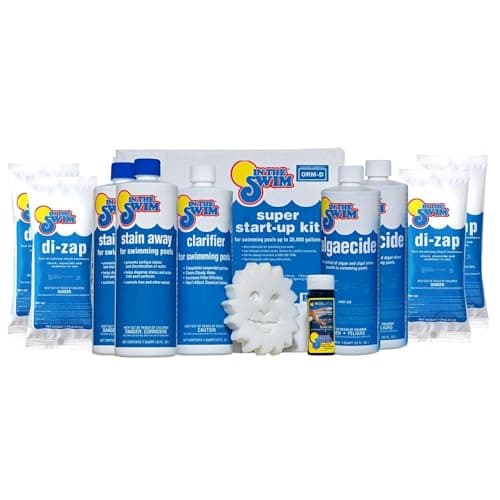
In The Swim Pool Opening Chemical Start-Up Kit, up to 35,000 Gallons
In The Swim
The most completely published opening kit here: ten items including test strips and written instructions. Also roughly three times the pool most readers of this site own.
#ad how this is funded · price as of October 8, 2026
Key specs
- Rated for
- Up to 35,000 gallons, published
- Stain control
- 2 x 1 qt Stain Away, published
- Clarifier
- 1 qt clarifier, published
- Shock
- 4 x 1 lb multi-shock bags, published
- Algaecide
- 2 x 1 qt, published
- Also included
- 1 oil and scum absorber, 10 x 4-way test strips, written opening instructions, published
- Test strip coverage
- Chlorine, pH, alkalinity and stabilizer, published
How it scoresour reading of published specs, not a test result
- Effectiveness
- 8.5
- Ease
- 9.0
- Water impact
- 7.5
- Cost per season
- 7.0
- Value
- 7.5
Overall 8.0 / 10
What works
- Publishes its full contents item by item, which is what lets you price an opening instead of guessing at it
- Includes test strips, so the kit can actually be used in the published order
- Includes an opening instruction sheet, which is the part a first opening is missing
- Covers the three jobs an opening really has: metals, chlorine demand and clarity
What doesn't
- Rated to 35,000 gallons against the 5,000 to 10,000 gallons most above-ground pools hold
- Buying it for a 10,000 gallon pool means paying for roughly three seasons of chemicals up front
- Four pounds of shock is more than a small pool needs in one opening
- Test strips do not read cyanuric acid accurately enough to make the stabilizer decision properly
Skip it if: A small pool. The arithmetic only works if you are honest that you are buying multi-season quantities, which is a legitimate choice but a different one from what the box implies.
What it costs to run: On a 10,000 gallon pool this is about a third of a kit per opening, so divide the price by three before comparing it with buying the four chemicals separately. Our opening-cost page does that arithmetic in full.
One honest season: The cheapest setup that genuinely works for a season of real swimming. Nothing spare, nothing missing.
Specs from: Leslie's — In The Swim Super Start-Up Chemical Kit up to 35,000 gallons, published contents
An opening on a pool filled from a well
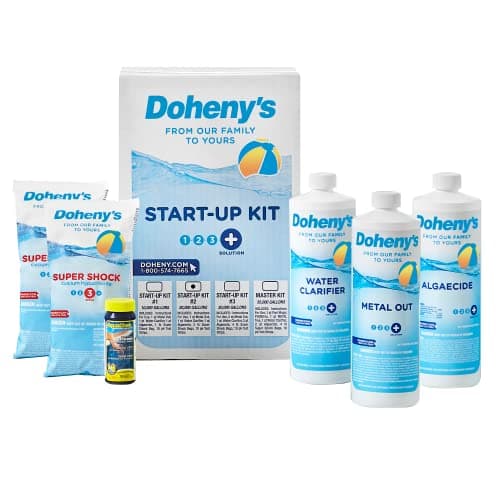
Doheny's Ultimate Pool Opening Start-Up Kit
Doheny's
Four chemicals and test strips, rated across a 10,000 to 30,000 gallon band. The metal sequestrant is the reason to choose it, and it is the one chemical a well-filled pool cannot open without.
#ad how this is funded · price as of October 8, 2026
Key specs
- Rated for
- Published across the maker's 10,000 to 30,000 gallon kit range
- Metal control
- Metal Out, published as preventing stains, rust and scale
- Algae control
- Spring Control, published
- Clarity
- Water clarifier, published
- Shock
- Premium Super Shock Plus, published
- Also included
- 10-pack of test strips, published
How it scoresour reading of published specs, not a test result
- Effectiveness
- 8.0
- Ease
- 9.0
- Water impact
- 8.0
- Cost per season
- 8.0
- Value
- 8.0
Overall 8.2 / 10
What works
- Leads with a metal sequestrant, which is the correct first chemical in a pool topped up from a well
- Rated from 10,000 gallons, so the smallest size in the range is closer to a real above-ground pool
- Four chemicals rather than ten, which is a more honest list for a pool that was closed properly
- Includes test strips, so the sequence can be followed as published
What doesn't
- The exact bottle sizes are not published per gallon band, so cost per opening is harder to pin down than the In The Swim kit
- Still sized above most above-ground pools at the top of the band
- No oil or scum absorber, which the competing kit includes
- "Spring Control" is a product name rather than a published active ingredient
Skip it if: A pool that was closed badly. An opening kit assumes you are starting from clear, cold water; a pool that went under the cover green is a different and more expensive job.
What it costs to run: Our well-water page is the reason this kit exists: sequestrant before shock, every time, or the iron in the fill water oxidises and stains the liner. That stain is the expensive outcome the kit is insurance against.
One honest season: The cheapest setup that genuinely works for a season of real swimming. Nothing spare, nothing missing.
The bottle you add at closing so opening is easier
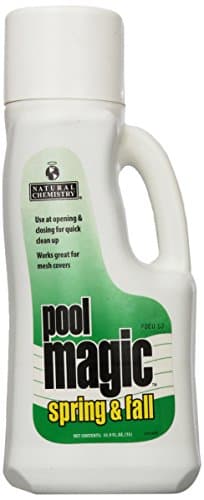
Natural Chemistry Pool Magic Spring & Fall, 1 Liter
Natural Chemistry
A cold-water enzyme formula dosed by the whole bottle rather than by the ounce, aimed squarely at the winter waterline ring. One of the few pool chemicals whose job is six months from now.
#ad how this is funded · price as of October 8, 2026
Key specs
- Volume
- 1 liter, published
- Dose
- Entire bottle per 25,000 gallons, published
- When
- At closing and again at opening, published
- Formulation
- Published as a concentrated enzyme formula designed to work in cold water
- Prerequisite
- Sanitizer must be below 5 ppm before adding, published
- Shocking
- Maker publishes that no shocking is necessary with it
- Appearance
- Published as coffee colored; the over-cap is a 4 oz measure
How it scoresour reading of published specs, not a test result
- Effectiveness
- 7.5
- Ease
- 9.5
- Water impact
- 8.5
- Cost per season
- 8.0
- Value
- 7.5
Overall 8.1 / 10
What works
- Dosed by the bottle, so there is nothing to get wrong at the end of a long closing day
- Explicitly formulated for cold water, which is the stated reason the standard enzyme is not used here
- Targets winter waterline ring, which is the single most common spring complaint on a vinyl pool
- Published as usable at both ends of the season from the same bottle size
What doesn't
- One bottle treats 25,000 gallons, so most above-ground pools are buying more than they need
- Nothing to see for six months, which makes it the easiest purchase to skip and the hardest to evaluate
- Needs sanitizer below 5 ppm, so it does not go in on the same pass as a closing shock
- Does not replace any part of a closing kit
Skip it if: Doing anything about water you can see. This is a preventative added to water you are about to cover up, and it will not clear or clarify anything today.
What it costs to run: Priced against the alternative, which is an acid wash or a season of stain remover in April. Our closing-cost page prices the whole job; this is a line item inside it, not a substitute for it.
One honest season: The cheapest setup that genuinely works for a season of real swimming. Nothing spare, nothing missing.
Specs from: Leslie's — Natural Chemistry Pool Magic Spring and Fall 1 L, published dosing and timing
When you need a number, not a color band
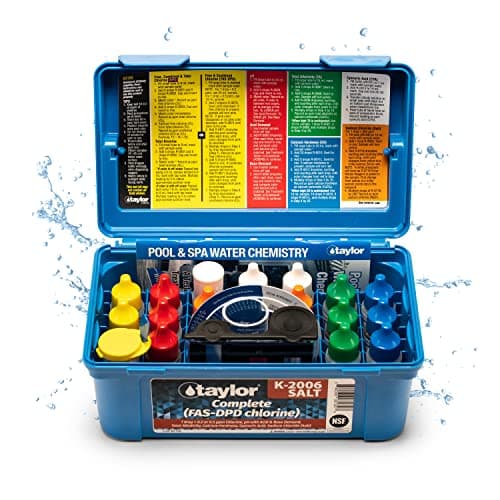
Taylor K-2006 Complete Test Kit (FAS-DPD)
Taylor Technologies
The reference kit. It uses a drop-count titration for free chlorine, which gives you an actual figure rather than a shade of pink. Overkill for a 1,500-gallon pool and indispensable when something has gone properly wrong.
#ad how this is funded · price as of October 8, 2026
Key specs
- Method
- FAS-DPD drop-count titration
- Measures
- Free and combined chlorine, pH, alkalinity, calcium hardness, cyanuric acid
- Resolution
- Reads to 0.2 ppm free chlorine with the standard 10 mL sample
- Format
- Reagent bottles and graduated comparators
How it scoresour reading of published specs, not a test result
- Accuracy
- 9.8
- Ease
- 5.5
- Coverage
- 9.5
- Cost per use
- 7.0
- Value
- 8.0
Overall 8.3 / 10
What works
- Distinguishes free from combined chlorine, which is the single most useful thing a test can tell you when water smells of chlorine
- Gives a numeric result you can act on precisely rather than a color to interpret
- Reagents are individually replaceable, so the kit is a multi-season purchase
What doesn't
- Considerably more expensive than strips and more of a ritual to use
- Reagents have a shelf life and do expire
- Genuinely more kit than a small seasonal pool needs
Skip it if: Casual weekly checks. If it is a five-minute job you will skip it, and a test you skip is worse than a rough one you actually do.
What it costs to run: The reagents are the running cost, not the kit. For most seasonal above-ground owners this is a second purchase made in year two after a bad algae summer, not a first one.
Several seasons: Buy-once. Built and warranted to come back out of the box for a few years, if you store it properly.
Specs from: Taylor Technologies
The consumable you will actually buy repeatedly
Type A Replacement Filter Cartridges (multipack)
Various
Buy them in a multipack before you need them. A pool running on an exhausted cartridge is a cloudy pool, and the fix is a two-dollar part you did not have.
Key specs
- Type
- Type A — the most common Intex format
- Replacement interval
- Every 2 weeks in heavy use, per Intex guidance
- Between changes
- Rinse, do not scrub
How it scoresour reading of published specs, not a test result
- Sizing fit
- 9.0
- Running cost
- 7.0
- Maintenance
- 8.5
- Build
- 7.0
- Value
- 8.5
Overall 8.2 / 10
What works
- Type A is the most widely stocked cartridge format in the US
- Multipacks cost a fraction of buying singles
- Having a spare turns a cloudy week into a five-minute fix
What doesn't
- It is a genuine recurring cost that nobody includes in the purchase price
- Aftermarket quality varies noticeably
- Rinsing extends life but does not restore a cartridge that is done
Skip it if: Being restored. Once the pleats are permanently gray and stiff, rinsing is not saving it.
What it costs to run: The line item most people leave out of their pool budget. Count how many you use in your first season and you have your real annual filtration cost — this is exactly the number the cost-to-run guide asks you to record.
One honest season: The cheapest setup that genuinely works for a season of real swimming. Nothing spare, nothing missing.
Filling from well water
Garden Hose Pre-Filter (Iron and Metals)
Various
A resin cartridge on the hose that takes iron and manganese out before they reach the pool. It is the only product on this site that prevents a problem rather than treating one.
Key specs
- Fitting
- Standard 3/4 in garden hose thread
- Media
- Iron-removal resin; also reduces calcium and magnesium
- Targets
- Iron, manganese, heavy metals, some chlorine
- Capacity
- Rated in gallons — 10,000 up to 100,000
- Use
- Inline on the fill hose, at fill and at top-up
- Life
- By gallons treated, not by time
How it scoresour reading of published specs, not a test result
- Effectiveness
- 8.5
- Ease
- 8.5
- Water impact
- 9.0
- Cost per season
- 7.5
- Value
- 8.0
Overall 8.2 / 10
What works
- Stops metal staining before it happens, which no stain remover can do
- Also reduces hardness, which matters on well water and hard municipal supplies
- Screws onto any hose in seconds — no plumbing, no tools
- Capacity ratings mean you can size it against your own pool volume
What doesn't
- Slows the fill noticeably, which on 6,000 gallons is a real amount of time
- The cartridge is a consumable rated in gallons, and a big pool eats a small one
- Pointless on a treated municipal supply with no metal problem
- Capacity ratings assume a stated metal concentration you probably do not know
Skip it if: Fixing an existing stain. It prevents the next one; the current one needs the citric-acid route our stain remover roundup covers.
What it costs to run: Size it against your own gallons. A 10,000-gallon cartridge filling a 6,981-gallon pool is nearly spent after one fill, and a 75,000-gallon unit covers years of fills and top-ups.
One honest season: The cheapest setup that genuinely works for a season of real swimming. Nothing spare, nothing missing.
Specs from: Garden hose iron pre-filters for pool filling — Amazon listing
Questions people actually ask
How much does it cost to open an above-ground pool?
Do I need an opening kit or can I buy the chemicals separately?
Is opening a pool cheaper than closing it?
How much water does an above-ground pool need at opening?
What is the first chemical to add when opening a pool?
Sources
- Leslie's — In The Swim Super Start-Up Chemical Kit up to 35,000 gallons, published contents
- Walmart — Doheny's Ultimate Pool Opening Start-Up Kit, published contents and gallon range
- Olivenhain Municipal Water District — published pool evaporation rates by wind speed
- EPA WaterSense — how the calculator works
- CDC — home pool and hot tub water treatment and testing
Read next
- What a pool actually costs, with the arithmetic shownPurchase, electricity, chemicals, water and replacement parts - added up, sourced, and shown as arithmetic you can redo.
- What closing an above-ground pool costsPublished closing-service prices compared against the DIY list, with the part of the bill that recurs separated from the part that amortizes.
- The bill a bad close sends you in AprilThe spring bill produced by a bad autumn close, priced line by line, and the three cheap items that prevent nearly all of it.
- Opening an above-ground pool in springThe spring sequence in order, why cloudy water at opening is normal, and the two timing errors that cause green openings.
- What to buy before you open, not halfway throughThe six-item spring shopping list, in the order the opening sequence needs them, plus what to leave until you have a reading.
- You lifted the cover and it is green. First decide, then treat.How to decide between draining and recovering a green pool at opening, and the full recovery sequence if you treat it.
- What a season of pool chemicals actually adds up toSeason chemical quantities computed from published dosing for four pool volumes, plus the shopping list that is genuinely necessary.
- Year two, and the lines that disappearWhich pool costs are one-off and which recur, with a year-one and year-two comparison for the same pool.
- What is worth doing yourself, and the two things that are notEvery above-ground pool task sorted into do-it-yourself, worth paying for, and not a DIY decision - with the reasoning for each.