Above-Ground Pools
Moving a pool, and the two things that decide whether it survives
You cannot slide a full pool, you cannot fold a cold liner, and a frame that came apart once will not necessarily go back together. Everything else is manageable.
Heads up: we earn a commission if you buy through the links on this page, at no extra cost to you. It never decides the ranking — here is how we pick and here is the full disclosure. Prices are checked automatically; last verified October 8, 2026.
The short version
- You cannot drag or slide a pool with water in it. Not a little water, not across a lawn, not with help. It is tons, and the liner takes the load.
- Treat it as a take-down and a rebuild, because that is what it is — even to move ten feet.
- Temperature decides the liner’s fate. Vinyl folded cold cracks along the folds. Move on a mild day or not at all.
- The new pad is the whole job. Nothing about the move matters if the ground at the destination is not level.
Why the obvious approach does not work
The idea that surfaces first is to drain most of the water, leave a few inches to keep the liner in place, and walk the pool to its new spot. It fails for a specific reason: a gallon of water weighs 8.34 pounds, so even six inches left in a 15-foot pool is well over a ton, and all of that load transfers into the liner and the frame joints as soon as the structure starts to flex.
The frames in this category are bolted assemblies designed to be loaded vertically by water pressure. They are not designed to be dragged, and the liner is not designed to be the thing that holds them together while you do it. So the honest answer to “can I move it without taking it down” is no, including for a short distance.
The sequence
Prepare the destination first
Before draining anything, level the new pad and get it ready. A pool that is down and drying while you discover the new spot has a slope is a pool sitting on the lawn for a week. Cut down into undisturbed soil rather than building the low side up — our leveling guide is the method.Let the chlorine fall, then drain deliberately
Stop dosing several days before and let the level drop. Then drain through the plug and a hose rather than tipping the wall, and spread the discharge — several thousand gallons arriving at one spot will saturate ground and can find a basement.Clean the liner while the wall is still supported
Wipe it down while there is enough water to hold the shape. Cleaning a standing wall is a fraction of the work of cleaning a heap of vinyl on wet grass.Photograph the frame before you take it apart
Every joint, every pin, from several angles. Instructions get lost and frame hardware in this category is frequently model-specific and unavailable separately — a photo is your only reference when it goes back together.Dry the liner completely, both sides
Even for a move across the garden that will happen tomorrow. Trapped moisture is mildew, and mildew in vinyl is permanent. Open it out in shade, then turn it and dry the underside.Fold warm and loose, or do not fold at all
If the move is same-day and short, roll the liner rather than folding it and keep it out of the sun. If it has to be folded, do it on a mild day along broad curves. Cold vinyl cracks along the fold lines the following summer.Rebuild on a ground cloth, then fill slowly
New pad, ground cloth, frame, liner. Put a couple of inches of water in and stop, smoothing wrinkles outward from the center while the liner can still move. Once there is a foot of water in it, every wrinkle you left is set for the season.
Moving it to a new house
Everything above applies, plus three logistics questions worth answering before you decide it is coming with you.
Will it fit in the vehicle? A dry frame pool packs down more than people expect, but the liner of a large pool is heavy and bulky and the frame components are long. A 12-foot pool is a car boot job; an 18-foot steel-wall pool is not, and it is generally not designed to be taken down casually at all.
Is the new garden actually suitable? Level ground, three feet of access all round, sun exposure, a route for the hose and a protected outdoor outlet for the pump. Our surface guide covers what the pool can stand on and the electrical guide covers the outlet.
Do the local rules differ? Permit thresholds, barrier requirements and HOA rules are set locally and the new address may not have the same answers as the old one. Our permits and rules guide lists the three calls to make.
| Component | Usually survives | Watch for |
|---|---|---|
| Frame components | Yes | Corrosion at joints; missing pins |
| Liner | If dried and folded warm | Cold folds, mildew, existing brittleness |
| Pump and hoses | Yes | Drain fully; do not store water in the housing |
| Ladder | Yes | Must still match the wall height |
| Ground cloth | Yes | Rinse and dry before packing |
| Cartridges | No | Consumable — start the new season fresh |
When it is not worth moving
Three cases where selling or giving it away and starting fresh is the better call. If the liner is aged, as above. If the frame has corrosion through any joint, because that is the load path. And if it is a soft-side pool already a couple of seasons old — these are honestly closer to consumables, and the risk of a fold cracking in transit is high enough that the move is a coin flip.
Against that, a one or two-season-old frame pool with a supple liner and all its hardware is well worth taking. These things are expensive to ship and cheap secondhand, which is the same asymmetry our buying used guide looks at from the other side of the transaction.
What to buy
Scores are our own reading of published specifications. They are not test results — we have not tested these products and we do not claim to.
Protecting the liner from below
Pool Ground Cloth / Under-Pool Pad
Various
Most liner punctures come from underneath, from a stone or a root you did not see. A ground cloth is the cheapest way to avoid the most expensive repair in above-ground pool ownership.
Key specs
- Function
- Barrier between ground and liner
- Sizing
- Should extend past the pool footprint
- Included with
- Some kits — check before buying separately
How it scoresour reading of published specs, not a test result
- Retention
- 8.0
- Durability
- 7.5
- Handling
- 8.5
- Running cost
- 10.0
- Value
- 9.0
Overall 8.5 / 10
What works
- Prevents the failure mode that ends pools: a puncture in the floor you cannot reach to patch
- Also slows grass and weeds growing up under the pool
- Included free in better kits, so check before you buy one
What doesn't
- Not a substitute for actually clearing stones and roots first
- Thin ones tear during installation before the pool is even up
- Traps moisture, which kills the grass underneath regardless
Skip it if: Fixing uneven ground. It protects against punctures; it does nothing about level, and level is the bigger problem.
What it costs to run: Compare its cost to a liner replacement, which is the single largest unplanned expense in above-ground pool ownership. It is not a close call.
Several seasons: Buy-once. Built and warranted to come back out of the box for a few years, if you store it properly.
When the liner has failed, not before
Replacement Above-Ground Pool Liner
Various
The one repair that is genuinely worth doing rather than replacing the whole pool, provided the frame is sound. Measure twice: liner fit is unforgiving.
Key specs
- Types
- Overlap, beaded and unibead — they are not interchangeable
- Measure
- Diameter and wall height, exactly
- Gauge
- Published in mil — thicker lasts longer and is harder to fit
How it scoresour reading of published specs, not a test result
- Retention
- 8.0
- Durability
- 8.0
- Handling
- 5.5
- Running cost
- 9.0
- Value
- 8.0
Overall 7.9 / 10
What works
- Far cheaper than replacing a pool whose frame is still good
- A thicker gauge liner outlasts the original on most budget kits
- Beaded liners can be replaced without dismantling the top rail
What doesn't
- Overlap, beaded and unibead are different fitting systems and buying the wrong one is a total loss
- Fitting is a warm-day job — cold vinyl will not stretch into place
- A liner failure often reveals a frame or base problem that caused it
Skip it if: A pool whose frame is corroded. Replacing the liner in a failing frame just moves the failure a few months out.
What it costs to run: The largest single unplanned expense of above-ground pool ownership, and it is mostly preventable: a ground cloth, a level base and a winter close done properly are what decide whether you ever buy one.
Several seasons: Buy-once. Built and warranted to come back out of the box for a few years, if you store it properly.
Not throwing away a float over one hole
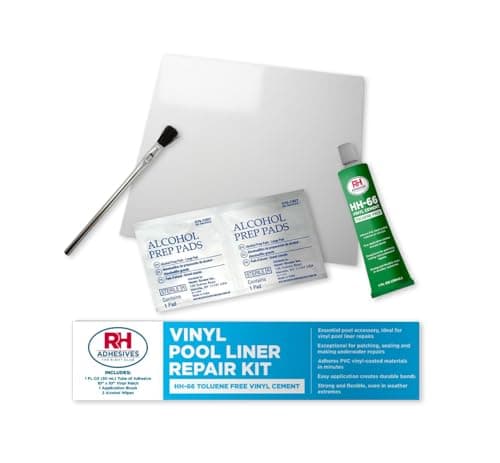
Vinyl Repair Patch Kit
Various
A few dollars of adhesive patches that turn most float failures into a ten-minute fix. The reason people replace floats annually is usually that they did not own one of these.
#ad how this is funded · price as of October 8, 2026
Key specs
- Use
- Vinyl floats, liners, air beds
- Requirement
- Surface must be clean and fully dry
- Cure
- Follow the kit — most need hours before re-inflating
How it scoresour reading of published specs, not a test result
- Material
- 8.0
- Valve
- 8.0
- Capacity
- 7.0
- Storage
- 9.5
- Value
- 9.5
Overall 8.5 / 10
What works
- Fixes the dominant failure mode of the entire floats category
- Also patches a pinhole in a pool liner, which is a far more expensive save
- Lasts indefinitely in the shed
What doesn't
- Will not fix a split seam, only a puncture
- Needs a genuinely dry surface, which is inconvenient poolside
- Cheap kits use adhesive that fails after a season in the water
Skip it if: Seam failures and valve leaks. Those are the end of the float and no patch changes that.
What it costs to run: The highest-leverage few dollars in this hub: one saved float pays for it several times over, and one saved liner pays for it a hundred times over.
Several seasons: Buy-once. Built and warranted to come back out of the box for a few years, if you store it properly.
Small yards and first-time owners
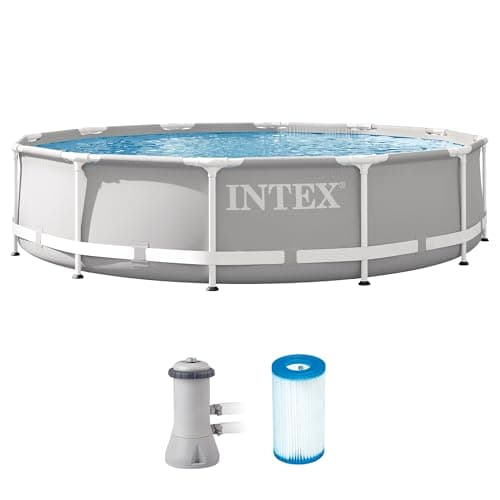
Intex Prism Frame Pool Set, 12ft x 30in
Intex
The size most people should buy first and the one most people talk themselves out of. 1,718 gallons is cheap to fill, cheap to treat, and forgiving of every mistake you are about to make.
Key specs
- Water capacity
- 1,718 gallons
- Pump supplied
- Krystal Clear C530 — 530 GPH pump / 475 GPH system
- Frame
- Powder-coated metal, tool-free Easy Lock
- Liner
- 3-ply, puncture resistant
- Manufacturer setup claim
- Ready in 30 minutes
- Pump wattage
- Not published by Intex
How it scoresour reading of published specs, not a test result
- Build
- 7.0
- Setup
- 9.0
- Upkeep
- 9.0
- Running cost
- 9.0
- Value
- 9.0
Overall 8.6 / 10
What works
- A 12-foot circle fits in a yard where a 15 or 18 will not, once you allow three feet of walking space
- 1,718 gallons turns over in about 3.6 hours on the supplied 475 GPH system flow — so a short daily run genuinely filters it
- Cheapest of the frame pools to make a mistake in: a bad chemical week costs a few dollars, not a few tens
- Tool-free assembly is real, not marketing — this is a genuinely one-afternoon job
What doesn't
- 30-inch wall means shallow water and it warms and cools fast
- Small enough that three adults fill it
- The C530 is sized for exactly this pool and nothing bigger, so it does not carry over if you upgrade
Skip it if: Anyone planning to swim rather than sit. This is a cooling-off and playing pool and it is very good at that.
What it costs to run: The cheapest frame pool here to run, and the gap is not small. At the EPA WaterSense average of $6.06 per 1,000 gallons a fill is about $10. Its turnover math — 1,718 gallons at 475 GPH system flow — means roughly 3.6 hours per full turnover, so a 7-8 hour daily run is two full turnovers rather than a partial one.
One honest season: The cheapest setup that genuinely works for a season of real swimming. Nothing spare, nothing missing.
Specs from: Intex — Prism Frame 12' x 30' pool set, Intex — Krystal Clear cartridge filter pumps
Getting in and out safely
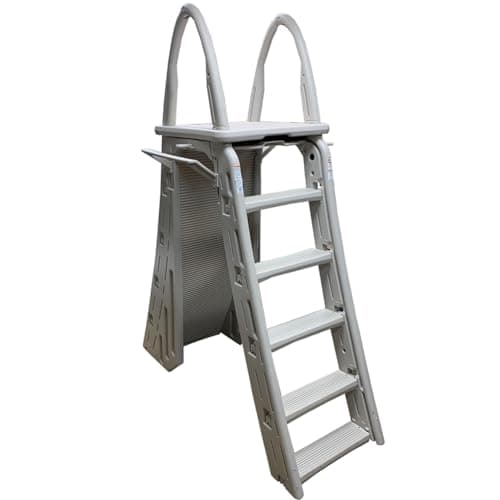
A-Frame Above-Ground Pool Ladder
Various
Read the published weight limit before anything else. It is frequently lower than buyers assume, and it is the one spec on a ladder that genuinely matters.
#ad how this is funded · price as of October 8, 2026
Key specs
- Critical spec
- Published weight capacity — check it against every adult who will use it
- Height match
- Must match your wall height, not approximate it
- Safety feature
- Removable or lockable outer steps on better models
How it scoresour reading of published specs, not a test result
- Sizing fit
- 8.5
- Running cost
- 10.0
- Maintenance
- 8.5
- Build
- 7.5
- Value
- 8.5
Overall 8.4 / 10
What works
- Removable outer steps genuinely prevent unsupervised access, which is a real safety layer
- Resin frames do not corrode the way early steel ladders did
- Correctly matched height is far more stable than a too-tall ladder
What doesn't
- Weight limits are often lower than people expect and are easy to overlook in a listing
- A ladder sized for a 42-inch wall is wrong on a 52-inch wall and vice versa
- Cheap models flex enough to feel alarming
Skip it if: Being a barrier on its own. The CPSC's guidance treats barriers, supervision and alarms as layers; a removable step is one layer, not the answer.
What it costs to run: Buy it with the pool. Kits that include a ladder are frequently cheaper than the pool-plus-ladder bought separately, and this is one of the accessories that makes a cheap-looking kit expensive.
Several seasons: Buy-once. Built and warranted to come back out of the box for a few years, if you store it properly.
Specs from: CPSC — Pool Safely
Questions people actually ask
Can you move an above-ground pool without draining it?
How do you move an above-ground pool to a new house?
Will the liner survive being moved?
Do I need to level the ground again after moving a pool?
Sources
Read next
- Above-ground pools for ordinary backyardsSoft-side, metal-frame and steel-wall pools compared by what they cost across a whole season, not at the till.
- Leveling the ground, and the weight that makes it matterThe tolerance manufacturers publish, the weight of water that enforces it, and the method for getting a circle genuinely flat with hand tools.
- How to set up an above-ground pool properlyLeveling, ground protection, filling and priming - the afternoon that decides how the rest of the season goes.
- Taking the pool down without ruining itThe take-down sequence for a seasonal pool: draining responsibly, drying completely, folding warm, and storing where rodents are not.
- Liner replacement: the big occasional cost, and how to avoid itOverlap, beaded and unibead are not interchangeable - plus the three habits that decide whether you ever need a replacement.
- A pool at a rented place, without losing the depositWhat to ask a landlord before buying, what actually risks a deposit, and which pools make sense when you might move.
- How long an above-ground pool actually lastsRealistic lifespans by pool type, the four failure modes that account for nearly all of them, and the cheap items that add seasons.