Pool Care & Chemistry
Leaving the pool for a week without coming home to a swamp
Nothing about a pool needs you daily. It does need chlorine that lasts, water that stays up and a pump that runs - and all three can be arranged before you get in the car.

Heads up: we earn a commission if you buy through the links on this page, at no extra cost to you. It never decides the ranking — here is how we pick and here is the full disclosure. Prices are checked automatically; last verified October 8, 2026.
The short version
- Three things fail while you are away: chlorine runs out, the level drops, and nothing circulates.
- Stabilizer is what makes chlorine last in sun. Check it before you go, not after.
- Do not shock the pool the morning you leave. Very high chlorine degrades fast and leaves you worse off by day four.
- Cover it if you can. A cover cuts evaporation and keeps sunlight off the chlorine.
What actually goes wrong
A pool does not need daily attention. What it needs is continuity, and a week away breaks three continuities at once.
Sanitizer runs out. Chlorine is consumed by sunlight and by whatever lands in the water. Without a reservoir it is gone in days, and the algae our algae guide describes takes hold within a day of that.
The level drops. Evaporation on a hot week can pull the water below the skimmer, at which point the pump draws air and stops circulating — the failure mode our auto-fill roundup exists to prevent.
Nothing circulates. If the pump is switched on and off by hand, it is off for the whole trip.
The setup, before you go
Test a week out, not the night before
You want time to correct stabilizer, alkalinity and pH before you leave. Chlorine without stabilizer burns off in sun; that is the reading that decides whether the dispenser lasts.Balance, then fill the dispenser
A loaded floating dispenser or feeder is the reservoir that carries the pool. A feeder's larger capacity is the real argument for one if you travel.Set the pump on a timer
Turnover does not pause for holidays. A timer runs the schedule you already use - our run-time guide covers working out the hours.Top the water up above normal
Fill to the upper end of the skimmer range so a week of evaporation cannot drop it below the intake.Cover it, and clear the deck
A cover cuts evaporation and blocks the sun that eats chlorine. Put floats and toys away so a storm cannot drop them in.
What to ask a neighbor to do
Keep it to three things, written down. Empty the skimmer basket. Check the water is still above the skimmer mouth and add some with a hose if not. Look at the water and send a photo.
That is enough to catch every common failure without asking someone to dose chemicals they do not understand. Do not leave a bucket of shock and instructions — oxidizers and an untrained helper are a bad combination, and CDC guidance on storing and handling pool chemicals is written for people who do this regularly.
The mistake to avoid the morning you leave
Shocking the pool hard as a parting gesture. Very high free chlorine degrades quickly in sunlight, so a big dose on Saturday is largely gone by Tuesday — and it will have driven pH up on the way. You arrive back to a pool with no sanitizer and bad balance.
The better approach is a balanced pool with a full dispenser, which delivers steadily for the whole week. CDC targets are a free chlorine floor of 1 ppm, or 2 ppm with a stabilizer, and pH 7.0 to 7.8 — that is the state you want the pool sitting in when you drive away.
Two weeks or longer
Past about ten days, a floating dispenser is not enough on its own. Either fit a feeder with real capacity — the common off-line unit holds 4.2 lb of tablets, as our dispenser comparison covers — or arrange for someone to actually test and dose once mid-trip.
In a heatwave, shorten that window. Our heatwave guide explains why hot weather attacks a small pool from three directions at once, and an unattended pool in 95°F has a shorter fuse than the same pool in June.
Coming home
Test before swimming, not after. Expect chlorine to be low and pH to have drifted up; both are normal and quick to correct. If the water has gone cloudy rather than green, our cloudy water guide works through the four causes in order, and the fix is usually filtration time rather than a chemical.
Two weeks, and what changes
Past about ten days the arithmetic shifts. A floating dispenser holds a few tablets; a feeder holds several pounds. If you travel for a fortnight regularly, that capacity difference is the strongest practical argument for a feeder, as our dispenser comparison covers.
The other two-week change is evaporation. A fortnight of hot weather can take a pool below the skimmer even with a cover, which is why an auto-fill device earns its place for frequent travelers — it is the one piece of automation that prevents a pump running dry.
The return routine
Look before you touch anything
Clear, cloudy or green tells you which of three jobs you have. Do not dose on arrival out of habit.Empty the baskets and brush the walls
A fortnight of debris is sitting somewhere. Brushing puts it where the filter can catch it.Test everything, then correct alkalinity first
Expect chlorine low and pH high. Fix alkalinity, then pH, then chlorine - in that order.Run the filter continuously for a day
Most post-holiday cloudiness is filtration time rather than a missing chemical.Only shock if the readings ask for it
A large dose into an already unbalanced pool usually makes the following week worse, not better.
If it has gone green rather than cloudy, that is a different process — brush, shock, filter, rebalance — and our algae guide sets out the order. It costs a few days of filtration rather than a lost season.
Security while the house is empty
A pool is a hazard whether or not you are home, and an empty house changes who might be near it. This is the part of leaving that has nothing to do with chemistry.
Lock the entry: slide the ladder up and padlock it, or lock the gate at the top of the steps. CPSC guidance for above-ground pools is built on the entry being securable, lockable or removable, and an unattended fortnight is exactly the case it is written for.
Put floats, toys and anything climbable away from the pool wall rather than beside it. And if a neighbor is checking the pool, make sure they know the entry stays locked when they leave — the most common failure is a helper who unlocks the ladder to empty a skimmer basket and does not lock it again.
Our fence roundup covers the barrier and our alarm roundup covers the layer that tells you when one has been crossed.
The honest recommendation
For a week, a balanced pool with a loaded dispenser, a timer on the pump and the level topped up will look after itself. Nothing else is required, and the most common mistake is doing more rather than less.
For a fortnight, add capacity: a feeder rather than a floater, and someone to look at it once. Past three weeks, the honest answer is that somebody has to test and dose while you are gone, and it is worth showing them how before you leave rather than sending instructions by text.
What to buy
Scores are our own reading of published specifications. They are not test results — we have not tested these products and we do not claim to.
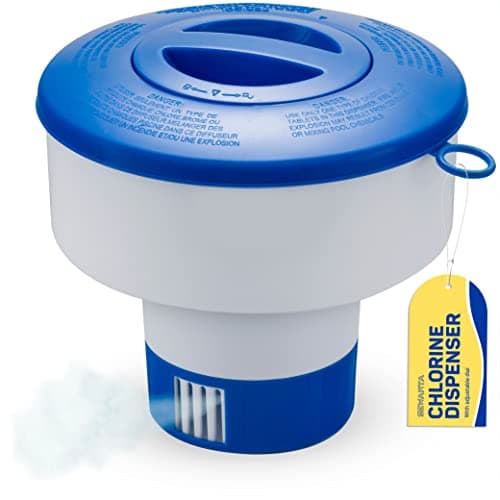
Making tablets work properly
Floating Chlorine Tablet Dispenser
Various
Two dollars of plastic that decides whether your chlorine dissolves evenly over days or sits in a corner bleaching your liner. Buy it with the tablets, not after.
#ad how this is funded · price as of October 8, 2026
Key specs
- Function
- Holds 3-inch tablets, meters dissolution rate
- Adjustment
- Vented base, adjustable on most models
- Compatibility
- Standard 3-inch tablets
How it scoresour reading of published specs, not a test result
- Effectiveness
- 8.0
- Ease
- 9.5
- Water impact
- 9.0
- Cost per season
- 9.8
- Value
- 9.5
Overall 9.0 / 10
What works
- Adjustable venting lets you slow or speed dissolution to match the weather
- Keeps tablets off the liner, which is what causes bleach spots
- Trivially cheap and lasts years
What doesn't
- Drifts to one end of the pool in wind, so distribution is uneven without circulation
- Must be removed before swimming with small children
- Cheap ones crack after a season in UV
Skip it if: Being left in an empty or unfiltered pool. Without circulation it creates a concentrated pocket rather than an even dose.
What it costs to run: The cheapest item on this site and one of the highest-return: even dissolution means you use fewer tablets to hold the same free chlorine level.
One honest season: The cheapest setup that genuinely works for a season of real swimming. Nothing spare, nothing missing.
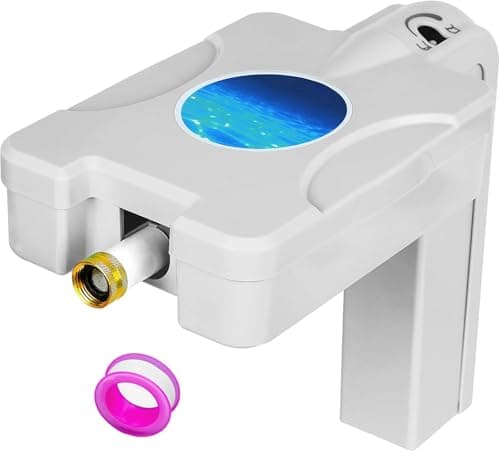
A pool that keeps dropping below the skimmer
Automatic Pool Filler / Water Leveler
Various
A float valve on a hose that tops the pool up to a set level. It exists because a pool that drops below the skimmer mouth starves the pump, and that is how pumps die.
#ad how this is funded · price as of October 8, 2026
Key specs
- Operation
- Float valve — no power, no electronics
- Supply
- Standard garden hose connection
- Level
- Adjustable set point
- Fitting
- Above-ground versions hang on the wall or rail
- Also suits
- Spas, ponds and inflatable pools
- Requirement
- A hose left connected, which is the real trade
How it scoresour reading of published specs, not a test result
- Sizing fit
- 7.0
- Running cost
- 8.0
- Maintenance
- 8.0
- Build
- 7.0
- Value
- 7.5
Overall 7.5 / 10
What works
- Removes the single most common cause of pump damage on a seasonal pool
- Purely mechanical — nothing to power, nothing to fail electronically
- Adjustable set point, so it holds the level the skimmer actually needs
- Useful during a heatwave when evaporation outruns your attention
What doesn't
- It needs a hose permanently connected and live, which not every yard allows
- A stuck float means an overflowing pool and a very large water bill
- It hides a leak — the pool stops dropping, so you stop noticing
- Above-ground mounting options are limited compared with inground
Skip it if: Telling you why the water is going. Evaporation and a liner leak look identical to a float valve, and only one of them is normal.
What it costs to run: The water is the cost, and it is the same water you would have added by hand. Check the pool against the mark occasionally anyway — a filler that has quietly replaced 2,000 gallons is reporting a leak, not doing its job.
Several seasons: Buy-once. Built and warranted to come back out of the box for a few years, if you store it properly.
Specs from: Automatic pool fillers and water levelers — current Amazon category listing
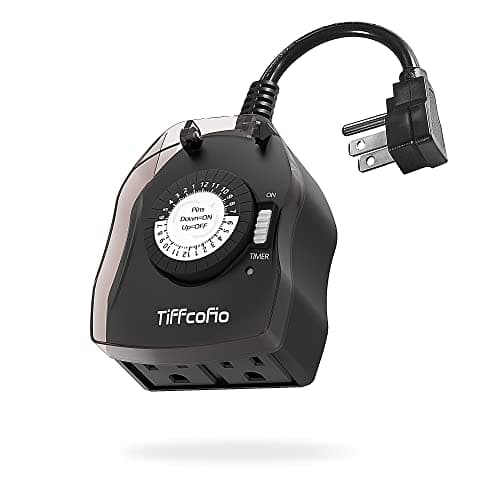
Cutting the electricity bill without cutting filtration
Outdoor Pool Pump Timer
Various
A weatherproof outdoor timer is the highest-return equipment purchase on this site. Most people run the pump too long because remembering to switch it off is a chore.
#ad how this is funded · price as of October 8, 2026
Key specs
- Type
- Outdoor-rated mechanical or digital timer
- Required rating
- Must be rated for the pump's amperage and for outdoor use
- Must not defeat
- The pump's GFCI protection
How it scoresour reading of published specs, not a test result
- Sizing fit
- 8.5
- Running cost
- 9.8
- Maintenance
- 9.0
- Build
- 7.5
- Value
- 9.5
Overall 9.0 / 10
What works
- Turns your filtration from a guess into a schedule
- Pays for itself within a single season on most pools
- Lets you shift running hours to off-peak if your utility has time-of-use rates
What doesn't
- Must be genuinely outdoor-rated and correctly amperage-matched, which cheap indoor timers are not
- Never bypass or defeat the pump's GFCI to fit one
- Mechanical timers drift and need resetting after a power cut
Skip it if: Fixing an undersized pump. Running the wrong pump on a schedule just makes the schedule longer.
What it costs to run: The arithmetic that justifies it: at the EIA's June 2026 US residential average of 18.34 cents per kWh, trimming a 400 W pump from 12 hours to 8 hours a day across a 120-day season saves 192 kWh, or about $35. That is more than the timer costs.
Several seasons: Buy-once. Built and warranted to come back out of the box for a few years, if you store it properly.
Specs from: EIA Electric Power Monthly, Table 5.6.A
Questions people actually ask
Can I leave a pool for a week unattended?
Should I shock the pool before going on vacation?
Should I leave the pump running the whole time?
What if the pool goes green while I am away?
Sources
Read next
- Pool care, from someone who assumes you have never done thisThe weekly routine, the four numbers that matter, and the fix for the week the water turns.
- The weekly pool routine, and how little time it really takesThe daily, weekly and monthly jobs written as a schedule, with the kit each one needs and roughly how long it takes.
- The pump timer pays for itself in one seasonWhat to look for in an outdoor pool timer, the three electrical requirements that are not optional, and how to set the schedule from your own turnover.
- The pump does not die of old age. It dies of low water.Automatic pool fillers and float-valve water levelers — what they prevent, what they cost, and the leak they can quietly conceal.
- Pool algae: brush, shock, filter, then rebalanceThe correct order for clearing green water, how to tell algae from pollen, and why algaecide prevents rather than cures.
- Floater or feeder: the same tablets, metered two different waysFloating dispensers against off-line tablet feeders: capacity, dose control, what each does to a vinyl liner, and why neither belongs in the skimmer basket.
- A heatwave attacks a small pool from three directions at onceWhy hot weather breaks a routine that works the rest of the season, and the adjustments that keep a small pool ahead of it.
- Cyanuric acid: the reading that explains your chlorineWhy an outdoor pool needs stabilizer, why tablets add it whether you want them to or not, and the only way to bring it back down.