Pool Equipment
The pad under the liner is the cheapest part of the build
A liner pad is a sheet of geotextile between the ground and the vinyl. It is the last thing in the budget and the first thing that decides whether a stone ends your liner in year three.
Heads up: we earn a commission if you buy through the links on this page, at no extra cost to you. It never decides the ranking — here is how we pick and here is the full disclosure. Prices are checked automatically; last verified October 8, 2026.
Quick picks
Segmented before it is ranked — the right answer depends on which of these you actually are. Tap any row for the full write-up.
Pre-cut to your pool
Ordered by pool size and shape and delivered cut to fit, with the widest published size chart here — round, oval and rectangular.
| # | Product | Best for | Score | Price |
|---|---|---|---|---|
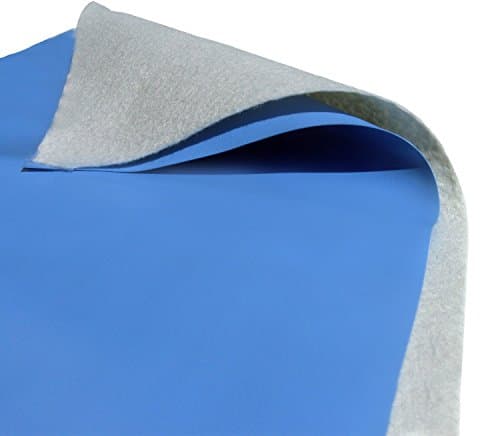
| 1 | Blue Wave Gorilla Floor Padding A geotextile developed for landfill liners, sold pre-cut to your pool size and shape. It is the one here with a published size chart covering round, oval and rectangular pools. | The pad sold pre-cut to your exact poolSeveral seasons | 8.3out of 10 |
The longest warranty
A woven geotextile with two years of cover and a high recycled content. Read the thickness claims carefully: retailers disagree with each other.
| # | Product | Best for | Score | Price |
|---|---|---|---|---|
| 1 | 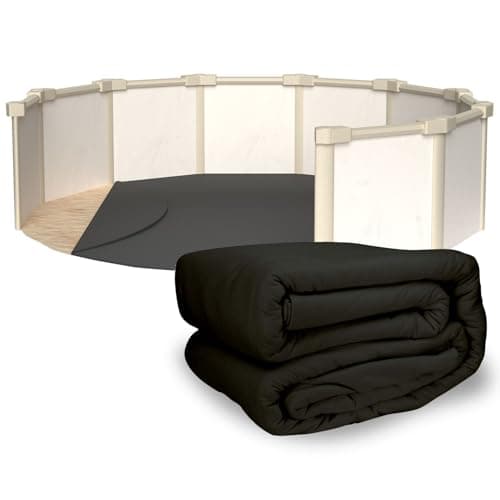 Rhino Pad Above-Ground Pool Liner Pad A woven geotextile with a two-year warranty, made largely from recycled material and sold pre-cut for round, oval and rectangular pools. Published thickness figures disagree between retailers. | The longest warranty of the pads hereSeveral seasons | 8.3out of 10 |
The only published fabric weight
A 220 g/m² non-woven pad that states the one number the rest of the category leaves out, and doubles as a weed barrier.
| # | Product | Best for | Score | Price |
|---|---|---|---|---|
| 1 | 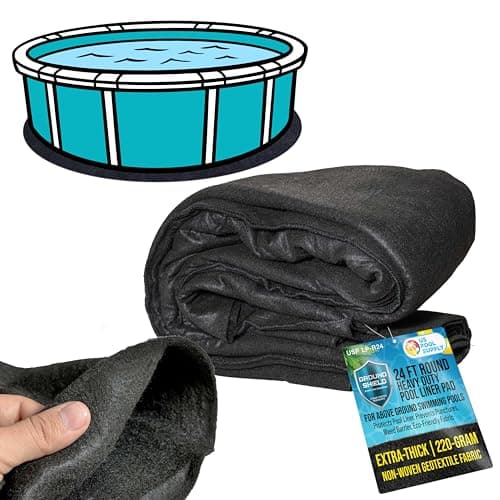 U.S. Pool Supply Ground Shield Pool Liner Pad A 220-gram non-woven geotextile that publishes the one number the others leave out. It doubles as a weed barrier and carries a two-year limited warranty. | The only one with a published fabric weightSeveral seasons | 8.3out of 10 |
The short version
- A pad goes on top of the base, not instead of it. Sand, vermiculite or concrete still has to be there. The pad is a protective layer between that base and the vinyl.
- Fabric weight is the only comparable number, and almost nobody prints it. One pad here publishes 220 g/m². The others describe the material and stop.
- The warranty exclusions tell you what it cannot do. Two of the three pads exclude nut grass — the exact weed that pierces pool floors.
- Pre-cut or trimmable is a real decision. Pre-cut means ordering the right size once; trimmable means a knife and a spare hour on install day.
What a liner pad is, and where it sits
A liner pad is a sheet of geotextile — a felt-like industrial fabric — laid between the prepared base of the pool and the vinyl liner. In The Swim describes its own version as “a thin mesh about 1/8" thick, similar to a rough felt fabric”, and that is a fair description of the whole category.
The most common misunderstanding is that the pad replaces the base. It does not. The Pool Factory’s installation guide puts the pad on top of the sand base, with the foam cove fitted above it. In The Swim makes the same point from the other direction: whether your base is sand, vermiculite or concrete, the pad is what stops punctures and tears reaching the liner. If you were hoping to skip the base work, read our leveling guide first — a pad over a lumpy yard is still a lumpy pool.
So the order on install day is: level ground, base material, pad, cove, liner. Five layers, and the pad is the cheapest of them by a wide margin.
What it is actually protecting against
Every manufacturer in this category names the same four enemies: stones, roots, glass and grass. Blue Wave describes its Gorilla padding as a geotextile developed to protect landfill liners, where a cut is a catastrophe, and claims it is impervious to almost any sharp object. U.S. Pool Supply lists punctures, tears, abrasions and rips from rocks, roots and glass.
What none of them promises is protection from nut grass. Two of the three pads here explicitly exclude it from the warranty. That exclusion is the most useful sentence in the whole category: the fabric is good against a stone pressed up from below and poor against a plant growing with purpose from beneath. If you have nut grass in the yard, deal with the grass before the pool goes up, because no pad in this roundup is warranted against it.
The second thing a pad does is comfort. A geotextile layer takes the print out of a floor, so feet do not find every pebble in the base, and footprints stop forming in the sand underneath. That is a quality-of-life argument rather than a structural one, but it is real and it lasts as long as the liner does.
The specifications that actually differ
1. Fabric weight. Geotextiles are compared by weight per square meter. Only one pad here publishes it: the Ground Shield, at 220 g/m². Blue Wave publishes neither weight nor thickness. Rhino Pad’s figures vary by retailer — one lists 1/8 inch, another 1/16 inch and 350 g/m² — so no single number can be trusted for it. When a category mostly refuses to publish its key number, the one product that does is worth noticing.
2. Woven or non-woven. Rhino Pad is described as a woven fabric; Ground Shield is explicitly non-woven. At equal weight, woven geotextiles generally resist tearing better, while non-woven fabrics drape and conform more easily over an imperfect base. Neither is universally better, and neither manufacturer publishes a tear-strength figure to settle it.
3. Pre-cut or trimmable. Blue Wave ships pre-cut to your pool size and publishes a size chart running from 12 ft round up to 33 ft, plus ovals to 21 x 43 ft and rectangles to 16 x 32 ft. Ground Shield and Rhino are trimmable on site. Pre-cut removes a job from install day; trimmable means one product covers a shape the chart does not.
4. Warranty length. Two years on Rhino and Ground Shield; 90 days on the Blue Wave pad, and Blue Wave’s own page and a retailer listing disagree about that — the retailer claims a year. On a part that is buried for a decade, the warranty is not really an insurance product. It is a statement of confidence, and it is the cheapest way to read what the maker expects.
5. What it sits on. Rhino publishes the widest list of acceptable surfaces: concrete, decks, dirt, wood and grass. That matters for the growing number of pools going up on an existing patio, a case our surface guide deals with in detail.
| Pad | Material | Published weight | Sizing | Warranty |
|---|---|---|---|---|
| Blue Wave Gorilla | Geotextile (landfill-liner grade) | Not published | Pre-cut, 12-33 ft round | 90 days (nut grass excluded) |
| Rhino Pad | Woven geotextile, 90% recycled | Conflicting figures | Pre-cut and trimmable | 2 years (nut grass excluded) |
| Ground Shield | Non-woven geotextile | 220 g/m² | Trimmable | 2 years limited |
The one claim worth distrusting
Retailer copy for these pads regularly claims two incompatible things on the same page: that the fabric lets moisture pass through so mildew cannot form, and that it acts as a vapor barrier keeping water away from the pool’s metal parts. A fabric can be permeable or it can be a barrier. It cannot be both.
In practice these pads are permeable — In The Swim says plainly that its pad allows moisture to pass through, which is what prevents mold and mildew growing in a sealed damp layer. Treat “vapor barrier” in a liner-pad listing as marketing rather than specification, and if you genuinely need ground moisture held back, that is a different product and a different install.
Installing it without creating the problem you are preventing
Finish the base first
Level the ground and lay the base material to the maker's depth. The pad does not fix a base that is out of level, and a wrinkle under vinyl becomes a wear point.Lay the pad dry and flat
Unroll it over the finished base with no folds. On a windy day, weigh the edges as you go - a geotextile sheet behaves like a sail.Trim to the wall, not past it
For a trimmable pad, cut so it runs to the inside of the wall track. In The Swim notes a pad can cover the wall-floor junction or sit behind the foam cove; pick one and be consistent the whole way round.Fit the cove on top
The foam cove goes above the pad, against the wall. Skipping the cove to save a step is how liners get stretched into the wall angle.Set the liner and fill slowly
Smooth the liner from the center out, then fill. Water weight is what finally presses the pad, base and liner into one flat floor.
What it costs, against what it is protecting
A liner pad is a one-off purchase with no running cost, which makes it unusual on this site. The sensible way to price it is against the thing it protects: the liner. Our liner replacement guide works through that bill in full, and it is the largest occasional cost most above-ground pool owners meet.
The comparison is not quite as simple as pad-versus-liner, because a pad does not guarantee a liner survives — it removes one category of failure. Punctures from below are one of several ways liners die; UV, chemistry and simple age are others, all of which our lifespan guide covers. What a pad buys is the removal of the most avoidable failure on that list, for a small fraction of the cost of the part it protects.
There is also a repair path that sits between the two. A pinhole from a stone can be patched rather than replaced, and our patch kit roundup covers the kits that work underwater. A pad makes that repair less likely; a patch kit makes it survivable when it happens anyway. Most pools should own both, and the pair together still costs a fraction of a liner.
When you can skip it
Three honest cases. First, a small soft-sided pool that comes down at the end of the season — a 10 or 12 foot Easy Set on a lawn for one summer is not a candidate for a geotextile pad, and the ground cloth in the box is proportionate. Second, a pool going up on a smooth concrete slab in good condition, where there is nothing sharp to protect against; many owners still use a pad for comfort underfoot, which is a preference rather than a need. Third, a pool you have already decided is a one-season experiment before buying properly.
Everywhere else — soil, sand, grass, anywhere roots or stones exist — the pad is the highest-return item in the entire build. It is the cheapest thing on the list and the only one that is impossible to add later without draining the pool and lifting the liner.
How we picked
We have not tested these pads and we do not claim to. The scores are our reading of what each manufacturer publishes, with weight given to the makers who publish anything at all. Where retailer listings disagree with each other — and in this category they frequently do — we say so on the pick rather than choosing the flattering number. The Poolvio pad that ranks well in Amazon results was left out entirely: no manufacturer page, no published specifications, nothing to verify.
Pads over concrete, decking and existing bases
A pad is not only for soil. In The Swim states that its pad works whether the base of the pool is sand, vermiculite or concrete, and Rhino publishes concrete, decks, dirt, wood and grass as acceptable surfaces.
On a concrete slab the argument changes from puncture protection to comfort and heat. A slab has nothing sharp in it, but it is hard underfoot and it conducts heat away from the liner. Plenty of owners on concrete fit a pad for those reasons alone, which is a preference rather than a requirement — our surface guide covers what a pool can and cannot sit on in more detail.
One detail worth getting right at install: In The Swim notes that a pad can either cover the junction of the wall and floor or fit behind the foam cove. Either is fine. What causes trouble is doing one on half the pool and the other on the rest, which leaves a step in the floor that shows through the liner for the rest of its life.
The picks, in full
Scores are our own reading of published specifications. They are not test results — we have not tested these products and we do not claim to.
Pick #1 · The pad sold pre-cut to your exact pool
Blue Wave Gorilla Floor Padding
Blue Wave
A geotextile developed for landfill liners, sold pre-cut to your pool size and shape. It is the one here with a published size chart covering round, oval and rectangular pools.
Key specs
- Material
- Geotextile, described by Blue Wave as developed to protect landfill liners
- Sizes
- Round 12 ft to 33 ft; oval 10 x 19 ft to 21 x 43 ft; rectangular 12 x 20 ft to 16 x 32 ft
- Supplied
- Pre-cut to the pool size ordered
- Protects against
- Cuts from grass, roots, rocks and glass under the liner
- Warranty
- 90 days per Blue Wave; one retailer listing claims one year — confirm before buying
- Thickness / weight
- Not published by the manufacturer
How it scoresour reading of published specs, not a test result
- Sizing fit
- 9.0
- Running cost
- 8.5
- Maintenance
- 8.0
- Build
- 8.0
- Value
- 8.0
Overall 8.3 / 10
What works
- Pre-cut to the pool size and shape, so there is no trimming and no seam in the middle of the floor
- The widest published size chart here, including ovals and rectangles
- Geotextile rather than foam, which grass and roots cut through
- Blue Wave publishes the size chart and the warranty terms, which several competitors do not
What doesn't
- Neither thickness nor fabric weight is published, so it cannot be compared on the numbers
- The published warranty is 90 days, the shortest here, and nut grass damage is excluded
- Manufacturer and retailer listings disagree on the warranty length
- Pre-cut means ordering the right size first time; there is no trimming a large one down
Skip it if: Being compared on paper. Blue Wave publishes what it is made of and what it resists, but not the thickness or fabric weight, so a spec-by-spec comparison against the Rhino Pad is not possible.
What it costs to run: A pad is bought once and stays under the pool for the life of the liner. Priced against a liner replacement, it is the cheapest insurance on the pool — our liner replacement guide has the number it is protecting.
Several seasons: Buy-once. Built and warranted to come back out of the box for a few years, if you store it properly.
Specs from: Blue Wave — liner pad for above-ground pools, published sizes and warranty, Pool Warehouse — Blue Wave Gorilla floor padding, published description
Pick #2 · The longest warranty of the pads here
Rhino Pad Above-Ground Pool Liner Pad
Rhino
A woven geotextile with a two-year warranty, made largely from recycled material and sold pre-cut for round, oval and rectangular pools. Published thickness figures disagree between retailers.
#ad how this is funded · price as of October 8, 2026
Key specs
- Material
- Woven geotextile fabric, high-density cloth fiber
- Recycled content
- 45% post-consumer and 45% industrial recycled material
- Thickness
- Retailer listings conflict: 1/8 in on one, 1/16 in and 350 g/m² on another
- Sizes
- Round, oval and rectangle, pre-cut and trimmable; smallest listed 12 ft round
- Suitable over
- Concrete, decks, dirt, wood and grass
- Warranty
- Two-year limited; nut grass and other weeds excluded
How it scoresour reading of published specs, not a test result
- Sizing fit
- 8.5
- Running cost
- 8.5
- Maintenance
- 8.0
- Build
- 8.5
- Value
- 8.0
Overall 8.3 / 10
What works
- A two-year limited warranty, the longest published among the pads here
- Pre-cut to the pool shape and still trimmable on site
- Rated by the seller for use over concrete and decking as well as soil
- Largely recycled content, which is unusual in this category
What doesn't
- Published thickness conflicts between retailers, so treat any single figure with suspicion
- Retailer copy claims it both passes moisture through and acts as a vapor barrier, which cannot both be true
- Nut grass, the weed most likely to pierce a liner, is excluded from the warranty
- No manufacturer page publishes the fabric weight for the round sizes
Skip it if: Stopping nut grass. The warranty excludes exactly the weed that most often comes through a pool floor, which tells you what the fabric cannot do.
What it costs to run: Sold per pool size, bought once. The running cost is zero; the saving is the liner it keeps whole, and a liner is the single largest occasional cost on an above-ground pool.
Several seasons: Buy-once. Built and warranted to come back out of the box for a few years, if you store it properly.
Specs from: PoolSupplies.com — Rhino Pad published material, sizes and suitable surfaces, SwimmingPoolLiners.com — Rhino Pad 33 ft round, published warranty terms
Pick #3 · The only one with a published fabric weight
U.S. Pool Supply Ground Shield Pool Liner Pad
U.S. Pool Supply
A 220-gram non-woven geotextile that publishes the one number the others leave out. It doubles as a weed barrier and carries a two-year limited warranty.
#ad how this is funded · price as of October 8, 2026
Key specs
- Material
- Heavy-duty 220-gram non-woven geotextile fabric
- Fabric weight
- 220 g/m², published — the only pad here that states it
- Protects against
- Punctures, tears, abrasions and rips from rocks, roots and glass
- Weed barrier
- Stated to prevent weeds growing through the pad
- Fits
- Soft-sided and hard-sided above-ground pools; trimmable
- Warranty
- Two-year limited, for pad replacement
- Shipping weight
- Not published
How it scoresour reading of published specs, not a test result
- Sizing fit
- 8.0
- Running cost
- 8.5
- Maintenance
- 8.5
- Build
- 8.0
- Value
- 8.5
Overall 8.3 / 10
What works
- Publishes its fabric weight, which makes it the only pad here you can actually compare on a number
- Two-year limited warranty
- Explicitly sold as a weed barrier as well as a liner pad
- Trimmable, and rated for both soft-sided and hard-sided pools
What doesn't
- Thickness is not published, only weight
- Breathability is not stated either way, so moisture behavior under the liner is unknown
- The published size range is narrow next to Blue Wave's chart
- Non-woven fabric is generally less tear-resistant than woven at the same weight
Skip it if: Covering unusual pool shapes. The published line is built around common round and oval sizes; an odd rectangle may mean trimming from a larger pad rather than buying to fit.
What it costs to run: One purchase, no running cost. Against the price of the liner it sits under, a pad is the cheapest line in the whole build — and the one most often skipped to save an afternoon.
Several seasons: Buy-once. Built and warranted to come back out of the box for a few years, if you store it properly.
Specs from: U.S. Pool Supply — Ground Shield round liner pad, published specifications
Questions people actually ask
Does a liner pad replace the sand base?
Will a pad stop grass and weeds coming through the liner?
How thick should a liner pad be?
Can I use landscape fabric or a tarp instead?
Can a pad be added after the pool is up?
Sources
- The Pool Factory — how to install a base for an above-ground pool liner
- In The Swim — Armor Shield above-ground pool liner pad, published description
- Blue Wave — liner pad for above-ground pools, sizes and warranty
- U.S. Pool Supply — Ground Shield liner pad, published specifications
- Royal Swimming Pools — should I use padding and foam cove under my liner
Read next
- Equipment, sized to your pool and costed by the wattPumps, filters, vacuums, heaters and ladders - matched to your gallons and priced by what they draw.
- The liner is the most expensive thing you can wreck in an afternoonBeaded, overlap and unibead liners explained, what gauge in mil buys, and the patch kit that turns a leak into a fifteen-minute job.
- The patch kit is the difference between a hole and a new linerUnderwater vinyl repair kits compared on cure time, patch material supplied and what each maker actually publishes — plus the one that sets in thirty minutes.
- Leveling the ground, and the weight that makes it matterThe tolerance manufacturers publish, the weight of water that enforces it, and the method for getting a circle genuinely flat with hand tools.
- What an above-ground pool can and cannot sit onEvery common surface assessed, with the load per square foot each pool size actually applies - the number that rules a deck in or out.
- Liner replacement: the big occasional cost, and how to avoid itOverlap, beaded and unibead are not interchangeable - plus the three habits that decide whether you ever need a replacement.
- How to set up an above-ground pool properlyLeveling, ground protection, filling and priming - the afternoon that decides how the rest of the season goes.
- How long an above-ground pool actually lastsRealistic lifespans by pool type, the four failure modes that account for nearly all of them, and the cheap items that add seasons.