Pool Equipment · Best Vacuum
The best above-ground pool vacuums
Three quite different products. Which one you need depends on whether your problem is silt or leaves, and on how big the pool is.

Heads up: we earn a commission if you buy through the links on this page, at no extra cost to you. It never decides the ranking — here is how we pick and here is the full disclosure. Prices are checked automatically; last verified October 19, 2026.
Quick picks
Segmented before it is ranked — the right answer depends on which of these you actually are. Tap any row for the full write-up.
For most above-ground pools
A manual head on your existing pump costs almost nothing to run and handles real debris. This is the default answer.
| # | Product | Best for | Score | Price |
|---|---|---|---|---|
| 1 | No image Manual Vacuum Head with Telescopic Pole and Hose Connects to the skimmer and uses the pump you already own. It is slower than a robot, cheaper than everything, and it is what most above-ground pools should have. | Actual debris, at the lowest costSeveral seasons | 8.8out of 10 | |
| 2 | 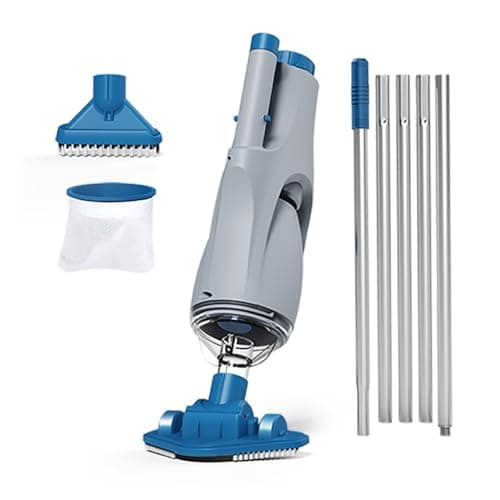 Rechargeable Handheld Pool Vacuum Battery, no hoses, no pump connection. It picks up what settles on the floor and that is genuinely all a seasonal above-ground pool needs. | The realistic vacuum for a seasonal poolOne honest season | 8.2out of 10 |
When the pool is large and nobody will vacuum
A robot is genuinely good and genuinely expensive relative to most above-ground pools. Read the honest case below.
| # | Product | Best for | Score | Price |
|---|---|---|---|---|
| 1 | 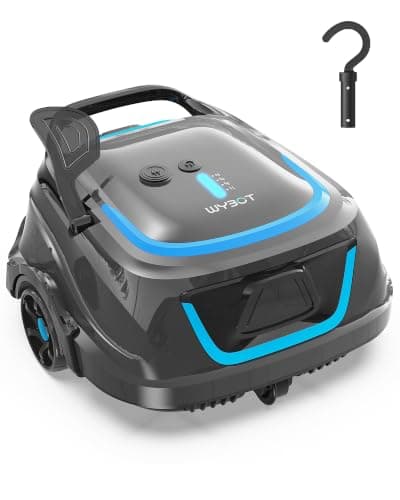 Cordless Robotic Pool Cleaner Genuinely good at the job and genuinely expensive relative to the pool. For a 1,700-gallon frame pool it costs a meaningful fraction of the pool itself, which is difficult to justify. | Large above-ground pools and people who will not vacuumMore than you need yet | 7.1out of 10 |
The short version
- Skimming first makes vacuuming mostly unnecessary. Debris that never sinks does not need lifting off the floor.
- Battery handhelds lift silt, not leaves. Know which problem you have.
- A manual head uses the pump you already own and costs nothing to run.
- Vacuuming loads the filter heavily. Plan to clean the cartridge immediately after.
Do you actually need one?
Genuinely worth asking. If you skim the surface twice a week, most debris never reaches the floor, and organic material removed while floating never gets a chance to consume your chlorine as it decomposes. A skimmer net costs a fraction of any vacuum and prevents most of the work.
What a net cannot do is lift fine silt that settles out of the water, or the debris that arrives overnight after a windy night. That is what vacuums are for.
The three types
| Type | Handles | Running cost | Needs |
|---|---|---|---|
| Battery handheld | Silt and fine debris | Recharging only | Nothing |
| Manual head + hose | Real debris including leaves | Pump hours you already pay for | A skimmer connection |
| Robotic cleaner | Everything on the floor | Its own battery | A pool big enough to justify it |
Battery handheld
No hoses, no pump connection, no priming. You charge it, walk it round the floor, and empty the onboard filter. Genuinely the right answer for a small pool: it works where a hose-driven head is impractical, and there is nothing to lose prime on.
The limits are real though. Suction is modest, so it lifts silt and not much heavier. Runtime is short. And on anything over about 5,000 gallons you will be recharging partway through, which is where it becomes tedious rather than convenient.
Manual head and hose
The default answer for most above-ground pools. It connects to the skimmer and uses the suction of the pump you already own, so there is no motor to fail and nothing to charge. It lifts real debris rather than just silt.
Two things to know. It needs a skimmer connection, which rules out most soft-side inflatable pools. And you have to prime the hose properly — fill it with water before connecting, or the pump loses prime and you start again.
Robotic
Filters independently of the pool pump, so it adds turnover rather than replacing it, and its onboard basket means it does not load your cartridge. That last point is genuinely useful.
But it costs a meaningful fraction of most above-ground pools, batteries degrade and are often not user-replaceable, and most models handle the floor rather than the walls of a soft-side pool. The honest case for and against is at robotic cleaners.
There is a third category between these and a robot. Our suction-side cleaner roundup covers cleaners driven entirely by the pump you already run — no motor, no battery, and on above-ground models a single moving part.
How to vacuum properly
Skim and brush first
Remove floating debris, then brush the walls so anything clinging to them ends up on the floor where you can lift it. Give it an hour to settle.Prime the hose (manual heads)
Submerge the whole hose and let it fill completely with water before connecting to the skimmer. Air in the hose is what makes the pump lose prime.Move slowly, in overlapping passes
Fast movement stirs debris back into suspension rather than lifting it. Slow overlapping passes, like mowing a lawn.Clean the filter immediately
Not tomorrow. A loaded cartridge undoes the work by leaving fine particulate circulating.Re-test the water
Stirring the floor puts organic material back into suspension, which consumes chlorine. Test after, not before.
The picks, in full
Scores are our own reading of published specifications. They are not test results — we have not tested these products and we do not claim to.
Pick #1 · Actual debris, at the lowest cost
Manual Vacuum Head with Telescopic Pole and Hose
Various
Connects to the skimmer and uses the pump you already own. It is slower than a robot, cheaper than everything, and it is what most above-ground pools should have.
Key specs
- Power
- Uses the pool's existing pump suction
- Needs
- A telescopic pole and a vacuum hose of the right length
- Fitting
- Must match the skimmer on your pool
- Consumables
- None beyond the filter it already loads
How it scoresour reading of published specs, not a test result
- Sizing fit
- 8.5
- Running cost
- 9.8
- Maintenance
- 8.0
- Build
- 8.0
- Value
- 9.5
Overall 8.8 / 10
What works
- No batteries, no motor, nothing that can fail electrically
- Lifts real debris, not just silt
- Cheapest capable option, by a wide margin
What doesn't
- You have to prime the hose properly or the pump loses suction
- Loads the filter heavily, so plan to clean it right after
- It is genuinely manual work and takes twenty minutes
Skip it if: A pool without a skimmer connection, which rules out most soft-side inflatables.
What it costs to run: Free to run beyond the pump time you are already paying for. The one hidden cost is filter loading — expect to clean the cartridge immediately after vacuuming.
Several seasons: Buy-once. Built and warranted to come back out of the box for a few years, if you store it properly.
Pick #2 · The realistic vacuum for a seasonal pool
Rechargeable Handheld Pool Vacuum
Various
Battery, no hoses, no pump connection. It picks up what settles on the floor and that is genuinely all a seasonal above-ground pool needs.
Key specs
- Power
- Rechargeable battery
- Runtime
- Published per model — typically enough for one small pool
- Collection
- Onboard filter bag or chamber
- Connection
- None to the pool's filtration
How it scoresour reading of published specs, not a test result
- Sizing fit
- 8.0
- Running cost
- 9.5
- Maintenance
- 7.5
- Build
- 7.0
- Value
- 8.5
Overall 8.2 / 10
What works
- No hoses to connect and no risk of losing pump prime
- Works in a pool too small for a hose-driven vacuum head
- Cheap enough that it is not a difficult decision
What doesn't
- Battery runtime is short, and on a bigger pool you will be recharging mid-job
- Suction is modest, so it lifts silt and not much heavier
- The onboard filter needs emptying constantly
Skip it if: A large pool with real debris. If leaves are the problem rather than silt, you want a hose-driven head.
What it costs to run: The cost here is your time rather than power. On a pool over about 5,000 gallons the recharge cycles make this genuinely tedious, and that is the argument for stepping up.
One honest season: The cheapest setup that genuinely works for a season of real swimming. Nothing spare, nothing missing.
Pick #3 · Large above-ground pools and people who will not vacuum
Cordless Robotic Pool Cleaner
Various
Genuinely good at the job and genuinely expensive relative to the pool. For a 1,700-gallon frame pool it costs a meaningful fraction of the pool itself, which is difficult to justify.
#ad how this is funded · price as of October 19, 2026
Key specs
- Power
- Onboard rechargeable battery
- Coverage
- Floor only on most above-ground models
- Runtime
- Published per model
- Filtration
- Onboard basket, independent of the pool's filter
How it scoresour reading of published specs, not a test result
- Sizing fit
- 6.5
- Running cost
- 8.0
- Maintenance
- 7.0
- Build
- 7.5
- Value
- 6.0
Overall 7.1 / 10
What works
- Filters independently of the pool pump, so it adds turnover rather than replacing it
- Genuinely hands-off once it is in the water
- Onboard basket means it does not load your cartridge
What doesn't
- Expensive relative to the price of most above-ground pools
- Batteries degrade and are frequently not user-replaceable
- Most models handle the floor but not the walls of a soft-side pool
Skip it if: Small pools. If your pool cost less than three of these, the money is better spent on a cover and a timer.
What it costs to run: The honest comparison: a manual vacuum head plus a pump timer costs a fraction of this and delivers most of the benefit. A robot earns its place on a large pool owned by someone who genuinely will not vacuum otherwise.
More than you need yet: Real capability a first-pool family cannot use yet. Buy cheaper and put the difference toward chemicals and a cover.
Pick #4 · The five-dollar tool you use most
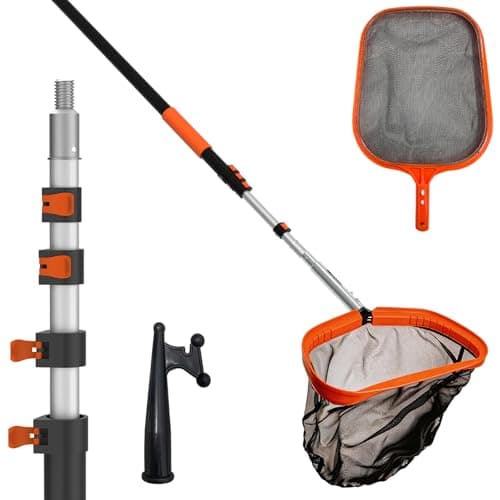
Skimmer Net with Telescopic Pole
Various
Catching leaves while they float is a two-minute job. Catching them after they sink is a vacuum session and a filter clean. Buy this first.
Key specs
- Type
- Flat skimmer or deep leaf rake
- Pole
- Telescopic, sized to reach the middle of your pool
- Frame
- Plastic or aluminum
How it scoresour reading of published specs, not a test result
- Running cost
- 10.0
- Value
- 9.5
Overall 8.8 / 10
What works
- The single most-used tool in pool ownership and among the cheapest
- Removing debris before it sinks prevents most of the work that follows
- A deep leaf rake handles far more per pass than a flat skimmer
What doesn't
- Cheap plastic frames snap where the pole attaches, which is the standard failure
- Telescopic poles seize with hard water unless rinsed
- A too-short pole means you cannot reach the middle, which makes it useless
Skip it if: Anything on the floor. This is a surface tool and pretending otherwise is how debris ends up in the filter.
What it costs to run: Free to use and it directly reduces your chemical bill: organic debris consumes chlorine as it breaks down, so removing leaves is the cheapest sanitizer saving there is.
Several seasons: Buy-once. Built and warranted to come back out of the box for a few years, if you store it properly.
Pick #5 · The consumable you will actually buy repeatedly
Type A Replacement Filter Cartridges (multipack)
Various
Buy them in a multipack before you need them. A pool running on an exhausted cartridge is a cloudy pool, and the fix is a two-dollar part you did not have.
Key specs
- Type
- Type A — the most common Intex format
- Replacement interval
- Every 2 weeks in heavy use, per Intex guidance
- Between changes
- Rinse, do not scrub
How it scoresour reading of published specs, not a test result
- Sizing fit
- 9.0
- Running cost
- 7.0
- Maintenance
- 8.5
- Build
- 7.0
- Value
- 8.5
Overall 8.2 / 10
What works
- Type A is the most widely stocked cartridge format in the US
- Multipacks cost a fraction of buying singles
- Having a spare turns a cloudy week into a five-minute fix
What doesn't
- It is a genuine recurring cost that nobody includes in the purchase price
- Aftermarket quality varies noticeably
- Rinsing extends life but does not restore a cartridge that is done
Skip it if: Being restored. Once the pleats are permanently gray and stiff, rinsing is not saving it.
What it costs to run: The line item most people leave out of their pool budget. Count how many you use in your first season and you have your real annual filtration cost — this is exactly the number the cost-to-run guide asks you to record.
One honest season: The cheapest setup that genuinely works for a season of real swimming. Nothing spare, nothing missing.
Questions people actually ask
What is the best vacuum for an above-ground pool?
Do I need a pool vacuum if I skim regularly?
Why does my pool pump lose suction when vacuuming?
Sources
Read next
- Equipment, sized to your pool and costed by the wattPumps, filters, vacuums, heaters and ladders - matched to your gallons and priced by what they draw.
- Robotic pool cleaners: good, and hard to justifyThe honest case for and against a robot on an above-ground pool, and the manual setup that does most of the job for a fraction of the price.
- Pool filters: the consumable nobody budgets forCartridge replacement intervals, what rinsing does and does not achieve, and when sand becomes the cheaper answer.
- Pool maintenance for beginners, in twenty minutes a weekThe complete weekly routine in order, what each step is actually for, and the things you can safely ignore.
- Cloudy pool water: work out which of four problems you haveA diagnostic decision tree for cloudy water - four causes, how to tell them apart, and the correct fix for each.