Pool Costs
It is not an investment, and pricing it as one is the mistake
An above-ground pool is personal property that happens to be in your yard. Treating it as home improvement is how people talk themselves into spending far more than the enjoyment is worth.
Heads up: we earn a commission if you buy through the links on this page, at no extra cost to you. It never decides the ranking — here is how we pick and here is the full disclosure. Prices are checked automatically; last verified October 8, 2026.
The short version
- A free-standing pool is personal property, not a fixture. It generally is not part of what the house is appraised on.
- It can narrow your buyer pool — some buyers see a maintenance liability rather than an amenity.
- The permanent things around it are different. A deck is an improvement; the pool sitting on it is not.
- Buy it for the summers, not the sale. That framing produces better spending decisions.
The distinction that answers the question
Fixtures versus personal property. A fixture is attached to the property and conveys with it; personal property does not. A free-standing above-ground pool with a hose to a pump sits firmly on the second side of that line — it can be dismantled and taken away, which is precisely what our moving a pool guide is about.
Anything that is genuinely built — a deck, a paved surround, a retaining wall, buried electrical — is on the first side. Those are improvements to the property and they are what a valuation is looking at.
So the honest framing is: the pool is a thing you own that is currently in the yard, and the construction around it is part of the house. That distinction explains almost everything else on this page.
| Item | Usually treated as | Note |
|---|---|---|
| Frame or soft-side pool | Personal property | Dismantles and leaves with you |
| Pump and filter | Personal property | Unplugs and goes in the shed |
| Built deck or paved surround | Improvement | Permanent construction |
| Permanent fencing | Improvement | And often a code requirement |
| Buried electrical to the pad | Improvement | Trade-installed, permanent |
| Semi-inground installation | Improvement | Excavated in — see our semi-inground guide |
What it does to a sale
Three effects, and only one is positive.
It narrows the buyer pool. Some buyers actively want a pool. Others see a running cost, a chemistry routine and a safety obligation attached to a house they were otherwise interested in. Families with toddlers frequently fall into the second group, and they are a large share of the market for family homes.
Its condition speaks about the house. A well-kept pool with clear water reads as a well-kept property. A green one with a sagging cover reads the opposite, and it does that disproportionately loudly — it is the largest single object in the yard. Our green pool guide is relevant here for reasons that have nothing to do with swimming.
It can genuinely appeal. To the right buyer at the right time of year, a working pool in a yard is an amenity they do not have to install. This is real and it is not the same thing as adding measurable value.
What this should change about your spending
This is the useful part, and it is why the page exists.
If a pool were an investment, spending more would be defensible on the grounds of return. It is not, so the only justification for any dollar spent is the enjoyment it produces. That reframes several decisions this hub covers:
The deck. Our deck cost guide notes it routinely exceeds the price of the pool. As an improvement it might partly return; as a platform for a pool you may not own in five years, it is worth thinking about twice.
Going bigger. Our cost of going bigger guide prices the step. The right question is how many more swims it produces, not whether it looks more impressive.
The honest first question. Our are they worth it guide exists to be read before any of this, and it talks as many people out of a pool as into one.
When you do sell
Decide early whether the pool is staying or going, and say so in the listing. Ambiguity helps nobody: a buyer who assumed it stayed and a seller who assumed it left is a bad week for everyone.
If it is going, our resale and disposal guide is realistic about what a used above-ground pool is worth and what removing one involves. If it is staying, leave it clean, leave the manual, and leave the water clear — that costs one weekend and it is the only version of this that reliably helps.
What to buy
Scores are our own reading of published specifications. They are not test results — we have not tested these products and we do not claim to.
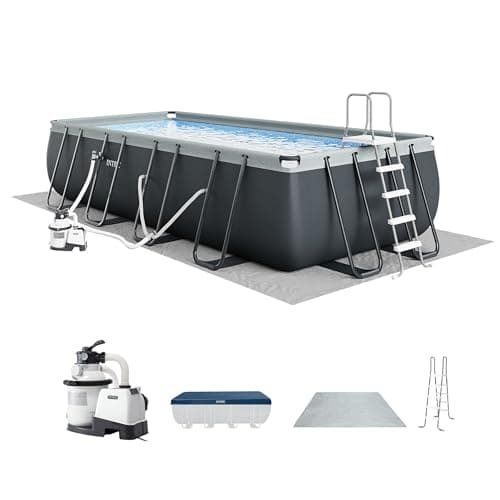
A family that will still be using it in year three
Intex Ultra XTR Frame Pool Set, 18ft x 52in
Intex
The biggest, sturdiest thing in this class that a homeowner can still put up in a weekend. It is also, by a wide margin, the most expensive one to run.
#ad how this is funded · price as of October 8, 2026
Key specs
- Water capacity
- 6,981 gallons
- Pump supplied
- 2,100 GPH sand filter
- Frame
- Galvanized steel, powder-coated inside and out
- Liner
- 3-ply, puncture and tear resistant
- Manufacturer setup claim
- Ready for water in 60 minutes
- Pump wattage
- Not published by Intex
How it scoresour reading of published specs, not a test result
- Build
- 9.0
- Setup
- 6.0
- Upkeep
- 7.5
- Running cost
- 5.0
- Value
- 8.5
Overall 8.4 / 10
What works
- 6,981 gallons is genuinely swimmable for adults, not just a cooling-off pool
- Sand filter rather than a cartridge, so there is no cartridge to buy every few weeks
- Galvanized frame with inner and outer powder coating is the most corrosion-resistant construction in this price class
- Ships with the ladder, cover and ground cloth that cheaper kits make you buy separately
What doesn't
- 52 inches of wall on an 18-foot circle is a lot of water pressure — the ground under it has to be genuinely level
- Intex publishes flow rate but not wattage, so you cannot compute your running cost until the pump is in your hands
- Too heavy and too large to take down and put up casually
Skip it if: Your yard is not close to level, or you want a pool you can pack away mid-season. Nearly 7,000 gallons is not a thing you move.
What it costs to run: It is the most water in this roundup, so it is the most chemicals, the most evaporation and the largest pump. Using ENERGY STAR's own published figures for above-ground pool pumps (an ENERGY STAR model saves about $20 a year, being 11% more efficient), a standard above-ground pump implies roughly $182 a year in electricity — and that is before you scale for a 2,100 GPH sand filter running on a pool this size. Price the season before you price the pool.
Several seasons: Buy-once. Built and warranted to come back out of the box for a few years, if you store it properly.
Specs from: Intex — Ultra XTR Frame 18' x 52' specifications, ENERGY STAR — Pool Pumps
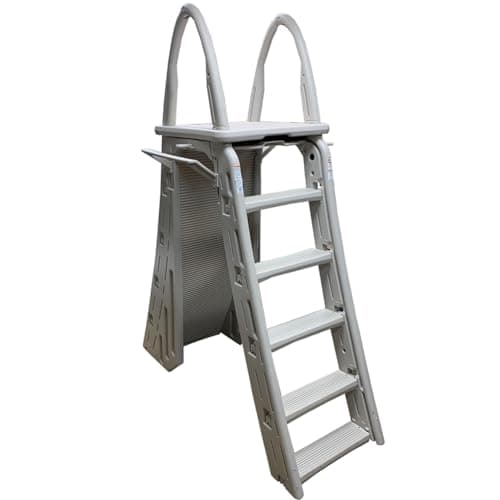
Getting in and out safely
A-Frame Above-Ground Pool Ladder
Various
Read the published weight limit before anything else. It is frequently lower than buyers assume, and it is the one spec on a ladder that genuinely matters.
#ad how this is funded · price as of October 8, 2026
Key specs
- Critical spec
- Published weight capacity — check it against every adult who will use it
- Height match
- Must match your wall height, not approximate it
- Safety feature
- Removable or lockable outer steps on better models
How it scoresour reading of published specs, not a test result
- Sizing fit
- 8.5
- Running cost
- 10.0
- Maintenance
- 8.5
- Build
- 7.5
- Value
- 8.5
Overall 8.4 / 10
What works
- Removable outer steps genuinely prevent unsupervised access, which is a real safety layer
- Resin frames do not corrode the way early steel ladders did
- Correctly matched height is far more stable than a too-tall ladder
What doesn't
- Weight limits are often lower than people expect and are easy to overlook in a listing
- A ladder sized for a 42-inch wall is wrong on a 52-inch wall and vice versa
- Cheap models flex enough to feel alarming
Skip it if: Being a barrier on its own. The CPSC's guidance treats barriers, supervision and alarms as layers; a removable step is one layer, not the answer.
What it costs to run: Buy it with the pool. Kits that include a ladder are frequently cheaper than the pool-plus-ladder bought separately, and this is one of the accessories that makes a cheap-looking kit expensive.
Several seasons: Buy-once. Built and warranted to come back out of the box for a few years, if you store it properly.
Specs from: CPSC — Pool Safely
A barrier between the yard and the water
Removable Mesh Pool Safety Fence
Various
Sectional mesh panels on stainless pegs that go in without concrete and come out for winter. The only item on this site that does anything about the risk that matters most.
Key specs
- Panel height
- 4 ft is the common residential size
- Panel length
- Sold in 12 ft and 15 ft sections
- Mesh
- UV-stabilized, chlorine-resistant, around 320 GSM
- Poles
- Powder-coated aluminum, roughly 36 in spacing
- Fixings
- Stainless steel pegs into sleeved ground holes
- Certification
- Look for ASTM F2286 on the listing
How it scoresour reading of published specs, not a test result
- Sizing fit
- 8.0
- Running cost
- 10.0
- Maintenance
- 8.5
- Build
- 8.0
- Value
- 8.5
Overall 8.6 / 10
What works
- Removable — the sleeves stay in the ground, the fence does not
- Mesh is see-through, so a child at the fence is still visible from the house
- No footings, no concrete, and no permanent change to the yard
- Sections can be reconfigured if the pool moves or the yard changes
What doesn't
- Only certain listings state ASTM F2286 compliance, and that is the line worth paying for
- Needs drilling sleeve holes into whatever surface surrounds the pool
- A self-closing, self-latching gate is usually a separate purchase
- Soft ground and sloped lawns both make a taut, secure run harder
Skip it if: Being a substitute for an adult watching. A fence buys time to notice; it does not remove the need to notice.
What it costs to run: Priced per linear foot, so the cost is set by your perimeter, not your pool. Measure the run you actually need to enclose before comparing listings — a 4-sided enclosure and a 3-sided one using the house wall are very different numbers.
Several seasons: Buy-once. Built and warranted to come back out of the box for a few years, if you store it properly.
Specs from: Removable mesh pool fences — current Amazon category listing
Questions people actually ask
Does an above-ground pool add value to a house?
Does a pool make a house harder to sell?
Is a semi-inground pool different for home value?
Should I remove my pool before selling?
Sources
Read next
- What a pool actually costs, with the arithmetic shownPurchase, electricity, chemicals, water and replacement parts - added up, sourced, and shown as arithmetic you can redo.
- Are backyard pools worth it?The four questions that decide whether a pool is a good buy for your household - argued honestly in both directions.
- What happens at the end: selling it, giving it away, or getting rid of itWhat a used above-ground pool is worth, what makes one saleable, and how to dispose of one that has failed.
- What an above-ground pool actually costs to run for a yearElectricity, chemicals, water and consumables for a full season - every input sourced, every calculation shown, and every assumption named.
- The deck costs more than the poolWhat drives above-ground pool deck cost, why it usually exceeds the pool itself, and the cheaper options that solve the same three problems.
- The kit price is the smallest number in the projectHow to build a realistic semi-inground pool budget — the six line items beyond the kit, and why three quotes beat any published average.
- The call to your insurer takes ten minutes and is not optionalWhat to ask your home insurer before putting up a pool, why liability coverage is the part that matters, and how safety equipment enters the conversation.
- Above-ground vs inground: which one you are actually shopping forCost, commitment, depth and reversibility compared - plus the budget point where the two categories genuinely start to overlap.
- The semi-inground pool solves the yard you actually haveSemi-inground pool kits explained: resin-coated steel walls, how far they can be buried, and the excavation and barrier obligations that come with them.