Above-Ground Pools
Above-ground vs inground: which one you are actually shopping for
These are not two grades of the same product. They differ in cost by an order of magnitude, and in reversibility completely.
Heads up: we earn a commission if you buy through the links on this page, at no extra cost to you. It never decides the ranking — here is how we pick and here is the full disclosure. Prices are checked automatically; last verified October 19, 2026.
The short version
- The decisive difference is reversibility, not price. An above-ground pool can be removed; an inground one cannot.
- Depth is the honest functional gap. Most above-ground pools are for sitting in; inground pools are for swimming in.
- Running costs converge more than purchase prices do — both are driven by gallons and pump hours.
- If you want to swim lengths, no amount of above-ground budget produces that. Know which product you are shopping for.
Why we cannot price the inground side
Straight away, the limit of this comparison: inground pool installation costs depend on excavation, access, soil, local labor rates, permitting and finish, and we have no sourced national figure we would stand behind. So we are not going to publish one. What we will do is compare the two categories on everything that is comparable, and be explicit that the purchase-price gap is large and locally variable.
If you want a number for your area, the only reliable route is two or three local quotes. Anything else, including anything we could write here, is a guess with a dollar sign in front of it.
What genuinely differs
| Above-ground | Inground | |
|---|---|---|
| Typical water depth | 23–48 in | Commonly 3–8 ft |
| Installation | An afternoon, DIY | Excavation, contractor, permits |
| Reversible? | Yes — drain and remove | No |
| Season | Usually seasonal; taken down or closed | Closed but permanent |
| Largest common capacity | ≈ 7,000 gal | Typically 15,000+ gal |
| Ground requirement | Level to 1–2 in | Engineered site |
The depth question decides most of it
This is the part that gets glossed over and it should not be. Intex publishes 23 inches of water depth in a 30-inch Easy Set. A 42-inch Bestway wall gives you something over three feet. Even the 52-inch Ultra XTR is a pool you stand in comfortably rather than one you dive into.
If the goal is somewhere to cool off, play with children, and be outside together, above-ground does that completely and the depth is irrelevant. If the goal is swimming lengths or diving, above-ground will not deliver it at any price in the category, and knowing that before you spend is worth more than any spec comparison.
Where running costs converge
Purchase prices differ enormously; running costs differ less than you would think, because both are driven by the same two things: gallons and pump hours. An inground pool holds more water, so it costs more to fill and to sanitize proportionally — but the arithmetic is identical, and the levers are identical too. A cover reduces evaporation in both. A timer reduces pump hours in both. Our cost-to-run guide works for either; only the gallons change.
Where the two categories overlap
At the top of the above-ground range — a large permanent steel-wall pool with a deck, a real filtration system and professional installation — the budget genuinely starts to approach the bottom of the inground range in some markets. If you find yourself there, get inground quotes before committing, because at that point you are choosing between two comparable investments rather than between a cheap option and an expensive one.
For everyone else the choice is clearer than it looks. Read are backyard pools worth it, work through the four questions there, and if the answer is yes, start at the main roundup.
What to buy
Scores are our own reading of published specifications. They are not test results — we have not tested these products and we do not claim to.
A family that will still be using it in year three
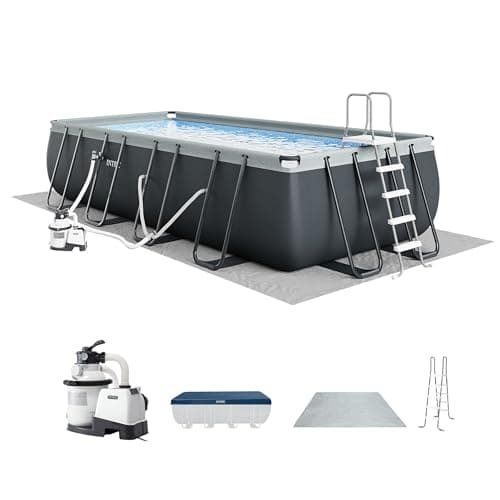
Intex Ultra XTR Frame Pool Set, 18ft x 52in
Intex
The biggest, sturdiest thing in this class that a homeowner can still put up in a weekend. It is also, by a wide margin, the most expensive one to run.
#ad how this is funded · price as of October 19, 2026
Key specs
- Water capacity
- 6,981 gallons; Intex publishes no fill percentage for this model
- Pump supplied
- 2,100 GPH sand filter
- Frame
- Galvanized steel, powder-coated inside and out
- Liner
- 3-ply, puncture and tear resistant
- Manufacturer setup claim
- Ready for water in 60 minutes
- Pump wattage
- Not published by Intex
How it scoresour reading of published specs, not a test result
- Build
- 9.0
- Setup
- 6.0
- Upkeep
- 7.5
- Running cost
- 5.0
- Value
- 8.5
Overall 8.4 / 10
What works
- 6,981 gallons is genuinely swimmable for adults, not just a cooling-off pool
- Sand filter rather than a cartridge, so there is no cartridge to buy every few weeks
- Galvanized frame with inner and outer powder coating is the most corrosion-resistant construction in this price class
- Ships with the ladder, cover and ground cloth that cheaper kits make you buy separately
What doesn't
- 52 inches of wall on an 18-foot circle is a lot of water pressure — the ground under it has to be genuinely level
- Intex publishes flow rate but not wattage, so you cannot compute your running cost until the pump is in your hands
- Too heavy and too large to take down and put up casually
Skip it if: Your yard is not close to level, or you want a pool you can pack away mid-season. Nearly 7,000 gallons is not a thing you move.
What it costs to run: It is the most water in this roundup, so it is the most chemicals, the most evaporation and the largest pump. Using ENERGY STAR's own published figures for above-ground pool pumps (an ENERGY STAR model saves about $20 a year, being 11% more efficient), a standard above-ground pump implies roughly $182 a year in electricity — and that is before you scale for a 2,100 GPH sand filter running on a pool this size. Price the season before you price the pool.
Several seasons: Buy-once. Built and warranted to come back out of the box for a few years, if you store it properly.
Specs from: Intex — Ultra XTR Frame 18' x 52' specifications, ENERGY STAR — Pool Pumps
The honest middle of the market
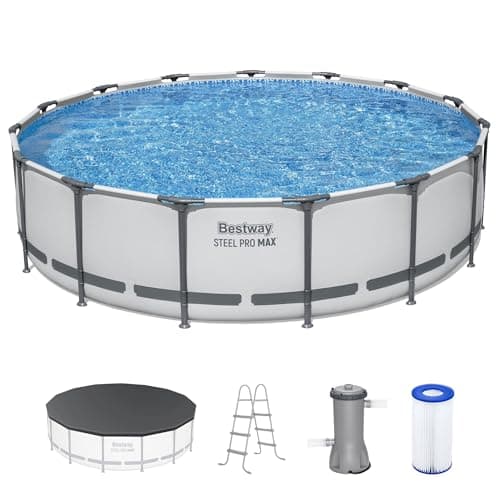
Bestway Steel Pro MAX Pool Set, 15ft x 42in
Bestway
Fewer gallons and a shallower wall than the Intex flagship, which makes it easier to level, cheaper to fill and cheaper to keep clean. For most first-pool families this is the right size, not the compromise size.
#ad how this is funded · price as of October 19, 2026
Key specs
- Water capacity
- 3,955 gallons (90% full)
- Pump supplied
- 1,000 gal filter pump, Type III cartridge
- Liner
- Tritech 3-layer
- Included
- Ladder and cover
- Wall height
- 42 inches
- Pump wattage
- Not published by Bestway (US listing)
How it scoresour reading of published specs, not a test result
- Build
- 7.5
- Setup
- 8.0
- Upkeep
- 8.0
- Running cost
- 7.5
- Value
- 8.8
Overall 8.2 / 10
What works
- 3,955 gallons is roughly 43% less water than the 18ft Intex — that is 43% less chemical spend, every season, forever
- 42-inch wall is far more forgiving of a yard that is nearly-but-not-quite level
- Ladder and cover included
- Cartridge filtration means no sand to buy or change
What doesn't
- Cartridges are a recurring consumable, and in a busy pool you will rinse one weekly
- 42 inches is shallow for adults who want to actually swim rather than sit
- Wattage is not published, so the running-cost math needs the label on the box
Skip it if: Adults who want to swim lengths. At 42 inches you are sitting in it, not swimming in it.
What it costs to run: The gallons are the story. Chemical dosing scales with volume, so 3,955 gallons costs meaningfully less to sanitize all season than 6,981 does. Filling it once at the EPA WaterSense national average of $6.06 per 1,000 gallons is about $24 of water; the same fill on the 18ft Intex is about $42.
Several seasons: Buy-once. Built and warranted to come back out of the box for a few years, if you store it properly.
Specs from: Bestway USA — Steel Pro MAX 15' x 42' pool set, EPA WaterSense — how the calculator works ($6.06 per 1,000 gallons)
Extending the season, at a price
Electric Above-Ground Pool Heater
Various
It works, and it will be the largest line on your pool electricity bill by a distance. Buy it knowing the running cost, not the purchase price.
Key specs
- Power draw
- Published in kW — this is the number that matters, not the price
- Circuit requirement
- Frequently needs a dedicated circuit — check before buying
- Rated pool size
- Published per model
How it scoresour reading of published specs, not a test result
- Build
- 7.0
- Running cost
- 2.5
- Value
- 5.0
Overall 6.0 / 10
What works
- Genuinely extends a swim season by weeks at each end
- Electric units are simpler to install than gas and need no fuel supply
- Manufacturers do publish kW draw, unlike pump makers
What doesn't
- The running cost dwarfs every other item on this site
- Often needs electrical work, which is a cost nobody quotes you up front
- Almost pointless without a solar cover to hold the heat you paid for
Skip it if: An uncovered pool. Heating water and then letting it evaporate overnight is the most expensive thing you can do with a pool.
What it costs to run: Do this arithmetic first. A 3 kW heater running 6 hours a day for 30 days is 540 kWh; at the EIA's June 2026 US residential average of 18.34 cents per kWh that is about $99 for one month. Compare that to the cost of a solar cover, which is a one-time purchase, before you decide.
More than you need yet: Real capability a first-pool family cannot use yet. Buy cheaper and put the difference toward chemicals and a cover.
Specs from: EIA Electric Power Monthly, Table 5.6.A
The single highest-return accessory here
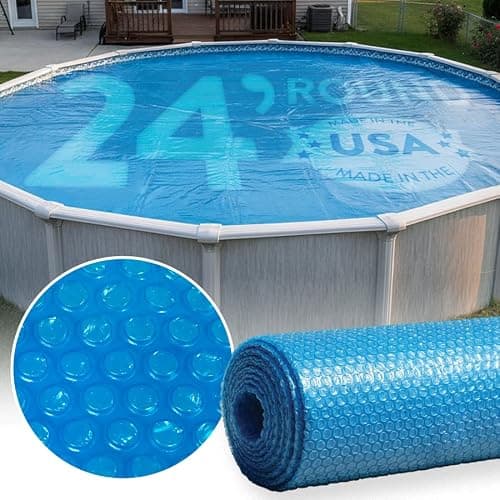
Bubble Solar Cover for Above-Ground Pools
Various
It cuts evaporation, and evaporation is simultaneously your water bill, your chemical bill and your heat loss. Nothing else on this site reduces three costs at once.
#ad how this is funded · price as of October 19, 2026
Key specs
- Construction
- Bubble sheet, thickness published in mil
- Thickness
- Higher mil lasts longer — 12 mil and 16 mil are common
- Fit
- Cut to size; buy oversize and trim
- Orientation
- Bubbles face down, toward the water
How it scoresour reading of published specs, not a test result
- Running cost
- 9.8
- Value
- 9.5
Overall 9.0 / 10
What works
- Reduces evaporation, which is the mechanism behind the water, chemical and heat savings all at once
- Cheap relative to everything it saves
- Can be cut to fit any pool shape, so sizing is forgiving
What doesn't
- Awkward to get on and off without a reel, and awkward is how covers end up unused
- Degrades in UV like every vinyl product
- Not a safety cover and will not support weight — this is important
Skip it if: Being a safety barrier. A solar cover looks solid and is not; a child or pet on it goes through and under.
What it costs to run: The one accessory with a clear payback. Every gallon that does not evaporate is a gallon you do not replace at the EPA WaterSense national average of $6.06 per 1,000 gallons, and it is chlorine you do not re-dose. If you buy one thing from this hub, buy this.
Several seasons: Buy-once. Built and warranted to come back out of the box for a few years, if you store it properly.
Specs from: EPA WaterSense — cost per 1,000 gallons
Questions people actually ask
Is an above-ground pool cheaper than an inground pool?
Can you swim laps in an above-ground pool?
Does an above-ground pool ruin your yard?
Sources
Read next
- Above-ground pools for ordinary backyardsSoft-side, metal-frame and steel-wall pools compared by what they cost across a whole season, not at the till.
- The best above-ground pools for an ordinary backyardFrame pools ranked on published specs and season running cost, from a 1,700-gallon first pool to a 7,000-gallon family one.
- Are backyard pools worth it?The four questions that decide whether a pool is a good buy for your household - argued honestly in both directions.
- What an above-ground pool actually costs to run for a yearElectricity, chemicals, water and consumables for a full season - every input sourced, every calculation shown, and every assumption named.
- What size pool your backyard can actually takeThe three-foot rule, the level-ground tolerance, and a table matching yard size to pool size with the running cost attached.