Pool Care & Chemistry
Pool enzymes: buy the one that publishes a dose rate
Enzymes handle the oils and organics chlorine is bad at - the waterline ring, the scum, the greasy feel after a party. They are not sanitizer, and only some of them tell you how much to use.
Heads up: we earn a commission if you buy through the links on this page, at no extra cost to you. It never decides the ranking — here is how we pick and here is the full disclosure. Prices are checked automatically; last verified October 8, 2026.
Quick picks
Segmented before it is ranked — the right answer depends on which of these you actually are. Tap any row for the full write-up.
If the waterline ring keeps coming back
The only one here that publishes an initial dose banded by actual phosphate reading, a weekly rate per gallon and a 48-hour ceiling.
| # | Product | Best for | Score | Price |
|---|---|---|---|---|
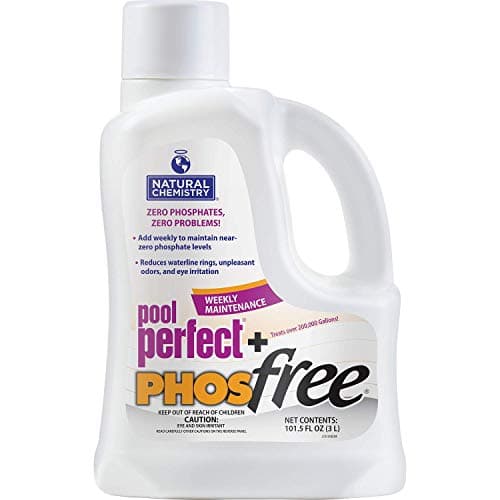
| 1 | Natural Chemistry Pool Perfect + PHOSfree, 3 Liter The enzyme product that publishes real numbers: a weekly dose per gallon, an initial dose banded by phosphate reading, and a 48-hour ceiling. It handles oils and phosphates, not germs. | A waterline ring that keeps coming backOne honest season | 8.2out of 10 |
If you are closing the pool in three weeks
A cold-water formula dosed by the whole bottle, aimed at the winter waterline ring you will otherwise meet in April.
| # | Product | Best for | Score | Price |
|---|---|---|---|---|
| 1 | 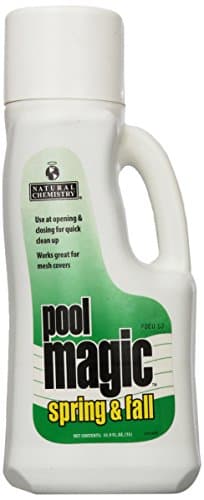 Natural Chemistry Pool Magic Spring & Fall, 1 Liter A cold-water enzyme formula dosed by the whole bottle rather than by the ounce, aimed squarely at the winter waterline ring. One of the few pool chemicals whose job is six months from now. | The bottle you add at closing so opening is easierOne honest season | 8.1out of 10 |
If you just want to try one on a small pool
One bottle, up to 30,000 gallons, published as salt-compatible. The least documented product here and the closest in size to a real above-ground pool.
| # | Product | Best for | Score | Price |
|---|---|---|---|---|
| 1 | 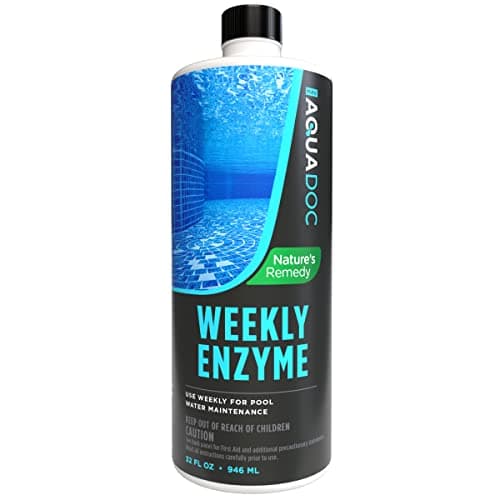 AquaDoc Pool Enzyme Treatment, 32 oz One bottle, up to 30,000 gallons, published as compatible with chlorine, bromine and salt. The least documented product here, and the one sized closest to an above-ground pool. | A single opening dose on a small poolA few weekends | 7.4out of 10 |
The short version
- Enzymes are for oils, not germs. They handle the waterline ring and the greasy feel; chlorine still has to be right.
- A published dose rate is the buying criterion. Two of these three publish one. The third publishes only a pool size, so you cannot price a season.
- The maker publishes its own prerequisites. Algae first, chlorine under 5 ppm before testing phosphates — worth reading as instructions, not fine print.
- One bottle really can be a season. At 1 oz per 2,000 gallons, a 3 L bottle runs a 10,000 gallon pool about twenty weeks.
What an enzyme is actually for
Chlorine is excellent at killing things and mediocre at dissolving things. The stuff people bring into a pool — sunscreen, body oil, hair product, the residue off a dozen pairs of hands — is non-living organic material, and chlorine deals with it by slowly oxidising it, consuming itself in the process. That consumption is a real chunk of why chlorine demand spikes after a busy weekend, which our swimmer load page quantifies.
An enzyme product attacks the same material directly. The visible results are the waterline ring not coming back, the filter staying cleaner for longer, and water that does not feel slick after a party. The invisible result is chlorine being spent on germs rather than on sunscreen.
The specification that separates these
Enzyme products are sold on adjectives. “Broad spectrum”, “natural”, “soft and silky water” — none of which can be checked. The one thing that can be checked is whether the maker publishes how much to use, because that is what lets you work out what a season costs.
| Product | Published dose | Published pool size | Season cost calculable? |
|---|---|---|---|
| Pool Perfect + PHOSfree, 3 L | 1 oz per 2,000 gal weekly | n/a - dosed by rate | Yes |
| Pool Magic Spring & Fall, 1 L | Entire bottle per 25,000 gal, twice a year | 25,000 gal | Yes |
| AquaDoc Pool Enzyme, 32 oz | Not published per gallon | Up to 30,000 gal | No |
What a season of the best-documented one actually costs to run
- Published weekly rate
- 1 oz per 2,000 gal
- A typical 15 ft above-ground pool
- about 4,400 gal
- Weekly dose for that pool
- about 2.2 oz
- Bottle size
- 3 L, about 101 oz
101 oz ÷ 2.2 oz per week
About 45 weeks of dosing - comfortably more than one season on a 15 ft pool
Note what that does to the price comparison. The 3 L bottle looks like the expensive option next to a 32 oz bottle, and per season on a real above-ground pool it is the cheap one. You can only see that because one maker published a rate.
The prerequisites the maker publishes
The Pool Perfect listing is unusually honest about what has to be true before the product can work, and both conditions are easy to get wrong.
| Published condition | Why it is there |
|---|---|
| "Algae must be treated first, prior to testing and lowering phosphates" | Living algae is holding phosphate; removing it while the bloom is alive measures and treats the wrong thing |
| "Chlorine must be under 5ppm before testing phosphates" | High chlorine interferes with the phosphate test, so the reading you dose from would be wrong |
| No more than 1 L (32 oz) in any 48 hour period | A dosing ceiling, published - the only one in this category we found |
| Filter 8 hours a day for a week, or 48 hours straight, without backwashing | The product works with the filter; backwashing mid-treatment removes what it has gathered |
That last row is the one that catches people on a cartridge-filter pool. The published instruction is to leave the filter alone for the treatment period, which conflicts with the instinct to clean a cartridge that is loading up. Our cartridge guide covers when a rising pressure actually requires attention.
And the first row is why a green pool is not an enzyme problem. If the water is green, the sequence in our algae guide comes first and enzymes come after, when you are cleaning up what the bloom left behind.
The closing bottle is a different product
Pool Magic Spring & Fall is on this page because it is an enzyme, but it belongs to a different job. It is published as a concentrated enzyme formula designed specifically to work in cold water, dosed as the entire bottle per 25,000 gallons at closing and again at opening, with the sanitizer below 5 ppm and no shocking required.
What it is for is the ring you find under the cover in April. Enzymes keep working at temperatures where chlorine has largely stopped, which is the entire argument for a cold-water formulation. The alternative to using it is scrubbing or a stain remover at opening, and our liner stains page is what that looks like when it goes wrong.
Who should skip enzymes entirely
Three situations. A pool nobody is swimming in much, because almost everything an enzyme targets arrives on a person — a lightly used pool does not develop a scum line. A pool where the actual complaint is cloudiness rather than film, which is a clarifier job. And a pool whose chlorine is not yet under control, because an enzyme on top of unresolved sanitizer is spending money on the second problem while the first one is still live.
The clearest case for buying one is the opposite: a pool that gets used by a group, regularly, with sunscreen on. Our pool foam page is often the same underlying issue — organics and surfactants the chlorine has not got through — and it is worth reading first if foam is what you are actually seeing.
The picks, in full
Scores are our own reading of published specifications. They are not test results — we have not tested these products and we do not claim to.
Pick #1 · A waterline ring that keeps coming back
Natural Chemistry Pool Perfect + PHOSfree, 3 Liter
Natural Chemistry
The enzyme product that publishes real numbers: a weekly dose per gallon, an initial dose banded by phosphate reading, and a 48-hour ceiling. It handles oils and phosphates, not germs.
Key specs
- Volume
- 3 liter, published
- Active approach
- Published as "broad spectrum enzymes" plus a phosphate remover
- Weekly dose
- 1 oz per 2,000 gallons, published
- Initial dose
- 0.5 L per 10,000 gal at 300 ppb phosphate or less; 1 L at 600 ppb; 1.5 L at 900 ppb, published
- Dose ceiling
- No more than 1 L (32 oz) in any 48 hour period, published
- Application
- Added to the skimmer with the filter running, published
- Prerequisite
- Maker says algae must be treated first, and chlorine must be under 5 ppm before testing phosphates
How it scoresour reading of published specs, not a test result
- Effectiveness
- 8.0
- Ease
- 9.0
- Water impact
- 8.5
- Cost per season
- 7.5
- Value
- 8.0
Overall 8.2 / 10
What works
- Publishes a dose per gallon, an initial dose banded by actual reading, and a maximum rate — rare in this category
- Targets the two things chlorine is bad at: non-living organics and phosphates
- A 3 L bottle at 1 oz per 2,000 gallons is a whole season for a 10,000 gallon pool with room to spare
- The maker publishes its own prerequisites rather than selling it as a cure-all
What doesn't
- Not a sanitizer and does not claim to be — chlorine still has to be right
- The phosphate half only earns its place if you have actually measured phosphates
- Published as needing the filter run 8 hours a day for a week, or 48 hours straight, without backwashing
- Soft, silky water is a feel claim, not a measurement
Skip it if: Rescuing a green pool. The maker is explicit that algae has to be dealt with first; enzymes work on the oils and organics left behind, not on a bloom.
What it costs to run: At the published 1 oz per 2,000 gallons, a 10,000 gallon pool uses 5 oz a week. A 3 L bottle is about 101 oz, so roughly 20 weeks — one season, one bottle, and that is the figure to price it on.
One honest season: The cheapest setup that genuinely works for a season of real swimming. Nothing spare, nothing missing.
Specs from: Royal Swimming Pools — Natural Chemistry Pool Perfect + PHOSfree 3 L, published claims and dosing
Pick #2 · The bottle you add at closing so opening is easier
Natural Chemistry Pool Magic Spring & Fall, 1 Liter
Natural Chemistry
A cold-water enzyme formula dosed by the whole bottle rather than by the ounce, aimed squarely at the winter waterline ring. One of the few pool chemicals whose job is six months from now.
#ad how this is funded · price as of October 8, 2026
Key specs
- Volume
- 1 liter, published
- Dose
- Entire bottle per 25,000 gallons, published
- When
- At closing and again at opening, published
- Formulation
- Published as a concentrated enzyme formula designed to work in cold water
- Prerequisite
- Sanitizer must be below 5 ppm before adding, published
- Shocking
- Maker publishes that no shocking is necessary with it
- Appearance
- Published as coffee colored; the over-cap is a 4 oz measure
How it scoresour reading of published specs, not a test result
- Effectiveness
- 7.5
- Ease
- 9.5
- Water impact
- 8.5
- Cost per season
- 8.0
- Value
- 7.5
Overall 8.1 / 10
What works
- Dosed by the bottle, so there is nothing to get wrong at the end of a long closing day
- Explicitly formulated for cold water, which is the stated reason the standard enzyme is not used here
- Targets winter waterline ring, which is the single most common spring complaint on a vinyl pool
- Published as usable at both ends of the season from the same bottle size
What doesn't
- One bottle treats 25,000 gallons, so most above-ground pools are buying more than they need
- Nothing to see for six months, which makes it the easiest purchase to skip and the hardest to evaluate
- Needs sanitizer below 5 ppm, so it does not go in on the same pass as a closing shock
- Does not replace any part of a closing kit
Skip it if: Doing anything about water you can see. This is a preventative added to water you are about to cover up, and it will not clear or clarify anything today.
What it costs to run: Priced against the alternative, which is an acid wash or a season of stain remover in April. Our closing-cost page prices the whole job; this is a line item inside it, not a substitute for it.
One honest season: The cheapest setup that genuinely works for a season of real swimming. Nothing spare, nothing missing.
Specs from: Leslie's — Natural Chemistry Pool Magic Spring and Fall 1 L, published dosing and timing
Pick #3 · A single opening dose on a small pool
AquaDoc Pool Enzyme Treatment, 32 oz
AquaDoc
One bottle, up to 30,000 gallons, published as compatible with chlorine, bromine and salt. The least documented product here, and the one sized closest to an above-ground pool.
#ad how this is funded · price as of October 8, 2026
Key specs
- Volume
- 32 oz, published
- Treats
- Up to 30,000 gallons, published
- Sanitizer compatibility
- Published as working with chlorine, bromine and saltwater systems
- Positioning
- Published as a pool opening chemical and a weekly maintenance product
- Dose rate
- Not published per gallon anywhere we could find
- Pool types
- Published for above-ground and inground
How it scoresour reading of published specs, not a test result
- Effectiveness
- 6.5
- Ease
- 9.0
- Water impact
- 8.0
- Cost per season
- 7.0
- Value
- 7.0
Overall 7.4 / 10
What works
- Explicitly published as salt-system compatible, which matters on the pools this site covers
- Single-bottle dosing for a whole pool, with no reading to take first
- The cheapest way to find out whether enzymes do anything for your water
- Sized for a real above-ground pool rather than a 25,000 gallon inground
What doesn't
- No per-gallon dose rate published, so a partial dose is guesswork
- No enzyme type, concentration or phosphate claim published
- Marketed both as an opening product and a weekly one without publishing different rates for each
- Nothing published about filter run time, which the better-documented enzymes all specify
Skip it if: Being compared. With no published dose rate you cannot work out cost per treatment, which is the only honest way to rank enzyme products against each other.
What it costs to run: Unpriceable per season, which is itself the finding. The two Natural Chemistry bottles on this page publish a rate, so you can calculate a season; this one you can only calculate per bottle.
A few weekends: Fine for a heatwave and a toddler. Treat it as consumable, not as a pool — it will not survive a winter in the yard.
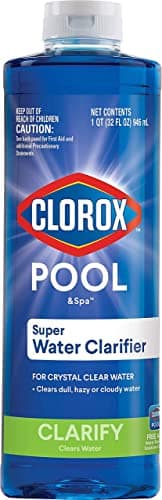
Pick #4 · Cloudy water that is chemically fine
Pool Water Clarifier
Various
Clumps particles too small for your filter into ones it can catch. Genuinely useful for the specific case where your chemistry reads correct and the water is still milky.
Key specs
- Function
- Coagulant — aggregates fine particles for filtration
- Requires
- A running filter; it does nothing on its own
- Typical treatment
- Dose, then run the filter continuously
How it scoresour reading of published specs, not a test result
- Effectiveness
- 7.5
- Ease
- 8.5
- Water impact
- 8.0
- Cost per season
- 8.5
- Value
- 7.5
Overall 7.8 / 10
What works
- Fixes the exact case where chemistry is balanced and the water still will not clear
- Cheap and quick when it is the right tool
- Works with the filter you already have rather than needing a better one
What doesn't
- Does nothing at all if the actual problem is low chlorine or a blocked filter
- Overdosing makes cloudiness worse, which is a genuinely counterintuitive failure
- Loads the filter, so it needs cleaning right after
Skip it if: Being the first thing you reach for. Test the water before you use this — most cloudy pools are a chemistry problem wearing a clarity costume.
What it costs to run: A few dollars a bottle, and worth it only when the decision tree points here. Reaching for clarifier first is how people spend twenty dollars solving a problem that a longer pump run would have fixed for free.
A few weekends: Fine for a heatwave and a toddler. Treat it as consumable, not as a pool — it will not survive a winter in the yard.
Pick #5 · When you need a number, not a color band
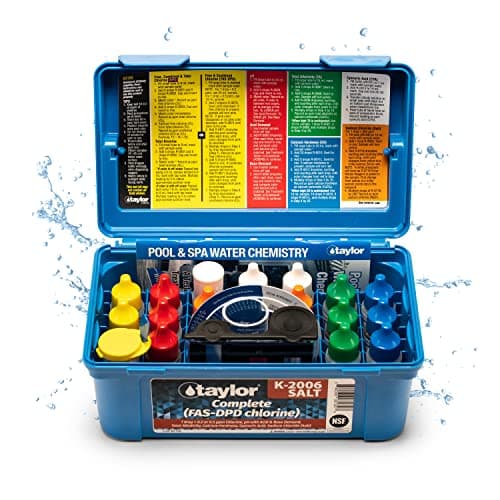
Taylor K-2006 Complete Test Kit (FAS-DPD)
Taylor Technologies
The reference kit. It uses a drop-count titration for free chlorine, which gives you an actual figure rather than a shade of pink. Overkill for a 1,500-gallon pool and indispensable when something has gone properly wrong.
#ad how this is funded · price as of October 8, 2026
Key specs
- Method
- FAS-DPD drop-count titration
- Measures
- Free and combined chlorine, pH, alkalinity, calcium hardness, cyanuric acid
- Resolution
- Reads to 0.2 ppm free chlorine with the standard 10 mL sample
- Format
- Reagent bottles and graduated comparators
How it scoresour reading of published specs, not a test result
- Ease
- 5.5
- Value
- 8.0
Overall 8.3 / 10
What works
- Distinguishes free from combined chlorine, which is the single most useful thing a test can tell you when water smells of chlorine
- Gives a numeric result you can act on precisely rather than a color to interpret
- Reagents are individually replaceable, so the kit is a multi-season purchase
What doesn't
- Considerably more expensive than strips and more of a ritual to use
- Reagents have a shelf life and do expire
- Genuinely more kit than a small seasonal pool needs
Skip it if: Casual weekly checks. If it is a five-minute job you will skip it, and a test you skip is worse than a rough one you actually do.
What it costs to run: The reagents are the running cost, not the kit. For most seasonal above-ground owners this is a second purchase made in year two after a bad algae summer, not a first one.
Several seasons: Buy-once. Built and warranted to come back out of the box for a few years, if you store it properly.
Specs from: Taylor Technologies
Questions people actually ask
Do pool enzymes actually work?
How much pool enzyme do I need?
Can enzymes replace chlorine in a pool?
Should I add enzymes or a clarifier?
Do I need the phosphate remover half?
Sources
Read next
- Pool care, from someone who assumes you have never done thisThe weekly routine, the four numbers that matter, and the fix for the week the water turns.
- Phosphates: real chemistry, and a very effective sales pitchWhat phosphates do, why an adequately chlorinated pool does not care, and the narrow set of cases where a remover earns its money.
- Foam on the water is a report on what went inThe four things that make a pool foam, how to tell them apart, and why anti-foam products hide the cause rather than fixing it.
- Pool clarifiers, and the three cases where one is the wrong answerClarifier, algaecide and shock compared for cloudy water, with the diagnostic that tells you which one your pool actually needs.
- Bather load: the variable that explains your worst weeksWhy gallons per swimmer is the number that matters, what a busy afternoon costs you in chlorine, and the routine that absorbs it.
- Stains on the liner, and the one test that tells you which kindOrganic or metal? The five-minute test that identifies a liner stain, plus what removes each kind and what prevents both.
- Chlorine alternatives, and the ones that are chlorine wearing a hatSalt, mineral systems, UV, ozone and biguanide assessed for a seasonal above-ground pool, with what each actually replaces.
- Pool closing kits: buy one the first year, then stopWhat is in a closing kit, whether the bundle premium is justified, and how to buy separately once you know your water.
- What a season of pool chemicals actually adds up toSeason chemical quantities computed from published dosing for four pool volumes, plus the shopping list that is genuinely necessary.