Pool Costs
Backyard pool or a membership: how to actually compare them
One side of this comparison we can price exactly. The other varies so much by town that anyone quoting you a national figure is making it up - so here is the worksheet instead.
Heads up: we earn a commission if you buy through the links on this page, at no extra cost to you. It never decides the ranking — here is how we pick and here is the full disclosure. Prices are checked automatically; last verified October 8, 2026.
The short version
- We can price the pool exactly and the membership not at all. Season-pass and club pricing varies enormously by town, so we give the worksheet rather than a number we would be inventing.
- The pool is front-loaded, the membership is flat. Which one wins depends almost entirely on how many summers you are comparing.
- Year two of a pool is dramatically cheaper than year one, which is the single biggest thing this comparison usually gets wrong.
- The deciding factors are usually not money. Travel time, supervision, depth and who the pool is actually for beat the arithmetic more often than not.
The side we can compute
Owning a seasonal above-ground pool resolves into a one-off spend and a set of recurring lines, all of which are computable from published figures. Our annual cost-to-run guide does the full worksheet; here is the shape of it for a mid-size pool.
The recurring side of owning a 3,955-gallon pool
- One fill [EPA WaterSense]
- 3.955 kgal × $6.06 = $23.96
- Pump electricity, 300 W, 8 h/day, 120 days [EIA]
- 288 kWh × $0.1834 = $52.82
- Chlorine tablets [Clorox Pool&Spa]
- ≈ 14 for a 17-week season
water $23.96 + electricity $52.82 + ≈14 tablets + shock + cartridges
Under $80 of computable cost, plus consumables priced at your own shelf
What is not on that list is the pool itself, plus the ladder, cover, ground cloth and testing kit — the one-off spend that lands entirely in year one. That asymmetry is the whole comparison, and it is why comparing “first year of a pool” against “one season pass” produces a misleading answer.
The side you have to fill in
Community pool passes, municipal season tickets and swim club memberships vary by an enormous factor between towns, between residents and non-residents, and between a family rate and individual tickets. There is no honest national figure and we are not going to print one. Instead, four numbers you can get in one phone call or one web page:
| Line | Where to get it | Note |
|---|---|---|
| Family season pass | Your municipal or club website | Check resident vs non-resident rates |
| Or: per-visit cost × visits | Same source | Only cheaper if you go rarely |
| Travel, per trip | Your own mileage and time | The line people leave out entirely |
| Extras | Lockers, parking, food, lessons | Consistently underestimated |
Year one is not the comparison
If you compare a single summer, a membership almost always wins, because you are weighing a season of swimming against a purchase plus a season of swimming. The question that matters is what happens in year two, and this is where the two sides diverge sharply.
A membership costs the same again. A pool does not: the pool, the ladder, the ground cloth, the cover, the dispenser and the pump are all already bought, and year two is water, electricity, tablets and cartridges. Our year two guide works through exactly which lines disappear. Run the comparison across three summers rather than one and the shape changes completely.
The corollary is the honest warning: if you are genuinely unsure whether the family will use it, the pool’s advantage never arrives, because it is entirely a function of years two and three. That is the scenario our are they worth it page argues against, and it talks people out of the purchase as often as into it.
What the money comparison misses
Travel and the friction of going. A backyard pool gets used at half past five on a Tuesday for twenty minutes. A pool twenty minutes away does not, and that difference is most of the actual swimming.
Depth. This one goes the other way, and it is the strongest argument for a membership. A community pool is deep enough for adults to swim properly. Almost nothing in this category is — our pools for adults page converts published gallons into real water depth and the answer is roughly 24 to 44 inches depending on what you buy. If adults want lengths rather than a cool-off, the membership is not merely competitive, it is correct.
Supervision. A public pool has lifeguards. A backyard pool has whoever is standing there, and the safety layers are yours to build — barrier, supervision, then flotation. Our permits and rules guide covers the barrier side and the swim vest guide covers the third layer.
Work. A membership has none. A pool is about half an hour a week of testing, brushing and filter maintenance, plus a weekend at each end of the season. Our weekly schedule is the honest version of what that involves. Some people enjoy it. Some genuinely do not, and for them the arithmetic is irrelevant.
The answer that fits most families
If the use case is small children cooling off in the garden on hot afternoons, the pool wins on year two and wins overwhelmingly on convenience, and it does not need to be a big one — our cheapest honest setup is six items and a 12-foot pool. If the use case is adults swimming lengths, or one hot fortnight a year, or a household with no appetite for a weekly routine, the membership is the better buy and there is no shame in the arithmetic saying so.
Plenty of families end up doing both, which is a perfectly rational answer that the comparison format tends to hide.
What to buy
Scores are our own reading of published specifications. They are not test results — we have not tested these products and we do not claim to.
Water in the yard this weekend
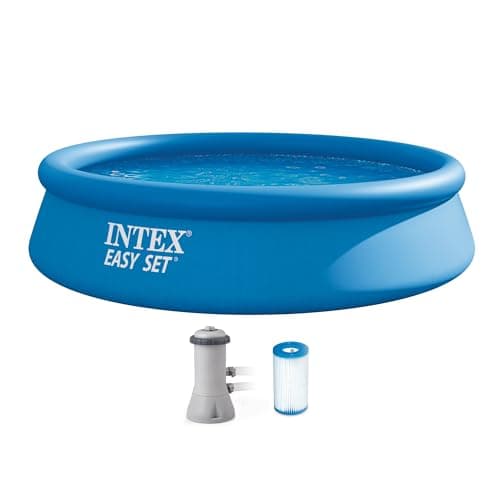
Intex Easy Set Pool Set, 12ft x 30in
Intex
Inflate the ring, add water, done. It is the fastest route from box to swimming that exists, and it is honest about being a seasonal item rather than a fixture.
#ad how this is funded · price as of October 8, 2026
Key specs
- Water capacity
- 1,485 gallons (80% full)
- Water depth
- 23 inches
- Pump supplied
- 530 GPH Krystal Clear cartridge pump
- Material
- 3-ply, puncture resistant
- Manufacturer setup claim
- Ready for water in about 10 minutes
- Pump wattage
- Not published by Intex
How it scoresour reading of published specs, not a test result
- Build
- 5.5
- Setup
- 9.8
- Upkeep
- 8.5
- Running cost
- 9.2
- Value
- 8.8
Overall 8.3 / 10
What works
- Genuinely 10 minutes to set up — the top ring rises with the water and there is no frame to assemble
- 1,485 gallons at 80% is a real, filterable pool rather than a paddling pool
- Comes down as fast as it goes up, which makes mid-season relocation possible
- Cheapest way to find out whether your family actually wants a pool before committing to a frame one
What doesn't
- The inflated ring is the single point of failure and it is exposed to sun all season
- 23 inches of water is shallow — this is for cooling off, not swimming
- Soft walls flex, so it needs level ground as much as a frame pool does
Skip it if: Lasting. Treat this as a two-or-three-season item at best and you will not be disappointed; expect five years and you will be.
What it costs to run: A fill at the EPA WaterSense average of $6.06 per 1,000 gallons is about $9. The 530 GPH pump moves 1,485 gallons in under three hours, so this is a pool where a genuinely short daily run does the job — which is where the running-cost saving actually comes from.
One honest season: The cheapest setup that genuinely works for a season of real swimming. Nothing spare, nothing missing.
Specs from: Intex — Easy Set 12' x 30' pool set, EPA WaterSense — cost per 1,000 gallons
Small yards and first-time owners
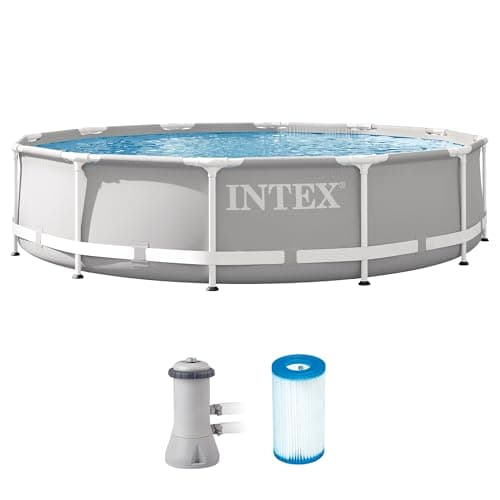
Intex Prism Frame Pool Set, 12ft x 30in
Intex
The size most people should buy first and the one most people talk themselves out of. 1,718 gallons is cheap to fill, cheap to treat, and forgiving of every mistake you are about to make.
Key specs
- Water capacity
- 1,718 gallons
- Pump supplied
- Krystal Clear C530 — 530 GPH pump / 475 GPH system
- Frame
- Powder-coated metal, tool-free Easy Lock
- Liner
- 3-ply, puncture resistant
- Manufacturer setup claim
- Ready in 30 minutes
- Pump wattage
- Not published by Intex
How it scoresour reading of published specs, not a test result
- Build
- 7.0
- Setup
- 9.0
- Upkeep
- 9.0
- Running cost
- 9.0
- Value
- 9.0
Overall 8.6 / 10
What works
- A 12-foot circle fits in a yard where a 15 or 18 will not, once you allow three feet of walking space
- 1,718 gallons turns over in about 3.6 hours on the supplied 475 GPH system flow — so a short daily run genuinely filters it
- Cheapest of the frame pools to make a mistake in: a bad chemical week costs a few dollars, not a few tens
- Tool-free assembly is real, not marketing — this is a genuinely one-afternoon job
What doesn't
- 30-inch wall means shallow water and it warms and cools fast
- Small enough that three adults fill it
- The C530 is sized for exactly this pool and nothing bigger, so it does not carry over if you upgrade
Skip it if: Anyone planning to swim rather than sit. This is a cooling-off and playing pool and it is very good at that.
What it costs to run: The cheapest frame pool here to run, and the gap is not small. At the EPA WaterSense average of $6.06 per 1,000 gallons a fill is about $10. Its turnover math — 1,718 gallons at 475 GPH system flow — means roughly 3.6 hours per full turnover, so a 7-8 hour daily run is two full turnovers rather than a partial one.
One honest season: The cheapest setup that genuinely works for a season of real swimming. Nothing spare, nothing missing.
Specs from: Intex — Prism Frame 12' x 30' pool set, Intex — Krystal Clear cartridge filter pumps
The honest middle of the market
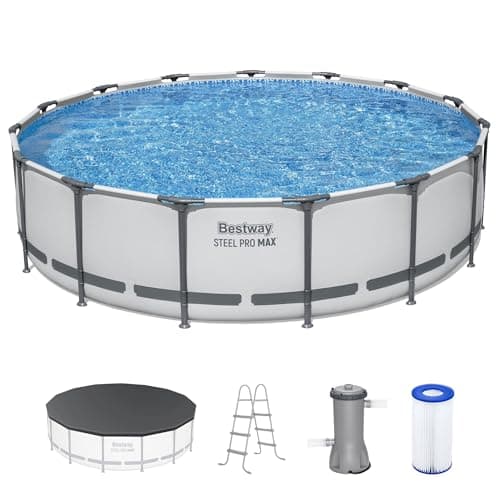
Bestway Steel Pro MAX Pool Set, 15ft x 42in
Bestway
Fewer gallons and a shallower wall than the Intex flagship, which makes it easier to level, cheaper to fill and cheaper to keep clean. For most first-pool families this is the right size, not the compromise size.
#ad how this is funded · price as of October 8, 2026
Key specs
- Water capacity
- 3,955 gallons (90% full)
- Pump supplied
- 1,000 gal filter pump, Type III cartridge
- Liner
- Tritech 3-layer
- Included
- Ladder and cover
- Wall height
- 42 inches
- Pump wattage
- Not published by Bestway (US listing)
How it scoresour reading of published specs, not a test result
- Build
- 7.5
- Setup
- 8.0
- Upkeep
- 8.0
- Running cost
- 7.5
- Value
- 8.8
Overall 8.2 / 10
What works
- 3,955 gallons is roughly 43% less water than the 18ft Intex — that is 43% less chemical spend, every season, forever
- 42-inch wall is far more forgiving of a yard that is nearly-but-not-quite level
- Ladder and cover included
- Cartridge filtration means no sand to buy or change
What doesn't
- Cartridges are a recurring consumable, and in a busy pool you will rinse one weekly
- 42 inches is shallow for adults who want to actually swim rather than sit
- Wattage is not published, so the running-cost math needs the label on the box
Skip it if: Adults who want to swim lengths. At 42 inches you are sitting in it, not swimming in it.
What it costs to run: The gallons are the story. Chemical dosing scales with volume, so 3,955 gallons costs meaningfully less to sanitize all season than 6,981 does. Filling it once at the EPA WaterSense national average of $6.06 per 1,000 gallons is about $24 of water; the same fill on the 18ft Intex is about $42.
Several seasons: Buy-once. Built and warranted to come back out of the box for a few years, if you store it properly.
Specs from: Bestway USA — Steel Pro MAX 15' x 42' pool set, EPA WaterSense — how the calculator works ($6.06 per 1,000 gallons)
The single highest-return accessory here
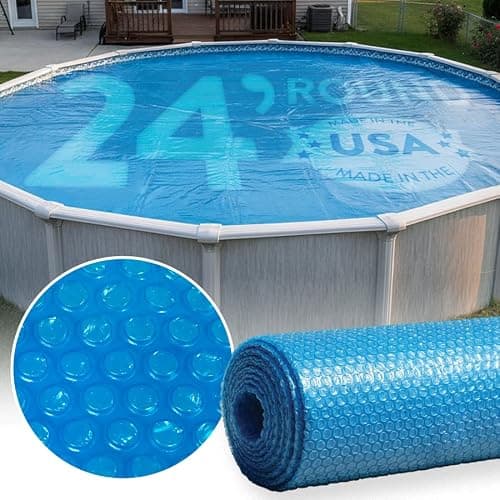
Bubble Solar Cover for Above-Ground Pools
Various
It cuts evaporation, and evaporation is simultaneously your water bill, your chemical bill and your heat loss. Nothing else on this site reduces three costs at once.
#ad how this is funded · price as of October 8, 2026
Key specs
- Construction
- Bubble sheet, thickness published in mil
- Thickness
- Higher mil lasts longer — 12 mil and 16 mil are common
- Fit
- Cut to size; buy oversize and trim
- Orientation
- Bubbles face down, toward the water
How it scoresour reading of published specs, not a test result
- Retention
- 9.0
- Durability
- 7.0
- Handling
- 6.0
- Running cost
- 9.8
- Value
- 9.5
Overall 9.0 / 10
What works
- Reduces evaporation, which is the mechanism behind the water, chemical and heat savings all at once
- Cheap relative to everything it saves
- Can be cut to fit any pool shape, so sizing is forgiving
What doesn't
- Awkward to get on and off without a reel, and awkward is how covers end up unused
- Degrades in UV like every vinyl product
- Not a safety cover and will not support weight — this is important
Skip it if: Being a safety barrier. A solar cover looks solid and is not; a child or pet on it goes through and under.
What it costs to run: The one accessory with a clear payback. Every gallon that does not evaporate is a gallon you do not replace at the EPA WaterSense national average of $6.06 per 1,000 gallons, and it is chlorine you do not re-dose. If you buy one thing from this hub, buy this.
Several seasons: Buy-once. Built and warranted to come back out of the box for a few years, if you store it properly.
Specs from: EPA WaterSense — cost per 1,000 gallons
Questions people actually ask
Is it cheaper to own a pool or join a community pool?
What does a backyard pool cost per year to run?
Why do you not publish community pool membership prices?
Can adults swim properly in an above-ground pool?
Sources
Read next
- What a pool actually costs, with the arithmetic shownPurchase, electricity, chemicals, water and replacement parts - added up, sourced, and shown as arithmetic you can redo.
- What an above-ground pool actually costs to run for a yearElectricity, chemicals, water and consumables for a full season - every input sourced, every calculation shown, and every assumption named.
- Are backyard pools worth it?The four questions that decide whether a pool is a good buy for your household - argued honestly in both directions.
- The cheapest pool setup that actually works for a yearA complete, deliberately minimal first-year setup: the pool, the pump, the testing, the chlorine and the one tool you will use most.
- Year two, and the lines that disappearWhich pool costs are one-off and which recur, with a year-one and year-two comparison for the same pool.
- The best 12-foot pools, and why 12 feet is the sensible sizeFrame and inflatable 12-foot pools side by side, with the fill cost and season chlorine bill computed from published gallons.