Pool Care & Chemistry
Foam on the water is a report on what went in
Clean pool water does not foam. Something in it is reducing the surface tension, and identifying which of four things it is takes about two minutes.
Heads up: we earn a commission if you buy through the links on this page, at no extra cost to you. It never decides the ranking — here is how we pick and here is the full disclosure. Prices are checked automatically; last verified October 8, 2026.
The short version
- Foam means surfactants — something that lowers the surface tension of the water. It is almost always something that was added, deliberately or on a swimsuit.
- Quat algaecides foam by design. Polyquat products are specifically non-foaming, which is one reason they are the sensible default.
- Bubbles at the return jet are not foam. That is air being drawn in upstream of the pump, which is a plumbing problem with a different fix.
- Anti-foam is cosmetic. It knocks the foam down and leaves the cause in the water, which is fine as a party trick and useless as a solution.
First, decide whether it is actually foam
Two different things get described the same way and they have nothing in common.
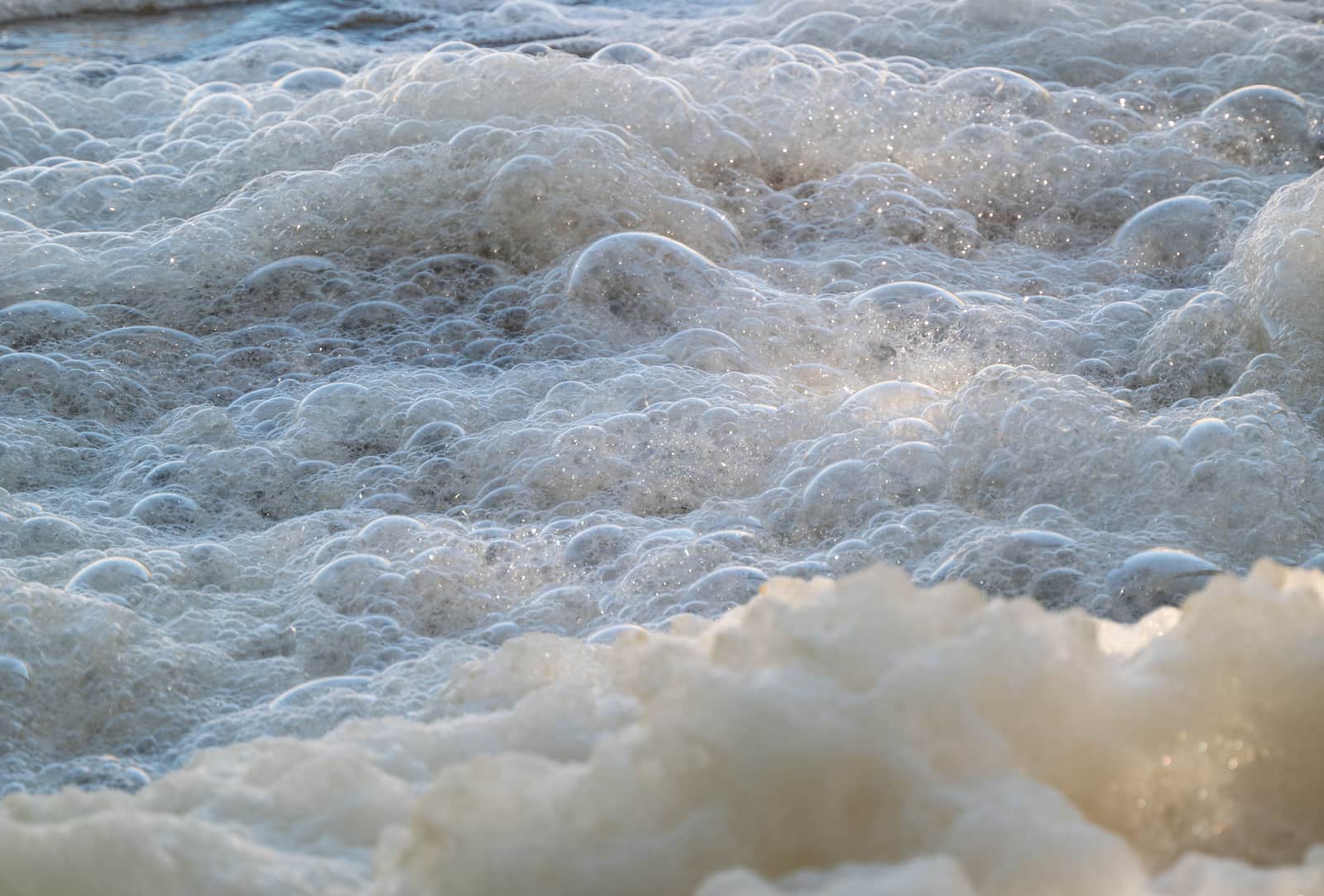
Foam is a persistent white head that sits on the surface, drifts to the downwind side, and stays there when the pump is off. It is a chemistry symptom.
Bubbles come out of the return jet, rise and pop within seconds, and stop when the pump stops. That is air being pulled into the system on the suction side — a water level below the middle of the skimmer opening, a loose hose fitting, or a dry O-ring on the strainer lid. Our pump troubleshooting guide has the sequence, and none of this page applies.
| Observation | Foam | Air in the system |
|---|---|---|
| Where it appears | All over, drifts downwind | At the return jet |
| When the pump stops | Stays | Stops within a minute |
| Texture | Persistent white head | Individual bubbles that pop |
| Fix lives in | Chemistry and what went in | The suction side of the plumbing |
The four causes of real foam
1. A quat algaecide. This is the most common single cause and the most preventable. Quaternary ammonium algaecides foam as a property of the chemistry, and overdosing makes it worse. Polyquat products are non-foaming, which is precisely why we treat polyquat as the default for a vinyl-lined seasonal pool — see our clarifier and algaecide guide. If the foam appeared within a day of dosing an algaecide, you have your answer.
2. Soaps and detergents on swimwear. Costumes washed in detergent and not rinsed thoroughly carry surfactant into the pool every single time. On a small pool with several swimmers this is enough on its own, and it is why the problem often appears at the start of a season when everything has just come out of the wash.
3. Body products. Sunscreen, hair conditioner, lotions and hair spray all reduce surface tension. This scales directly with how many people are in the water, which is the same mechanism our swimmer load guide covers for chlorine demand.
4. Very soft water with heavy agitation. Water low in dissolved minerals foams more readily than hard water. On a seasonal vinyl pool this is rarely the primary cause — and low hardness is not otherwise a problem on a vinyl liner, as our calcium hardness guide explains — but it can make one of the other three worse.
What to actually do
Skim the foam off physically
It is on the surface, which is the easiest place in the pool to remove something from. A net takes most of it in a couple of passes and removes the surfactant along with it rather than dispersing it.Stop adding whatever you last added
Particularly algaecide. If you dosed a quat product, do not dose again to “get on top of it” — you are adding more of the cause. Switch to a non-foaming polyquat for future prevention.Test, because foam often travels with something else
Free chlorine, pH and total alkalinity at minimum. Heavy bather load produces foam and chlorine demand at the same time, so the foam is frequently the visible half of a sanitizer problem. Our test kit roundup covers what to use.Run the filter and deal with the cartridge
Surfactants and the organic load that came with them end up in the media. Run the pump continuously while you are clearing this, and expect to rinse or replace the cartridge afterwards — Intex guidance is roughly every two weeks in heavy use anyway.Shock at dusk if the load was people rather than product
A busy weekend produces foam, chloramines and a depressed free chlorine reading together. Shock in the evening with the pump running, because sunlight destroys unstabilized chlorine quickly. Our shock guide covers dosing.Dilute, if it is persistent and cheap to do
On a seasonal above-ground pool, replacing a portion of the water is a genuinely cheap reset — about $8 of water for a third of a 3,955-gallon pool at the national average. It removes whatever is in solution rather than treating it. Our cost-to-fill guide has the arithmetic.
Why we do not recommend anti-foam
Anti-foam products work, in the narrow sense that they collapse the foam. What they do not do is remove the surfactant, so the water is in exactly the same state afterwards with an extra additive in it. If the foam was the visible symptom of a heavy bather load, you have hidden your only warning sign.
There is one honest use: you have people coming in an hour and you want the pool to look right. That is a legitimate reason and it is worth knowing the product exists. It is not a treatment, and dosing it repeatedly through a season means you never dealt with the cause.
Preventing it
Rinse swimwear in plain water rather than washing it in detergent, or at least rinse it thoroughly afterwards. Ask people to shower or rinse before getting in, which also reduces chlorine demand and the chloramine smell our chlorine smell guide covers. Use a polyquat algaecide rather than a quat one, and dose it as prevention at the label rate rather than as a cure at whatever seems like enough. And skim daily, because everything on the surface is easier to remove than anything in the water.
What to buy
Scores are our own reading of published specifications. They are not test results — we have not tested these products and we do not claim to.
Preventing algae, not curing it
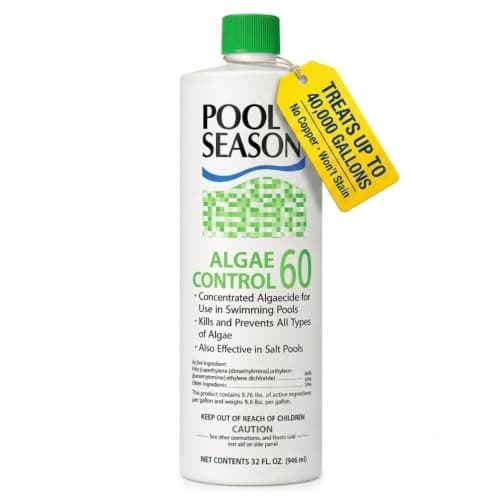
Pool Algaecide (polyquat 60)
Various
Polyquat is the non-foaming, non-staining choice and it is far better at stopping algae than at killing an established bloom. Use it as insurance and as part of closing.
Key specs
- Type
- Polyquaternium (polyquat 60)
- Foaming
- Non-foaming, unlike quat algaecides
- Metal content
- None, unlike copper-based algaecides
How it scoresour reading of published specs, not a test result
- Effectiveness
- 7.5
- Ease
- 9.0
- Water impact
- 9.0
- Cost per season
- 7.5
- Value
- 8.0
Overall 8.0 / 10
What works
- Does not foam, which the cheaper quat products do
- No copper, so no risk of the metal staining a vinyl liner
- The standard product in a winterizing routine, for good reason
What doesn't
- Poor at killing an established bloom — shock does that job
- More expensive than copper-based alternatives
- Easy to over-rely on instead of maintaining chlorine
Skip it if: Rescuing a green pool. Brush and shock first; algaecide is what stops it coming back.
What it costs to run: One of the few chemicals where buying the better version is clearly right — a copper algaecide that stains a liner costs vastly more than the few dollars it saved.
One honest season: The cheapest setup that genuinely works for a season of real swimming. Nothing spare, nothing missing.
The default first test kit
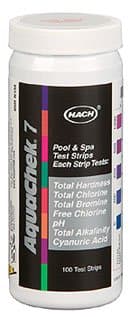
AquaChek Silver 7-Way Test Strips (100 count)
AquaChek
Seven readings in fifteen seconds, including the two that beginners never measure and then fight all summer: total alkalinity and cyanuric acid.
#ad how this is funded · price as of October 8, 2026
Key specs
- Tests
- Free chlorine, total chlorine, bromine, pH, total alkalinity, total hardness, cyanuric acid
- Free chlorine range
- 0-20 ppm
- pH range
- 6.2-8.4
- Total alkalinity range
- 0-240 ppm
- Cyanuric acid range
- 0-300 ppm
- Read time
- 15 seconds
- Count
- 100 strips
How it scoresour reading of published specs, not a test result
- Accuracy
- 7.0
- Ease
- 9.5
- Coverage
- 9.5
- Cost per use
- 9.0
- Value
- 9.2
Overall 8.9 / 10
What works
- Covers cyanuric acid, which most cheap strips omit and which is the reason chlorine stops working in a stabilized pool
- pH range spans 6.2-8.4, comfortably bracketing the CDC's recommended 7.0-7.8
- 15 seconds and a color chart printed on the bottle — no separate booklet to lose
- 100 strips is a full season of twice-weekly testing with room to spare
What doesn't
- Strips are a comparison against a printed color chart, so they are directional rather than precise
- Reading them in bright sun is harder than it should be
- The bottle must be kept sealed and dry or the strips degrade quietly
Skip it if: Fine adjustment. If you are chasing a stubborn problem and need a number rather than a color band, a liquid reagent kit is the tool.
What it costs to run: 100 strips at twice-weekly testing covers roughly two seasons for one pool. The real saving is upstream: knowing your alkalinity stops you buying pH adjuster you did not need.
One honest season: The cheapest setup that genuinely works for a season of real swimming. Nothing spare, nothing missing.
Specs from: CDC — home pool and hot tub water treatment and testing
Actually clearing a green pool
Calcium Hypochlorite Pool Shock
Various (compare available chlorine %)
Unstabilized, fast-acting and strong. This is the tool for an algae bloom precisely because it does not add more cyanuric acid to a pool that probably already has too much.
Key specs
- Type
- Calcium hypochlorite, unstabilized
- Adds stabilizer
- No
- Adds
- Calcium hardness
- Dosing
- By pool volume, per the bag
How it scoresour reading of published specs, not a test result
- Effectiveness
- 9.5
- Ease
- 6.5
- Water impact
- 7.0
- Cost per season
- 9.0
- Value
- 8.8
Overall 8.6 / 10
What works
- No cyanuric acid added, so it does not worsen the problem it is usually solving
- Fast and strong enough to actually break an algae bloom in one treatment when dosed properly
- Cheap per pound of available chlorine
What doesn't
- Adds calcium hardness, which matters in hard-water areas
- Must be dissolved properly or it will bleach a vinyl liner where it settles
- Needs careful storage — it is a genuine oxidizer, not a household product
Skip it if: Routine daily chlorination. This is the emergency tool; tablets are the routine.
What it costs to run: The single most cost-effective way to fix a green pool, and the most commonly under-dosed. Half a dose twice does not equal a full dose once — it just wastes the bag.
One honest season: The cheapest setup that genuinely works for a season of real swimming. Nothing spare, nothing missing.
The consumable you will actually buy repeatedly
Type A Replacement Filter Cartridges (multipack)
Various
Buy them in a multipack before you need them. A pool running on an exhausted cartridge is a cloudy pool, and the fix is a two-dollar part you did not have.
Key specs
- Type
- Type A — the most common Intex format
- Replacement interval
- Every 2 weeks in heavy use, per Intex guidance
- Between changes
- Rinse, do not scrub
How it scoresour reading of published specs, not a test result
- Sizing fit
- 9.0
- Running cost
- 7.0
- Maintenance
- 8.5
- Build
- 7.0
- Value
- 8.5
Overall 8.2 / 10
What works
- Type A is the most widely stocked cartridge format in the US
- Multipacks cost a fraction of buying singles
- Having a spare turns a cloudy week into a five-minute fix
What doesn't
- It is a genuine recurring cost that nobody includes in the purchase price
- Aftermarket quality varies noticeably
- Rinsing extends life but does not restore a cartridge that is done
Skip it if: Being restored. Once the pleats are permanently gray and stiff, rinsing is not saving it.
What it costs to run: The line item most people leave out of their pool budget. Count how many you use in your first season and you have your real annual filtration cost — this is exactly the number the cost-to-run guide asks you to record.
One honest season: The cheapest setup that genuinely works for a season of real swimming. Nothing spare, nothing missing.
Cloudy water that is chemically fine
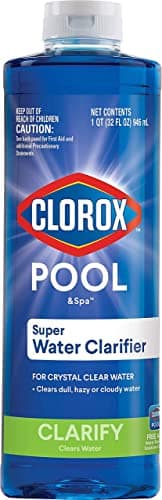
Pool Water Clarifier
Various
Clumps particles too small for your filter into ones it can catch. Genuinely useful for the specific case where your chemistry reads correct and the water is still milky.
Key specs
- Function
- Coagulant — aggregates fine particles for filtration
- Requires
- A running filter; it does nothing on its own
- Typical treatment
- Dose, then run the filter continuously
How it scoresour reading of published specs, not a test result
- Effectiveness
- 7.5
- Ease
- 8.5
- Water impact
- 8.0
- Cost per season
- 8.5
- Value
- 7.5
Overall 7.8 / 10
What works
- Fixes the exact case where chemistry is balanced and the water still will not clear
- Cheap and quick when it is the right tool
- Works with the filter you already have rather than needing a better one
What doesn't
- Does nothing at all if the actual problem is low chlorine or a blocked filter
- Overdosing makes cloudiness worse, which is a genuinely counterintuitive failure
- Loads the filter, so it needs cleaning right after
Skip it if: Being the first thing you reach for. Test the water before you use this — most cloudy pools are a chemistry problem wearing a clarity costume.
What it costs to run: A few dollars a bottle, and worth it only when the decision tree points here. Reaching for clarifier first is how people spend twenty dollars solving a problem that a longer pump run would have fixed for free.
A few weekends: Fine for a heatwave and a toddler. Treat it as consumable, not as a pool — it will not survive a winter in the yard.
Questions people actually ask
Why is my pool foaming?
Is pool foam dangerous?
Does algaecide cause pool foam?
Should I use an anti-foam product?
Sources
Read next
- Pool care, from someone who assumes you have never done thisThe weekly routine, the four numbers that matter, and the fix for the week the water turns.
- Pool clarifiers, and the three cases where one is the wrong answerClarifier, algaecide and shock compared for cloudy water, with the diagnostic that tells you which one your pool actually needs.
- Pool algae: brush, shock, filter, then rebalanceThe correct order for clearing green water, how to tell algae from pollen, and why algaecide prevents rather than cures.
- Cloudy pool water: work out which of four problems you haveA diagnostic decision tree for cloudy water - four causes, how to tell them apart, and the correct fix for each.
- Bather load: the variable that explains your worst weeksWhy gallons per swimmer is the number that matters, what a busy afternoon costs you in chlorine, and the routine that absorbs it.
- Pool pump problems, diagnosed in the cheapest orderThe five-check diagnostic sequence for an above-ground pool pump, from free fixes to the point at which it is genuinely the motor.
- Filter cartridges: the consumable nobody budgets forThe replacement interval, the rinse-versus-scrub question, and how the cartridge treadmill compares with a sand filter across a season.