Pool Care & Chemistry
Small children and pool water, without the scare stories
Three things genuinely matter and the rest is noise. The trouble is that the three are not the ones people worry about.

Heads up: we earn a commission if you buy through the links on this page, at no extra cost to you. It never decides the ranking — here is how we pick and here is the full disclosure. Prices are checked automatically; last verified October 8, 2026.
The short version
- Chlorine is not instant. Sanitizer needs contact time, which is why keeping a level continuously matters more than any single dose.
- Swim diapers contain solids, not liquids, and they are not waterproof. They buy you time to notice, not immunity.
- Teach children not to swallow the water. It is the single most effective habit and it is free.
- Drowning risk dwarfs water quality risk. A barrier and a dedicated water watcher matter more than anything on this page.
Keeping the ranking straight
Before the hygiene detail, the proportion has to be right, because it is easy to spend an afternoon researching water chemistry and none on the thing that actually poses the risk. The Consumer Product Safety Commission frames pool safety around layers of protection — a barrier that prevents unsupervised access, an adult whose only job is watching, and appropriate flotation.
On an above-ground pool the wall is the barrier and the ladder is the gap in it, which is why a removable or lockable ladder is the most useful safety purchase in this hub — see our ladder guide. Approved flotation for a weak swimmer is a separate purchase from a pool toy that looks like one, which our swim vest guide covers. Water quality comes after both.
What chlorine does and does not do
Chlorine is a disinfectant, not a force field. It needs contact time to inactivate what enters the water, and how much time depends on what it is dealing with and on how much free chlorine is actually available.
That has one clear practical implication: a pool that holds a steady level all week is doing far more than one that spikes on Saturday and drifts to nothing by Wednesday. This is why we keep returning to the floating dispenser — published trichlor dosing is two three-inch tablets a week per 10,000 gallons, and a dispenser delivers that steadily rather than in a burst.
The CDC publishes a minimum of at least 1 ppm free chlorine for pools, and at least 2 ppm where a stabilizer such as trichlor is in use, with pH between 7.2 and 7.8. pH matters more than people expect here, because chlorine loses effectiveness as pH rises — a pool with the right chlorine reading and the wrong pH is not doing what the number suggests. Our pH and alkalinity guide covers correcting them in the right order.
Swim diapers, honestly
They are worth using and they are widely misunderstood. A swim diaper is designed to contain solids and does not absorb or retain liquid — if it did, it would swell into a sandbag the moment the child got in.
So the realistic expectation is that it buys you containment and time to notice, not isolation. Which points at practical habits rather than product choice: change it before getting in rather than after, take toilet breaks roughly every hour, change away from the pool rather than beside it, and wash hands afterwards.
| Practice | Effect | Cost |
|---|---|---|
| Barrier and a dedicated water watcher | Addresses the dominant risk | Free, plus a ladder |
| Not swallowing pool water | The single most effective hygiene habit | Free |
| Holding free chlorine steadily all week | Sanitizer that is actually working | A dispenser |
| Rinsing off before getting in | Less chlorine demand, cleaner water | Free |
| Hourly toilet breaks, change away from the pool | Fewer incidents to manage | Free |
| Keeping pH in range | Chlorine works as the reading implies | A balancer |
| Buying a stronger sanitizer | Marginal next to the above | Money |
If there is an accident in the pool
It happens, and having a plan means it is a two-hour interruption rather than a panic. Everyone out. Remove as much of the material as possible with a net or a scoop rather than letting it break up — dispersing it is the thing to avoid. Then shock the pool properly, at dusk if you can, with the pump running, and filter continuously afterwards.
Test before anyone goes back in, and change the cartridge afterwards rather than rinsing it. The CDC publishes guidance on responding to contamination incidents in home pools, and it is worth reading once in advance rather than searching for it on the day — our shock guide covers the dosing side.
Skin, eyes and the things people blame on chlorine
Stinging eyes are far more often a pH problem than a chlorine problem. Water outside the published 7.2 to 7.8 range is uncomfortable regardless of the sanitizer level, and correcting total alkalinity first is what makes a pH correction hold.
The strong chlorine smell is the other one. It is chloramines — spent chlorine — and it means the pool needs more sanitizer rather than less, which is the opposite of most people’s instinct. Our chlorine smell guide is the explanation, and with children in a small pool it comes up often, because bather load in a small volume is high. Our swimmer load guide covers that arithmetic.
The weekly rhythm with children in the house
Test twice a week as a baseline and again after any busy afternoon. Skim daily, because everything organic that sinks becomes chlorine demand. Keep the dispenser loaded so the level does not trough mid-week. Rinse children off before they get in. And take the ladder out or lock it whenever the pool is not in use.
Our weekly schedule is the general version; the only thing children change about it is that the testing needs to be responsive to use rather than purely calendar-driven.
What to buy
Scores are our own reading of published specifications. They are not test results — we have not tested these products and we do not claim to.
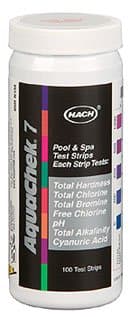
The default first test kit
AquaChek Silver 7-Way Test Strips (100 count)
AquaChek
Seven readings in fifteen seconds, including the two that beginners never measure and then fight all summer: total alkalinity and cyanuric acid.
#ad how this is funded · price as of October 8, 2026
Key specs
- Tests
- Free chlorine, total chlorine, bromine, pH, total alkalinity, total hardness, cyanuric acid
- Free chlorine range
- 0-20 ppm
- pH range
- 6.2-8.4
- Total alkalinity range
- 0-240 ppm
- Cyanuric acid range
- 0-300 ppm
- Read time
- 15 seconds
- Count
- 100 strips
How it scoresour reading of published specs, not a test result
- Accuracy
- 7.0
- Ease
- 9.5
- Coverage
- 9.5
- Cost per use
- 9.0
- Value
- 9.2
Overall 8.9 / 10
What works
- Covers cyanuric acid, which most cheap strips omit and which is the reason chlorine stops working in a stabilized pool
- pH range spans 6.2-8.4, comfortably bracketing the CDC's recommended 7.0-7.8
- 15 seconds and a color chart printed on the bottle — no separate booklet to lose
- 100 strips is a full season of twice-weekly testing with room to spare
What doesn't
- Strips are a comparison against a printed color chart, so they are directional rather than precise
- Reading them in bright sun is harder than it should be
- The bottle must be kept sealed and dry or the strips degrade quietly
Skip it if: Fine adjustment. If you are chasing a stubborn problem and need a number rather than a color band, a liquid reagent kit is the tool.
What it costs to run: 100 strips at twice-weekly testing covers roughly two seasons for one pool. The real saving is upstream: knowing your alkalinity stops you buying pH adjuster you did not need.
One honest season: The cheapest setup that genuinely works for a season of real swimming. Nothing spare, nothing missing.
Specs from: CDC — home pool and hot tub water treatment and testing
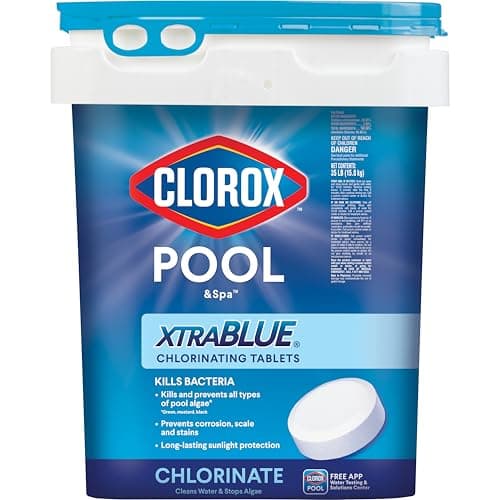
The default chlorine source
Clorox Pool&Spa 3-Inch Chlorinating Tablets
Clorox Pool&Spa
Stabilized trichlor tablets in a floating dispenser is the standard answer for a seasonal above-ground pool, and this is the standard version of it.
#ad how this is funded · price as of October 8, 2026
Key specs
- Type
- Stabilized trichlor, 3-inch tablets
- Contains stabilizer
- Yes — cyanuric acid is part of trichlor
- Dosing
- Per manufacturer instructions, by pool volume
- CDC target
- At least 2 ppm free chlorine when using a stabilizer
How it scoresour reading of published specs, not a test result
- Effectiveness
- 9.0
- Ease
- 9.0
- Water impact
- 6.0
- Cost per season
- 8.5
- Value
- 8.5
Overall 8.5 / 10
What works
- Dissolves slowly, so a floating dispenser meters chlorine out over days rather than hours
- Stabilized, so sunlight does not destroy your chlorine within an afternoon
- Widely stocked, so you are never hunting for it in July
What doesn't
- Every tablet adds cyanuric acid, and in a pool you never fully drain that accumulates until chlorine stops responding
- Trichlor is acidic and will pull your pH down over a season
- Tablets must be kept dry and sealed or they degrade and gas off
Skip it if: A small pool that is topped up rather than drained. Cyanuric acid only leaves with the water, so in a 1,500-gallon pool it climbs fast.
What it costs to run: The standing chemical cost of the season, and it scales directly with gallons. Watch the cyanuric acid reading on your test strip: once it is high, you are buying chlorine that cannot work, which is the most common invisible waste in a first pool year.
One honest season: The cheapest setup that genuinely works for a season of real swimming. Nothing spare, nothing missing.
Specs from: CDC — free chlorine target with cyanuric acid
Actually clearing a green pool
Calcium Hypochlorite Pool Shock
Various (compare available chlorine %)
Unstabilized, fast-acting and strong. This is the tool for an algae bloom precisely because it does not add more cyanuric acid to a pool that probably already has too much.
Key specs
- Type
- Calcium hypochlorite, unstabilized
- Adds stabilizer
- No
- Adds
- Calcium hardness
- Dosing
- By pool volume, per the bag
How it scoresour reading of published specs, not a test result
- Effectiveness
- 9.5
- Ease
- 6.5
- Water impact
- 7.0
- Cost per season
- 9.0
- Value
- 8.8
Overall 8.6 / 10
What works
- No cyanuric acid added, so it does not worsen the problem it is usually solving
- Fast and strong enough to actually break an algae bloom in one treatment when dosed properly
- Cheap per pound of available chlorine
What doesn't
- Adds calcium hardness, which matters in hard-water areas
- Must be dissolved properly or it will bleach a vinyl liner where it settles
- Needs careful storage — it is a genuine oxidizer, not a household product
Skip it if: Routine daily chlorination. This is the emergency tool; tablets are the routine.
What it costs to run: The single most cost-effective way to fix a green pool, and the most commonly under-dosed. Half a dose twice does not equal a full dose once — it just wastes the bag.
One honest season: The cheapest setup that genuinely works for a season of real swimming. Nothing spare, nothing missing.
Small children, with adult supervision
Toddler Swim Vest / Puddle Jumper Style Flotation
Various
If you want flotation for a small child, buy something that is genuinely rated for it rather than an inflatable seat. Look for US Coast Guard approval printed on the product, not a picture of a child on the box.
Key specs
- What to check
- US Coast Guard approval statement, printed on the product
- Weight range
- Printed on the label — match it to the child
- Not a substitute for
- Supervision or a barrier
How it scoresour reading of published specs, not a test result
- Material
- 8.0
- Valve
- 8.0
- Capacity
- 8.5
- Storage
- 8.5
- Value
- 8.5
Overall 8.3 / 10
What works
- A Coast Guard-approved device is a fundamentally different product from a pool toy
- Weight-rated, so there is an objective way to check it fits your child
- Frees a child's arms, which an inflatable ring does not
What doesn't
- Not all products marketed for toddlers carry Coast Guard approval — you have to read the label
- Children outgrow the weight range quickly
- Can create false confidence in both child and adult
Skip it if: Replacing supervision. The CPSC's pool safety guidance is built on layers — barriers, supervision and appropriate flotation — and no single item substitutes for the others.
One honest season: The cheapest setup that genuinely works for a season of real swimming. Nothing spare, nothing missing.
Specs from: CPSC — Pool Safely
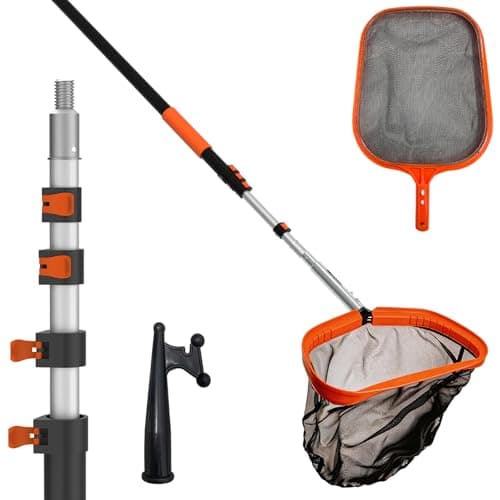
The five-dollar tool you use most
Skimmer Net with Telescopic Pole
Various
Catching leaves while they float is a two-minute job. Catching them after they sink is a vacuum session and a filter clean. Buy this first.
Key specs
- Type
- Flat skimmer or deep leaf rake
- Pole
- Telescopic, sized to reach the middle of your pool
- Frame
- Plastic or aluminum
How it scoresour reading of published specs, not a test result
- Retention
- 8.5
- Durability
- 7.0
- Handling
- 9.0
- Running cost
- 10.0
- Value
- 9.5
Overall 8.8 / 10
What works
- The single most-used tool in pool ownership and among the cheapest
- Removing debris before it sinks prevents most of the work that follows
- A deep leaf rake handles far more per pass than a flat skimmer
What doesn't
- Cheap plastic frames snap where the pole attaches, which is the standard failure
- Telescopic poles seize with hard water unless rinsed
- A too-short pole means you cannot reach the middle, which makes it useless
Skip it if: Anything on the floor. This is a surface tool and pretending otherwise is how debris ends up in the filter.
What it costs to run: Free to use and it directly reduces your chemical bill: organic debris consumes chlorine as it breaks down, so removing leaves is the cheapest sanitizer saving there is.
Several seasons: Buy-once. Built and warranted to come back out of the box for a few years, if you store it properly.
Questions people actually ask
Is it safe for toddlers to swim in a chlorinated pool?
Do swim diapers actually work?
What should I do if there is an accident in the pool?
Why does the pool sting my child's eyes?
Sources
Read next
- Pool care, from someone who assumes you have never done thisThe weekly routine, the four numbers that matter, and the fix for the week the water turns.
- Clear water and safe water are two different thingsWhy a pool can look perfect and be unsanitized, why haze is often harmless, and the four readings that answer the question clarity cannot.
- Bather load: the variable that explains your worst weeksWhy gallons per swimmer is the number that matters, what a busy afternoon costs you in chlorine, and the routine that absorbs it.
- The weekly pool routine, and how little time it really takesThe daily, weekly and monthly jobs written as a schedule, with the kit each one needs and roughly how long it takes.
- Swim vests and floaties: the label that separates them from toysHow to tell an approved flotation device from a pool toy, what the weight range on the label means, and why neither replaces supervision.
- Toddler pool floats: know which of two products you are buyingThe critical distinction between comfort seats and rated flotation, what to check on the label, and why shade is the underrated feature.
- The best backyard pools for kidsPools chosen for young children - depth, shade and securability rank above capacity and construction here.
- Above-ground pool ladders, and the spec everyone skipsWeight capacity, height matching, and removable outer steps - the three things that decide whether a ladder is right.