Floats & Fun · Best Swim Vest
Swim vests and floaties: the label that separates them from toys
Almost everything inflatable in the pool aisle is a toy, including several things shaped exactly like a life jacket. The approval statement printed on the product is the only way to tell.

Heads up: we earn a commission if you buy through the links on this page, at no extra cost to you. It never decides the ranking — here is how we pick and here is the full disclosure. Prices are checked automatically; last verified October 8, 2026.
Quick picks
Segmented before it is ranked — the right answer depends on which of these you actually are. Tap any row for the full write-up.
If you want an approved device
Check the product itself for a US Coast Guard approval statement and a printed weight range. That statement, on the product, is the thing you are buying.
| # | Product | Best for | Score | Price |
|---|---|---|---|---|
| 1 | No image Toddler Swim Vest / Puddle Jumper Style Flotation If you want flotation for a small child, buy something that is genuinely rated for it rather than an inflatable seat. Look for US Coast Guard approval printed on the product, not a picture of a child on the box. | Small children, with adult supervisionOne honest season | 8.3out of 10 |
If you want shade and a seat, not flotation
A canopy float is a comfortable place to put a small child in shallow water with an adult within arm's reach. It is not a safety device and it does not claim to be.
| # | Product | Best for | Score | Price |
|---|---|---|---|---|
| 1 | 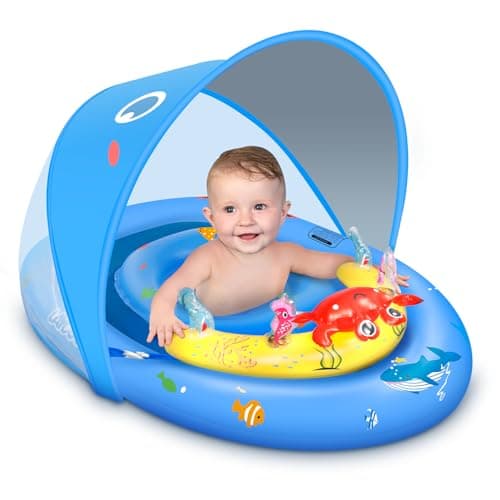 Toddler Pool Float with Canopy For a toddler in a pool, sun exposure is the more likely problem on any given afternoon. A canopy addresses that. It is comfort equipment, not safety equipment, and the distinction matters. | Shade firstA few weekends | 6.8out of 10 |
If you want something for confidence, not for safety
Foam noodles are the cheapest, most durable thing in this hub and they have no air chamber to lose. They are a swimming aid for a supervised child, nothing more.
| # | Product | Best for | Score | Price |
|---|---|---|---|---|
| 1 | No image Foam Pool Noodles (multipack) Closed-cell foam cannot puncture and cannot deflate, which makes a noodle structurally the most durable object in this hub. It is also the cheapest. | The cheapest thing that worksSeveral seasons | 8.0out of 10 |
The short version
- Look for a US Coast Guard approval statement printed on the product. If it is not there, the item is a toy, whatever it is shaped like.
- Match the weight range on the label to the child, not to their age. Age ranges on packaging are marketing; the printed weight range is the spec.
- Nothing here replaces supervision or a barrier. The CPSC campaigns on layers of protection, and a flotation aid is one thin layer among several.
- Inflatable armbands and rings are toys. They can deflate, slip off, or invert a small child, and none of them is a safety device.
The distinction the aisle deliberately blurs
Walk down the pool aisle and you will find, next to each other and at similar prices, things that are safety equipment and things that look like safety equipment. Some of them carry a US Coast Guard approval statement. Most of them do not. The packaging is not going to make the difference obvious, and the shapes are frequently identical.
The rule is simple and worth internalizing before you buy anything on this page: read the product itself, not the box art. An approved device carries an approval statement printed on the garment. A toy carries a warning that it is not a life-saving device, usually in small print, usually on the inside. Both statements are legally required to be there; only one of them is what you want.
| Product type | What it is | What it is not |
|---|---|---|
| USCG-approved vest or jacket | A flotation device with a printed approval statement and weight range | A substitute for supervision |
| Puddle-jumper style aid | A wearable aid — check the specific product for approval | Guaranteed approved just because of the shape |
| Inflatable armbands and rings | Toys that add buoyancy | Safety equipment in any sense |
| Canopy float seat | A shaded seat for a supervised infant in shallow water | A flotation device — it has no rating at all |
| Foam noodles | A durable, cheap swimming aid with no air chamber | Anything a non-swimmer should rely on |
Fit is the spec, and it is printed on the product
Approval means the device performs as intended for a person within the weight range it was approved for. Outside that range, it does not, and a vest that is too large is actively worse than none at all because a child can slip downward inside it. So the number you are matching is weight, printed on the label, against the child in front of you. Age guidance on the packaging is a convenience, not a specification.
Check the fit in the house before the pool. The device should not ride up past the chin when you lift gently at the shoulders. Straps and buckles should all be present and fastened — a correctly sized vest with an unfastened crotch strap behaves like an oversized one.
Why a backyard pool changes the calculation
A public pool has lifeguards. A backyard above-ground pool has whoever is standing there, and the whole point of the CPSC’s layers-of-protection framing is that no single layer is sufficient on its own. The layers that matter for an above-ground pool are, in rough order of effectiveness: a barrier that prevents unsupervised access, an adult whose only job is watching, and then flotation.
Removable or lockable outer steps on a ladder are the most practical barrier most above-ground pools have, and they are cheap. Our ladder guide leads with that feature for exactly this reason. A vest is genuinely useful, but it belongs behind the barrier and the supervision, not in front of them.
What we can and cannot tell you about specific products
We have not tested any of these and we are not a certification body. What we can do is tell you which specification to check and where it is printed, because that is the part that is genuinely decidable from published information. Approval status can vary between SKUs that look identical and share a product family name, so the statement on the item in your hands is the authority — not a roundup, including this one.
The scores below reflect construction and practicality: material, valve type, weight capacity as published, and how the thing stores. They are not safety ratings and must not be read as one. Our methodology page sets out what our scores mean across the site.
Looking after them
Flotation aids fail the same way every other inflatable does — at the seams and at the valve, usually after being stored damp or left in the sun all season. Foam products fail differently and more slowly, by surface crumbling from UV, which is why noodles outlast almost everything else in this hub. Our storage guide covers keeping all of it usable, and how long floats last covers what actually ends them.
A vest protects one child while it is worn, which is a different job from being able to reach someone who is already in difficulty. Our rescue equipment roundup covers the reach pole and throw ring that public pools are required to carry and domestic pools almost never have.
The picks, in full
Scores are our own reading of published specifications. They are not test results — we have not tested these products and we do not claim to.
Pick #1 · Small children, with adult supervision
Toddler Swim Vest / Puddle Jumper Style Flotation
Various
If you want flotation for a small child, buy something that is genuinely rated for it rather than an inflatable seat. Look for US Coast Guard approval printed on the product, not a picture of a child on the box.
Key specs
- What to check
- US Coast Guard approval statement, printed on the product
- Weight range
- Printed on the label — match it to the child
- Not a substitute for
- Supervision or a barrier
How it scoresour reading of published specs, not a test result
- Material
- 8.0
- Valve
- 8.0
- Capacity
- 8.5
- Storage
- 8.5
- Value
- 8.5
Overall 8.3 / 10
What works
- A Coast Guard-approved device is a fundamentally different product from a pool toy
- Weight-rated, so there is an objective way to check it fits your child
- Frees a child's arms, which an inflatable ring does not
What doesn't
- Not all products marketed for toddlers carry Coast Guard approval — you have to read the label
- Children outgrow the weight range quickly
- Can create false confidence in both child and adult
Skip it if: Replacing supervision. The CPSC's pool safety guidance is built on layers — barriers, supervision and appropriate flotation — and no single item substitutes for the others.
One honest season: The cheapest setup that genuinely works for a season of real swimming. Nothing spare, nothing missing.
Specs from: CPSC — Pool Safely
Pick #2 · Shade first
Toddler Pool Float with Canopy
Various
For a toddler in a pool, sun exposure is the more likely problem on any given afternoon. A canopy addresses that. It is comfort equipment, not safety equipment, and the distinction matters.
Key specs
- Type
- Inflatable seat with removable canopy
- Safety rating
- None — this is not a flotation device
- Weight range
- Printed on the product
- Canopy
- Usually removable, often the first part to fail
How it scoresour reading of published specs, not a test result
- Material
- 6.0
- Valve
- 6.5
- Capacity
- 7.0
- Storage
- 8.0
- Value
- 7.0
Overall 6.8 / 10
What works
- Shade is the genuinely useful feature for the age group
- Leg holes keep a small child seated rather than sliding
- Cheap enough to treat as a one-season item, which it is
What doesn't
- Not a life jacket and must never be used as one
- Canopy seams tear well before the float itself does
- Children outgrow it within a single summer
Skip it if: Anything unsupervised, ever. Use it within arm's reach and treat it as furniture rather than safety gear.
A few weekends: Fine for a heatwave and a toddler. Treat it as consumable, not as a pool — it will not survive a winter in the yard.
Specs from: CPSC — Pool Safely
Pick #3 · The cheapest thing that works
Foam Pool Noodles (multipack)
Various
Closed-cell foam cannot puncture and cannot deflate, which makes a noodle structurally the most durable object in this hub. It is also the cheapest.
Key specs
- Material
- Closed-cell polyethylene foam
- Failure mode
- Surface crumbling from UV, not puncture
- Buoyancy
- Inherent — no air chamber to lose
How it scoresour reading of published specs, not a test result
- Material
- 9.0
- Valve
- 10.0
- Capacity
- 5.0
- Storage
- 5.5
- Value
- 9.5
Overall 8.0 / 10
What works
- No air chamber, so no valve to leak and no seam to split
- Survives being stood on, thrown and bitten
- Cheap enough to buy six and not care
What doesn't
- UV eventually makes the surface crumble and shed foam into the pool
- Not a flotation device and should not be treated as one
- Awkward to store because they do not compress
Skip it if: Supporting an adult for any length of time, and absolutely not a safety device for a child.
Several seasons: Buy-once. Built and warranted to come back out of the box for a few years, if you store it properly.
Questions people actually ask
How do I know if a swim vest is Coast Guard approved?
Are puddle jumpers safe for a backyard pool?
Are inflatable armbands safe?
Does a swim vest mean I can stop watching?
Sources
Read next
- Floats, loungers and the stuff that makes the pool worth havingFloats for adults, toddlers and dogs - ranked on seam and valve construction, which is what actually decides how long they last.
- Toddler pool floats: know which of two products you are buyingThe critical distinction between comfort seats and rated flotation, what to check on the label, and why shade is the underrated feature.
- The best pool floatsFloats ranked on material, valve type and published weight capacity - the three specs that decide whether it survives a season.
- How long pool floats last, and why yours did notWhat actually destroys a pool float, the four-step routine that roughly triples its life, and when to patch versus replace.
- The best backyard pools for kidsPools chosen for young children - depth, shade and securability rank above capacity and construction here.
- Above-ground pool ladders, and the spec everyone skipsWeight capacity, height matching, and removable outer steps - the three things that decide whether a ladder is right.
- Noodles or a swim vest: only one of them has a label that means anythingFoam noodles against labeled swim vests for young children: what each is actually designed to do, what to check on the label, and why supervision is the real answer.