Floats & Fun · Best for Toddlers
Toddler pool floats: know which of two products you are buying
An inflatable seat and an approved flotation vest look similar in a listing and are not the same product. This page is mostly about telling them apart.
Heads up: we earn a commission if you buy through the links on this page, at no extra cost to you. It never decides the ranking — here is how we pick and here is the full disclosure. Prices are checked automatically; last verified October 18, 2026.
Quick picks
Segmented before it is ranked — the right answer depends on which of these you actually are. Tap any row for the full write-up.
If the child needs flotation
Buy something rated for it. Look for the US Coast Guard approval statement printed on the product itself, not a picture of a child on the box.
| # | Product | Best for | Score | Price |
|---|---|---|---|---|
| 1 | No image Toddler Swim Vest / Puddle Jumper Style Flotation If you want flotation for a small child, buy something that is genuinely rated for it rather than an inflatable seat. Look for US Coast Guard approval printed on the product, not a picture of a child on the box. | Small children, with adult supervisionOne honest season | 8.3out of 10 |
If the child does not need flotation
Then this is furniture, and shade is the feature that actually matters at this age.
| # | Product | Best for | Score | Price |
|---|---|---|---|---|
| 1 | 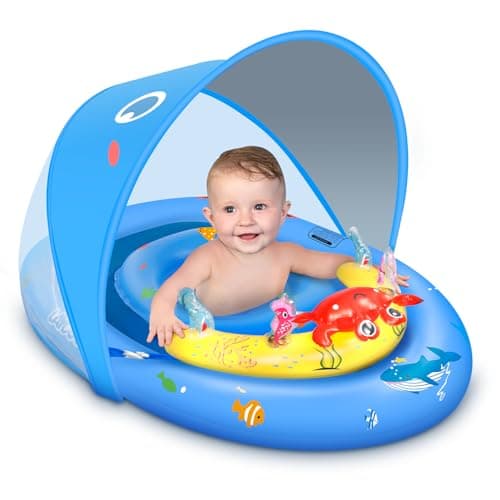 Toddler Pool Float with Canopy For a toddler in a pool, sun exposure is the more likely problem on any given afternoon. A canopy addresses that. It is comfort equipment, not safety equipment, and the distinction matters. | Shade firstA few weekends | 6.8out of 10 | |
| 2 | No image Weighted Dive Toy Set Negatively buoyant rings and sticks that sink and stay put. Cheap, indestructible, and the single best return on money in a pool with children in it. | Keeping kids in the pool for an extra hourSeveral seasons | 8.5out of 10 |
The short version
- Two different products. An inflatable seat is comfort; a Coast Guard-approved vest is flotation. The listings do not always make this obvious.
- Check the product itself, not the packaging. Approval is printed on approved devices.
- Shade is the underrated feature at this age. Sun exposure is the more likely problem on any given afternoon.
- Nothing here replaces supervision or a barrier. The CPSC frames safety as layers, and no product is more than one of them.
The distinction that matters
Walk down the pool aisle and two products look similar: a colorful inflatable seat with leg holes, and a foam-panel vest. They are not variations of one thing.
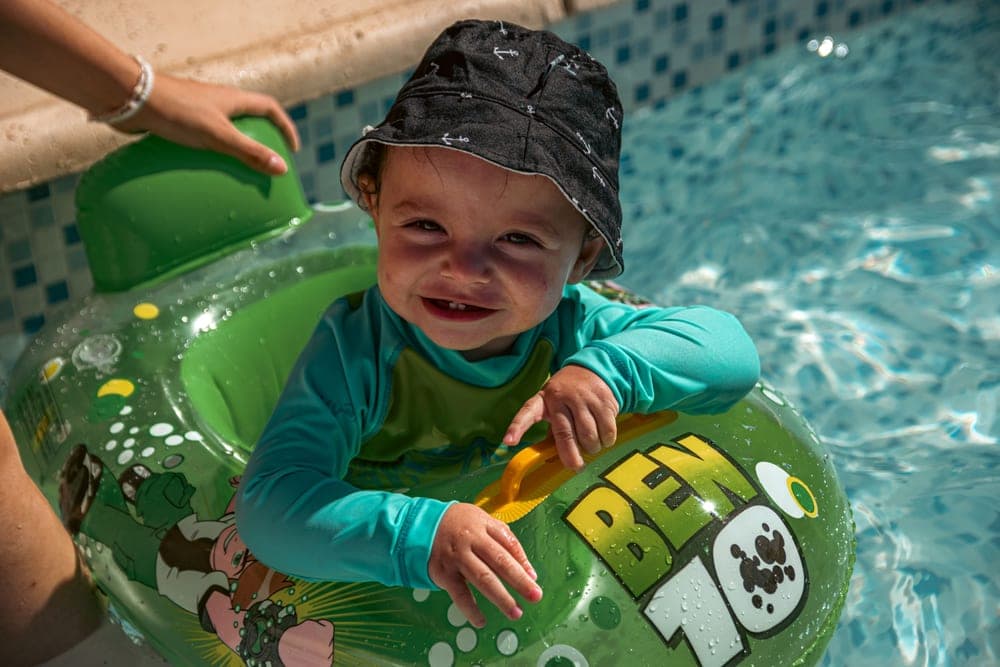
An inflatable seat has no safety rating. It holds a child upright in the water while the air is in it, which is a comfort function. It can deflate, it can tip, and a child can slip through it.
A Coast Guard-approved flotation device is tested and rated, it uses inherently buoyant foam rather than air, and it carries a printed approval statement and a weight range. The US Coast Guard maintains the approval framework and the marking is on the device itself.
If your child needs flotation, buy the second one. If they do not, the first is fine and should be understood as furniture.
What to check on the label
| Check | Rated device | Inflatable seat |
|---|---|---|
| Approval statement | Printed on the product | Absent |
| Weight range | Stated, and specific | Often vague or absent |
| Buoyancy source | Inherently buoyant foam | Air chambers |
| Failure mode | None — foam does not deflate | Deflates, tips, slips |
| What it is for | Flotation | Comfort and shade |
Why shade is the feature we would actually prioritize
For an under-five in a backyard pool on a summer afternoon, sun exposure is the more probable problem than anything else. A float with an integrated canopy addresses that directly, and most toddler floats do not have one.
Two caveats. The canopy is almost always the first part to tear, so treat the whole thing as a one-season purchase. And a canopy over a float is not a substitute for shade over the pool — if the pool sits in full sun all day, that is worth solving at the pool level rather than the float level.
What toddlers actually use
Not floats, mostly. In the shallow water of a typical family above-ground pool, the things that get used are weighted dive toys and foam noodles — neither of which can puncture, both of which work in 24 inches of water, and both of which cost a fraction of a float.
If you are outfitting a pool for young children, our kids pool roundup covers the pool side, and the honest advice is to spend less on the pool and something on the toys.
For the age group the pool is genuinely too deep for, there is an alternative that sits beside it rather than in it. Our splash pad roundup covers a few inches of water on a mat — which changes the supervision picture without pretending to remove the need for it.
Decide whether flotation is actually needed
A confident swimmer in shallow water does not need it. A non-swimmer does, and needs a rated device rather than a seat.If yes, check the product for an approval statement
It is printed on approved devices. A photo of a child on the box is marketing, not certification.Match the weight range to the child, now
Not to the child they will be next year. Weight ranges are narrow at this age and an ill-fitting device is worse than none because it creates confidence without support.Set the supervision rule before anyone gets in
Within arm's reach, one designated adult, no phone. Every layer the CPSC describes is a human layer at this age, because there is no barrier once the child is already in the water.
The picks, in full
Scores are our own reading of published specifications. They are not test results — we have not tested these products and we do not claim to.
Pick #1 · Small children, with adult supervision
Toddler Swim Vest / Puddle Jumper Style Flotation
Various
If you want flotation for a small child, buy something that is genuinely rated for it rather than an inflatable seat. Look for US Coast Guard approval printed on the product, not a picture of a child on the box.
Key specs
- What to check
- US Coast Guard approval statement, printed on the product
- Weight range
- Printed on the label — match it to the child
- Not a substitute for
- Supervision or a barrier
How it scoresour reading of published specs, not a test result
- Material
- 8.0
- Valve
- 8.0
- Capacity
- 8.5
- Storage
- 8.5
- Value
- 8.5
Overall 8.3 / 10
What works
- A Coast Guard-approved device is a fundamentally different product from a pool toy
- Weight-rated, so there is an objective way to check it fits your child
- Frees a child's arms, which an inflatable ring does not
What doesn't
- Not all products marketed for toddlers carry Coast Guard approval — you have to read the label
- Children outgrow the weight range quickly
- Can create false confidence in both child and adult
Skip it if: Replacing supervision. The CPSC's pool safety guidance is built on layers — barriers, supervision and appropriate flotation — and no single item substitutes for the others.
One honest season: The cheapest setup that genuinely works for a season of real swimming. Nothing spare, nothing missing.
Specs from: CPSC — Pool Safely
Pick #2 · Shade first
Toddler Pool Float with Canopy
Various
For a toddler in a pool, sun exposure is the more likely problem on any given afternoon. A canopy addresses that. It is comfort equipment, not safety equipment, and the distinction matters.
Key specs
- Type
- Inflatable seat with removable canopy
- Safety rating
- None — this is not a flotation device
- Weight range
- Printed on the product
- Canopy
- Usually removable, often the first part to fail
How it scoresour reading of published specs, not a test result
- Material
- 6.0
- Valve
- 6.5
- Capacity
- 7.0
- Storage
- 8.0
- Value
- 7.0
Overall 6.8 / 10
What works
- Shade is the genuinely useful feature for the age group
- Leg holes keep a small child seated rather than sliding
- Cheap enough to treat as a one-season item, which it is
What doesn't
- Not a life jacket and must never be used as one
- Canopy seams tear well before the float itself does
- Children outgrow it within a single summer
Skip it if: Anything unsupervised, ever. Use it within arm's reach and treat it as furniture rather than safety gear.
A few weekends: Fine for a heatwave and a toddler. Treat it as consumable, not as a pool — it will not survive a winter in the yard.
Specs from: CPSC — Pool Safely
Pick #3 · Keeping kids in the pool for an extra hour
Weighted Dive Toy Set
Various
Negatively buoyant rings and sticks that sink and stay put. Cheap, indestructible, and the single best return on money in a pool with children in it.
Key specs
- Type
- Weighted rings, sticks or discs
- Buoyancy
- Sinks and stays upright on the floor
- Material
- Rubber or weighted plastic
How it scoresour reading of published specs, not a test result
- Material
- 9.0
- Valve
- 10.0
- Capacity
- 6.0
- Storage
- 9.0
- Value
- 9.5
Overall 8.5 / 10
What works
- Nothing to inflate, nothing to puncture, nothing to store carefully
- Works in a 30-inch pool where most float toys do not
- Genuinely encourages swimming rather than sitting
What doesn't
- Bright colors fade and then they are harder to find on a blue liner
- Hard edges on cheap sets can mark a vinyl liner
- Small parts, so check the age rating for younger children
Skip it if: Very shallow water, where there is not enough depth to make retrieving them interesting.
Several seasons: Buy-once. Built and warranted to come back out of the box for a few years, if you store it properly.
Pick #4 · The cheapest thing that works
Foam Pool Noodles (multipack)
Various
Closed-cell foam cannot puncture and cannot deflate, which makes a noodle structurally the most durable object in this hub. It is also the cheapest.
Key specs
- Material
- Closed-cell polyethylene foam
- Failure mode
- Surface crumbling from UV, not puncture
- Buoyancy
- Inherent — no air chamber to lose
How it scoresour reading of published specs, not a test result
- Material
- 9.0
- Valve
- 10.0
- Capacity
- 5.0
- Storage
- 5.5
- Value
- 9.5
Overall 8.0 / 10
What works
- No air chamber, so no valve to leak and no seam to split
- Survives being stood on, thrown and bitten
- Cheap enough to buy six and not care
What doesn't
- UV eventually makes the surface crumble and shed foam into the pool
- Not a flotation device and should not be treated as one
- Awkward to store because they do not compress
Skip it if: Supporting an adult for any length of time, and absolutely not a safety device for a child.
Several seasons: Buy-once. Built and warranted to come back out of the box for a few years, if you store it properly.
Questions people actually ask
Are toddler pool floats safe?
What is the difference between a pool float and a life jacket?
What should I buy for a toddler in a backyard pool?
Sources
Read next
- Floats, loungers and the stuff that makes the pool worth havingFloats for adults, toddlers and dogs - ranked on seam and valve construction, which is what actually decides how long they last.
- The best pool floatsFloats ranked on material, valve type and published weight capacity - the three specs that decide whether it survives a season.
- The best pool toys for a backyard poolWeighted dive toys, foam noodles and games that work in 24 inches of water - and cannot puncture.
- The best backyard pools for kidsPools chosen for young children - depth, shade and securability rank above capacity and construction here.
- The best inflatable backyard poolsSoft-side pools compared on published capacity and setup time, plus what actually destroys them and how to slow it down.