Pool Care & Chemistry
Chlorine is too high: the three ways down, and why two of them are wrong
Stop the source, take the cover off, retest in the morning. That is the answer for almost every high reading - and the two things that stop it working are a solar cover and a stabilizer level nobody mentions.
Heads up: we earn a commission if you buy through the links on this page, at no extra cost to you. It never decides the ranking — here is how we pick and here is the full disclosure. Prices are checked automatically; last verified October 22, 2026.
Quick picks
Segmented before it is ranked — the right answer depends on which of these you actually are. Tap any row for the full write-up.
If you need the pool today: the one that publishes a dose
90% granular sodium thiosulfate, with a published rate of 5 ounces per 10,000 gallons to drop 5.5 ppm. That is the only figure in this category you can scale down to an above-ground pool.
| # | Product | Best for | Score | Price |
|---|---|---|---|---|
| 1 | 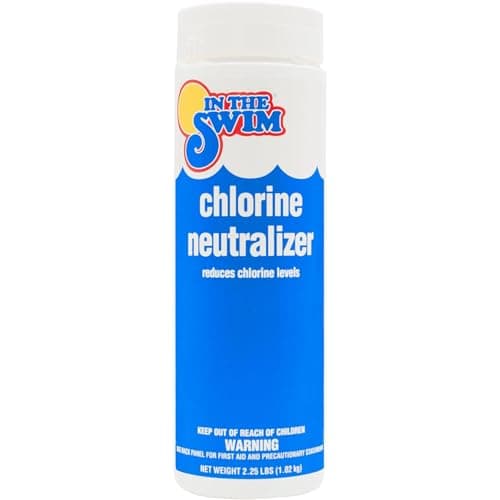 In The Swim Chlorine Neutralizer, 2.25 lb Publishes both numbers the category usually withholds: 90% granular sodium thiosulfate, and a dose of 5 ounces per 10,000 gallons to drop free chlorine by 5.5 ppm. That makes it the one product here you can scale to a small pool instead of guessing. | The only neutralizer here that publishes a dose you can divideA few weekends | 8.0out of 10 |
The smaller tub, with the specification gap
A 1 lb size that suits a small pool better - from a brand already used across this site - but the listing publishes no dose rate and no concentration.
| # | Product | Best for | Score | Price |
|---|---|---|---|---|
| 1 | 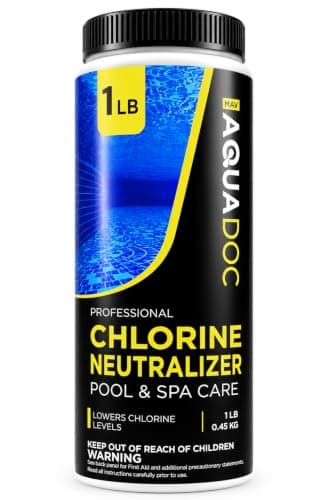 AquaDoc Chlorine Neutralizer, 1 lb A 1 lb sodium thiosulfate neutralizer in a size that suits an above-ground pool better than a commercial tub. The problem is what the listing does not say: it tells you to add "the recommended amount" without publishing what that amount is, or what concentration the granules are. | The smaller tub, from a brand already on this site — with no published doseA few weekends | 6.4out of 10 |
Before you treat anything: confirm the number
A drop-count titration reads to 0.2 ppm. Knowing whether you are at 6 ppm or 16 decides whether you wait overnight or act, and a color block cannot tell you that.
| # | Product | Best for | Score | Price |
|---|---|---|---|---|
| 1 | 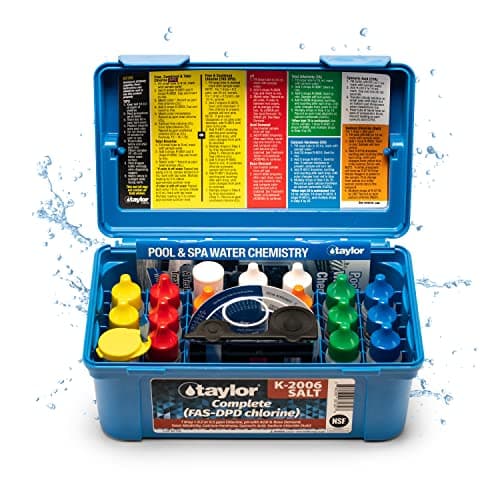 Taylor K-2006 Complete Test Kit (FAS-DPD) The reference kit. It uses a drop-count titration for free chlorine, which gives you an actual figure rather than a shade of pink. Overkill for a 1,500-gallon pool and indispensable when something has gone properly wrong. | When you need a number, not a color bandSeveral seasons | 8.3out of 10 |
The thing that is usually still dosing while you wait
A floating dispenser keeps feeding tablets whether anyone swims or not. Taking it out is the first step and it costs nothing.
| # | Product | Best for | Score | Price |
|---|---|---|---|---|
| 1 | 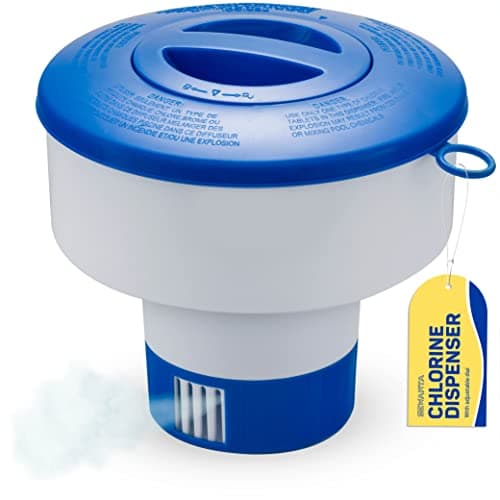 Floating Chlorine Tablet Dispenser Two dollars of plastic that decides whether your chlorine dissolves evenly over days or sits in a corner bleaching your liner. Buy it with the tablets, not after. | Making tablets work properlyOne honest season | 9.0out of 10 |
The short version
- Usually, do nothing. Stop the source, pull the cover off, retest in the morning. Chlorine falls on its own in sunlight, for free.
- Two things block the free route. A solar cover and a high stabilizer level - and stabilizer exists precisely to stop UV destroying chlorine.
- Only one neutralizer here publishes a dose. 5 oz per 10,000 gallons for 5.5 ppm. The other says to add “the recommended amount” without stating it.
- Draining is the expensive wrong answer. 10 ppm down to 4 means replacing 60 percent of the water, and re-balancing everything that comes with it.
If your free chlorine reads high, the correct first move is almost always to do less rather than more. Take the floating dispenser out, take the solar cover off, leave the pump running, and test again in the morning. In an unstabilized pool in summer sun that is usually the whole fix, and it costs nothing.
The rest of this page is for the two cases where that is not enough: you need the pool today, or the reading is not falling and you want to know why.
The number you are waiting for
Not a feeling about the smell, and not a number of hours. The published figure is 4 ppm free chlorine, and it comes from the product label rather than from advice: the EPA master label for calcium hypochlorite under Reg. No. 1258-427 prohibits re-entry above 4 ppm. The CDC publishes 1-4 ppm as the free chlorine range for pools.
Our guide to when you can swim after adding chemicals makes the broader version of this argument: every label gives you a reading to hit, not a clock to run down. High chlorine is the same problem viewed from the other side - you are waiting for a number, and the only question is how fast you want it to arrive.
Route one: sunlight, which is free
Ultraviolet light breaks free chlorine down. That is why outdoor pools lose chlorine through the day and indoor ones do not, and it is why the overwhelming majority of high readings resolve themselves overnight with the cover off.
Three things to do, in this order, and all of them are free:
Take the floating dispenser or feeder out
This is the step people skip, and it is the reason the reading does not move. A floating dispenser keeps dissolving tablets whether anyone is swimming or not, and an inline feeder does the same whenever the pump runs. Lift it out and put it in a bucket.Take the solar cover off
A solar cover is a UV barrier as well as a heat blanket. Leaving it on while you wait for sunlight to do the work is working against yourself - this is the single most common reason a reading stays stubbornly high for days.Run the pump and leave it alone
Circulation keeps the chlorine evenly distributed so your next reading is representative rather than a sample from a hot spot near the return.
Why the free route sometimes does not work
Because you may have deliberately made it not work. Cyanuric acid - stabilizer, the thing in every stabilized tablet - exists for exactly one purpose: to protect free chlorine from being destroyed by sunlight.
That is a feature all season and a problem on the one afternoon you want chlorine to fall. In a heavily stabilized pool the UV route is slow, and it gets slower the higher the stabilizer reading climbs. Our cyanuric acid guide covers how CYA accumulates in a pool that is topped up rather than drained, and why the reading only ever goes up.
The practical consequence for this page: if you run stabilized tablets and your CYA is high, plan on the neutralizer rather than the weather.
Route two: a neutralizer, which is fast
Sodium thiosulfate removes free chlorine on contact. It is cheap, it works in minutes, and the category has exactly one problem - most of it will not tell you how much to use.
| Product | Concentration published | Dose rate published | Size |
|---|---|---|---|
| In The Swim Chlorine Neutralizer | 90% sodium thiosulfate | 5 oz per 10,000 gal, drops 5.5 ppm | 2.25 lb |
| AquaDoc Chlorine Neutralizer | Not published | Not published — "the recommended amount" | 1 lb |
For a chemical whose entire job is removing a measured quantity of sanitizer, a product that will not publish a rate is asking you to dose by eye. Under-dose and nothing happens. Over-dose and you have stripped the pool to zero free chlorine, which is a genuinely worse state than the one you were trying to fix - unprotected water in warm weather is how an algae bloom starts.
Scaling the published dose to a real above-ground pool
- Published rate
- 5 oz per 10,000 gallons lowers free chlorine 5.5 ppm
- Intex Prism Frame 12 ft
- 1,718 published gallons
- Bestway Steel Pro MAX 15 ft
- 3,955 published gallons
- Intex Ultra XTR 18 ft
- 6,981 published gallons
5 oz x (your gallons / 10,000) = ounces for a 5.5 ppm drop
About 0.9 oz, 2.0 oz and 3.5 oz respectively
Route three: dilution, which is the expensive one
Partially draining and refilling does work, because dilution is linear and predictable. It is also almost always the wrong choice, and the arithmetic shows why.
What it costs to dilute 10 ppm down to 4 ppm
- Starting point
- 10 ppm free chlorine
- Target
- 4 ppm — the published re-entry limit
- Pool
- 6,981 gallons (Intex Ultra XTR 18 ft, published)
- Water rate [EPA WaterSense — how the calculator works]
- $6.06 per 1,000 gallons
keep 4/10 = 40% → replace 60% → 6,981 x 0.60 = 4,189 gal → 4.189 x $6.06
About 4,189 gallons and roughly $25 of water
The three routes, side by side
| Route | Cost | Speed | Main risk |
|---|---|---|---|
| Sunlight, cover off, source removed | Free | Overnight to a day | Blocked by high stabilizer |
| Sodium thiosulfate neutralizer | Pennies per correction | Minutes | Overshooting to zero chlorine |
| Partial drain and refill | ~$25 of water, plus re-balancing | Hours of filling | Rebalancing the whole pool |
Read down the risk column and the ordering is obvious. The free route fails slowly and harmlessly. The fast route fails by overshooting, which is recoverable but annoying. The expensive route does not really fail at all - it just costs far more than the problem is worth, in water and in work.
If you run a salt pool, the source is the generator
Everything above assumes tablets. On a saltwater pool there is no floater to lift out — the cell is manufacturing chlorine every hour the pump runs, which makes “stop the source” a dial rather than a bucket.
Turn the output percentage down before you do anything else, and expect the reading to keep climbing for a few hours afterwards because the water already in circulation is still carrying what the cell made this morning. Our salt system roundup covers output settings, and salt against chlorine explains why a salt pool drifts high far more easily than a tablet pool: the generator has no idea whether anyone swam today, and most units on an above-ground pool are rated for two to three times the water they are actually treating.
The neutralizer arithmetic is identical — it is the same free chlorine, made a different way — but turning the cell down is free and permanent, so do that first and treat the chemical as the thing that buys you this afternoon.
Three things not to do
High chlorine attracts bad advice, and the three most common suggestions all make the situation worse or waste money.
| Suggestion | What it actually does | Verdict |
|---|---|---|
| Add stabilizer to lock it up | Protects the chlorine from sunlight instead of removing it | Backwards — it blocks the free route |
| Shock it to burn it off | Adds more chlorine to a pool that already has too much | Wrong problem |
| Add clarifier or algaecide | Neither reacts with free chlorine | No effect, and money spent |
The first one is worth dwelling on because it sounds plausible and it is the exact opposite of helpful. Cyanuric acid does not reduce free chlorine — it shields it. Adding stabilizer to a pool reading high leaves you with the same chlorine and a higher CYA level that will make every future reading slower to fall, and CYA only ever goes up unless you replace water. It converts a one-afternoon problem into a season-long one.
The second comes from confusing shock with breakpoint chlorination. Shocking is how you deal with combined chlorine and the smell that goes with it, which our chlorine smell guide covers — it is an answer to the wrong question when free chlorine is the thing that is high.
How high is actually a problem
Worth being proportionate. The published instruction is to stay out until free chlorine is back inside 1-4 ppm, and that is the line to hold — not because 5 ppm is dangerous in some dramatic sense, but because the label limit is the only objective number anyone has given you and treating it as negotiable is how people end up swimming at 15 ppm.
What over-chlorinated water reliably does is irritate: stinging eyes, dry skin and itching afterwards, and bleached swimwear and hair over repeated exposure. Those are the complaints that usually send someone to a test kit in the first place. We are not going to put a threshold on any of it, because nothing we can cite publishes one — the sources here publish a target range and a re-entry prohibition, and neither is expressed as a danger level.
Stopping it happening again
High chlorine is nearly always a dosing-hardware problem rather than a chemistry one, and it has three common causes.
A floater left in after shocking
You shock the pool, the level spikes as intended, and the dispenser carries on adding on top of it. Our pool shock guide covers dosing the shock itself; the step it cannot do for you is pulling the floater before you start.A feeder set too high for a small pool
Inline and offline feeders are designed around pools several times the size of a typical above-ground one. Our floater against inline feeder comparison works through which suits a small pool, and the answer usually involves running it well below its nominal setting.Shocking a pool that did not need it
Shock is for a specific problem, not a weekly habit. The weekly routine is built around testing and adjusting rather than dosing on a calendar, which is the single best way to never see a 15 ppm reading in the first place.
What we are not telling you
How long your pool will take. That depends on your stabilizer level, your sun exposure, your water temperature and how much chlorine is in there to begin with, and nobody publishes a rate that covers those variables honestly. Anyone giving you “chlorine drops X ppm per day” is quoting a figure that assumes a pool that is not yours.
We have also not tested either neutralizer. Everything said about them above is read off their current listings: one publishes a concentration and a dose rate, the other publishes neither, and that difference is the whole basis for preferring the first. The published 4 ppm limit is the EPA label's, not ours, and it is the number to act on.
What to buy
Scores are our own reading of published specifications. They are not test results — we have not tested these products and we do not claim to.
The only neutralizer here that publishes a dose you can divide
In The Swim Chlorine Neutralizer, 2.25 lb
In The Swim
Publishes both numbers the category usually withholds: 90% granular sodium thiosulfate, and a dose of 5 ounces per 10,000 gallons to drop free chlorine by 5.5 ppm. That makes it the one product here you can scale to a small pool instead of guessing.
#ad how this is funded · price as of October 22, 2026
Key specs
- Dose
- "5 ounces per 10,000 gallons of water to lower chlorine levels 5.5 ppm", published
- Concentration
- "90% Granular Sodium Thiosulfate", published
- Size
- 2.25 lb (36 oz)
- Premixing
- "No premixing required", published
- Acts on
- Free available chlorine, published
- Doses per tub
- About 10 full-strength doses on a 7,000 gallon pool, about 40 on a 1,700 gallon one — arithmetic from the published rate
- Bromine
- Not stated on this listing either way
How it scoresour reading of published specs, not a test result
- Effectiveness
- 8.5
- Ease
- 7.0
- Water impact
- 6.5
- Cost per season
- 9.0
- Value
- 8.5
Overall 8.0 / 10
What works
- Publishes a dose rate per 10,000 gallons AND the ppm it moves, which is the only way to size a dose for a small pool
- Publishes its concentration at 90%, so it can be compared against anything else that states one
- No premixing, which matters because this is a chemical you add in small, measured amounts
- A 36 oz tub is years of supply on an above-ground pool — this is not a recurring cost
What doesn't
- Sized for a 10,000 gallon pool, so almost every dose on an above-ground pool is a fraction you have to work out
- Overshooting strips the pool to zero free chlorine, which is a worse state than the one you started in
- Does not state whether it works on bromine, which the competing BioGuard product does claim
- Bought in a hurry and then used once, which is the honest usage pattern
Skip it if: Being the first thing you reach for. Chlorine falls on its own in sunlight and the pool is usually swimmable the next morning for nothing. This is the product for when you need the pool today, not the product for a high reading.
What it costs to run: Priced per use rather than per tub, this is close to free. At the published 5 oz per 10,000 gallons, a 6,981 gallon pool needs about 3.5 oz to drop 5.5 ppm, so a 36 oz tub is roughly ten corrections. Compare that with the dilution route, where dropping 10 ppm to 4 ppm on the same pool means replacing about 4,189 gallons - roughly $25 of water at the EPA WaterSense national average, plus re-balancing everything that came with it.
A few weekends: Fine for a heatwave and a toddler. Treat it as consumable, not as a pool — it will not survive a winter in the yard.
The smaller tub, from a brand already on this site — with no published dose
AquaDoc Chlorine Neutralizer, 1 lb
MAV AquaDoc
A 1 lb sodium thiosulfate neutralizer in a size that suits an above-ground pool better than a commercial tub. The problem is what the listing does not say: it tells you to add "the recommended amount" without publishing what that amount is, or what concentration the granules are.
Key specs
- Dose
- Not published — the listing says to add "the recommended amount"
- Concentration
- Not published; described only as "Sodium Thiosulfate Based Formula"
- Size
- 1 lb (16 oz)
- Method
- Published sequence: test with strips, add, then let the filter circulate
- Compatibility
- "chlorine treated pools and spas, including inground and above ground systems", published
- Made in
- "Made in the USA", published
- Stated use case
- Published as for "elevated chlorine levels after shocking or overfeeding"
How it scoresour reading of published specs, not a test result
- Effectiveness
- 7.0
- Ease
- 5.5
- Water impact
- 6.5
- Cost per season
- 7.0
- Value
- 6.0
Overall 6.4 / 10
What works
- A 1 lb tub is a realistic quantity for an above-ground pool rather than a commercial pack
- Publishes the right procedure — test first, then add, then circulate — which is the part people skip
- Names the actual use case, over-shocking and over-feeding, rather than selling it as routine maintenance
- Same brand as several chemicals already recommended across this site, so it is a known quantity
What doesn't
- No dose rate published anywhere on the listing, for a chemical whose entire job is removing a measured amount
- No concentration published, so it cannot be compared against the 90% figure its competitor states
- "Add the recommended amount" is not a recommendation, and without it you are dosing a sanitizer remover by eye
- Costs nearly the same as a tub with more than twice the product and a published rate
Skip it if: Being dosed accurately, which is the only thing that matters here. Under-dose and nothing happens; over-dose and the pool has no sanitizer at all. A product that will not publish a rate makes both outcomes more likely.
A few weekends: Fine for a heatwave and a toddler. Treat it as consumable, not as a pool — it will not survive a winter in the yard.
When you need a number, not a color band
Taylor K-2006 Complete Test Kit (FAS-DPD)
Taylor Technologies
The reference kit. It uses a drop-count titration for free chlorine, which gives you an actual figure rather than a shade of pink. Overkill for a 1,500-gallon pool and indispensable when something has gone properly wrong.
Key specs
- Method
- FAS-DPD drop-count titration
- Measures
- Free and combined chlorine, pH, alkalinity, calcium hardness, cyanuric acid
- Resolution
- Reads to 0.2 ppm free chlorine with the standard 10 mL sample
- Format
- Reagent bottles and graduated comparators
How it scoresour reading of published specs, not a test result
- Ease
- 5.5
- Value
- 8.0
Overall 8.3 / 10
What works
- Distinguishes free from combined chlorine, which is the single most useful thing a test can tell you when water smells of chlorine
- Gives a numeric result you can act on precisely rather than a color to interpret
- Reagents are individually replaceable, so the kit is a multi-season purchase
What doesn't
- Considerably more expensive than strips and more of a ritual to use
- Reagents have a shelf life and do expire
- Genuinely more kit than a small seasonal pool needs
Skip it if: Casual weekly checks. If it is a five-minute job you will skip it, and a test you skip is worse than a rough one you actually do.
What it costs to run: The reagents are the running cost, not the kit. For most seasonal above-ground owners this is a second purchase made in year two after a bad algae summer, not a first one.
Several seasons: Buy-once. Built and warranted to come back out of the box for a few years, if you store it properly.
Specs from: Taylor Technologies
Making tablets work properly
Floating Chlorine Tablet Dispenser
Various
Two dollars of plastic that decides whether your chlorine dissolves evenly over days or sits in a corner bleaching your liner. Buy it with the tablets, not after.
#ad how this is funded · price as of October 22, 2026
Key specs
- Function
- Holds 3-inch tablets, meters dissolution rate
- Adjustment
- Vented base, adjustable on most models
- Compatibility
- Standard 3-inch tablets
How it scoresour reading of published specs, not a test result
- Effectiveness
- 8.0
- Ease
- 9.5
- Water impact
- 9.0
- Cost per season
- 9.8
- Value
- 9.5
Overall 9.0 / 10
What works
- Adjustable venting lets you slow or speed dissolution to match the weather
- Keeps tablets off the liner, which is what causes bleach spots
- Trivially cheap and lasts years
What doesn't
- Drifts to one end of the pool in wind, so distribution is uneven without circulation
- Must be removed before swimming with small children
- Cheap ones crack after a season in UV
Skip it if: Being left in an empty or unfiltered pool. Without circulation it creates a concentrated pocket rather than an even dose.
What it costs to run: The cheapest item on this site and one of the highest-return: even dissolution means you use fewer tablets to hold the same free chlorine level.
One honest season: The cheapest setup that genuinely works for a season of real swimming. Nothing spare, nothing missing.
The default first test kit
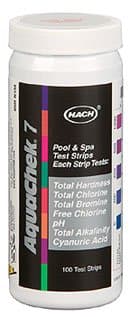
AquaChek Silver 7-Way Test Strips (100 count)
AquaChek
Seven readings in fifteen seconds, including the two that beginners never measure and then fight all summer: total alkalinity and cyanuric acid.
#ad how this is funded · price as of October 22, 2026
Key specs
- Tests
- Free chlorine, total chlorine, bromine, pH, total alkalinity, total hardness, cyanuric acid
- Free chlorine range
- 0-20 ppm
- pH range
- 6.2-8.4
- Total alkalinity range
- 0-240 ppm
- Cyanuric acid range
- 0-300 ppm
- Read time
- 15 seconds
- Count
- 100 strips
How it scoresour reading of published specs, not a test result
- Ease
- 9.5
- Value
- 9.2
Overall 8.9 / 10
What works
- Covers cyanuric acid, which most cheap strips omit and which is the reason chlorine stops working in a stabilized pool
- pH range spans 6.2-8.4, comfortably bracketing the CDC's recommended 7.0-7.8
- 15 seconds and a color chart printed on the bottle — no separate booklet to lose
- 100 strips is a full season of twice-weekly testing with room to spare
What doesn't
- Strips are a comparison against a printed color chart, so they are directional rather than precise
- Reading them in bright sun is harder than it should be
- The bottle must be kept sealed and dry or the strips degrade quietly
Skip it if: Fine adjustment. If you are chasing a stubborn problem and need a number rather than a color band, a liquid reagent kit is the tool.
What it costs to run: 100 strips at twice-weekly testing covers roughly two seasons for one pool. The real saving is upstream: knowing your alkalinity stops you buying pH adjuster you did not need.
One honest season: The cheapest setup that genuinely works for a season of real swimming. Nothing spare, nothing missing.
Specs from: CDC — home pool and hot tub water treatment and testing
The single highest-return accessory here
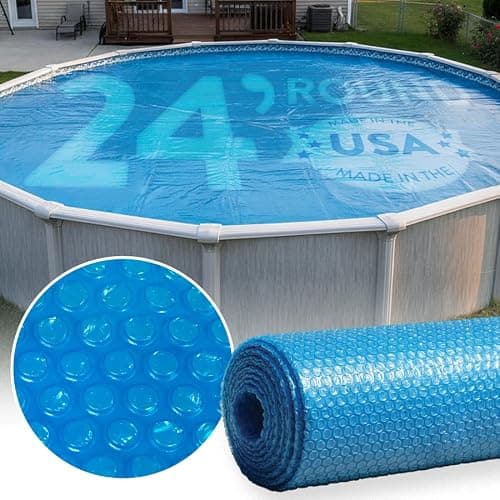
Bubble Solar Cover for Above-Ground Pools
Various
It cuts evaporation, and evaporation is simultaneously your water bill, your chemical bill and your heat loss. Nothing else on this site reduces three costs at once.
#ad how this is funded · price as of October 22, 2026
Key specs
- Construction
- Bubble sheet, thickness published in mil
- Thickness
- Higher mil lasts longer — 12 mil and 16 mil are common
- Fit
- Cut to size; buy oversize and trim
- Orientation
- Bubbles face down, toward the water
How it scoresour reading of published specs, not a test result
- Value
- 9.5
Overall 9.0 / 10
What works
- Reduces evaporation, which is the mechanism behind the water, chemical and heat savings all at once
- Cheap relative to everything it saves
- Can be cut to fit any pool shape, so sizing is forgiving
What doesn't
- Awkward to get on and off without a reel, and awkward is how covers end up unused
- Degrades in UV like every vinyl product
- Not a safety cover and will not support weight — this is important
Skip it if: Being a safety barrier. A solar cover looks solid and is not; a child or pet on it goes through and under.
What it costs to run: The one accessory with a clear payback. Every gallon that does not evaporate is a gallon you do not replace at the EPA WaterSense national average of $6.06 per 1,000 gallons, and it is chlorine you do not re-dose. If you buy one thing from this hub, buy this.
Several seasons: Buy-once. Built and warranted to come back out of the box for a few years, if you store it properly.
Specs from: EPA WaterSense — cost per 1,000 gallons
Questions people actually ask
How high is too high for pool chlorine?
How do you lower chlorine in a pool fast?
Why is my chlorine not coming down?
Should I drain the pool to lower chlorine?
Is it dangerous to swim in a pool with high chlorine?
Sources
- CDC — home pool and hot tub water treatment and testing
- EPA — master label, calcium hypochlorite EPA Reg. No. 1258-427 (re-entry prohibited above 4 ppm)
- In The Swim Chlorine Neutralizer — published dose rate and 90% sodium thiosulfate concentration
- AquaDoc Chlorine Neutralizer — published composition and procedure, no dose rate stated
- EPA WaterSense — how the calculator works
Read next
- Pool care, from someone who assumes you have never done thisThe weekly routine, the four numbers that matter, and the fix for the week the water turns.
- How long before you can swim? The label gives a number, not a timePublished re-entry rules for each pool chemical, read off EPA labels - and why the real answer is a chlorine reading rather than a number of hours.
- Cyanuric acid: the reading that explains your chlorineWhy an outdoor pool needs stabilizer, why tablets add it whether you want them to or not, and the only way to bring it back down.
- Pool shock: use enough, once, and use the right kindCal-hypo versus dichlor, correct dosing, and the counter-intuitive reason a chlorine smell means you need more chlorine.
- The floating dispenser, and why it prevents more than it costsWhat to look for in a floating chlorine dispenser, why loose tablets damage liners, and the tablet arithmetic by pool size.
- Floater or feeder: the same tablets, metered two different waysFloating dispensers against off-line tablet feeders: capacity, dose control, what each does to a vinyl liner, and why neither belongs in the skimmer basket.
- The best solar covers, and why this is the one thing to buyBubble covers compared on thickness and sizing, plus the arithmetic that makes this the highest-return purchase in the hub.
- How many gallons your pool holds, and why two of the same size disagreeThe number every chemical dose on this site depends on, and the published evidence that two pools of the same size can be 233 gallons apart on paper and 53 apart in reality.
- The weekly pool routine, and how little time it really takesThe daily, weekly and monthly jobs written as a schedule, with the kit each one needs and roughly how long it takes.