Above-Ground Pools
How many gallons your pool holds, and why two of the same size disagree
Use the maker's published figure if there is one, and the formula if there is not. The catch is that the published figure is only true at the fill level it assumes - and makers state that level inconsistently, when they state it at all.
Heads up: we earn a commission if you buy through the links on this page, at no extra cost to you. It never decides the ranking — here is how we pick and here is the full disclosure. Prices are checked automatically; last verified October 19, 2026.
The short version
- Use the maker’s figure if there is one. It beats any calculation — but only at the fill level it states, and makers state that inconsistently.
- Intex publishes 80% on one pool and 90% on another the same size. 1,485 gallons against 1,718, which is 233 gallons of nothing but convention.
- The formula is a ceiling. On both pools we checked it lands about 10 to 15 percent above the published number.
- Measure the water, not the wall. A 52-inch wall is not 52 inches of water, and that error alone is worth hundreds of gallons.
Take the maker’s published water capacity if your pool has one, note the fill percentage printed beside it, and write the number on the pump. If there is no published figure — and three of the pools in our own registry do not have one — measure the water depth, measure across the water line, run the formula below, and take about ten percent off the answer.
This is the most quietly important number in pool ownership and almost nothing explains it honestly. Across this site we give dose instructions “per 10,000 gallons” dozens of times. This is the page that tells you what to divide by.
Two 12-foot pools, 233 gallons apart
Start with the evidence, because it reframes the whole question. These are two pools from the same manufacturer, at the same nominal size, in the same published height bracket:
| Pool | Published water capacity | Fill percentage stated | Published pool height |
|---|---|---|---|
| Intex Easy Set 12 ft x 30 in | 1,485 gallons | 80% | 36 in or less |
| Intex Prism Frame 12 ft x 30 in | 1,718 gallons | 90% | 36 in or less |
A buyer comparing those two numbers would conclude the Prism Frame holds about 16 percent more water. It does not. Most of the gap is the percentage beside the figure, and you can take it out with one division:
The same two pools on a common basis
- Easy Set, published [Intex — Easy Set 12' x 30' pool set]
- 1,485 gallons at 80%
- Prism Frame, published [Intex — Prism Frame 12' x 30' pool set]
- 1,718 gallons at 90%
1,485 / 0.80 = 1,856 1,718 / 0.90 = 1,909
About 1,856 against about 1,909 gallons — a 2.8% difference, not 16%
And two 18-foot pools you cannot do that to
The normalization above only works when both makers publish a percentage. Often one does not:
| Pool | Published water capacity | Fill percentage stated |
|---|---|---|
| Intex Ultra XTR Frame 18 ft x 52 in | 6,981 gallons | None published |
| Bestway Hydrium 18 ft x 52 in | 7,192 gallons | 90% |
Three percent apart on paper, and no way to tell whether that is a real difference or another convention gap, because Intex gives the figure with nothing beside it. We checked its product page specifically for this and it reads “Water Capacity: 6,981 gallons” and nothing more — no percentage anywhere on the page.
That is not a slip. Across the Intex pages we were able to read, the Easy Set states 80 percent, the Prism Frame states 90 percent, the rectangular Ultra XTR states 90 percent, and the round Ultra XTR states nothing at all. One manufacturer, three conventions.
Published capacities, with the percentage they assume
Every figure below is the manufacturer’s own, for a pool we track in our product registry. The third column is the part that is usually missing when people quote these numbers at each other, and the bottom rows are the pools that publish nothing at all.
| Pool | Nominal size | Published capacity | Fill % stated |
|---|---|---|---|
| Intex Easy Set | 12 ft x 30 in | 1,485 gal | 80% |
| Intex Prism Frame | 12 ft x 30 in | 1,718 gal | 90% |
| Bestway Power Steel | 18 x 9 ft x 48 in | 3,913 gal | 90% |
| Bestway Steel Pro MAX | 15 ft x 42 in | 3,955 gal | 90% |
| Intex Ultra XTR rectangular | 18 x 9 ft x 52 in | 4,545 gal | 90% |
| Intex Ultra XTR round | 18 ft x 52 in | 6,981 gal | None published |
| Bestway Hydrium | 18 ft x 52 in | 7,192 gal | 90% |
| Bestway Power Steel | 24 x 12 ft x 52 in | 7,937 gal | 90% |
| Bestway APX 365 | 20 ft x 52 in | 8,781 gal | 90% |
| Intex Ultra XTR round | 24 ft x 52 in | 12,481 gal | None published |
| Intex Metal Frame | 10 ft x 30 in | Not published | n/a |
| Summer Waves Elite | 14 ft | Not published | n/a |
| Lake Effect Bermuda | 12 ft x 48 in | Not published | n/a |
Read down the last column and the shape of the problem is obvious. Bestway states 90 percent on everything it publishes. Intex states 80 percent, 90 percent, or nothing, depending on the model. And three pools reach the customer with no figure at all, which is a quarter of this table.
Two practical uses for it. First, as a sanity check: if your calculation lands wildly away from a comparable pool here, you have probably measured the wall rather than the water. Second, as a shopping input — the gallons are the running cost. Our cost of going bigger guide prices what each step up the table actually commits you to, and it is a steeper curve than the sticker prices suggest.
Ovals and rectangles
Rectangles are the easy case and the best documented: both Bestway Power Steel rectangles and the rectangular Ultra XTR publish a capacity with a 90 percent basis, and length x width x depth needs no geometry beyond multiplication.
Ovals are the awkward one. A true oval is not an ellipse and not a rectangle with round ends, and the published figures are thinner — the Bestway oval Steel Pro MAX in our registry carries no capacity figure we could source. Treating it as an ellipse (3.14 x half the length x half the width x depth x 7.48) over-estimates slightly, which is the right direction to be wrong in for equipment sizing and the wrong one for chemicals. Our oval pool roundup covers the other ways ovals cost you — covers, reels and nets are all harder to source in oval sizes.
The formula, and the one input everybody gets wrong
The arithmetic is easy. The measurement is where it goes wrong.
Round pool: 3.14 x radius x radius x average water depth x 7.48
Rectangle: length x width x average water depth x 7.48
Oval: 3.14 x (length ÷ 2) x (width ÷ 2) x average water depth x 7.48
Everything in feet. The 7.48 is simply how many US gallons fit in a cubic foot, and it comes straight out of the gallon’s definition rather than from anybody’s table: a US gallon is 231 cubic inches, a cubic foot is 1,728 cubic inches, and 1,728 divided by 231 is 7.48.
The input that ruins the answer is depth. A 52-inch wall is not 52 inches of water. Every above-ground pool is filled to a line below the top rail, and on a 52-inch pool that freeboard is usually six to ten inches. Our pool sizing guide makes this point under its own heading because it catches people at the buying stage too — the depth you are paying for is not the depth you swim in.
Use a tape measure in the water. Not the box, not the wall, not the number on the label.
Worked example: a 12 ft round pool with a 30 in wall, filled to 27 in
- Radius
- 6 ft
- Average water depth
- 27 in = 2.25 ft (90% of a 30 in wall)
- Gallons per cubic foot
- 1,728 cubic inches / 231 = 7.48
3.14 x 6 x 6 x 2.25 x 7.48
About 1,902 gallons
What the number actually changes
Worth being specific, because the answer is not “everything” and pretending otherwise makes people anxious about a figure that is fine.
| What you are doing | How sensitive it is | Why |
|---|---|---|
| Routine chlorine dosing | Low | You test and adjust; 10% is inside the noise |
| Shocking a green pool | High | Dosed per 10,000 gal, and under-dosing feeds the algae instead of killing it |
| Buying a salt chlorine generator | High | Units carry a hard maximum gallon rating |
| Sizing a pump or filter | High | Turnover is gallons divided by flow rate |
| Balancing pH and alkalinity | Medium | Dosed per volume, but corrected by retest |
| Winterizing chemicals | Medium | Kits are sold by gallon band |
| Pricing a fill | Low | A 10% error on water is pennies |
The pattern is clear enough to act on: anything you test afterwards is forgiving, and anything you buy once is not.
Where it bites hardest: shock
Shock is the case worth laboring. It is dosed per 10,000 gallons, it is used in exactly the situation where the water has already got away from you, and an under-dose does not partially work — it fails to reach breakpoint and you have spent the money for nothing. Our pool shock roundup compares cal-hypo and dichlor on label dose rates, and every one of those rates is per volume.
If you fill your pool above the line its published figure assumes and then dose off that figure, the arithmetic is unkind: dosing a 1,485-gallon number into a pool actually holding about 1,856 gallons delivers 80 percent of the intended dose. For weekly chlorine that is a non-event. For a shock treatment it is the difference between a clear pool on Saturday and the same green pool plus an empty bag.
Where it bites quietly: equipment ratings
Equipment carries hard gallon ceilings, and they are published. The Intex Krystal Clear C1000 cartridge pump is rated for pools up to about 6,000 gallons — which means an 18-foot Ultra XTR at its published 6,981 gallons is already past it. A salt chlorine generator like the Hayward AquaTrol publishes an 18,000-gallon rating, so headroom is cheap at the top of the range and non-existent at the bottom.
Our pump sizing guide works through turnover properly, including the two flow rates manufacturers quote and which of them to trust. All of it starts from the number on this page.
The measurement, step by step
Ten minutes once, and you never do it again. If your pool has a published figure, steps one and four are all you need.
Look for the maker's published figure first
Box, manual or product page. If it is there it beats anything you can calculate — but read whether a fill percentage is printed beside it, because that is the level the figure is true at.Measure the water, not the wall
Tape measure in the pool, floor to the actual water line. On a 52-inch wall expect six to ten inches of freeboard, and it all comes off your volume.Measure across the water line, not the frame
Diameter at the water surface for a round pool; length and width the same way for a rectangle. If two readings differ, average them.Convert to feet and multiply
Round: 3.14 x radius x radius x average water depth x 7.48. Rectangle: length x width x average water depth x 7.48.Take about ten percent off, if you had to calculate
The formula ran 10 to 15 percent above Intex's published figures on both pools we checked. Where a published number exists, prefer it.Write it on the pump
Permanent marker on the pump housing or filter lid. Every dose and every equipment rating for the life of the pool refers back to it, and nobody remembers it in April.
The published ratings your number has to clear
This is where the gallon figure stops being trivia. Equipment is sold against a published maximum, and unlike a chemical dose there is no retest to save you — you either bought a unit that covers your water or you did not.
| Unit | Published rating | Covers an 18 ft x 52 in pool at ~7,000 gal? |
|---|---|---|
| Intex Krystal Clear C1000 cartridge pump | Up to 6,000 gal | No |
| Bestway Flowclear Hydrogenic 6 salt | Up to 7,000 gal | Marginal |
| Intex QZ1100 ozone and saltwater | 6,000 to 15,000 gal | Yes |
| Hayward AquaTrol salt | Up to 18,000 gal | Yes |
| Intex QS1600 Plus salt | Up to 18,000 gal | Yes |
| Solaxx Saltron Retro salt | Up to 20,000 gal | Yes |
Two things fall out of that table, and the reassuring one is worth saying first. Salt generators are rated far above what an above-ground pool holds. Three of the four here cover 18,000 gallons or more, against a typical 18-foot pool at about 7,000. For most readers the gallon rating is simply not the binding constraint on a salt system, whatever the upsell says — our salt system roundup ranks them on the things that actually differ.
The unforgiving one is filtration. The C1000 publishes a 6,000-gallon ceiling, which an 18-foot Ultra XTR exceeds on its own published figure of 6,981 before you have measured anything. That is a pump bought on pool diameter rather than on water, and it is a common and expensive way to be wrong. The pump sizing guide has the turnover arithmetic; this page just supplies the numerator.
The same logic runs through the seasonal purchases. Winterizing kits are sold in gallon bands, opening kits likewise — our opening cost guide found both kits it priced were rated for 30,000 to 35,000 gallons against the 5,000 to 10,000 most above-ground pools hold, so the instruction there is to divide the dose by three. You cannot divide by three without knowing what you are dividing.
What we could not verify
Bestway’s Steel Pro MAX product page returned a 404 when we went back to re-check its published 3,955 gallons at 90 percent, so that figure is carried from our earlier sourcing rather than re-confirmed today. The Intex figures on this page — 1,485 at 80 percent, 1,718 at 90 percent, 6,981 with no percentage, 4,545 at 90 percent — were all read off Intex’s own product pages while writing it.
We also cannot tell you how any manufacturer derives its capacity figure. None of them publishes the method, which is why this page gives you the formula, the published numbers, and the honest size of the gap between them rather than pretending the two agree.
The short version
Published figure beats formula
If the maker gives you a number, use it, and note the fill percentage printed beside it.No published figure means formula minus ten percent
Three of the pools in our registry have no published capacity. For those, calculate and then knock a tenth off.Never compare two capacity figures without their percentages
Two 12-foot Intex pools are 16 percent apart on paper and under 3 percent apart in reality.Write it on the pump
Then use it everywhere: dosing in the weekly routine, pricing in chemical cost, and sizing in salt systems.
What to buy
Scores are our own reading of published specifications. They are not test results — we have not tested these products and we do not claim to.
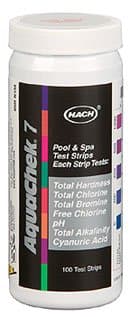
The default first test kit
AquaChek Silver 7-Way Test Strips (100 count)
AquaChek
Seven readings in fifteen seconds, including the two that beginners never measure and then fight all summer: total alkalinity and cyanuric acid.
#ad how this is funded · price as of October 19, 2026
Key specs
- Tests
- Free chlorine, total chlorine, bromine, pH, total alkalinity, total hardness, cyanuric acid
- Free chlorine range
- 0-20 ppm
- pH range
- 6.2-8.4
- Total alkalinity range
- 0-240 ppm
- Cyanuric acid range
- 0-300 ppm
- Read time
- 15 seconds
- Count
- 100 strips
How it scoresour reading of published specs, not a test result
- Accuracy
- 7.0
- Ease
- 9.5
- Coverage
- 9.5
- Cost per use
- 9.0
- Value
- 9.2
Overall 8.9 / 10
What works
- Covers cyanuric acid, which most cheap strips omit and which is the reason chlorine stops working in a stabilized pool
- pH range spans 6.2-8.4, comfortably bracketing the CDC's recommended 7.0-7.8
- 15 seconds and a color chart printed on the bottle — no separate booklet to lose
- 100 strips is a full season of twice-weekly testing with room to spare
What doesn't
- Strips are a comparison against a printed color chart, so they are directional rather than precise
- Reading them in bright sun is harder than it should be
- The bottle must be kept sealed and dry or the strips degrade quietly
Skip it if: Fine adjustment. If you are chasing a stubborn problem and need a number rather than a color band, a liquid reagent kit is the tool.
What it costs to run: 100 strips at twice-weekly testing covers roughly two seasons for one pool. The real saving is upstream: knowing your alkalinity stops you buying pH adjuster you did not need.
One honest season: The cheapest setup that genuinely works for a season of real swimming. Nothing spare, nothing missing.
Specs from: CDC — home pool and hot tub water treatment and testing
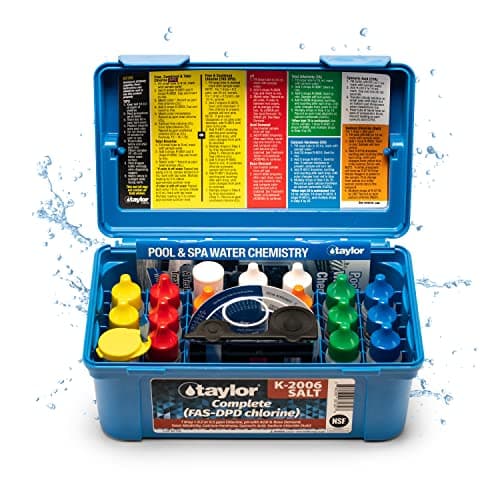
When you need a number, not a color band
Taylor K-2006 Complete Test Kit (FAS-DPD)
Taylor Technologies
The reference kit. It uses a drop-count titration for free chlorine, which gives you an actual figure rather than a shade of pink. Overkill for a 1,500-gallon pool and indispensable when something has gone properly wrong.
Key specs
- Method
- FAS-DPD drop-count titration
- Measures
- Free and combined chlorine, pH, alkalinity, calcium hardness, cyanuric acid
- Resolution
- Reads to 0.2 ppm free chlorine with the standard 10 mL sample
- Format
- Reagent bottles and graduated comparators
How it scoresour reading of published specs, not a test result
- Accuracy
- 9.8
- Ease
- 5.5
- Coverage
- 9.5
- Cost per use
- 7.0
- Value
- 8.0
Overall 8.3 / 10
What works
- Distinguishes free from combined chlorine, which is the single most useful thing a test can tell you when water smells of chlorine
- Gives a numeric result you can act on precisely rather than a color to interpret
- Reagents are individually replaceable, so the kit is a multi-season purchase
What doesn't
- Considerably more expensive than strips and more of a ritual to use
- Reagents have a shelf life and do expire
- Genuinely more kit than a small seasonal pool needs
Skip it if: Casual weekly checks. If it is a five-minute job you will skip it, and a test you skip is worse than a rough one you actually do.
What it costs to run: The reagents are the running cost, not the kit. For most seasonal above-ground owners this is a second purchase made in year two after a bad algae summer, not a first one.
Several seasons: Buy-once. Built and warranted to come back out of the box for a few years, if you store it properly.
Specs from: Taylor Technologies
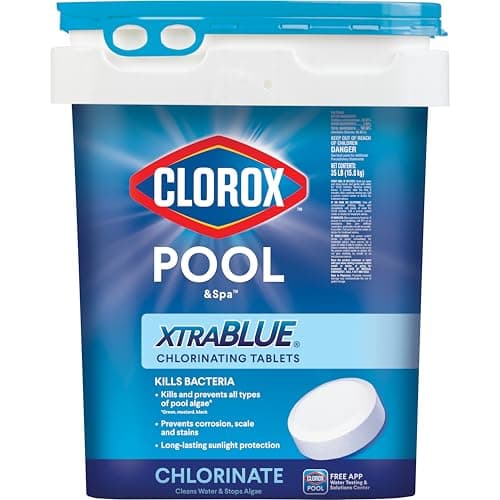
The default chlorine source
Clorox Pool&Spa 3-Inch Chlorinating Tablets
Clorox Pool&Spa
Stabilized trichlor tablets in a floating dispenser is the standard answer for a seasonal above-ground pool, and this is the standard version of it.
#ad how this is funded · price as of October 19, 2026
Key specs
- Type
- Stabilized trichlor, 3-inch tablets
- Contains stabilizer
- Yes — cyanuric acid is part of trichlor
- Dosing
- Per manufacturer instructions, by pool volume
- CDC target
- At least 2 ppm free chlorine when using a stabilizer
How it scoresour reading of published specs, not a test result
- Effectiveness
- 9.0
- Ease
- 9.0
- Water impact
- 6.0
- Cost per season
- 8.5
- Value
- 8.5
Overall 8.5 / 10
What works
- Dissolves slowly, so a floating dispenser meters chlorine out over days rather than hours
- Stabilized, so sunlight does not destroy your chlorine within an afternoon
- Widely stocked, so you are never hunting for it in July
What doesn't
- Every tablet adds cyanuric acid, and in a pool you never fully drain that accumulates until chlorine stops responding
- Trichlor is acidic and will pull your pH down over a season
- Tablets must be kept dry and sealed or they degrade and gas off
Skip it if: A small pool that is topped up rather than drained. Cyanuric acid only leaves with the water, so in a 1,500-gallon pool it climbs fast.
What it costs to run: The standing chemical cost of the season, and it scales directly with gallons. Watch the cyanuric acid reading on your test strip: once it is high, you are buying chlorine that cannot work, which is the most common invisible waste in a first pool year.
One honest season: The cheapest setup that genuinely works for a season of real swimming. Nothing spare, nothing missing.
Specs from: CDC — free chlorine target with cyanuric acid
The default shock for a vinyl pool
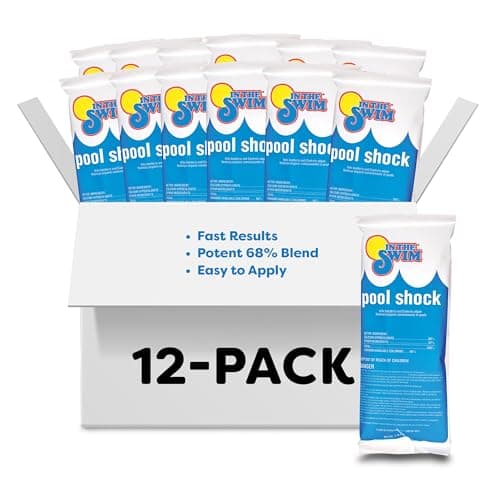
In The Swim Pool Shock, 68% Cal-Hypo, 12 x 1 lb
In The Swim
Sixty-eight percent calcium hypochlorite in pre-measured pound bags, with a published dose and a published re-entry rule. It adds calcium and no stabilizer, which is the right trade for most above-ground pools.
#ad how this is funded · price as of October 19, 2026
Key specs
- Active
- Calcium hypochlorite, 68%
- Available chlorine
- 65% minimum
- Stabilizer
- None — non-stabilized, adds no cyanuric acid
- Calcium
- Yes, it is a calcium-based shock
- Dose
- One 1 lb bag per 10,000 gal gives 5-10 ppm free chlorine in a clean, balanced pool
- Pre-dissolve
- In The Swim says vinyl pools should pre-dissolve in a bucket first
- Swim again
- Not until free chlorine is back to 1-4 ppm
How it scoresour reading of published specs, not a test result
- Effectiveness
- 9.0
- Ease
- 8.0
- Water impact
- 7.0
- Cost per season
- 8.5
- Value
- 8.5
Overall 8.4 / 10
What works
- Pre-measured 1 lb bags, so dosing a 10,000 gallon pool is one bag and no scale
- Adds no cyanuric acid, which matters because CYA only leaves a pool by dilution
- Published dose and published re-entry level, both on the product page
- The strongest available-chlorine figure of the shocks here at 65% minimum
What doesn't
- Adds calcium every time, which accumulates in hard-water areas
- Undissolved granules can bleach a vinyl liner, hence the pre-dissolve instruction
- Not stabilized, so in strong sun the chlorine it adds burns off quickly
- Twelve pounds of oxidizer needs proper, separated storage
Skip it if: Hard water. If your calcium hardness is already high, a calcium-based shock pushes it further, and our calcium hardness guide explains why that is hard to undo without draining.
What it costs to run: Shock is bought by available chlorine, not by the pound. At 65% available chlorine this delivers more oxidizer per bag than the 54% and 40% products here, which is the comparison to make before price.
One honest season: The cheapest setup that genuinely works for a season of real swimming. Nothing spare, nothing missing.
Specs from: In The Swim — pool shock treatment 1 lb bags, published analysis and dose
Pools up to about 6,000 gallons
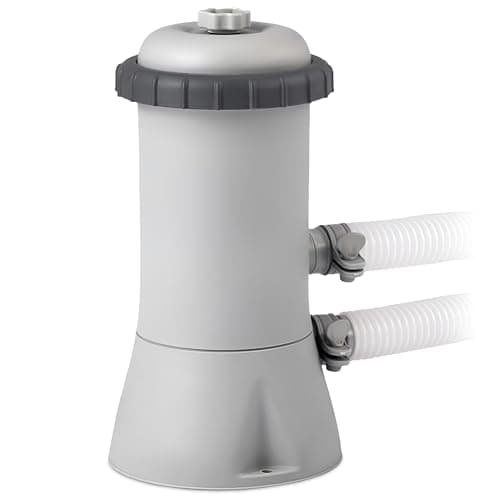
Intex Krystal Clear C1000 Cartridge Filter Pump
Intex
The workhorse replacement pump for mid-size frame pools. 1,000 GPH pump flow, 750 GPH through the system once the cartridge is in the way — and that second number is the one your turnover math needs.
#ad how this is funded · price as of October 19, 2026
Key specs
- Pump flow rate
- 1,000 GPH
- System flow rate
- 750 GPH
- Rated pool size
- Up to 6,000 gallons
- Cartridge
- Type A
- Wattage
- Not published by Intex
How it scoresour reading of published specs, not a test result
- Sizing fit
- 9.0
- Running cost
- 7.0
- Maintenance
- 7.5
- Build
- 7.5
- Value
- 8.5
Overall 8.3 / 10
What works
- Intex publishes both pump flow and system flow, which is more honesty than most of this category offers
- Type A cartridges are the most widely stocked filter consumable in the US
- Sized correctly for the 12ft-15ft frame pools most families own
What doesn't
- Wattage is not published anywhere on the Intex site, so you cannot cost it before purchase
- Cartridge-only, so there is a consumable every few weeks in a busy pool
- GFCI cord length dictates where the pool can go more than people expect
Skip it if: Pools over about 6,000 gallons. Above that you are asking it to run all day to achieve one turnover, which is the expensive way to filter.
What it costs to run: Do the turnover math before you buy: 750 GPH system flow moves 4,000 gallons in 5.3 hours. Two turnovers a day is therefore about 11 hours of running. At the EIA's June 2026 US residential average of 18.34 cents per kWh, every 100 watts of pump draw running 11 hours a day for a 120-day season costs about $24. Find your wattage on the pump label and multiply.
Several seasons: Buy-once. Built and warranted to come back out of the box for a few years, if you store it properly.
Specs from: Intex — Krystal Clear cartridge filter pumps, EIA Electric Power Monthly, Table 5.6.A — US residential average price
A large pool, bought once, from the inground specialist
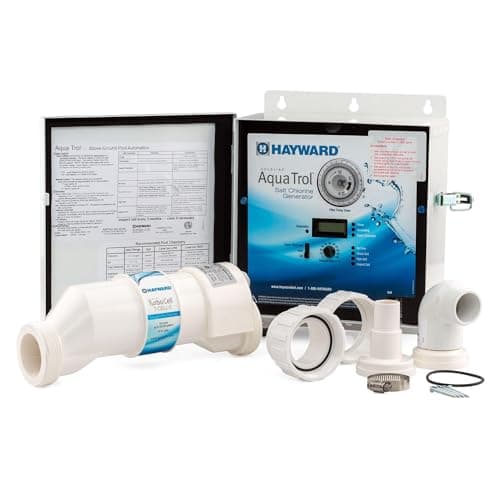
Hayward AquaTrol Salt Chlorine Generator (W3AQ-TROL-RJ-TL)
Hayward
A return-jet mounted generator rated to 18,000 gallons, with a built-in 24-hour timer that runs your filter pump as well. It is the premium end of the category by a wide margin.
#ad how this is funded · price as of October 19, 2026
Key specs
- Pool size
- Up to 18,000 gal
- Mounting
- Return jet twist lock fittings, with twist lock line cord and outlet
- Pump control
- 24-hr timer outlet for the filter pump
- Scheduling
- Multiple run periods a day, 15-minute increments
- Chlorine output
- Not published on the listing we checked
- Warranty
- 1 year parts
How it scoresour reading of published specs, not a test result
- Sizing fit
- 6.0
- Running cost
- 7.0
- Maintenance
- 8.5
- Build
- 9.0
- Value
- 5.0
Overall 7.1 / 10
What works
- Runs the filter pump on its own timer, so it replaces a separate pump timer too
- Multiple daily run periods in 15-minute steps, the most flexible scheduling here
- Return-jet mounting keeps it at the pool rather than on the equipment pad
- From the manufacturer behind much of the inground salt market
What doesn't
- Several times the price of the Intex and Bestway units — by far the most expensive option here
- Output was not published on the listing we checked, so it cannot be compared like-for-like
- One-year parts warranty on the most expensive unit in the roundup
- Rated far beyond most above-ground pools
Skip it if: Being value for money on a seasonal pool. Its strengths are real, and on a pool you drain every autumn the payback arithmetic does not reach them.
What it costs to run: The pump timer is a genuine saving — it replaces a separate purchase. It does not close the price gap. Run the numbers in our salt system payback guide before choosing this over an Intex unit.
More than you need yet: Real capability a first-pool family cannot use yet. Buy cheaper and put the difference toward chemicals and a cover.
Specs from: Hayward AquaTrol return-jet 18K gallons — published specifications (retailer listing), Hayward AquaTrol W3AQ-TROL-RJ-TL — current listing (return jet twist lock, line cord and outlet)
Questions people actually ask
How many gallons is a 12 foot above-ground pool?
How do you calculate pool volume in gallons?
Why is the gallon figure on the box lower than my calculation?
Does it matter if my gallon number is a bit wrong?
Is wall height the same as water depth?
Sources
Read next
- Above-ground pools for ordinary backyardsSoft-side, metal-frame and steel-wall pools compared by what they cost across a whole season, not at the till.
- What size pool your backyard can actually takeThe three-foot rule, the level-ground tolerance, and a table matching yard size to pool size with the running cost attached.
- What it costs to fill a pool, and to keep it fullOne fill priced for four common pool volumes at the national average water rate, plus why every gallon you add has to be re-balanced.
- Sizing a pump: the number on the box is not the number you useTurnover time computed from published system flow rates for common pool volumes, and why an oversized pump costs you money every day.
- The weekly pool routine, and how little time it really takesThe daily, weekly and monthly jobs written as a schedule, with the kit each one needs and roughly how long it takes.
- Pool shock: what else you are adding decides which one to buyCal-hypo and dichlor shock compared on available chlorine, what each adds to the water for good, published doses and how long before you can swim.
- The best salt systems for an above-ground pool start with your pumpFive named salt chlorine generators for above-ground pools compared on pump flow, pool rating, chlorine output and installation — the four specs that decide fit.
- What a season of pool chemicals actually adds up toSeason chemical quantities computed from published dosing for four pool volumes, plus the shopping list that is genuinely necessary.
- Fifty-two inches is where the pool becomes chest-deepDeep-wall 52-inch above-ground pools compared on what the extra depth buys, what it costs in water and ground preparation, and who it suits.