Above-Ground Pools
The neighbor questions to answer before the pool goes up
Almost every pool dispute is about one of four things, and all four are decided on siting day - when they cost nothing to fix.

Heads up: we earn a commission if you buy through the links on this page, at no extra cost to you. It never decides the ranking — here is how we pick and here is the full disclosure. Prices are checked automatically; last verified October 8, 2026.
The short version
- Four causes, and all are siting decisions — pump noise, overlooking, water discharge, and where the splash lands.
- The pump is the only thing running when nobody is swimming. Site it away from the boundary and put it on a timer.
- A four-foot wall changes sight lines both ways. Standing in a pool puts your eye level above a typical fence.
- Several thousand gallons has to go somewhere, and it must not be the neighbor’s garden.
One: the pump, which runs when you are not there
Swimming is intermittent and cheerful; the pump is continuous and mechanical, and it is the thing that runs at eight in the morning while somebody next door is reading in their garden. It is by a distance the most common source of complaint.
Three decisions fix it, and all three are free. Site the pump on the side away from the nearest boundary rather than wherever the outlet happens to be. Stand it on something solid — a paving slab rather than bare soil — because a pump vibrating against a hollow or resonant surface is much louder than the same pump on a slab. And put it on a timer so it runs in the middle of the day rather than early morning or late evening.
The timer is worth having regardless, because pump electricity is the largest running cost of owning a pool and run time is the variable you control — our run-time guide derives the hours from your own turnover figure. If the pump is genuinely noisy rather than just present, that is usually a fault rather than a characteristic, and our pump noise guide covers diagnosing it.
Two: overlooking, which surprises people
A 42-inch or 52-inch wall raises the floor you are standing on by a meaningful amount. Stand in a pool on a 52-inch wall and your eye level is roughly four feet higher than it is on the lawn — frequently above the top of a boundary fence.
That changes sight lines in both directions, and it is worth walking before you build: stand on a step-ladder at the intended spot and look around. If the answer is that you are looking into a bedroom window or a neighbor’s patio, moving the pool ten feet on siting day is free and moving it after it is full is not — our guide to moving a pool covers what that actually involves.
Screening is the other answer, and planting on the boundary side does double duty: it addresses the sight line and it acts as a windbreak, which reduces evaporation and therefore heat loss.
Three: where several thousand gallons goes
At some point the pool gets drained — partially mid-season to bring stabilizer down, and fully at the end of the season or at a take-down. A 15-foot pool holds 3,955 gallons and an 18-foot one 6,981, and all of it has to go somewhere.
Water released in one spot saturates ground, can undermine a path or a wall, and on any slope finds the lowest point — which may be next door or under a building. Drain slowly, move the outflow around, and direct it away from boundaries and structures. Let the chlorine level fall for several days first, and check your local rules on discharging pool water, which vary and which we cannot look up for you.
This is also a siting decision: our surface and siting guide covers looking at where water goes before the pool goes in rather than after, and the take-down guide covers doing it properly at the end of the season.
| Cause | Decision | Cost if made early |
|---|---|---|
| Pump noise | Site away from the boundary, on a slab, on a timer | Nothing |
| Overlooking | Check sight lines from a step-ladder first | Nothing |
| Draining water | Plan the route away from boundaries and buildings | Nothing |
| Splash and traffic | Put the entry side away from the fence | Nothing |
| Any of the above, fixed later | Drain, dismantle, level a new pad, rebuild | A weekend, at best |
Four: splash, traffic and the wet side
The side of the pool with the ladder is the side that gets the traffic, the splash and the permanently wet ground. Putting that side against a boundary means the wet, muddy strip is exactly where you cannot easily maintain it, and it is where noise is loudest for the neighbor.
Turn the ladder toward the house instead. It also improves supervision, because the entry point is the part you most want to be able to see from a window — and it keeps the removable ladder somewhere you will actually remember to take out. Our ladder guide covers why removable or lockable outer steps are the practical barrier on an above-ground pool.
The rules that are not about being polite
Some of this is governed rather than negotiated. Setbacks from property lines, barrier requirements, overhead power line clearances and permit thresholds are all set locally, and an HOA can be stricter than the law. Those are phone calls rather than judgment calls, and they are worth making before you buy, because any of them can change which pool you get and where it goes.
Our permits and rules guide lists exactly what to ask the building department, the HOA and your insurer, and the renters guide covers the extra conversation if you do not own the house.
The one thing worth being generous about
Noise you can control, sight lines you can screen, water you can direct. The thing you cannot control is that children in a pool are loud, and that is a normal use of a garden on a hot afternoon.
What makes that a non-issue rather than a grievance is everything else on this page being handled: if the pump is quiet, nothing overlooks anyone and no water has ever appeared next door, an hour of shrieking on a Saturday is just summer. If those things are not handled, it is the last item on a list.
What to buy
Scores are our own reading of published specifications. They are not test results — we have not tested these products and we do not claim to.
Cutting the electricity bill without cutting filtration
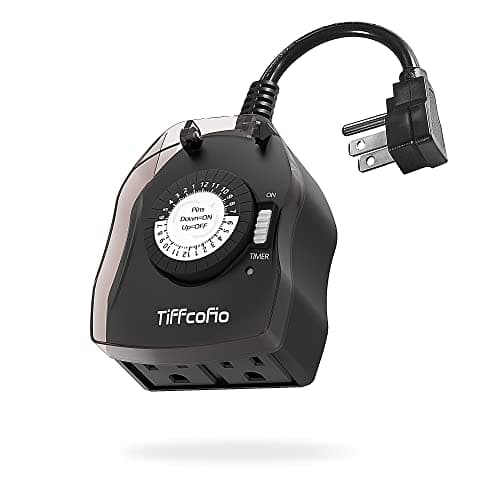
Outdoor Pool Pump Timer
Various
A weatherproof outdoor timer is the highest-return equipment purchase on this site. Most people run the pump too long because remembering to switch it off is a chore.
#ad how this is funded · price as of October 8, 2026
Key specs
- Type
- Outdoor-rated mechanical or digital timer
- Required rating
- Must be rated for the pump's amperage and for outdoor use
- Must not defeat
- The pump's GFCI protection
How it scoresour reading of published specs, not a test result
- Sizing fit
- 8.5
- Running cost
- 9.8
- Maintenance
- 9.0
- Build
- 7.5
- Value
- 9.5
Overall 9.0 / 10
What works
- Turns your filtration from a guess into a schedule
- Pays for itself within a single season on most pools
- Lets you shift running hours to off-peak if your utility has time-of-use rates
What doesn't
- Must be genuinely outdoor-rated and correctly amperage-matched, which cheap indoor timers are not
- Never bypass or defeat the pump's GFCI to fit one
- Mechanical timers drift and need resetting after a power cut
Skip it if: Fixing an undersized pump. Running the wrong pump on a schedule just makes the schedule longer.
What it costs to run: The arithmetic that justifies it: at the EIA's June 2026 US residential average of 18.34 cents per kWh, trimming a 400 W pump from 12 hours to 8 hours a day across a 120-day season saves 192 kWh, or about $35. That is more than the timer costs.
Several seasons: Buy-once. Built and warranted to come back out of the box for a few years, if you store it properly.
Specs from: EIA Electric Power Monthly, Table 5.6.A
The single highest-return accessory here
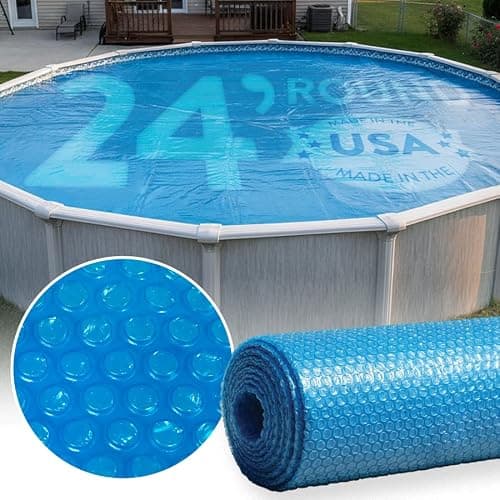
Bubble Solar Cover for Above-Ground Pools
Various
It cuts evaporation, and evaporation is simultaneously your water bill, your chemical bill and your heat loss. Nothing else on this site reduces three costs at once.
#ad how this is funded · price as of October 8, 2026
Key specs
- Construction
- Bubble sheet, thickness published in mil
- Thickness
- Higher mil lasts longer — 12 mil and 16 mil are common
- Fit
- Cut to size; buy oversize and trim
- Orientation
- Bubbles face down, toward the water
How it scoresour reading of published specs, not a test result
- Retention
- 9.0
- Durability
- 7.0
- Handling
- 6.0
- Running cost
- 9.8
- Value
- 9.5
Overall 9.0 / 10
What works
- Reduces evaporation, which is the mechanism behind the water, chemical and heat savings all at once
- Cheap relative to everything it saves
- Can be cut to fit any pool shape, so sizing is forgiving
What doesn't
- Awkward to get on and off without a reel, and awkward is how covers end up unused
- Degrades in UV like every vinyl product
- Not a safety cover and will not support weight — this is important
Skip it if: Being a safety barrier. A solar cover looks solid and is not; a child or pet on it goes through and under.
What it costs to run: The one accessory with a clear payback. Every gallon that does not evaporate is a gallon you do not replace at the EPA WaterSense national average of $6.06 per 1,000 gallons, and it is chlorine you do not re-dose. If you buy one thing from this hub, buy this.
Several seasons: Buy-once. Built and warranted to come back out of the box for a few years, if you store it properly.
Specs from: EPA WaterSense — cost per 1,000 gallons
Getting in and out safely
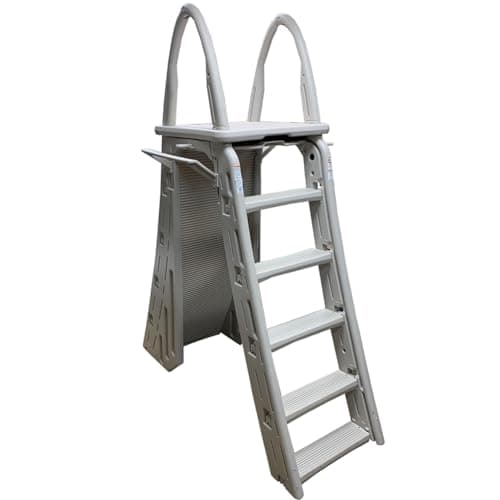
A-Frame Above-Ground Pool Ladder
Various
Read the published weight limit before anything else. It is frequently lower than buyers assume, and it is the one spec on a ladder that genuinely matters.
#ad how this is funded · price as of October 8, 2026
Key specs
- Critical spec
- Published weight capacity — check it against every adult who will use it
- Height match
- Must match your wall height, not approximate it
- Safety feature
- Removable or lockable outer steps on better models
How it scoresour reading of published specs, not a test result
- Sizing fit
- 8.5
- Running cost
- 10.0
- Maintenance
- 8.5
- Build
- 7.5
- Value
- 8.5
Overall 8.4 / 10
What works
- Removable outer steps genuinely prevent unsupervised access, which is a real safety layer
- Resin frames do not corrode the way early steel ladders did
- Correctly matched height is far more stable than a too-tall ladder
What doesn't
- Weight limits are often lower than people expect and are easy to overlook in a listing
- A ladder sized for a 42-inch wall is wrong on a 52-inch wall and vice versa
- Cheap models flex enough to feel alarming
Skip it if: Being a barrier on its own. The CPSC's guidance treats barriers, supervision and alarms as layers; a removable step is one layer, not the answer.
What it costs to run: Buy it with the pool. Kits that include a ladder are frequently cheaper than the pool-plus-ladder bought separately, and this is one of the accessories that makes a cheap-looking kit expensive.
Several seasons: Buy-once. Built and warranted to come back out of the box for a few years, if you store it properly.
Specs from: CPSC — Pool Safely
Small frame and inflatable pools
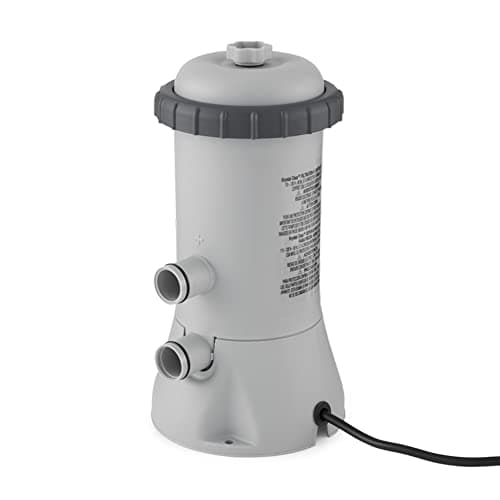
Intex Krystal Clear C530 Cartridge Filter Pump
Intex
530 GPH pump flow, 475 GPH through the system. The right pump for a 12-foot pool and badly undersized for anything much bigger.
#ad how this is funded · price as of October 8, 2026
Key specs
- Pump flow rate
- 530 GPH
- System flow rate
- 475 GPH
- Cartridge
- Type A
- Wattage
- Not published by Intex
How it scoresour reading of published specs, not a test result
- Sizing fit
- 8.0
- Running cost
- 9.0
- Maintenance
- 7.0
- Build
- 7.0
- Value
- 8.5
Overall 8.0 / 10
What works
- Correctly matched to the 12ft Prism Frame and Easy Set pools it ships with
- Smallest pump here that will still genuinely turn over a real pool
- Type A cartridges, which are everywhere
What doesn't
- Undersized the moment you upgrade the pool, and it will not carry over
- No wattage published
- Cartridge needs rinsing frequently in a busy small pool
Skip it if: Anything over about 2,000 gallons. Below that it is right; above it you are running it all day for one turnover.
What it costs to run: 475 GPH system flow turns over 1,718 gallons in about 3.6 hours, so a 7-hour daily run is two full turnovers. That is a genuinely short run time and it is where a small pool's low running cost actually comes from.
One honest season: The cheapest setup that genuinely works for a season of real swimming. Nothing spare, nothing missing.
Specs from: Intex — Krystal Clear cartridge filter pumps
Questions people actually ask
How loud is an above-ground pool pump?
Do I need to tell my neighbors before putting up a pool?
Where should I drain pool water so it does not affect neighbors?
Will an above-ground pool let me see into next door?
Sources
Read next
- Above-ground pools for ordinary backyardsSoft-side, metal-frame and steel-wall pools compared by what they cost across a whole season, not at the till.
- Permits, fences and the calls to make before you buyThe questions that decide whether you need a permit or a barrier, who to ask, and the safety layers that apply regardless of what the rules say.
- What an above-ground pool can and cannot sit onEvery common surface assessed, with the load per square foot each pool size actually applies - the number that rules a deck in or out.
- A pool at a rented place, without losing the depositWhat to ask a landlord before buying, what actually risks a deposit, and which pools make sense when you might move.
- Four pump noises, and only one of them is expensiveHow to diagnose a pool pump by the noise it is making, which faults are free to fix, and how to quiet a healthy pump.
- How long to run the pump, worked out rather than repeatedRun time derived from your own turnover time, when in the day to run it, and what each hour a day costs across a season.
- Taking the pool down without ruining itThe take-down sequence for a seasonal pool: draining responsibly, drying completely, folding warm, and storing where rodents are not.