Above-Ground Pools
A pool at a rented place, without losing the deposit
The pool is the easy part. The lawn underneath it, the water you have to put somewhere, and the sentence in your tenancy agreement are the parts that cost money.
Heads up: we earn a commission if you buy through the links on this page, at no extra cost to you. It never decides the ranking — here is how we pick and here is the full disclosure. Prices are checked automatically; last verified October 8, 2026.
The short version
- Ask in writing, before buying. Verbal permission is worth nothing at the end of a tenancy, and a pool is exactly the kind of thing agreements cover in a sentence nobody reads.
- The lawn is the deposit risk, not the pool. Grass under a pool dies, and the recovery takes weeks, not days.
- Buy for portability. If you may move within two years, the pool that packs into a car is worth more than the pool that holds more water.
- Plan the drain before the fill. Several thousand gallons has to go somewhere that is not the neighbor’s garden or a basement.
The conversation to have first
Most tenancy agreements do not mention pools specifically. That is not permission; it means the question falls under general clauses about alterations, the condition of the garden, and anything that affects the landlord’s insurance. Asking is not optional and doing it in writing is what makes the answer useful later.
| Ask | Why it matters | Get it in writing? |
|---|---|---|
| Is a temporary above-ground pool permitted? | General alteration clauses usually cover it | Yes |
| Any size limit, or must it come down seasonally? | Changes which pool you should buy | Yes |
| Is the lawn condition expected to be restored? | This is the actual deposit risk | Yes |
| Does it affect their insurance or require anything? | Their policy, their answer | Yes |
| Where may several thousand gallons be drained? | Saturated ground and drains are their problem too | Ideally |
The deposit risk is the grass
The pool itself leaves nothing behind. What it leaves behind is a perfect circle of dead, compacted lawn, because grass under a pool has had no light for four months and several tons of pressure on it.
This is manageable and it is entirely predictable, which means it can be planned for rather than discovered at check-out. Our pool and lawn guide covers the recovery in detail; the short version is that it takes weeks of growing season, so a pool that comes down in late August leaves you time and one that comes down in October does not.
The second, less obvious risk is water. Several thousand gallons released in one place saturates ground, can undermine a path, and in the wrong spot finds its way into a building. At the EPA WaterSense national average of $6.06 per 1,000 gallons the water is cheap; the damage is not. Drain slowly, move the hose around, and direct it away from the house and away from boundaries.
Buy for the move you might make
This is where renting genuinely changes the buying decision, and it points in an unusual direction: the cheap pool is often the correct pool, not the compromise.
A 12-foot inflatable packs into a car, sets up in about ten minutes according to Intex’s published claim, holds 1,485 gallons at 80 percent full, and costs about $9 of water to fill. If you move next spring, it comes with you and nothing is wasted. A 12-foot frame pool is the step up: 1,718 gallons, a bolted frame, still genuinely portable, and it will come back out of the box for several seasons if stored properly.
Above that, portability falls away quickly. A 15-foot pool is a two-person take-down and a large 18-foot steel-wall pool is not designed to be moved casually at all — our guide to moving a pool covers what that actually involves. If there is a real chance you will be somewhere else next summer, that is a strong argument for staying small.
| Pool | Gallons | Take-down | Moves well? |
|---|---|---|---|
| 12ft inflatable | 1,485 | One person, an afternoon | Yes — car boot |
| 12ft frame | 1,718 | One or two people, a day | Yes |
| 15ft frame | 3,955 | Two people, a weekend | With effort |
| 18ft steel wall | 6,981 | Not a casual job | No |
The things that are the same as anywhere
Renting does not change the physics. You still need genuinely level ground and a ground cloth — and at a rented property the cloth is doing double duty, because it also protects the lawn slightly and keeps the underside of the liner clean for the move. Our leveling guide is the method.
You still need a protected outdoor outlet for the pump, and an extension cord across a garden is not the answer — which at a rented property means asking rather than installing. Our electrical safety guide covers why it matters and what is and is not a tenant job. If there is no suitable outlet, that may simply decide the question.
And local rules still apply regardless of who owns the house. Permit thresholds and barrier requirements are set by your jurisdiction, not your landlord, and both of them can have a say — our permits and rules guide covers the calls to make.
The end-of-tenancy checklist
Drain slowly and spread it. Take the pool down on a mild day and dry the liner fully before it goes in a box, or you will unpack mildew next summer — our storage guide is the routine. Lift the ground cloth and let the ground breathe. Then reseed or turf the circle and give it as much growing season as you can.
Photograph the lawn before the pool goes up and again after it recovers. That single habit converts an argument at check-out into a two-minute conversation.
What to buy
Scores are our own reading of published specifications. They are not test results — we have not tested these products and we do not claim to.
Water in the yard this weekend
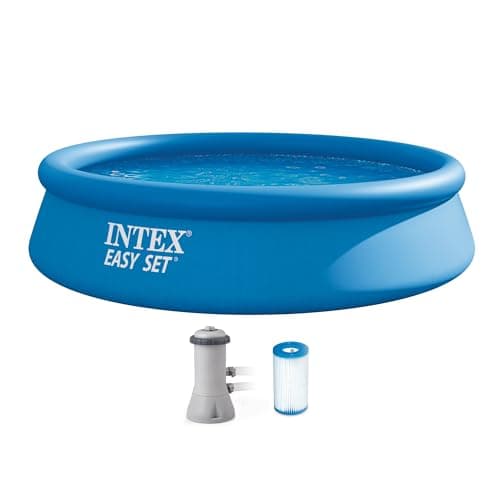
Intex Easy Set Pool Set, 12ft x 30in
Intex
Inflate the ring, add water, done. It is the fastest route from box to swimming that exists, and it is honest about being a seasonal item rather than a fixture.
#ad how this is funded · price as of October 8, 2026
Key specs
- Water capacity
- 1,485 gallons (80% full)
- Water depth
- 23 inches
- Pump supplied
- 530 GPH Krystal Clear cartridge pump
- Material
- 3-ply, puncture resistant
- Manufacturer setup claim
- Ready for water in about 10 minutes
- Pump wattage
- Not published by Intex
How it scoresour reading of published specs, not a test result
- Build
- 5.5
- Setup
- 9.8
- Upkeep
- 8.5
- Running cost
- 9.2
- Value
- 8.8
Overall 8.3 / 10
What works
- Genuinely 10 minutes to set up — the top ring rises with the water and there is no frame to assemble
- 1,485 gallons at 80% is a real, filterable pool rather than a paddling pool
- Comes down as fast as it goes up, which makes mid-season relocation possible
- Cheapest way to find out whether your family actually wants a pool before committing to a frame one
What doesn't
- The inflated ring is the single point of failure and it is exposed to sun all season
- 23 inches of water is shallow — this is for cooling off, not swimming
- Soft walls flex, so it needs level ground as much as a frame pool does
Skip it if: Lasting. Treat this as a two-or-three-season item at best and you will not be disappointed; expect five years and you will be.
What it costs to run: A fill at the EPA WaterSense average of $6.06 per 1,000 gallons is about $9. The 530 GPH pump moves 1,485 gallons in under three hours, so this is a pool where a genuinely short daily run does the job — which is where the running-cost saving actually comes from.
One honest season: The cheapest setup that genuinely works for a season of real swimming. Nothing spare, nothing missing.
Specs from: Intex — Easy Set 12' x 30' pool set, EPA WaterSense — cost per 1,000 gallons
The direct alternative to the Easy Set
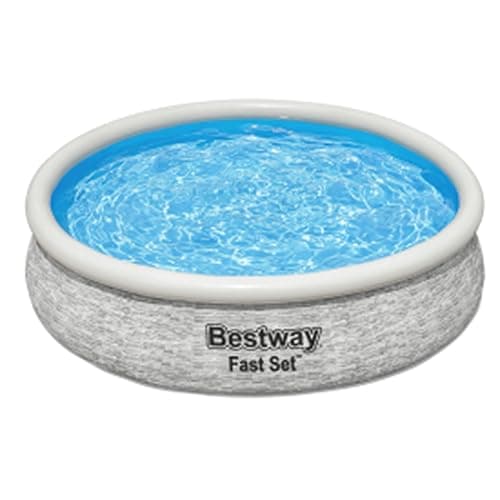
Bestway Fast Set Inflatable Pool, 12ft
Bestway
Bestway's answer to the Intex Easy Set, built the same way and priced against it. Buy whichever is cheaper on the day; there is no meaningful difference in the construction.
Key specs
- Nominal size
- 12ft diameter
- Construction
- Inflatable top ring, soft wall
- Water capacity
- Varies by SKU — Bestway publishes it per model
- Pump supplied
- Varies by SKU
- Pump wattage
- Not published
How it scoresour reading of published specs, not a test result
- Build
- 5.5
- Setup
- 9.5
- Upkeep
- 8.5
- Running cost
- 9.2
- Value
- 8.5
Overall 8.0 / 10
What works
- Same inflate-and-fill design as the Easy Set with the same ten-minute setup
- Frequently cheaper than the Intex equivalent, and the two are close enough that price should decide it
- Bestway publishes capacity per SKU, so you can dose correctly from day one
What doesn't
- Same exposed inflatable ring, same failure mode
- Cartridge availability is slightly thinner than Intex in most US stores
- SKU numbering makes it easy to buy the pool-only version by mistake
Skip it if: Being distinguishable from its Intex rival. If you were hoping for a reason to prefer one, the honest answer is price and stock.
What it costs to run: Identical running-cost profile to the Easy Set at the same size. The decision that actually moves your annual bill is the pool's gallons, not the badge on it.
One honest season: The cheapest setup that genuinely works for a season of real swimming. Nothing spare, nothing missing.
Specs from: Bestway USA
Small yards and first-time owners
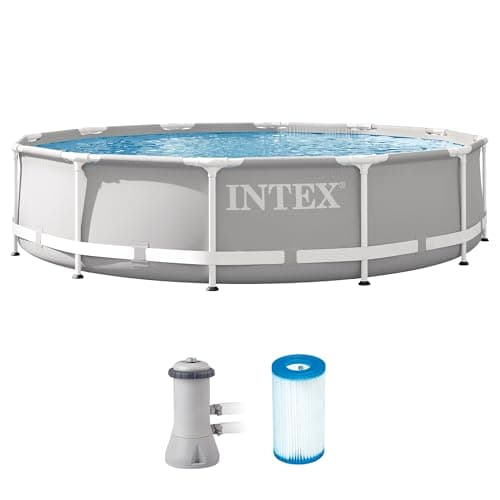
Intex Prism Frame Pool Set, 12ft x 30in
Intex
The size most people should buy first and the one most people talk themselves out of. 1,718 gallons is cheap to fill, cheap to treat, and forgiving of every mistake you are about to make.
Key specs
- Water capacity
- 1,718 gallons
- Pump supplied
- Krystal Clear C530 — 530 GPH pump / 475 GPH system
- Frame
- Powder-coated metal, tool-free Easy Lock
- Liner
- 3-ply, puncture resistant
- Manufacturer setup claim
- Ready in 30 minutes
- Pump wattage
- Not published by Intex
How it scoresour reading of published specs, not a test result
- Build
- 7.0
- Setup
- 9.0
- Upkeep
- 9.0
- Running cost
- 9.0
- Value
- 9.0
Overall 8.6 / 10
What works
- A 12-foot circle fits in a yard where a 15 or 18 will not, once you allow three feet of walking space
- 1,718 gallons turns over in about 3.6 hours on the supplied 475 GPH system flow — so a short daily run genuinely filters it
- Cheapest of the frame pools to make a mistake in: a bad chemical week costs a few dollars, not a few tens
- Tool-free assembly is real, not marketing — this is a genuinely one-afternoon job
What doesn't
- 30-inch wall means shallow water and it warms and cools fast
- Small enough that three adults fill it
- The C530 is sized for exactly this pool and nothing bigger, so it does not carry over if you upgrade
Skip it if: Anyone planning to swim rather than sit. This is a cooling-off and playing pool and it is very good at that.
What it costs to run: The cheapest frame pool here to run, and the gap is not small. At the EPA WaterSense average of $6.06 per 1,000 gallons a fill is about $10. Its turnover math — 1,718 gallons at 475 GPH system flow — means roughly 3.6 hours per full turnover, so a 7-8 hour daily run is two full turnovers rather than a partial one.
One honest season: The cheapest setup that genuinely works for a season of real swimming. Nothing spare, nothing missing.
Specs from: Intex — Prism Frame 12' x 30' pool set, Intex — Krystal Clear cartridge filter pumps
Protecting the liner from below
Pool Ground Cloth / Under-Pool Pad
Various
Most liner punctures come from underneath, from a stone or a root you did not see. A ground cloth is the cheapest way to avoid the most expensive repair in above-ground pool ownership.
Key specs
- Function
- Barrier between ground and liner
- Sizing
- Should extend past the pool footprint
- Included with
- Some kits — check before buying separately
How it scoresour reading of published specs, not a test result
- Retention
- 8.0
- Durability
- 7.5
- Handling
- 8.5
- Running cost
- 10.0
- Value
- 9.0
Overall 8.5 / 10
What works
- Prevents the failure mode that ends pools: a puncture in the floor you cannot reach to patch
- Also slows grass and weeds growing up under the pool
- Included free in better kits, so check before you buy one
What doesn't
- Not a substitute for actually clearing stones and roots first
- Thin ones tear during installation before the pool is even up
- Traps moisture, which kills the grass underneath regardless
Skip it if: Fixing uneven ground. It protects against punctures; it does nothing about level, and level is the bigger problem.
What it costs to run: Compare its cost to a liner replacement, which is the single largest unplanned expense in above-ground pool ownership. It is not a close call.
Several seasons: Buy-once. Built and warranted to come back out of the box for a few years, if you store it properly.
Questions people actually ask
Can I put an above-ground pool up at a rented house?
Will a pool damage the lawn and cost me my deposit?
Which pool is best if I might move house?
Where should I drain a pool at a rented property?
Sources
Read next
- Above-ground pools for ordinary backyardsSoft-side, metal-frame and steel-wall pools compared by what they cost across a whole season, not at the till.
- Permits, fences and the calls to make before you buyThe questions that decide whether you need a permit or a barrier, who to ask, and the safety layers that apply regardless of what the rules say.
- Moving a pool, and the two things that decide whether it survivesThe sequence for relocating an above-ground pool across the garden or to a new house, and an honest read on when it is not worth it.
- The circle of dead grass, and how long it really takes to fixWhy grass under a pool dies, how long recovery actually takes, and the timing decision that halves it.
- The best inflatable backyard poolsSoft-side pools compared on published capacity and setup time, plus what actually destroys them and how to slow it down.
- The cheapest pool setup that actually works for a yearA complete, deliberately minimal first-year setup: the pool, the pump, the testing, the chlorine and the one tool you will use most.
- Taking the pool down without ruining itThe take-down sequence for a seasonal pool: draining responsibly, drying completely, folding warm, and storing where rodents are not.