Pool Equipment
Four pump noises, and only one of them is expensive
New noise from a pool pump is almost always a restriction upstream rather than a failing motor. Diagnosing by sound gets you to the right check in about a minute.

Heads up: we earn a commission if you buy through the links on this page, at no extra cost to you. It never decides the ranking — here is how we pick and here is the full disclosure. Prices are checked automatically; last verified October 8, 2026.
The short version
- New noise is usually cavitation — the pump straining against a restriction on the suction side and pulling air out of the water.
- Gurgling means the water level, almost always. Check that before anything else, because it is free and it is right most of the time.
- A deep hum with no flow is not a noise problem, it is a pump that has lost prime or a motor that will not start.
- A healthy pump can still be too loud for its location, and that is a mounting problem with a free fix.
Diagnosing by sound
Pool pumps make a small number of distinct noises and each points somewhere specific. Working from the sound gets you to the right check faster than working from the symptom, and every check below is free.
| Noise | Likely cause | Check |
|---|---|---|
| Gurgling, sucking, intermittent | Water level below the middle of the skimmer opening | Top up the pool |
| Rattling, like gravel in the housing | Cavitation — a restriction on the suction side | Baskets, hose kinks, cartridge |
| Loud, strained running with weak return | Loaded filter media | Rinse or replace the cartridge; backwash sand |
| Deep hum, nothing moving | Lost prime, or a motor that will not start | Prime it; if it still hums, it is the motor |
| Buzzing or vibration through the ground | Mounting rather than mechanics | Stand it on a slab |
| Screeching that rises with speed | Bearings — the one genuinely bad sign | Plan a replacement |
Cavitation, which accounts for most of it
When a pump cannot draw water as fast as it wants to, it starts pulling dissolved air out of the water instead. The bubbles collapse violently inside the housing, which produces the characteristic rattle — it genuinely sounds like gravel.
It is not a fault in the pump. It is the pump reporting a restriction upstream of it, and the list is short: a water level below the middle of the skimmer opening, a full skimmer basket, a full pump strainer basket, a kinked or collapsed hose, or filter media loaded past the point where rinsing helps.
Work through those in that order and the noise almost always resolves. Our troubleshooting guide is the same sequence approached from the symptom side, and the skimmer guide covers the operating window that catches most people.
The noises that are not the pump
Gurgling is water and air arriving together, and on a small pool it is usually a level that has dropped through evaporation. It takes ten seconds to check and a solar cover reduces how often it happens.
Vibration through decking or a hollow base is a mounting problem. The same pump on bare soil, on a hollow plastic box and on a paving slab produces three noticeably different amounts of noise, because the surface it sits on either damps the vibration or amplifies it.
A rushing sound at the return is normal water noise and is a function of flow and jet angle. Angling the return slightly downward reduces surface turbulence and the noise with it — and it also stops the jet blowing floating debris away from the skimmer.
Quieting a pump that is working correctly
If the checks come back clean and the pump is simply audible, the fixes are all cheap and none of them involves the pump itself.
Stand it on a solid slab. A paving slab on firm ground, not directly on soil and not on anything hollow. This is the single biggest change available.
Add a rubber mat under it. Anything that decouples the housing from the slab reduces transmitted vibration, provided it does not block ventilation.
Check nothing is touching it. A hose resting against a fence panel, or the housing touching a wall, turns that surface into a soundboard.
Move the run time. The pump running at eleven in the morning is a different proposition from the pump running at seven. Two shorter daytime blocks cost the same electricity as one long one and avoid the quiet hours entirely — our run-time guide covers scheduling and the neighbors guide covers why this is the most common source of complaint.
The one noise that means replacement
A rising screech or a metallic whine that tracks with motor speed, present from the moment it starts and not affected by anything you do upstream, is a bearing. That is a mechanical failure inside a sealed consumer unit, and parts availability in this category is poor enough that replacement is the realistic answer.
The same is true of a motor that hums loudly without starting, or trips protection repeatedly — and repeated tripping specifically is a stop-and-call-an-electrician situation rather than a maintenance one, as our electrical safety guide sets out.
When you do replace it, size to your gallons rather than to the shelf and check the hose fittings before ordering — fitting mismatch is the most common reason a correctly sized pump goes back, which our fittings guide covers.
What normal sounds like
Worth stating, because “is this normal” is the actual question. A healthy small cartridge pump is a steady, unremarkable hum with a soft rush of water at the return. It does not change pitch, it does not rattle, and it sounds the same on the first day of the season as on the last.
Change is the signal, not volume. A pump that has always been slightly loud and still is, is fine. A pump that sounded different this morning is telling you something upstream changed — and it is almost always the water level, a basket or the cartridge.
What to buy
Scores are our own reading of published specifications. They are not test results — we have not tested these products and we do not claim to.
Small frame and inflatable pools
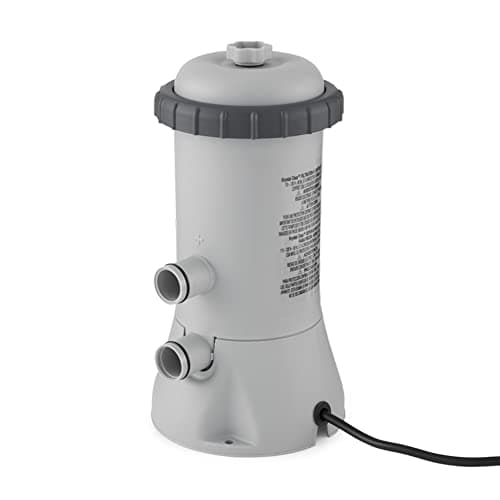
Intex Krystal Clear C530 Cartridge Filter Pump
Intex
530 GPH pump flow, 475 GPH through the system. The right pump for a 12-foot pool and badly undersized for anything much bigger.
#ad how this is funded · price as of October 8, 2026
Key specs
- Pump flow rate
- 530 GPH
- System flow rate
- 475 GPH
- Cartridge
- Type A
- Wattage
- Not published by Intex
How it scoresour reading of published specs, not a test result
- Sizing fit
- 8.0
- Running cost
- 9.0
- Maintenance
- 7.0
- Build
- 7.0
- Value
- 8.5
Overall 8.0 / 10
What works
- Correctly matched to the 12ft Prism Frame and Easy Set pools it ships with
- Smallest pump here that will still genuinely turn over a real pool
- Type A cartridges, which are everywhere
What doesn't
- Undersized the moment you upgrade the pool, and it will not carry over
- No wattage published
- Cartridge needs rinsing frequently in a busy small pool
Skip it if: Anything over about 2,000 gallons. Below that it is right; above it you are running it all day for one turnover.
What it costs to run: 475 GPH system flow turns over 1,718 gallons in about 3.6 hours, so a 7-hour daily run is two full turnovers. That is a genuinely short run time and it is where a small pool's low running cost actually comes from.
One honest season: The cheapest setup that genuinely works for a season of real swimming. Nothing spare, nothing missing.
Specs from: Intex — Krystal Clear cartridge filter pumps
Pools up to about 6,000 gallons
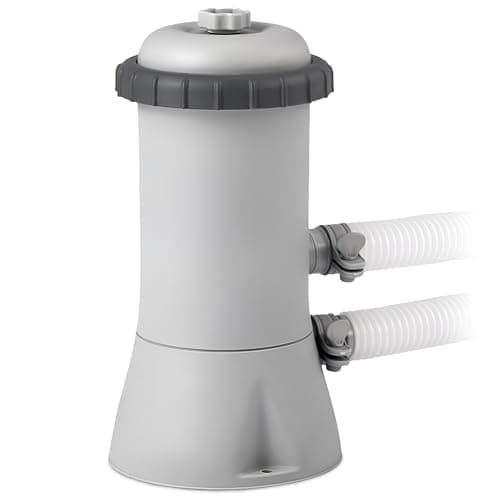
Intex Krystal Clear C1000 Cartridge Filter Pump
Intex
The workhorse replacement pump for mid-size frame pools. 1,000 GPH pump flow, 750 GPH through the system once the cartridge is in the way — and that second number is the one your turnover math needs.
#ad how this is funded · price as of October 8, 2026
Key specs
- Pump flow rate
- 1,000 GPH
- System flow rate
- 750 GPH
- Rated pool size
- Up to 6,000 gallons
- Cartridge
- Type A
- Wattage
- Not published by Intex
How it scoresour reading of published specs, not a test result
- Sizing fit
- 9.0
- Running cost
- 7.0
- Maintenance
- 7.5
- Build
- 7.5
- Value
- 8.5
Overall 8.3 / 10
What works
- Intex publishes both pump flow and system flow, which is more honesty than most of this category offers
- Type A cartridges are the most widely stocked filter consumable in the US
- Sized correctly for the 12ft-15ft frame pools most families own
What doesn't
- Wattage is not published anywhere on the Intex site, so you cannot cost it before purchase
- Cartridge-only, so there is a consumable every few weeks in a busy pool
- GFCI cord length dictates where the pool can go more than people expect
Skip it if: Pools over about 6,000 gallons. Above that you are asking it to run all day to achieve one turnover, which is the expensive way to filter.
What it costs to run: Do the turnover math before you buy: 750 GPH system flow moves 4,000 gallons in 5.3 hours. Two turnovers a day is therefore about 11 hours of running. At the EIA's June 2026 US residential average of 18.34 cents per kWh, every 100 watts of pump draw running 11 hours a day for a 120-day season costs about $24. Find your wattage on the pump label and multiply.
Several seasons: Buy-once. Built and warranted to come back out of the box for a few years, if you store it properly.
Specs from: Intex — Krystal Clear cartridge filter pumps, EIA Electric Power Monthly, Table 5.6.A — US residential average price
Getting off the cartridge treadmill
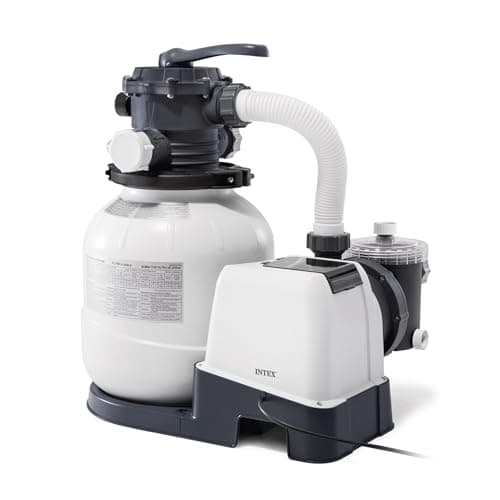
Intex Krystal Clear Sand Filter Pump
Intex
Sand filtration replaces a recurring cartridge purchase with a backwash valve and a bag of sand that lasts years. On a pool you intend to keep, the arithmetic favors it.
Key specs
- Media
- Filter sand (or glass media)
- Maintenance
- Backwash rather than rinse-and-replace
- Media life
- Several seasons before replacement
- Wattage
- Not published by Intex
How it scoresour reading of published specs, not a test result
- Sizing fit
- 8.5
- Running cost
- 8.0
- Maintenance
- 8.5
- Build
- 8.0
- Value
- 8.5
Overall 8.4 / 10
What works
- No cartridges to buy, which removes the single largest recurring equipment cost
- Backwashing takes about two minutes versus rinsing a cartridge in the yard
- Sand lasts years rather than weeks
What doesn't
- Backwashing sends water down the drain, and that water has chemicals in it you paid for
- Higher purchase price than a cartridge pump of the same flow
- Heavier and needs a stable, level base of its own
Skip it if: A small seasonal pool that comes down every autumn. The payback period is measured in seasons, so it only works if there will be seasons.
What it costs to run: The comparison to run: cartridge replacements per season versus one bag of sand every few years, plus the water each backwash discards at the EPA WaterSense average of $6.06 per 1,000 gallons. On a pool you will own for three or more years, sand usually wins.
Several seasons: Buy-once. Built and warranted to come back out of the box for a few years, if you store it properly.
Specs from: EPA WaterSense — cost per 1,000 gallons
Cutting the electricity bill without cutting filtration
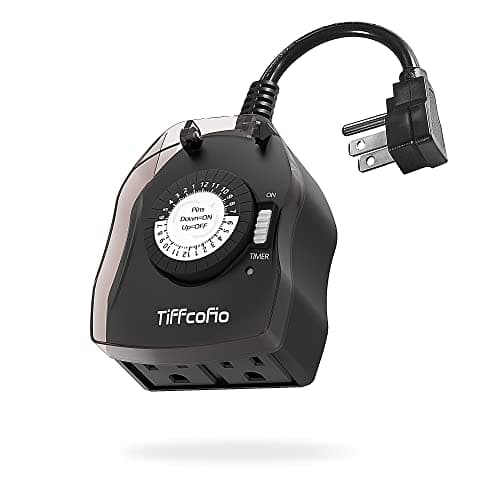
Outdoor Pool Pump Timer
Various
A weatherproof outdoor timer is the highest-return equipment purchase on this site. Most people run the pump too long because remembering to switch it off is a chore.
#ad how this is funded · price as of October 8, 2026
Key specs
- Type
- Outdoor-rated mechanical or digital timer
- Required rating
- Must be rated for the pump's amperage and for outdoor use
- Must not defeat
- The pump's GFCI protection
How it scoresour reading of published specs, not a test result
- Sizing fit
- 8.5
- Running cost
- 9.8
- Maintenance
- 9.0
- Build
- 7.5
- Value
- 9.5
Overall 9.0 / 10
What works
- Turns your filtration from a guess into a schedule
- Pays for itself within a single season on most pools
- Lets you shift running hours to off-peak if your utility has time-of-use rates
What doesn't
- Must be genuinely outdoor-rated and correctly amperage-matched, which cheap indoor timers are not
- Never bypass or defeat the pump's GFCI to fit one
- Mechanical timers drift and need resetting after a power cut
Skip it if: Fixing an undersized pump. Running the wrong pump on a schedule just makes the schedule longer.
What it costs to run: The arithmetic that justifies it: at the EIA's June 2026 US residential average of 18.34 cents per kWh, trimming a 400 W pump from 12 hours to 8 hours a day across a 120-day season saves 192 kWh, or about $35. That is more than the timer costs.
Several seasons: Buy-once. Built and warranted to come back out of the box for a few years, if you store it properly.
Specs from: EIA Electric Power Monthly, Table 5.6.A
The consumable you will actually buy repeatedly
Type A Replacement Filter Cartridges (multipack)
Various
Buy them in a multipack before you need them. A pool running on an exhausted cartridge is a cloudy pool, and the fix is a two-dollar part you did not have.
Key specs
- Type
- Type A — the most common Intex format
- Replacement interval
- Every 2 weeks in heavy use, per Intex guidance
- Between changes
- Rinse, do not scrub
How it scoresour reading of published specs, not a test result
- Sizing fit
- 9.0
- Running cost
- 7.0
- Maintenance
- 8.5
- Build
- 7.0
- Value
- 8.5
Overall 8.2 / 10
What works
- Type A is the most widely stocked cartridge format in the US
- Multipacks cost a fraction of buying singles
- Having a spare turns a cloudy week into a five-minute fix
What doesn't
- It is a genuine recurring cost that nobody includes in the purchase price
- Aftermarket quality varies noticeably
- Rinsing extends life but does not restore a cartridge that is done
Skip it if: Being restored. Once the pleats are permanently gray and stiff, rinsing is not saving it.
What it costs to run: The line item most people leave out of their pool budget. Count how many you use in your first season and you have your real annual filtration cost — this is exactly the number the cost-to-run guide asks you to record.
One honest season: The cheapest setup that genuinely works for a season of real swimming. Nothing spare, nothing missing.
Questions people actually ask
Why does my pool pump sound like gravel?
Why is my pool pump gurgling?
How can I make my pool pump quieter?
When is a noisy pool pump a sign it needs replacing?
Sources
Read next
- Equipment, sized to your pool and costed by the wattPumps, filters, vacuums, heaters and ladders - matched to your gallons and priced by what they draw.
- Pool pump problems, diagnosed in the cheapest orderThe five-check diagnostic sequence for an above-ground pool pump, from free fixes to the point at which it is genuinely the motor.
- What kills pool pumps, and none of it is running timeThe four things that end small pool pumps, why none of them is age, and the maintenance habits that genuinely extend one.
- The skimmer is the cheapest part of the system and the one that stops itHow a skimmer actually works, the water level it needs, and the three silent faults that get blamed on the pump.
- Nothing in this category is standardized, and the hoses are where you find outHow to measure your own hose and fitting sizes, why suction-side air leaks matter so much, and what to check before ordering a replacement pump.
- How long to run the pump, worked out rather than repeatedRun time derived from your own turnover time, when in the day to run it, and what each hour a day costs across a season.
- The neighbor questions to answer before the pool goes upThe four things that cause pool disputes with neighbors, and how siting decisions made once prevent all of them.